Ringkasan Eksekutif
A steel wire coil compressing and rack take off machine compacts and straps the coil while it is still on its rack. It then tilts coil and rack through 90° and draws the coil off, so the empty rack can go back to the coiler. The rack guides the coil and stops it deforming under the 10–20 t compacting force. A worked example estimates the stripping force for a 2 t coil.
Daftar Isi
- Why the coil is compacted on its rack
- Integrated coil compaction and rack take-off station
- From loose coil to rack return
- Why the coil is tilted before take-off
- Worked example: stripping force for a 2 t coil
- Compacting without a rack
- Daftar periksa pemilihan
- Keamanan: EN 415-10 dan ISO 12100
- Pertanyaan yang Sering Diajukan (FAQ) tentang Teknik
- Langkah selanjutnya
- Bacaan terkait
- sumber
Why the coil is compacted on its rack
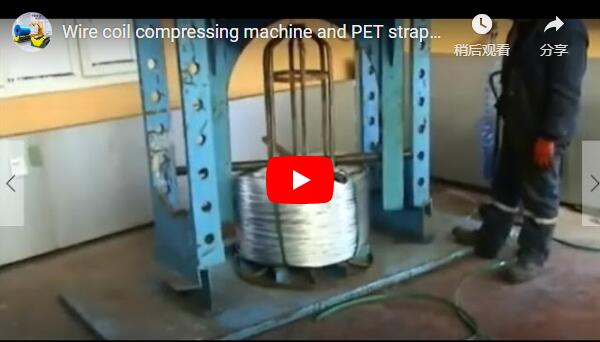
Wire coils are collected on a rack, often a rosette rack, below the coiler. The rack’s centre post runs up through the coil eye. When the press comes down, that post keeps the turns centred. Take the rack away first and the coil, even if it stands steady, can deform sideways under compaction.
So the coil is compacted and strapped on the rack, and only then taken off it.
Integrated coil compaction and rack take-off station
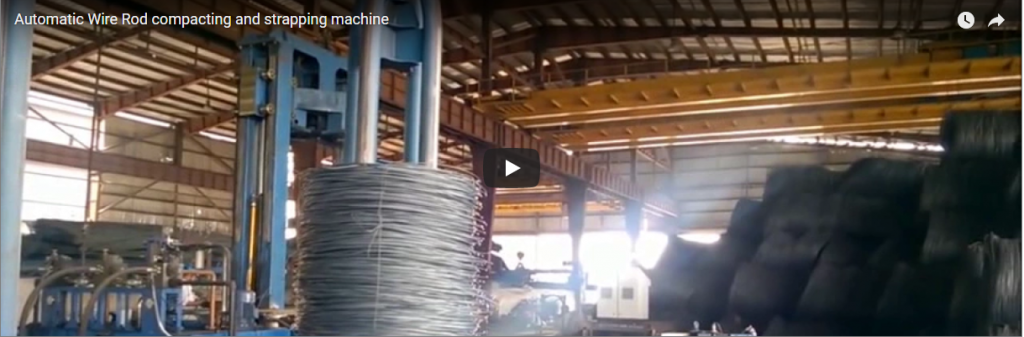
The station is a structural steel gantry over a horizontal rack conveyor. The coil arrives on its rack and stops under the gantry. A hydraulic press head runs down a vertical guide and compacts the coil from above. The electrical enclosure, with a cooling fan, stands at the side. For reference, our wire rod compactor works at 210 bar with a 30–40 s compacting and strapping cycle.
Further along, a tilting unit turns the strapped coil and its rack through 90° so the coil lies horizontal. Support rollers take the coil as it is drawn off the rack post.
From loose coil to rack return
- Rack in. The loaded rack moves into the compacting station.
- Kompak The press head comes down and compacts the coil on the rack.
- Tali. Straps are applied while the press holds the coil.
- Di luar. The press lifts and the rack moves on.
- Memiringkan. The tilting unit turns coil and rack through 90°.
- Take off. The coil is drawn off the rack post onto the support rollers and goes to storage or wrapping.
- Rack return. The empty rack is turned back upright and returned to the coiler.
Why the coil is tilted before take-off
Upright, the coil would have to be lifted straight up the full height of the rack post, so the lift carries the whole coil weight. Tilted horizontal, the coil weight rests on the support rollers. Taking it off is then a horizontal pull that only has to overcome friction between the coil eye and the post.
Worked example: stripping force for a 2 t coil
Illustrative coil: 2,000 kg, compacted and strapped, lying horizontal on the post and rollers. Friction coefficients are typical values for steel on steel, used only to bound the force.
| Kasus | Perhitungan | Hasil |
|---|---|---|
| Vertical lift off the post | m × g = 2,000 × 9.81 | ≈ 19.6 kN |
| Horizontal pull, μ = 0.2 | 0.2 × 19.6 kN | ≈ 3.9 kN |
| Horizontal pull, μ = 0.3 | 0.3 × 19.6 kN | ≈ 5.9 kN |
Hasil. With the coil tilted, the take-off drive needs roughly 4–6 kN plus a margin, against about 20 kN to lift the coil vertically, and the coil stays low the whole time. The worst case is when all the weight bears on the post. Where the support rollers carry the coil, sliding friction is replaced by rolling friction, typically below 0.05, and the pull drops further. The real drive is sized on your coil and rack at quote.
Compacting without a rack
Some plants want to remove the rack before strapping. We then offer two choices. One is to keep a basket round the coil during compacting. The other is a guide that comes down from the top of the station into the coil ID before the press closes. Both keep the coil from deforming.
Daftar periksa pemilihan
- Diameter luar (OD), diameter dalam (ID), tinggi, dan berat kumparan.
- Rack type and a drawing or photo of the rack layout.
- Compacted height and strap count.
- Where the coil goes after take-off.
- How the empty rack returns.
- Foundation and conveyor heights at your site.
Keamanan: EN 415-10 dan ISO 12100
The line is designed to EN 415-10, and its risks are assessed to ISO 12100. The hazards are the press head, the tilting unit, the take-off stroke and the moving racks. The work area is guarded with interlocked access, and strapping by hand, where used, is done only with the press holding and the other drives safe. Who supplies the guards and CE documents is settled in the contract.
Pertanyaan yang Sering Diajukan (FAQ) tentang Teknik
Q: Why not take the coil off the rack before compacting? A: The rack post keeps the coil centred under the press; without it, the coil can deform.
Q: How much force does compacting use? A: Our compactors work in the 10–20 t range, set to the wire and coil.
Q: Does the line need a foundation? A: Some machines do, so the conveyor heights match and the press and tilter loads go into the floor. Foundation loads come with the layout drawing.
Q: How is the line tested before shipment? A: In our factory each unit is run in automatic and semi-auto mode; the full rack loop is completed on site once the foundations are in.
Q: Which standard applies? A: EN 415-10 for the line, and an ISO 12100 risk assessment behind the CE marking.
Langkah selanjutnya
- Send coil data and a rack drawing Kirimkan ke info@fhopepack.com.
- Kami menjabarkan compacting, tilting, take-off and rack return.
- Kami membalas dalam waktu 24 jam dengan tata letak dan penawaran harga.
Bacaan terkait
- Pemadatan kawat batang (produk)
- Automatic steel wire compacting and spool take-off
- Kompresi batang kawat baja otomatis dengan mesin strapping
- Steel wire coil compressing machine with moving clamp
sumber
- FHOPE wire coil compactor product pages
- FHOPE project notes on rack compacting, rack take-off and carrier return
- Tim teknik kami: gaya pemadatan 10–20 ton
- Worked example: illustrative figures; g = 9.81 m/s²
- Standar: EN 415-10; ISO 12100:2010
Terakhir ditinjau: 18-10-2026