Overlap Arithmetic and What Sets It
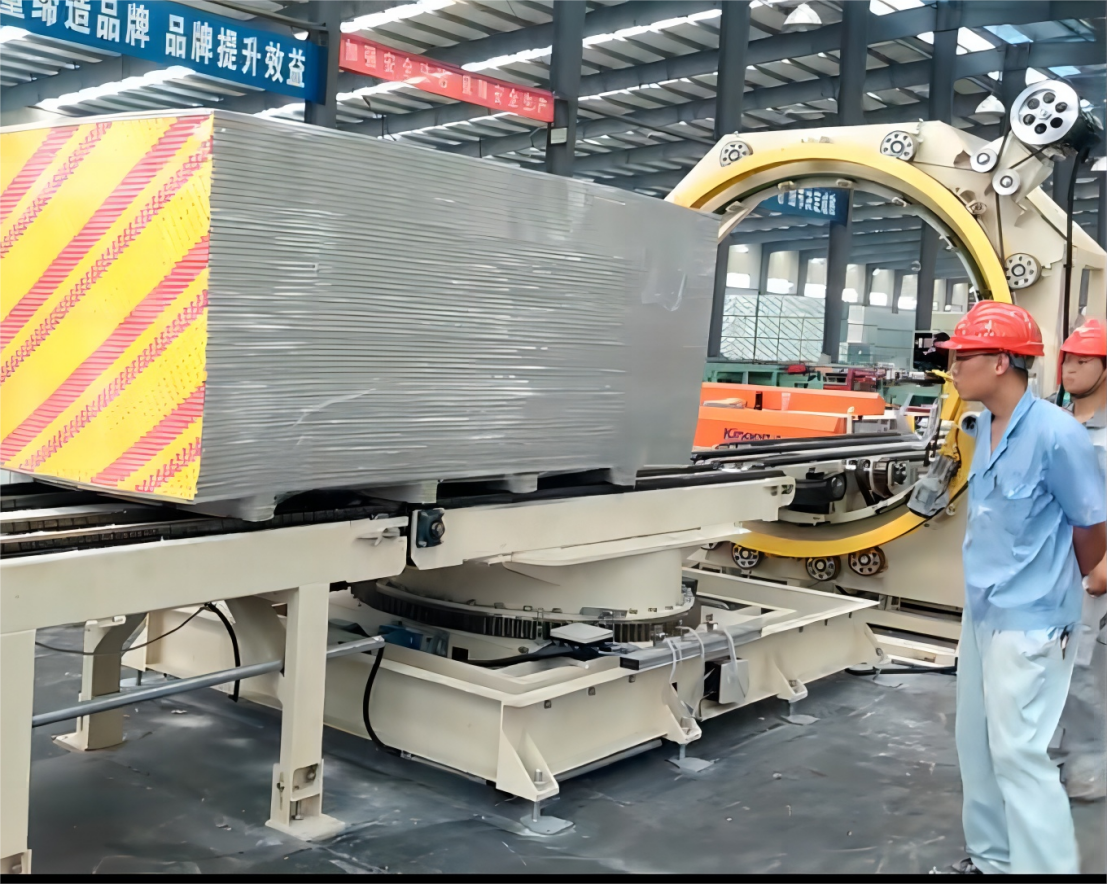
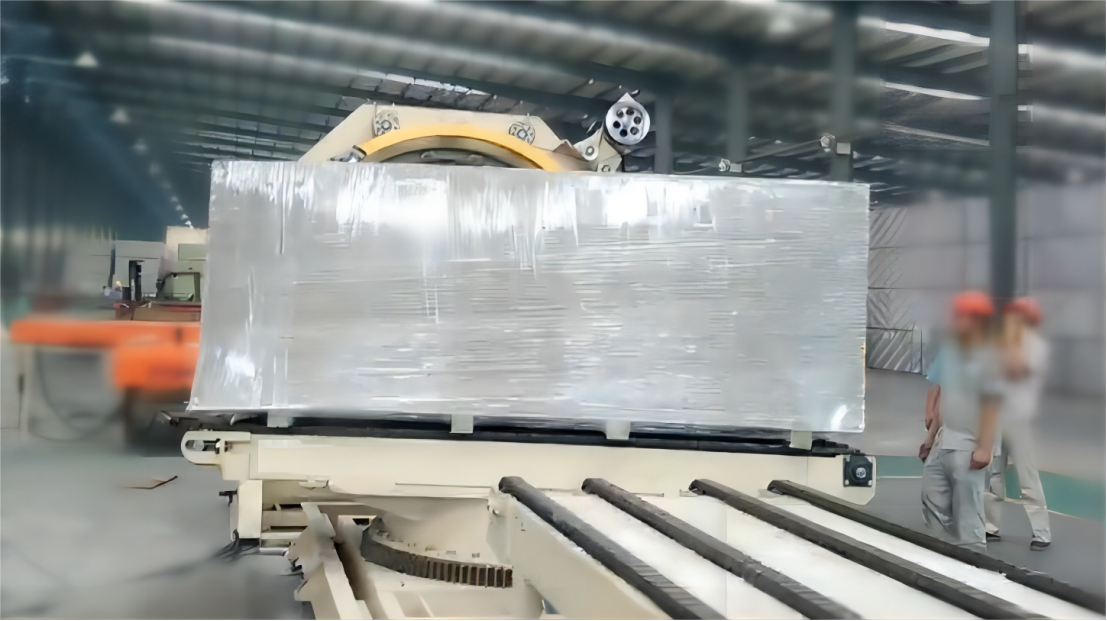
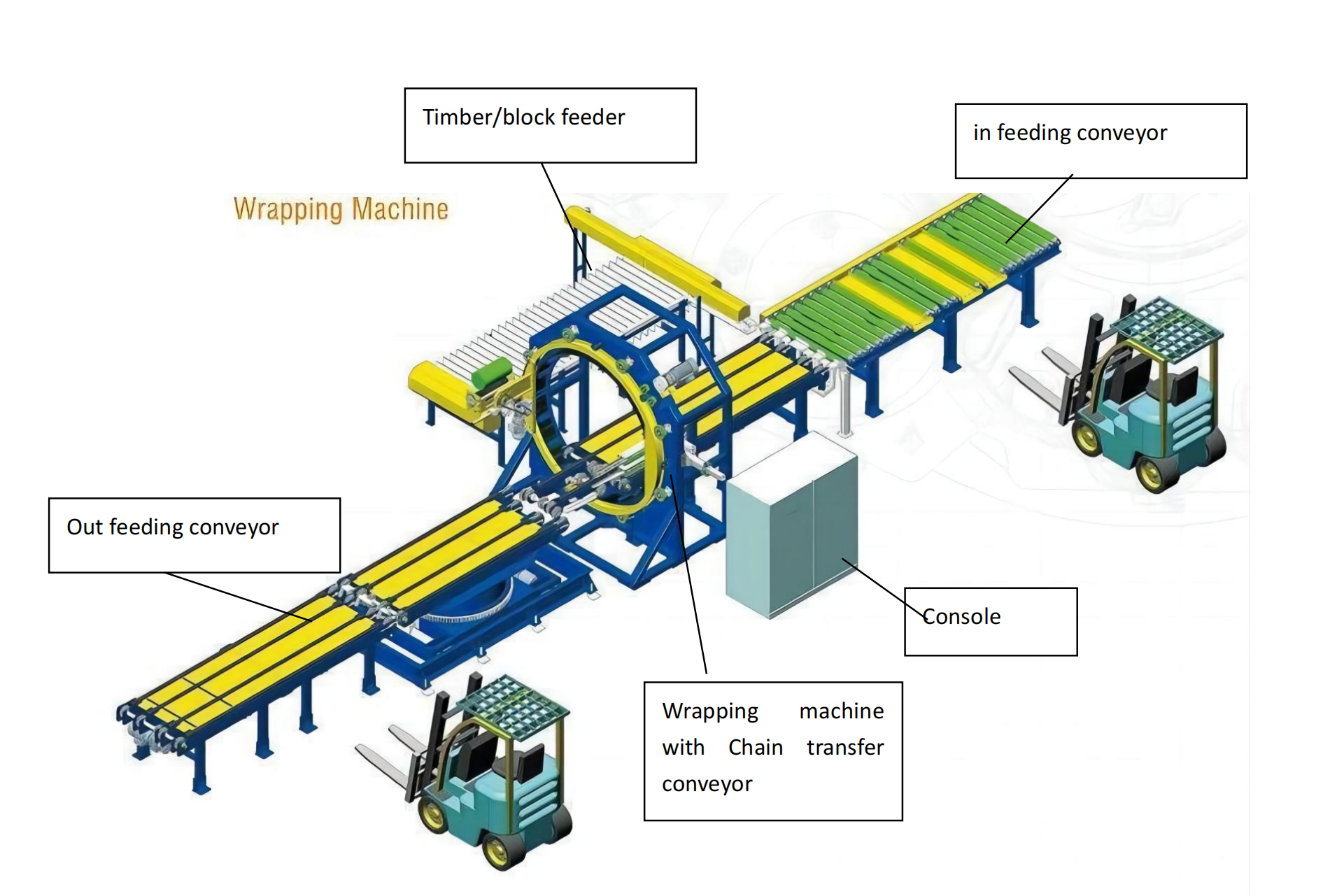
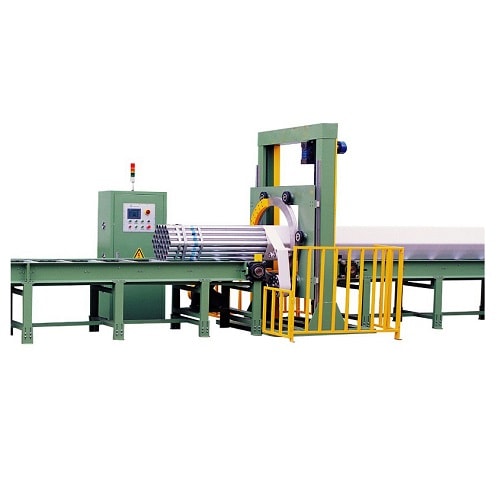
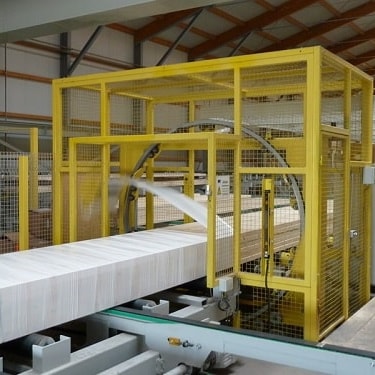
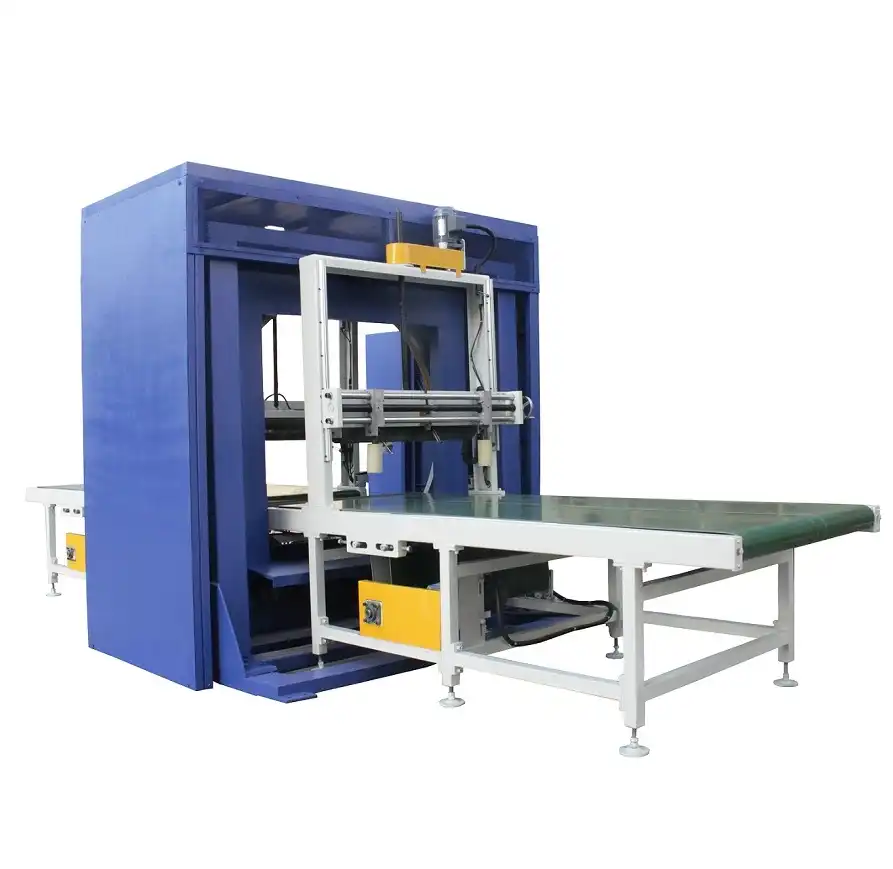
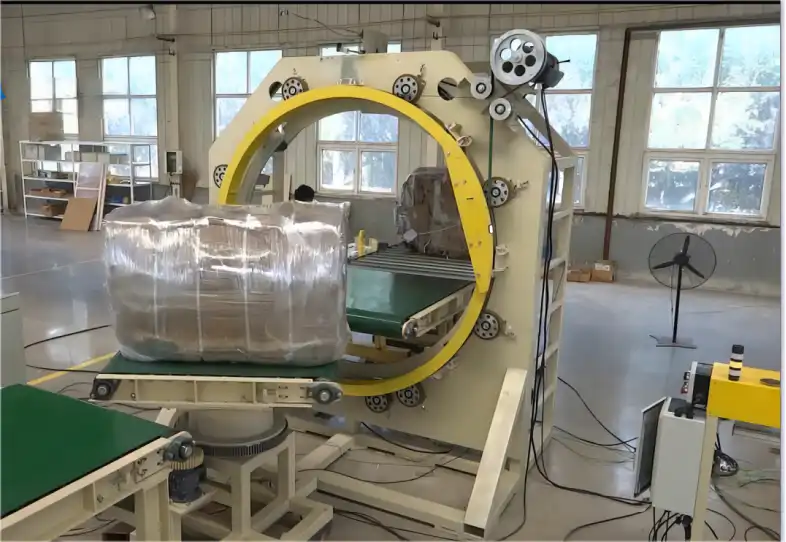
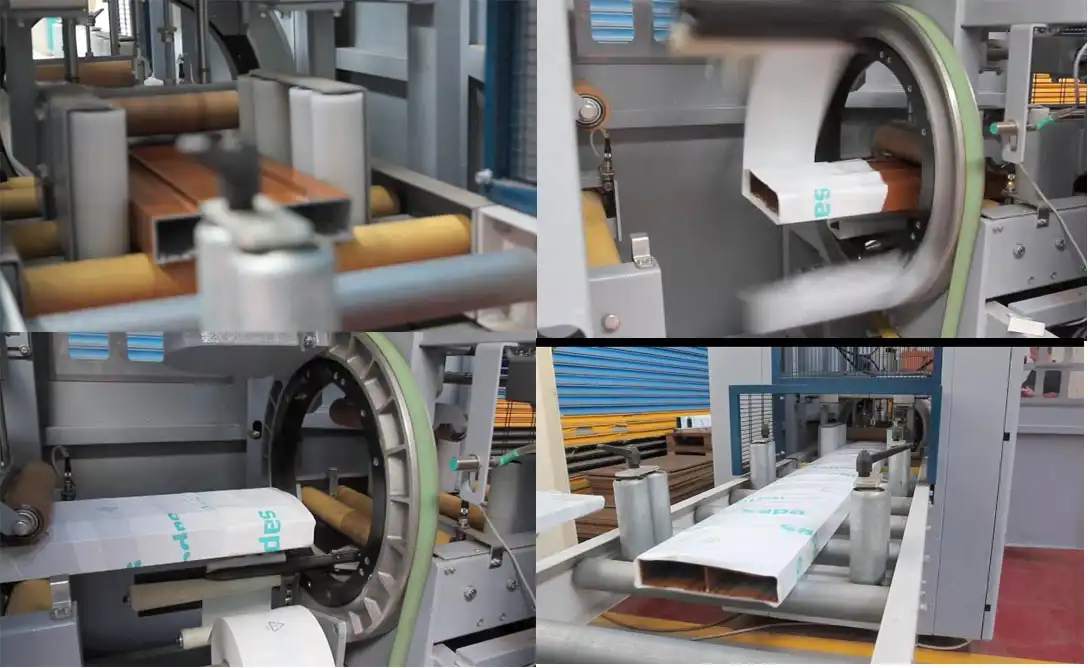
The cycle itself — infeed, squaring, clamping, helical orbit, cut-and-wipe — is described on the product page. What decides whether the wrap the customer signed off actually comes off the line is the ratio between linear feed, film width and ring speed.
K_overlap = 1 - (V_conveyor / (W_film * N_ring))
V_conveyor is line feed in mm/min, W_film the working film width in mm, and N_ring the ring speed in rpm. For board packaging the ratio is normally held between 0.30 and 0.60: below that the wrap is thin at the corners, above it the film cost climbs without adding containment.
Two practical consequences follow. Film width is the cheapest lever — a wider web raises overlap without slowing the line — but only up to the width the carriage can carry without fouling the bore. Ring speed is the most expensive lever, because it drives inertia and power; on a large bore, raising ring speed to recover overlap costs more than changing film. That is why the overlap target is settled against the bore before the machine is ordered rather than tuned afterwards.
Machine Sizing: How Do You Calculate Ring Bore Clearance?
To accurately size a horizontal wrapping ring, calculate the maximum circumscribed circle of the panel cross-section (Load OD). The inner ring bore (D_ring) must equal or exceed the diagonal load OD plus radial clearances for the film roll carriage and dynamic mechanical runout.
Choosing an undersized ring causes severe collisions between film rolls and bundle corners. An oversized ring adds rotational inertia, elevates electrical energy consumption, and compromises packaging cycle speed.
Geometric Circumscribed Load Calculation
For rectangular or square bundles of width W և բարձրություն H, define the cross-sectional diagonal (Load_OD):
Load_OD = sqrt(W^2 + H^2)
For asymmetrical profiles or palletized sheets with varying stack profiles, evaluate the absolute maximum dimensions across all intended production batches.
True Mechanical Interference Equation
The inner bore diameter of the rotating ring (D_ring) must account for the physical intrusion of the film dispenser carriage, cutting mechanisms, and running tolerance clearances:
D_ring >= OD_load + 400 (FHOPE standard clearance budget)
-
sqrt(W^2 + H^2): Maximum cross-sectional diagonal across panel corners (mm).
-
C_carriage: Radial intrusion depth of the film carriage into the ring aperture, including a full 250 mm outer-diameter film roll (typically 180 mm to 250 mm based on roll core design).
-
S_clearance: Dynamic engineering running clearance between the moving film roll perimeter and the bundle corner (minimum recommended value: 80 mm to 100 mm).
Հաշվարկի օրինակ (պատկերազարդ)
A mill packs structural insulation sheets measuring 1200 mm wide by 400 mm high. The film carriage intrudes 200 mm into the bore, and the plant requires a standard 100 mm dynamic clearance allowance:
Load_OD = sqrt(1200^2 + 400^2) = sqrt(1,440,000 + 160,000) = 1265 mm
D_ring >= 1265 + 400 = 1665 mm
Note: This calculation represents an illustrative engineering sizing baseline. The final ring bore and motor torque envelope must be verified on the project General Arrangement (GA) drawing.
Mechanical Dynamics: Non-Circular Radius Pulsation and Tension Control
Wrapping rectangular panel profiles causes continuous swings in the effective radius from the center of rotation to the film touchpoint. This variation demands active dynamic tension damping to avoid breaking the film across sharp panel corners or allowing loose film along wide flat faces.
Non-Circular Radius Pulsation
When wrapping a broad board pack (e.g., 1200 mm wide by 200 mm high), the instantaneous wrap radius transitions between:
-
R_min = H / 2 = 100 mm (at the flat center)
-
R_max = sqrt((W/2)^2 + (H/2)^2) = sqrt(600^2 + 100^2) ~= 608 mm (at the sharp corner)
This 6:1 radius ratio means the instantaneous linear film unwind velocity fluctuates dramatically during a single 360-degree ring rotation:
V_film(theta) = omega_ring * R(theta)
If a machine uses a basic friction brake, the film tension will spike when hitting the corner (risking breakage or crushing the edge) and drop along the wide face (causing loose wrap).
Active Dynamic Tension Compensation Solutions
-
Mechanical Dancer Arms with Torsion Springs: The film passes over an idler roller mounted on a spring-loaded pivot arm. When the corner pulls film rapidly, the arm deflects inward, supplying buffered film slack without a sharp tension spike.
-
Powered Pre-Stretch Delivery with Variable Slip: Twin knurled pre-stretch rollers, geared at ratios from 200% to 300%, stretch the film before it departs the carriage. The elastic elongation memory of LLDPE ensures steady film tension during radius shifts, stabilizing the bundle without edge distortion.
-
Corner Deceleration Profiling: Advanced PLC algorithms modulate ring variable-speed drives to trim angular velocity slightly as the film carriage nears the bundle corners, protecting delicate pack profiles.
Material Handling and Conveyor Integration Dynamics
Integrating a horizontal wrapper into high-volume panel manufacturing requires careful management of product transfer across gaps, bundle top pressure, and conveyor drive synchronization.
Crossing Conveyor Throat Clearances
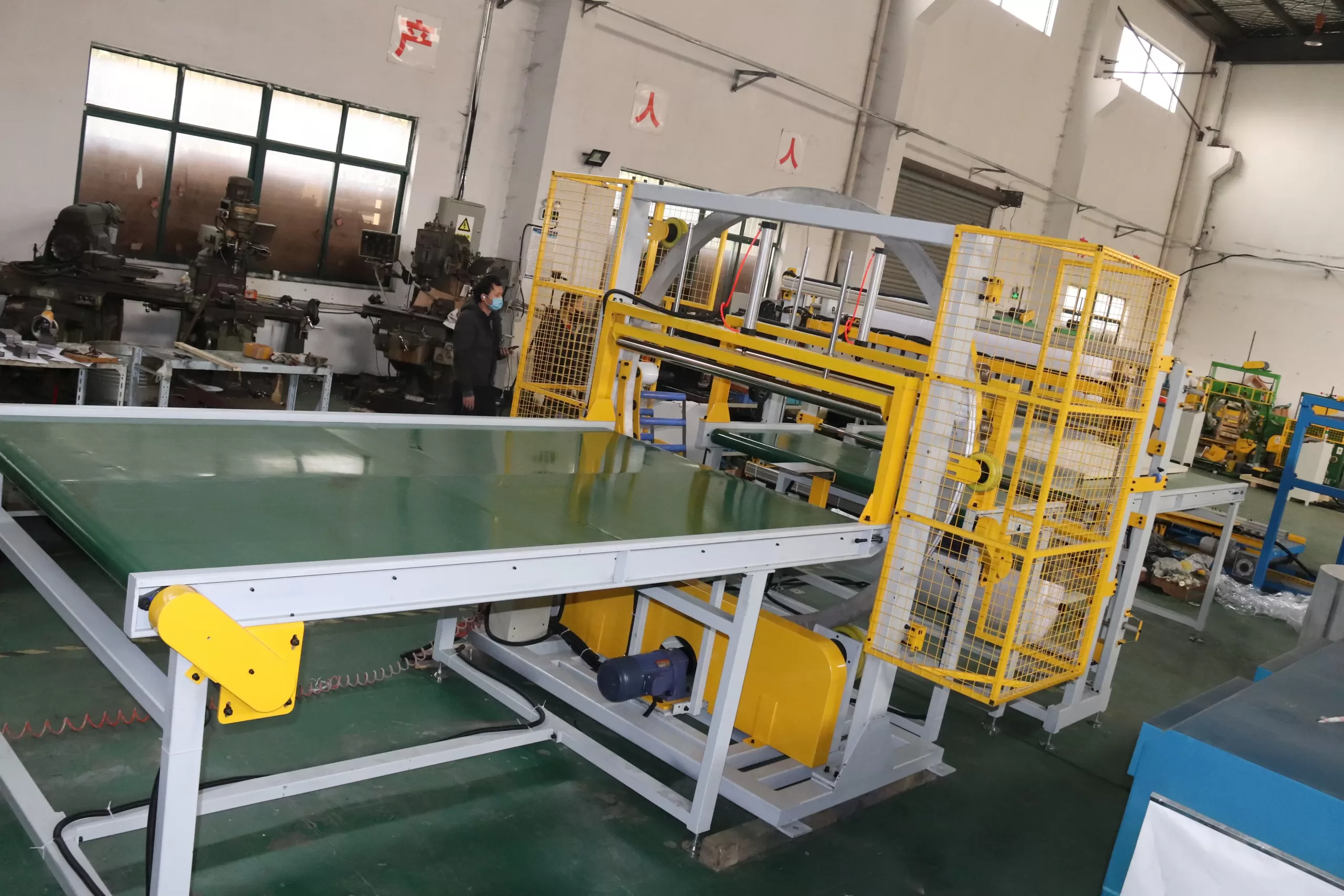
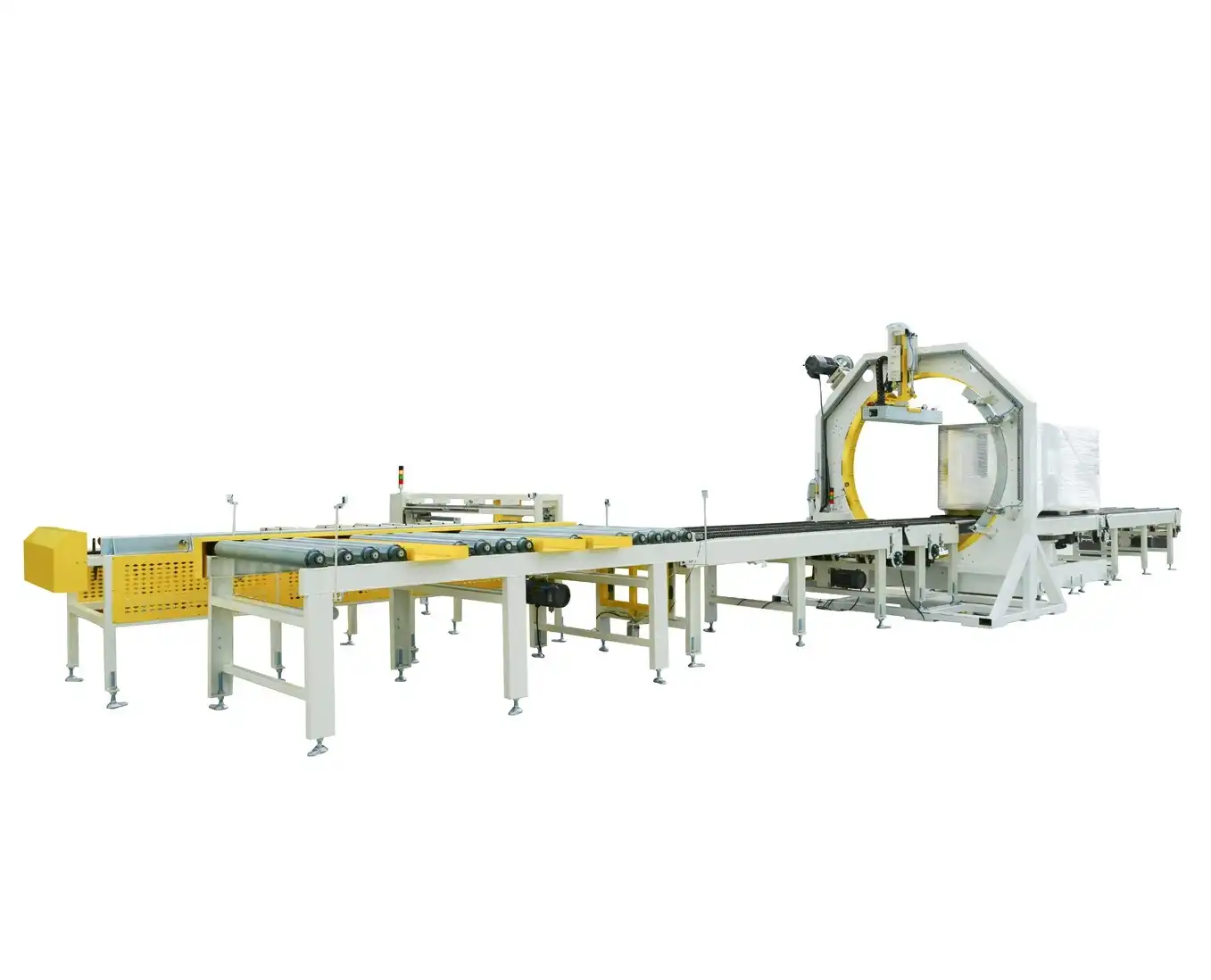
The vertical ring frame introduces an unavoidable gap in the conveyor bed where the aluminum ring rotates around the passline.
-
Short Bundles (< 1000 mm): May dip or skew in the gap between the infeed and outfeed beds.
-
Engineered Bridge Plates: Powered polyurethane transition rollers or low-friction high-density polyethylene (HDPE) skate plates extend into the ring bore to support the product leading edge until the outfeed conveyor takes over.
Top Pressure Roll Integration
Low-density boards and smooth composite stacks can lift during high-speed wrapping. Dual pneumatic hold-down cylinders apply balanced top pressure on both the infeed and outfeed conveyors.
Polyurethane rollers with vulcanized coatings grip the top sheets firmly, preventing the rotational drag of the film carriage from twisting the bundle out of square.
What Changes When the Line Switches Panel Formats
A panel line that runs insulation bales in the morning and engineered timber packs in the afternoon spends its engineering effort on the changeover rather than on the ring. Three settings move with the format, and each one has a failure mode that only shows up in production.
The first is hold-down pressure. A pneumatic top roller set for a timber pack will crush the edge of a PIR bale, and a setting light enough for foam will let a dense pack lift under the rotational drag of the carriage. Because the correct pressure differs by a factor rather than by a percentage, it belongs in the PLC as a stored recipe per format, together with the stroke, so the operator selects the format instead of judging the pressure.
The second is film width against pitch. Overlap is a ratio, so a wider web raises containment without slowing the line — but only up to the width the carriage can carry inside the bore. Changing film width without re-checking the ratio quietly changes the wrap the customer signed off.
The third is the bridge plate across the ring gap. Short packs need powered transition rollers or skate plates to cross the gap without dipping; long, stiff packs cross it as a beam and do not. Where the line mixes both, the bridge stays fitted and the roller drive is switched with the recipe, which is cheaper than a mechanical changeover on every batch.
Safety Architecture and International Norms
Industrial panel wrappers must comply with rigid safety frameworks to protect operators from rotating mechanical rings, high-speed carriages, and pneumatic cutting hazards.
-
Perimeter Enclosure Guards: Interlocked perimeter fencing prevents operator access to the rotating ring envelope during automatic cycles. Access gates use monitored safety tongue switches linked to safety relays.
-
Light Curtains with Muting Logic: Optical light curtains permit panel bundles to enter and exit the enclosure while immediately halting machine drives if a human hand crosses the sensing plane.
-
Pneumatic Depressurization Valves: The pneumatic system incorporates monitored dump valves (conforming to ISO 4414). When an emergency stop trips, all air supply dumps safely, locking moving mechanisms and preventing residual-pressure clamp strokes.
Four-Sided vs. Six-Sided Packaging Configurations
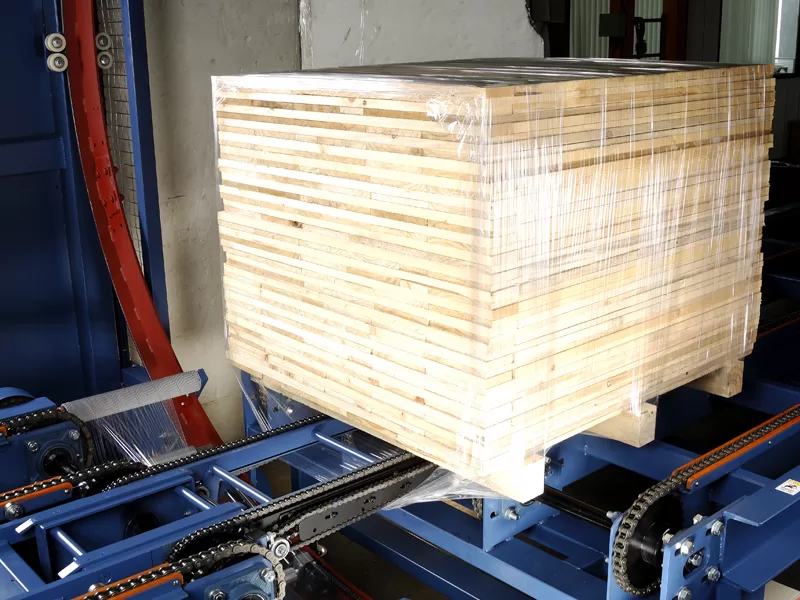
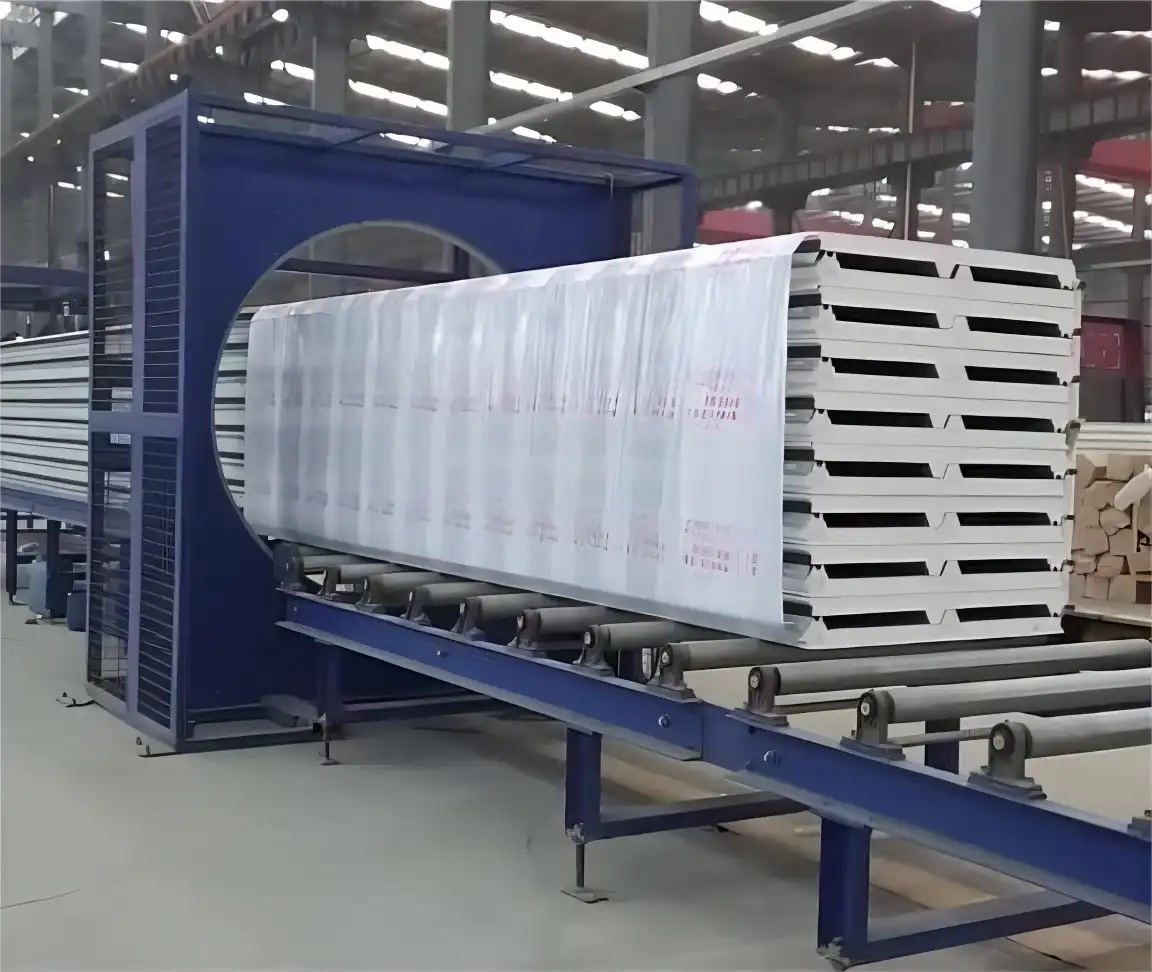
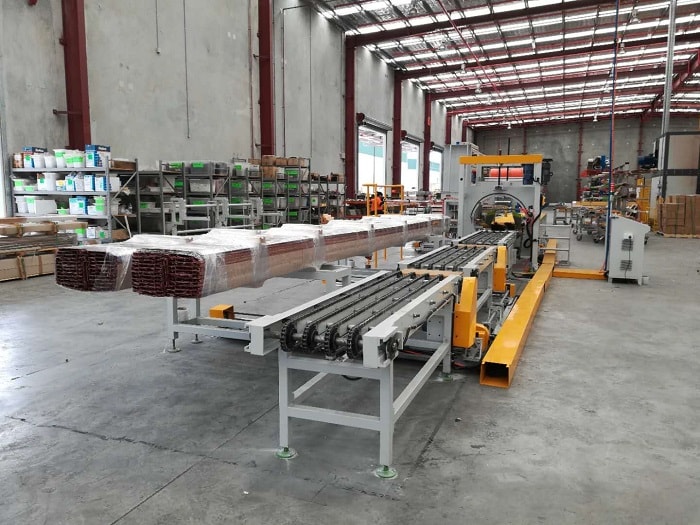
Standard orbital horizontal wrapping applies continuous spiral layers over the four longitudinal faces of the bundle. Full moisture-tight, six-sided protection requires auxiliary systems to cap the exposed leading and trailing ends.
1. Four-Sided Bundling Applications
-
Suitable for indoor distribution, standard freight trailers, and automated storage and retrieval systems (ASRS).
-
Concentrates on bundle rigidity to replace plastic or steel banding.
-
Yields the fastest cycle rates and lowest consumable cost per ton of packaged material.
2. Six-Sided Encapsulation Workflows
-
Designed for engineered panels shipped on open flatbed trucks or stored in open lumber yards.
-
Integrates a mechanical top/end sheet dispenser upstream of the orbital ring.
-
The machine cuts and places a protective polyethylene sheet over the leading edge, drapes it across the top, and folds it over the trailing end. The orbital ring then overwraps these end flaps, sealing the pack against liquid water and high humidity.
Technical RFQ Data Matrix: Engineering Input Requirements
To receive a detailed engineering proposal, general arrangement drawings, and quotation, provide the dimensional and mechanical values listed below.
Engineering Service Level Agreement (SLA)
Upon receiving your verified dimensional and operational data matrix, FHOPEPACK guarantees:
24
24-Hour Interference & Sizing Audit:
Calculation of ring diameter, film carriage runout, and dynamic clearance checks delivered within one business day.
48
48-Hour Preliminary General Arrangement (GA) Drawing:
Full 2D dimensional drawing and 3D step model demonstrating conveyor integration, top clamp strokes, and footprint requirements.
Հաճախակի տրվող հարցեր
What film gauge and core specifications work best in this carriage?
Carriages run standard cast or blown LLDPE industrial stretch films from 17 to 35 microns (68 to 140 gauge). Standard core internal diameter is 76 mm (3 inches), with roll outer diameters up to 250 mm and roll widths between 125 mm and 250 mm. Blown films provide superior puncture resistance along sharp engineered timber corners.
How does the machine accommodate different pack heights automatically?
Dual optical sensors detect the changing height of incoming loads as they pass the infeed threshold. The PLC directs the pneumatic top hold-down cylinders to extend until adjustable-pressure limit switches detect contact with the top board face. This ensures that mixed-height batches run continuously without manual tool adjustments.
What regular maintenance schedules apply to the rotating ring?
-
Օրական: Clean wood dust from optical photo-eyes, light curtain lenses, and film cutting blades.
-
Շաբաթաթերթ: Inspect the polyurethane friction drive wheels for wear, check tension on drive timing belts, and clean film debris from the rotating carriage mandrel.
-
Ամսական: Grease main ring support track bearings, clear pneumatic air filter moisture bowls, and check safety interlock switches for proper release.
Engineering Conclusion: Machine Sizing and Action Plan
Two numbers bracket a panel line: the widest diagonal it must clear fixes the bore, and the softest board it must not crush fixes the hold-down. A wrapper sized only for the average pack will either foul the largest one or crush the lightest one, and both failures appear after the machine is anchored rather than during the quotation.
Four-sided spiral wrapping covers dry indoor transit; six-sided encapsulation adds end caps where the pack meets weather or sea freight. Once a line stops being a panel line, the constraint moves from the pack to the transfer: round bundles roll, profiles twist, and pallets need a bridge rather than a plate.
Submit the maximum and minimum load dimensions, the line speed requirement and the pack weights to the FHOPEPACK engineering team for the bore interference report and the tailored GA proposal.