Kokkuvõte
Packaging equipment for steel wire coils does three jobs in one cell: it compacts the loose coil, straps it while it is held compact, and takes the coil off its spool so the spool can go back to the line. The line shown was built in our workshop for a distribution partner; our equivalent solution is set out below. Our compactors work at 10–20 t, and a 2 t coil example shows the height and volume saved.
Sisukord
- Why compact a steel wire coil before strapping
- Our equivalent compacting and spool take-off cell
- From spool to strapped coil
- Process options: manual or automatic at each step
- Worked example: a 2 t wire coil
- Valiku kontroll-leht
- Ohutus: EN 415-10 ja ISO 12100
- Inseneri KKK
- Järgmine samm
- Seotud lugemine
- Allikad
Why compact a steel wire coil before strapping
A steel wire coil comes off the take-up loose and tall. Strapped as it is, it stays tall, the straps slacken as the turns settle, and fewer coils fit on a truck. Compacting first presses the turns together, so the straps go on a short, dense coil and stay tight.
The spool or carrier the coil was formed on also has to come out. Taking it off in the same cell saves a crane move and sends the spool straight back to the take-up.
Our equivalent compacting and spool take-off cell
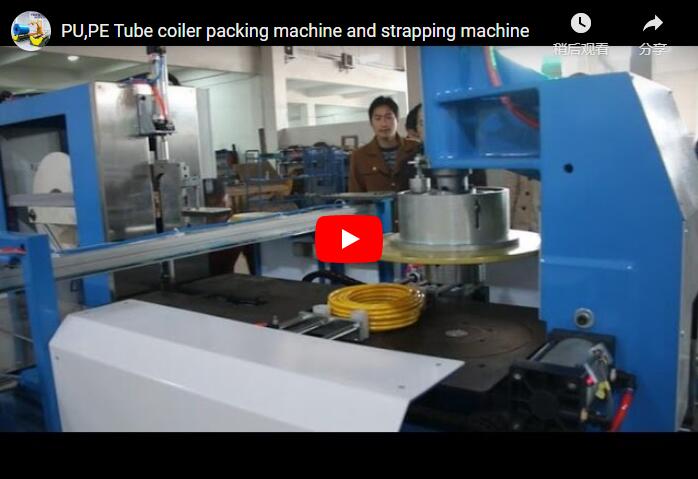
The cell is a tall blue steel frame over a powered chain conveyor. The coil arrives on its spool and is lifted into the frame. A hydraulic press comes down from above and compacts the coil against the base, and the straps go on while the press holds it. The spool is then drawn out and the compacted coil, eye vertical, runs out on the chain conveyor.
The line was engineered for a distribution partner, so it carries their branding. Our own FHOPE system uses the same compacting, strapping and spool take-off sequence, built to your coil and spool.
From spool to strapped coil
- In-feed. The coil on its spool enters on the chain conveyor.
- Kompaktne The hydraulic press closes on the coil and holds it at the set height.
- Rihm. Straps go on through the gaps in the press while the force is held.
- Vabastage. The press opens; the coil keeps its compacted height.
- Spool take-off. The spool is pulled out of the coil eye and returned.
- Out-feed. The strapped coil leaves on the conveyor for wrapping or storage.
Process options: manual or automatic at each step
Each step can be manual or automatic. We match the level to your output:
| Samm | Poolautomaatne | Täisautomaat |
|---|---|---|
| Coil loading and compacting | coil placed by hoist or forklift, compacting by machine | automatic loading and compacting |
| kopsakas | by hand, operator or machine turns the coil | automatic strapping heads |
| Spool take-off | käsitsi | by machine |
| Wrapping or shrinking | manual bagging | automatic shrinking or film wrap |
For low volume, a semi-auto cell with machine compacting and hand strapping is often the right choice.
Worked example: a 2 t wire coil
Illustrative coil: 2,000 kg, OD 1,200 mm, ID 800 mm, loose height 1,400 mm, compacted to around 800 mm.
| Samm | Arvutus | Tulemus |
|---|---|---|
| Annulus area | π/4 × (1.2² − 0.8²) m² | ≈ 200 000 m² |
| Loose volume | 0.63 m² × 1.4 m | ≈ 0.88 m³ |
| Compacted volume | 0.63 m² × 0.8 m | ≈ 0.50 m³ |
| Height saved | (1,400 − 800) ÷ 1,400 | ≈ 43% |
| Pressjõud | 300 000–350 000 tonni | ≈ 98–196 kN |
| Pressure on the coil face | 98–196 kN ÷ 0.63 m² | ≈ 156–312 kPa |
Tulemus. The coil takes about 43% less height. On a truck with a fixed deck height, that is often the difference between one layer and two. We configure the hydraulic compaction force between 98 and 196 kN (10–20 t) to the wire grade and diameter, so the coil compacts without marking the turns.
Cylinder size (formula). Bore area A = F ÷ p. At a 210 bar (21 MPa) working pressure, 98 kN needs about 4,670 mm², a single cylinder of about 77 mm bore; 196 kN needs about 9,340 mm², about 109 mm bore. With two or four cylinders the bore per cylinder drops accordingly.
Cycle (formula). T = t_in + t_compact + n × t_strap + t_release + t_spool + t_out. For reference, our wire rod compactor with 4 strapping heads runs a 30–40 s cycle at 210 bar. Spool take-off adds to that, so the full cell time is measured on a trial coil and confirmed at quote.
Valiku kontroll-leht
- Coil OD, ID, loose height and weight.
- Wire grade and diameter.
- Spool or carrier type, and how it returns to the take-up.
- Straps per coil, and strap type (PET or steel).
- Mähised tunnis.
- What follows: film wrap, shrink bag or storage.
Ohutus: EN 415-10 ja ISO 12100
We design the compacting cell to EN 415-10 and carry out the risk assessment to ISO 12100. The main hazards are the press closing, stored hydraulic pressure, the spool take-off stroke and the strap whip at cutting. The press area is guarded and interlocked; strapping by hand is done only with the press holding and the drives in a safe state. Guards and CE documents are agreed per project.
Inseneri KKK
Q: Why strap while the press is still closed? A: The press holds the turns tight. Strapped after release, the coil springs back and the straps slacken.
Q: Can our existing spools or baskets be used? A: Usually, yes. We design the take-off to the spool you already run.
Q: What compacting force do we need? A: Our compactors work in the 10–20 t range; the setting depends on the wire and the coil size.
Q: Which standard applies? A: EN 415-10 for the cell, with ISO 12100 for the risk assessment.
Järgmine samm
- Send coil size, weight and spool type aadressile info@fhopepack.com.
- Teeme ettepaneku a semi-auto or full-auto cell.
- Vastame 24 tunni jooksul with a layout and quotation.
Seotud lugemine
- Wire rod compactor (product)
- Steel wire coil compressing and rack take-off machine
- Terasest valtstraadi pooli automaatne kokkupressimine rihmamasinaga
- Kuidas terastraati automaatselt tihendada ja lintida
Allikad
- FHOPE wire coil compactor and wire rod compactor product pages
- FHOPE project notes on compacting, strapping and spool take-off options
- Our engineering team: compacting force 10–20 t
- Töönäide: illustreerivad joonised
- Standardid: EN 415-10; ISO 12100:2010
Viimati üle vaadatud: 2026-10-18