Kokkuvõte Our automatic plastic pipe bundling, strapping and bagging machine counts the pipes, gathers them into a bundle, straps it in an inline strapping module and seals it in a PE or PP bag. Our bagging line takes bundles of 110–260 mm OD at about 1–3 bundles per minute. The machine shown is a compact version for short pipes. A worked example sets the bundle size and checks it against your extrusion output.
Sisukord
- Why bundle and bag plastic pipes
- Töötsükkel samm-sammult
- Näidatud masin
- Bundling and bagging line data
- Worked example: bundle size and output
- Options: strapping and labelling
- Valiku kontroll-leht: mida meile saata
- Ohutus ja EN 415-10
- Inseneri KKK
- Järgmine samm
- Seotud lugemine
- Allikad
Why bundle and bag plastic pipes
PPR and PVC pipes for plumbing are sold by the bundle, and buyers expect a clean, closed pack with the right count. Loose or crossed pipes in a bundle look bad, scratch each other and are hard to count at the store.
A bag keeps dust off the pipe bore and outer surface, and a printed or labelled bag carries the product data. Done by hand, counting, binding and bagging is slow and inconsistent. Our line does it in one pass.
Töötsükkel samm-sammult
- Söötmine. Pipes come from the extrusion line or from a pipe cart.
- Loendamine. The program counts the pipes, and you set the number per bundle.
- Gathering and aligning. The pipes collect in a pocket, and an aligning device keeps the ends even. The pipes lie parallel, without crossing.
- Binding and strapping. A rotating ring head binds the bundle so it holds its shape, and the strapping module puts straps at the positions you set.
- Bag making and filling. The machine makes a bag from PE or PP film, welds it, and pushes the bundle in.
- Sealing and discharge. Kott suletakse, viiakse järjekorra lõppu ja kallutatakse välja.
Bag size and shape are set for a single pipe or a bundle and follow the pipe diameter.
Näidatud masin
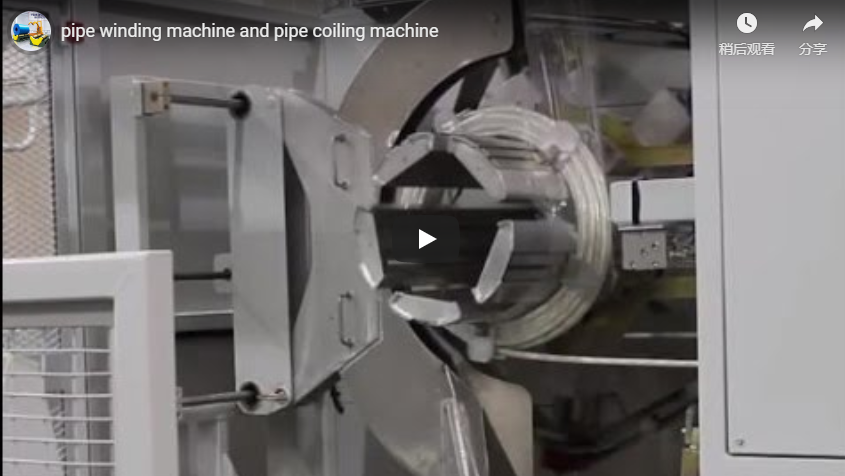
Our compact white bundling and bagging machine handles short white plastic pipes. The pipes run along an infeed conveyor and gather in a V-shaped pocket. A small rotating ring head binds the bundle, and film-covered bundles pass on to the bagging section. A touch-screen panel with an emergency stop sits on the machine frame.
Bundling and bagging line data
| Kirje | Kottidesse pakkimise liin | Off-line bundling line |
|---|---|---|
| Toru materjal | PPR, PVC; steel tube and hose on request | PVC |
| Pipe or bundle size | kimbu välisläbimõõt 110–260 mm | pipe OD 22–60 mm |
| Toru pikkus | made to your min. and max. length | 4 m ja 5.8 m |
| Kiirus | about 1–3 bundles/min | about 1–2 bundles/min |
| Pipe lifting | - | up to 60 pipes/min |
| Bag or strap | welded PE or PP bag | PP strapping belt |
| Varustama | 380 V, 50 Hz; air 7–8 bar | - |
The off-line line works down to 18 mm OD, though pipes below 22 mm may need manual help at the infeed. For short pipes like those shown, we size the pocket, pusher and bag to your length range. Air consumption and film roll size depend on the bag and cycle, and we state both in our quotation.
Worked example: bundle size and output
A plant extrudes 32 mm PPR pipe and wants bags of 19 pipes. These are illustrative customer figures.
Bundle OD. Nineteen round pipes pack into a hexagon five pipes across. The bundle OD is about 5 × 32 = 160 mm, which sits inside the 110–260 mm bagging range.
Bag size. The bag has to go round the bundle with room to slide on. Its flat width is about π × 160 ÷ 2 = 251 mm plus a sliding allowance that we set on trial.
Output check. At 1–3 bundles per minute the line packs 19–57 pipes per minute. If the extruder and cutter deliver 30 pipes per minute, the line needs 30 ÷ 19 = 1.6 bundles per minute, inside its range.
Üldreegel. Pipes per minute from production ÷ pipes per bundle gives the bundle rate the line must reach.
Options: strapping and labelling
The strapping module sits before the bagging station, so the bundle goes into the bag already strapped. You can set the pipe count, the bundle shape, the number of straps and their positions. A labelling machine can then stick adhesive labels with barcodes or production data on the bag.
Valiku kontroll-leht: mida meile saata
- Pipe material, OD and length.
- Pipes per bundle and bundle shape.
- Bag or strap, and film type.
- Pipes per minute from your line.
- Online after the extruder, or off-line from carts.
- Labelling or printing needs.
Ohutus ja EN 415-10
For CE markets we use EN 415-10 as our reference, with a risk assessment to ISO 12100. The main hazards are the rotating binding head, the bag welding and sealing station and the pusher.
Keep the guards over the binding head and sealing station closed in automatic mode. Use the emergency stop before clearing a jammed pipe or bag.
Inseneri KKK
Q: Can it bag a single pipe as well as a bundle? A: Yes. The bag is set for a single pipe or a bundle, and its shape follows the pipe diameter.
Q: Does it connect to our extrusion line? A: Yes. It can run online after the extruder or off-line from pipe carts.
Q: What bag material does it use? A: Welded PE or PP film, made into a bag on the machine.
K: Milliste standardite järgi te ehitate? V: Meie CE-märgise viitena on EN 415-10 koos ISO 12100 riskihindamisega.
Järgmine samm
- Email your pipe sizes, pipes per bundle and line speed et info@fhopepack.com.
- Vastame 24 tunni jooksul koos ettepanekuga, with the line layout.
- We send a bag and bundle test plan for your pipes.
Seotud lugemine
- Automaatne PPR/PVC torude pakkimisliin
- Automatic pipe bundle making and banding machine
- Automatic PPR/PVC pipe strap packing machine
- PVC toru kottide pakkimismasin
- On-line PVC, PE and PPR pipe bundling and PP strapping line
Allikad
- Specifications: FHOPE PPR/PVC pipe bagging line, off-line pipe bundling line and PPR/PVC pipe strap packing machine pages
- Masina video: plastic pipe bundling, strapping and bagging on YouTube
- Bundle size and output: our worked example, illustrative pipe figures
- Standardid: EN 415-10 (pakkimismasinad, üldine ohutus); ISO 12100:2010
Viimati üle vaadatud: 2026-10-17