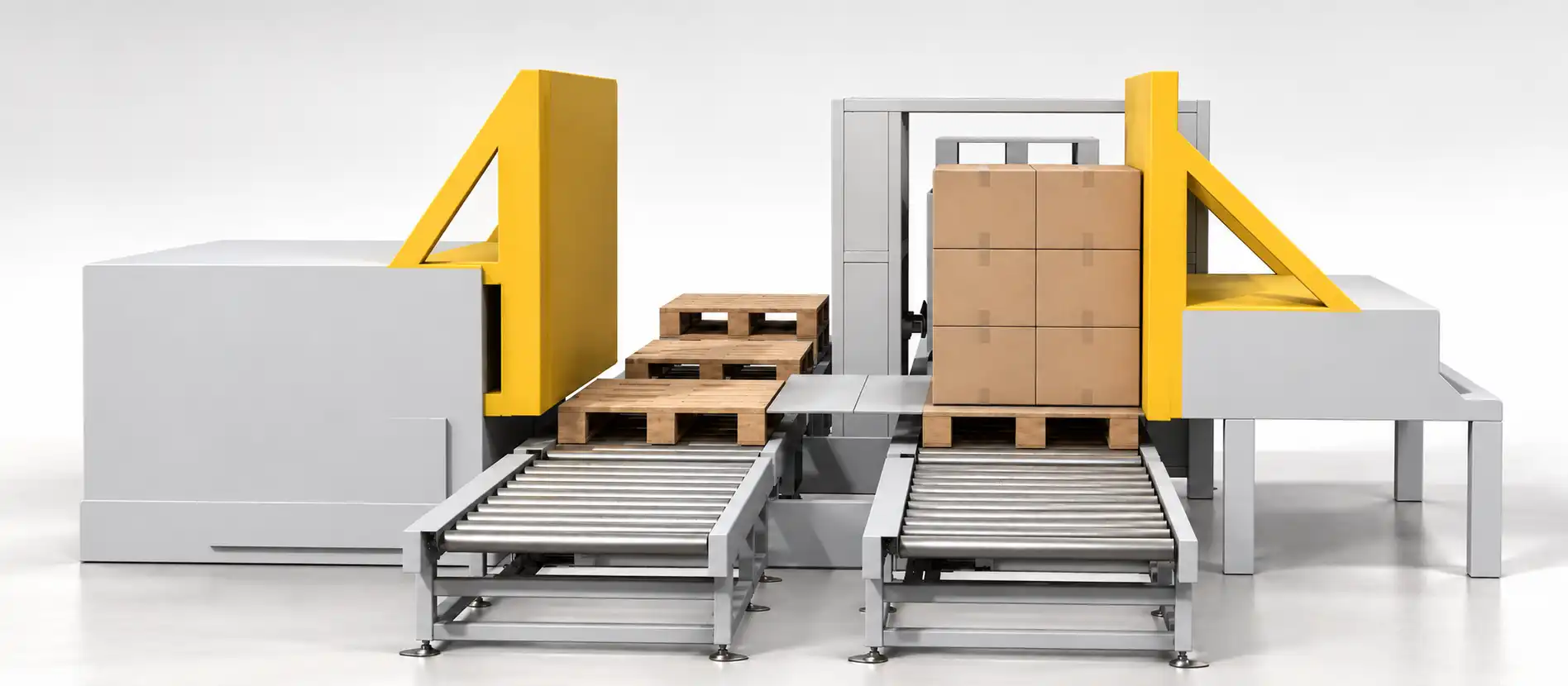
Περίληψη Our push-type pallet changer swaps a pallet without turning the load at all. A hydraulic pusher slides the goods off the source pallet onto the target pallet, and the empty pallets are gathered automatically. The standard design handles loads up to 1,000 kg, which covers most pallets. Heavier builds are possible when the load has a cardboard base that can take the rubbing.
Πίνακας περιεχομένων
- How the push-type changer works
- Why the load stays near 1,000 kg
- Which loads suit pushing
- Push type, V-shape or 180°
- Push-type changer data
- Ασφάλεια και εγκατάσταση
- Λίστα ελέγχου επιλογής
- Συχνές ερωτήσεις μηχανικής
- Επόμενο βήμα
- Σχετική ανάγνωση
- Πηγές
How the push-type changer works
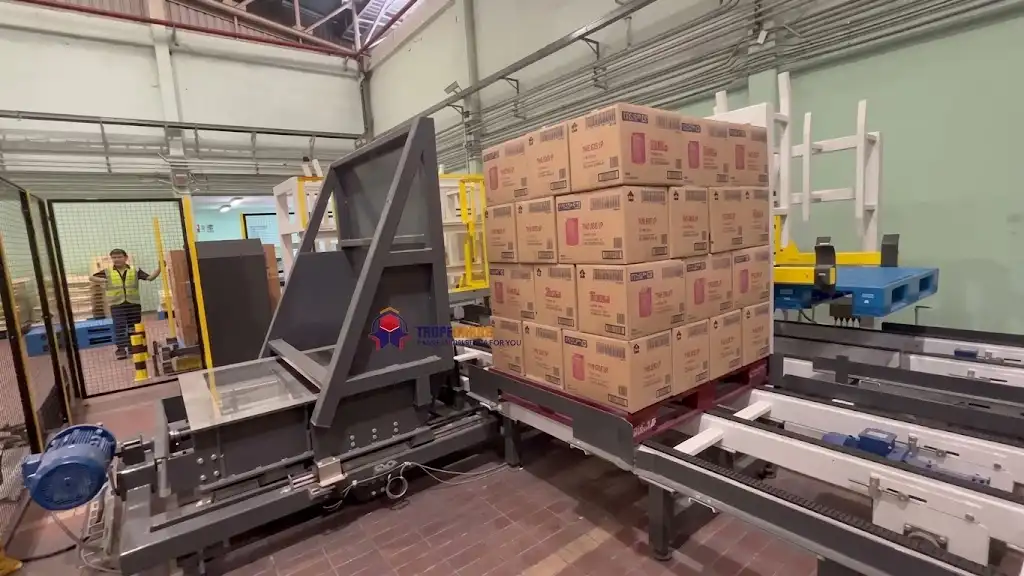
A forklift sets the loaded pallet on the infeed side at floor level. The target pallet waits on the other side, set level with the source pallet so the bottom layer cannot catch on its leading edge. A hydraulic cylinder drives the push plate against the side of the load and slides the whole stack across onto the target pallet. The machine then gathers the empty source pallet, so the operator does not have to lift it out by hand.
There is no inverting, tilting or clamping, so the goods stay upright the whole time. In our video, the only machine motion is the push stroke: the carton stack crosses to the new pallet while the forklift waits, and the forklift lifts it away a few seconds later. Because nothing turns, a cycle is mostly forklift time.
Why the load stays near 1,000 kg
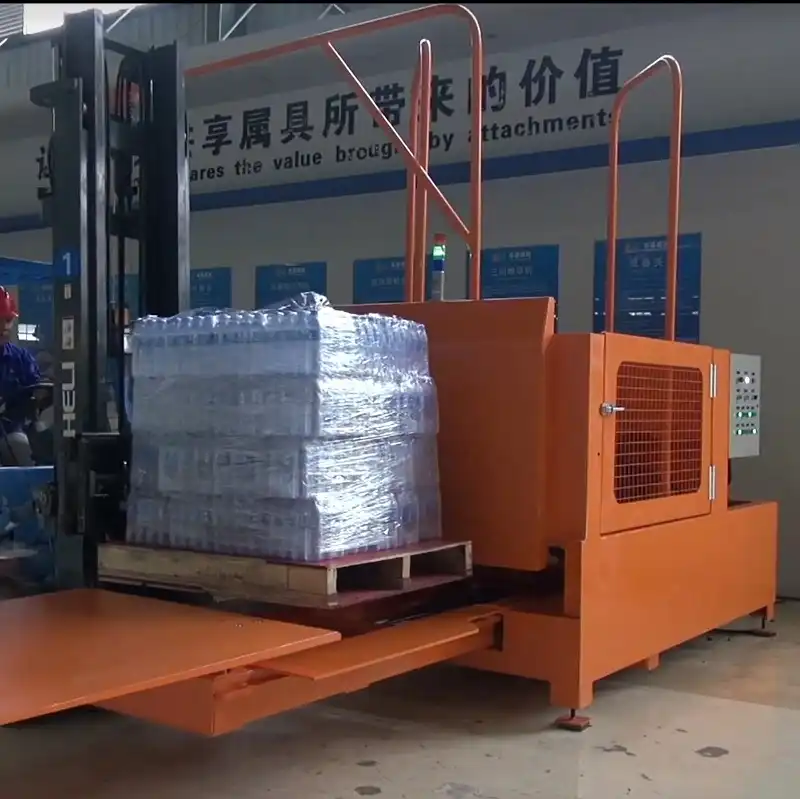
The push plate has to overcome friction between the bottom layer and the pallet deck. That friction grows with load weight, so the design usually stays at or under 1,000 kg.
An illustrative estimate shows the scale. Push force is roughly the friction coefficient times the load weight. With a coefficient of 0.4 for cartons on wood, a 1,000 kg load needs about 3.9 kN, and a 2,000 kg load about 7.8 kN. The cylinder can deliver more force. The real limit is the bottom layer of the load, which takes all of that rubbing.
Which loads suit pushing
| Φορτίο | Push type? | Λόγος |
|---|---|---|
| Cartons, shrink-wrapped packs, bagged goods | Ναι | Stable stack, the base can take light rubbing |
| Load with a cardboard base or bottom sheet | Yes, also above 1,000 kg on a custom build | The cardboard takes the rubbing, not the product |
| Goods that must not tip or turn | Ναι | The load never leaves the upright position |
| Bare product with a finish that must not scratch | Οχι | Choose a tilting or inverting changer |
| Loose, unbonded stack | Stretch wrap it first | The push plate acts on one side only, so loose cartons can shingle or tip |
Pushing is the mildest way to change a pallet for sensitive goods that must not be turned over. Mild here means no tilting; it does not mean no friction. If the bottom of your product cannot rub, a V-shape or 180° machine is the better choice.
Typical push-type jobs are swapping wooden shipping pallets for plastic pallets before goods enter a hygiene area, and bottled liquids that must stay upright.
Push type, V-shape or 180°
| Μηχανή | Πώς απελευθερώνει την παλέτα | Τυπικό φορτίο |
|---|---|---|
| Μετατροπέας τύπου ώθησης | Slides the goods onto another pallet | 1,000 kg |
| Μετατροπέας σχήματος V | Γέρνει το φορτίο κατά 90° στο πλάι του | 1.5 t standard, up to 3 t on special builds |
| Μετατροπέας 180° (FPFZ-1) | Γυρίζει το φορτίο ανάποδα | Έως 1.2 τόνους |
Push-type changer data
| Είδος | Push-type pallet changer |
|---|---|
| Μέθοδος | Pushing, no inverting, tilting or clamping |
| Φορτίο | πρότυπο 1,000 κιλών |
| Heavier builds | Custom, for loads with a cardboard base that tolerate rubbing |
| κίνησης | Hydraulic cylinder with durable valves |
| Φόρτωση | Επίπεδο δαπέδου |
| Empty pallets | Gathered automatically after the change |
| Εγκατάσταση | Standalone, or as part of a conveyor system |
Ασφάλεια και εγκατάσταση
The changer works at floor level, so forklifts or pallet trucks feed it without a ramp. Installed standalone, it serves one loading point. Built into a conveyor system, the pallet change happens in line, with no forklift move between the conveyor and the changer. The hydraulic valves are chosen to avoid oil leaks, and maintenance is simple.
The risk assessment covers the gap between the push plate and the load, which closes during the stroke, so we keep that zone guarded and away from the control point.
Τα ισχύοντα πρότυπα εξαρτώνται από την αγορά προορισμού. Για τις αγορές CE, το ISO 12100 ορίζει τη μέθοδο αξιολόγησης κινδύνου και το EN 415-10 ορίζει τις γενικές απαιτήσεις για τις μηχανές συσκευασίας.
Selection checklist for a push-type pallet changer
- Heaviest load, and whether it is above 1,000 kg.
- What the bottom layer is: cartons, cardboard sheet or bare product.
- Can the base take light rubbing?
- Source and target pallet sizes.
- Standalone or in a conveyor line.
- Απαιτούνται παλέτες ανά ώρα.
- Τοπική παροχή ρεύματος.
Συχνές ερωτήσεις μηχανικής
Q: How heavy a load can the push-type changer handle? A: 1,000 kg, which covers most pallets. A custom build can go higher if the load has a cardboard base and tolerates the rubbing.
Q: Why not push heavier loads? A: Push force grows with weight, and all of it acts as friction on the bottom layer. Above about 1,000 kg, that rubbing starts to damage most products.
Q: Does the load get tilted or clamped? A: No. The goods stay upright and are slid across, so they suit loads that must not be turned over.
Q: Can it run inside a conveyor line? A: Yes. It works as a standalone unit or as part of a conveyor system, at floor level.
Q: What happens to the empty pallets? A: The machine gathers them automatically after each change, so the operator never lifts an empty pallet by hand.
Επόμενο βήμα
We plan your push-type pallet changer in three steps:
- Υποβάλετε το σχέδιό σας with your pallet sizes, load weights and bottom-layer material to info@fhopepack.com.
- Λάβετε μια πρόταση εντός 48 ωρών, with the pusher design and line layout.
- Κλείστε ραντεβού για έρευνα τοποθεσίας to check the floor and the forklift path.
Σχετική ανάγνωση
- Εναλλάκτης παλετών τύπου pushing
- Μετατροπέας παλετών σε σχήμα V
- Μετατροπέας παλετών 180°
- Βίντεο: Ανακύκλωση παλετών τύπου C 180° και μετατροπέας παλετών
Πηγές
- Pushing method, floor level, hydraulic drive, automatic pallet gathering, standalone or conveyor: pushing type pallet changer page
- 1,000 kg load, friction limit and custom range: FHOPE engineering team, 2026-10-04
- Comparison values: Σελίδα αλλαγής παλέτας σε σχήμα V, Σελίδα μετατροπέα παλετών 180°
- Μηχανή σε δράση: our push-type pallet changer video on YouTube
- Πεδίο εφαρμογής των προτύπων: ISO 12100: 2010, EN 415-10: 2014
Τελευταία αξιολόγηση: 04-10-2026