
What are the steel coil packing line dimensions?
Are you struggling to optimize your factory layout, dealing with bottlenecks in your steel coil packaging process, or perhaps wondering if a fully automated system can even fit into your existing space? Many plant managers, like our friend Ivan in Russia, face the exact challenge of integrating robust machinery into production lines that are already running tight. Understanding the physical dimensions of a steel coil packing line is not just about measuring equipment; it is about foreseeing operational efficiency, ensuring safety, and maximizing your return on investment. Ignoring this crucial aspect can lead to costly reconfigurations, reduced output, and missed opportunities.
A typical steel coil packing line’s overall dimensions are highly variable, often ranging from 15 to 60 meters in length and 3 to 8 meters in width, depending on the required level of automation, the specific components included, and the coil sizes (diameter, width, weight) it is designed to handle. These lines are engineered to process various steel types, such as cold-rolled, galvanized, or color-coated coils, and integrate functions like turning, conveying, wrapping, strapping, and labeling within a defined operational footprint.
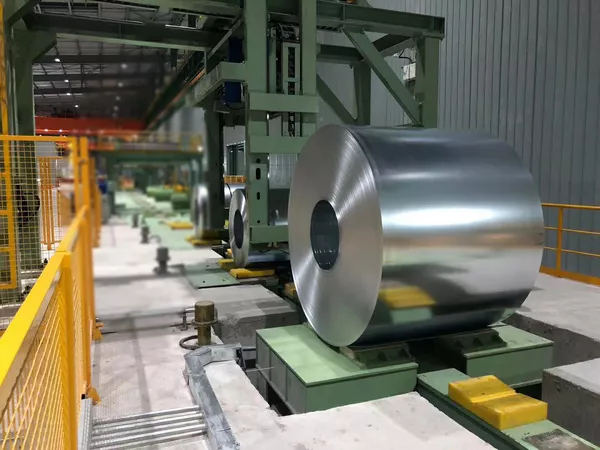
Knowing the precise dimensions helps you plan your factory floor effectively. It allows you to visualize the flow of material, identify potential pinch points, and ensure seamless integration with upstream and downstream processes. I want to guide you through the factors that determine these critical measurements, helping you make informed decisions for your next packing solution.
Why Do Steel Coil Packing Line Dimensions Matter?
Many businesses often overlook the critical role of physical space when planning new industrial equipment. This can lead to significant problems down the line, such as operational inefficiencies or safety hazards. Have you considered how the footprint of your packing line directly impacts your entire production flow? Failing to account for exact dimensions can result in cramped working conditions, bottlenecks, and even the need for costly factory reconfigurations.
The dimensions of a steel coil packing line matter immensely because they directly influence factory layout, operational efficiency, safety protocols, and the overall cost-effectiveness of your production. Proper sizing ensures that the equipment fits seamlessly within the available space, allows for unimpeded material flow, and provides adequate clearance for maintenance and emergency exits, thereby preventing accidents and optimizing throughput in industrial environments.

Understanding these dimensions is not just about fitting a machine; it’s about engineering a smarter, safer, and more productive factory. This becomes especially true when dealing with heavy, bulky items like steel coils that require precise handling.
1. Space Optimization: Maximizing Your Factory’s Potential
For many manufacturers, factory floor space is a precious commodity. Every square meter counts. Properly understanding packing line dimensions allows you to:
- Avoid Overcrowding: Prevent placing equipment too close, which can hinder operator movement and material transport. A well-spaced layout improves ergonomics and reduces worker fatigue.
- Streamline Workflow: Design a logical flow from production to packaging to warehousing. This minimizes unnecessary movements, reduces idle time, and boosts overall productivity.
- Future-Proofing: Allocate space not just for current needs but also for potential expansion or future upgrades. This foresight prevents major disruptions when new technologies emerge or production volumes increase.
2. Operational Efficiency: Keeping Production Flowing Smoothly
An automated steel coil packing line is a significant investment aimed at improving speed and consistency. Its dimensions play a crucial part in achieving those goals:
- Seamless Integration: Ensure the packing line integrates smoothly with existing equipment, such as slitting lines, roll forming machines, or overhead cranes. Correct dimensions mean fewer adaptors or custom modifications, saving time and money during installation.
- Reduced Handling Time: A compact, well-designed line can minimize the distance coils travel between stages, speeding up the entire packing process. This is vital for high-volume operations where every second counts.
- Maintenance Access: Adequate spacing around each component of the packing line is essential for routine maintenance, troubleshooting, and repairs. Easy access helps reduce downtime and prolongs the lifespan of your machinery.
3. Safety and Compliance: Protecting Your Workforce and Assets
Safety in a steel plant is paramount, especially when handling heavy materials like coils that can weigh several tons. The dimensions directly impact the safety of your personnel and compliance with industry standards:
- Clear Walkways: Ensure sufficient clearance for personnel to move safely around the machinery, separating human activity from heavy machinery operations. This reduces the risk of collisions and accidents.
- Emergency Exits and Access: Proper layout ensures that emergency exits are not obstructed and that emergency services can access any part of the line if needed. This is a critical regulatory requirement in most industrial settings.
- Reduced Manual Intervention: Automated lines, with dimensions that facilitate robot or automated guided vehicle (AGV) integration, reduce the need for manual handling of heavy coils. This lowers the risk of strain injuries or accidents caused by human error, a key concern for managers like Ivan dealing with labor shortages. (industrial safety, factory layout planning, production line efficiency)
What Key Components Influence Packing Line Footprint?
When you envision a steel coil packing line, it’s easy to just see the final packed coil. However, this integrated system is a complex symphony of specialized machines, each contributing to the overall size and functionality. Have you ever considered what individual elements take up the most space and why understanding each component is crucial for your factory layout? Without this insight, you might underestimate the total footprint required, leading to unforeseen spatial challenges during installation.
The footprint of a steel coil packing line is primarily influenced by its core components: the coil loading and unloading systems (e.g., coil cars, walking beams), the strapping machines (orbital or radial), the wrapping machines (orbital stretch wrappers), conveyor systems (roller or chain), and additional stations like weighing, labeling, and stacking units. Each of these elements requires specific clearances and operational space, and their number, size, and configuration directly determine the overall length and width of the complete packing solution.
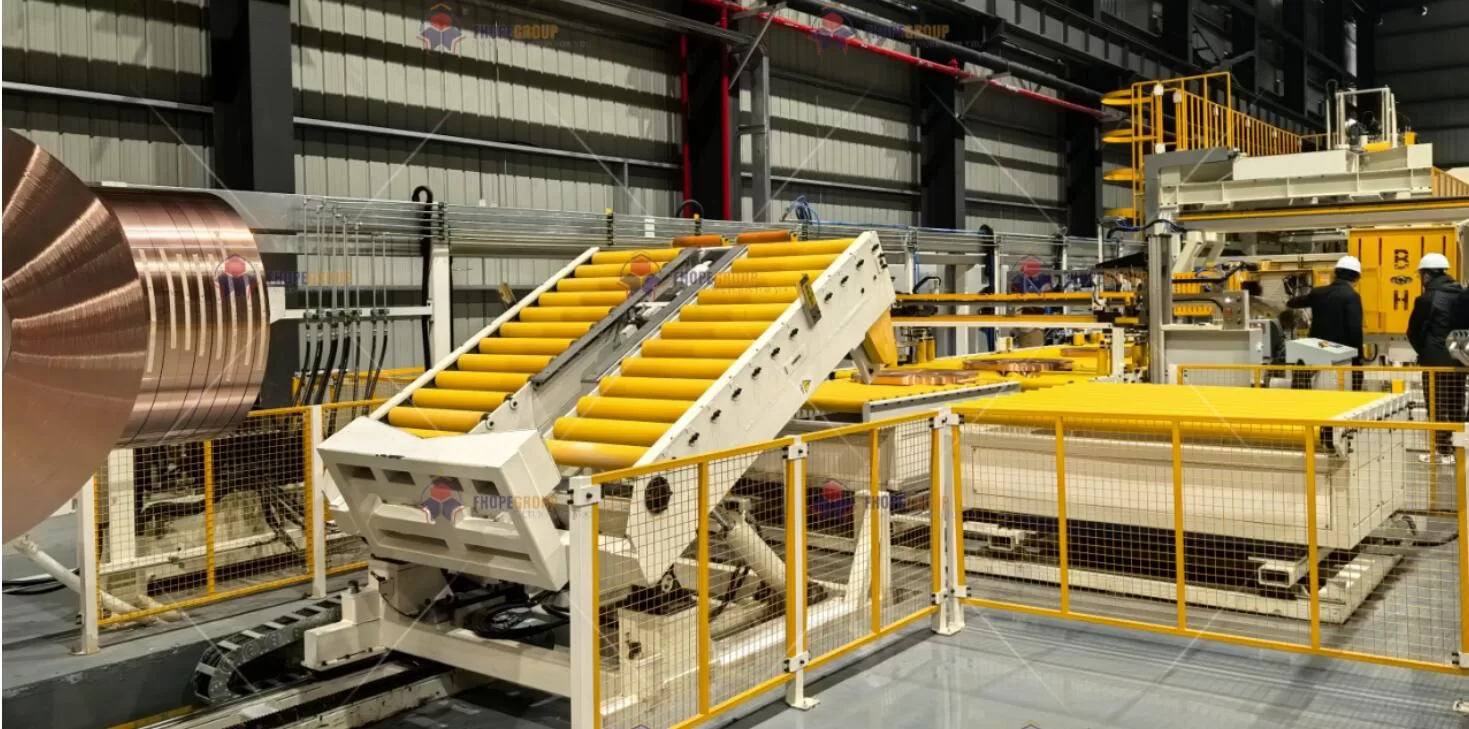
Understanding these components helps you not only to visualize the space requirements but also to customize a line that fits your specific production needs.
1. Coil Loading and Unloading Systems
These are the entry and exit points for your steel coils, often dictating the initial and final space requirements:
- Coil Cars/V-Type Carts: Used to load coils onto the main conveyor or transfer them between stations. Their dimensions depend on the maximum coil weight and diameter they need to handle. A system for a 3-ton coil will be significantly larger than one for smaller wire coils.
- Walking Beam Conveyors: These provide automated indexing and transfer of coils, often found in heavy-duty lines. They require significant length to move multiple coils sequentially.
- Palletizing/Stacking Systems: For finished coils, automatic stacking or palletizing solutions might be integrated. These units, especially for multiple coil stacks, add to the overall line length and often require buffer zones.
2. Strapping Machines (Orbital & Radial)
Strapping is a fundamental step for securing steel coils. The type and number of strapping machines heavily influence the line’s length:
- Orbital Strapping Machines: These machines move around the coil to apply strapping, often from a fixed position, adding width to accommodate the rotation. They are essential for securing the outer diameter of the coil.
- Radial Strapping Machines: These are generally more compact, applying straps across the coil’s face. If multiple straps are needed (e.g., for export requirements), several units might be integrated, increasing the line’s length.
- Multiple Heads: For faster throughput or to meet specific packing standards (like Ivan’s need for multiple straps for export), multiple strapping heads can be installed, which adds to the physical length of the strapping station.
3. Wrapping Machines (Orbital Stretch Wrappers)
Moisture and rust prevention are critical for steel coils, making wrapping machines a core component. These units often represent a significant portion of the line’s length and width:
- Orbital Stretch Wrappers: These machines rotate a film dispenser around the coil as it passes through, creating a tightly wrapped, protective layer. The size of the orbital ring must accommodate the largest coil diameter, directly impacting the machine’s width and the clearance needed around it.
- Shrink Wrapping Tunnels: For some applications, a heat shrink tunnel might be used. These tunnels can be quite long, depending on the desired wrapping speed and heat exposure time.
- Film Roll Storage: Automated film change systems and storage for large film rolls also contribute to the machine’s overall footprint, requiring space for spare material and accessibility.
4. Conveyor Systems
Conveyors are the backbone that connects all the stations, ensuring a continuous flow of material:
- Roller Conveyors: Common for moving coils horizontally. Their length is determined by the number of stations, the distance between them, and any required buffer zones.
- Chain Conveyors: Used for heavier coils or specific indexing requirements. These can be more robust but also require more space due to their heavy-duty construction.
- Turning Devices: For applications requiring coils to be oriented differently (e.g., eye-to-sky to eye-to-bore), special turning devices or tilting tables are integrated, adding to both the length and sometimes the width of the line. (packing line components, industrial machinery footprint, automated packaging equipment)
How Do Coil Dimensions Impact Packing Line Design?
Every steel coil is unique in its size and weight, and these characteristics are fundamental drivers in the design and subsequent dimensions of a packing line. Have you ever considered that the maximum diameter or weight of the coils you produce dictates the entire scale of your packaging solution? Overlooking these coil-specific parameters can result in an undersized line that can’t handle your products, or an oversized one that wastes valuable factory space and capital.
Coil dimensions, specifically outer diameter (OD), inner diameter (ID), width, and weight, critically impact the design and overall footprint of a steel coil packing line. Larger or heavier coils require more robust, larger-scale machinery, including wider conveyors, stronger loading systems, and wider strapping and wrapping machines to accommodate their physical size and weight, thus dictating a greater physical presence on the factory floor.

These coil parameters are not just numbers; they are the blueprint for your packing line, influencing everything from motor strength to structural integrity.
1. Coil Outer Diameter (OD) and Inner Diameter (ID)
The diameter of your coils directly affects the size of several key components:
- Wrapping Ring Diameter: The orbital wrapper’s ring must be large enough to allow the largest coil to pass through easily. A larger coil OD means a larger wrapper, increasing the machine’s overall width and height.
- Conveyor Width and Roller Length: Conveyors need to be wide enough to safely support the coil without overhang. The length of individual rollers must match or exceed the coil width to prevent sagging or instability.
- Coil Car Dimensions: Loading and unloading coil cars must have cradles or platforms that can securely hold coils with various IDs and ODs. Adjustable designs are common but still require space for their full range of motion.
2. Coil Width
The width of the steel coil is another crucial factor that directly impacts the packing line’s dimensions:
- Strapping Machine Traverse: Strapping machines, especially those applying radial straps, need to be able to traverse the full width of the coil. Wider coils may require larger gantry systems or more robust mechanisms for strap application.
- Conveyor Design: The structural integrity of the conveyor system needs to support the coil’s weight uniformly across its width. This might mean more support beams or a wider base, increasing the overall footprint.
- Wrapping Film Coverage: For optimal moisture protection, the wrapping film needs to cover the entire width of the coil effectively. This influences the selection of film width and the wrapping pattern, which can affect the machine’s speed and overall length if multiple passes are needed.
3. Coil Weight
Heavy coils demand robust engineering, which inherently translates to larger and stronger components:
- Structural Robustness: All components, from conveyors to loading systems, must be built with heavier gauge steel and stronger motors to handle coils weighing 1-3 tons (or more, like Ivan’s typical coils) safely and reliably. This adds to the physical size and footprint of the machinery.
- Motor and Drive Systems: Larger, more powerful motors are needed to move heavy coils along the line and operate strapping and wrapping mechanisms. These motors themselves are physically larger and require more space for cooling and maintenance.
- Safety Features: Increased weight capacity often means enhanced safety features, such as reinforced safety guards, heavier-duty sensors, and more robust braking systems, all of which contribute to the overall machine dimensions and necessary clearances. (coil size impact, heavy-duty packing equipment, customized line design)
What Are Typical Dimensions for Standard Coil Packing Lines?
Many clients ask me for a ballpark figure when planning their factory space. They need to know what “average” looks like to begin their layout designs. However, providing a single typical dimension for a steel coil packing line is like giving a “typical” size for a house – it varies wildly based on needs. Are you wondering what a common line setup actually looks like in terms of length and width for different production scales? Without a general understanding, it’s hard to even start budgeting for space.
Typical dimensions for standard steel coil packing lines can vary significantly, but a basic semi-automatic line designed for medium-sized coils might be around 15-25 meters long and 3-5 meters wide. A fully automatic, high-capacity line handling heavier and wider coils, integrating multiple wrapping and strapping stations, can easily extend to 30-60 meters in length and 5-8 meters in width. These figures depend on the degree of automation, the type of steel coils (e.g., cold-rolled, galvanized), and the specific packing requirements.

Let me break down what you might expect for different levels of automation and capacity, based on my experience helping factories worldwide.
1. Entry-Level / Semi-Automatic Lines
These lines are often chosen by companies with lower production volumes or those transitioning from purely manual operations.
- Length: Typically 15-25 meters. This includes a loading station, one strapping machine, one wrapping machine, and an unloading station.
- Width: Around 3-5 meters. This width accommodates the largest coil diameter plus the operational space for the orbital wrapper and basic safety clearances.
- Capacity: Suitable for processing 10-20 coils per hour, often requiring some manual intervention for tasks like core inserting or final inspection.
- Typical Coil Range: Max OD up to 1500mm, max weight 1-2 tons. These lines provide a good balance of automation and cost-effectiveness for smaller facilities.
2. Medium-Capacity / Fully Automatic Lines
These are popular for factories with consistent production and a desire to reduce manual labor, similar to Ivan’s goals.
- Length: Generally 25-40 meters. This allows for additional components like automatic coil turning devices, multiple strapping heads (for PET and/or steel strap), and possibly dual wrapping stations for faster throughput or double protection.
- Width: 4-6 meters. The increased width accounts for larger coil handling, more complex machinery like a coil lifter/turner, and broader safety zones for automated operation.
- Capacity: Can handle 20-40 coils per hour, with minimal manual intervention. These lines significantly improve efficiency and consistency.
- Typical Coil Range: Max OD up to 2000mm, max weight 2-5 tons. These lines are robust enough for continuous two-shift operations, a crucial factor for demanding environments like steel mills.
3. High-Capacity / Integrated Automated Lines
These are the most advanced solutions, designed for very high volumes, demanding packaging standards (like CE/ISO for exports), and maximum labor reduction.
- Length: 40-60+ meters. These lines often feature multiple loading buffers, sophisticated coil centering systems, several strapping and wrapping stations in parallel or series, automatic labeling, weighing, and advanced data integration. They also include extended conveyor systems for accumulated coils.
- Width: 6-8+ meters. The greater width is needed for parallel processing capabilities, larger diameter orbital wrappers, and extensive safety guarding for completely automated operation.
- Capacity: Capable of processing 40-80+ coils per hour, running 24/7 with minimal operator oversight. These are turnkey solutions that transform packaging into a streamlined, highly efficient process.
- Typical Coil Range: Max OD up to 2500mm, max weight 5-10 tons. These lines address complex challenges such as diverse product types (cold-rolled, galvanized, color-coated) and strict quality requirements, providing comprehensive solutions for major industrial players. (standard packing line dimensions, automated packaging capacity, industrial equipment sizing)
How Can FHOPEPACK Customize Packing Line Dimensions for Your Factory?
Understanding typical dimensions is a good starting point, but every factory, every production line, and every coil product is unique. Generic solutions rarely deliver optimal results. Many clients approach me wondering if their specific layout constraints or unique coil characteristics can truly be accommodated. Are you concerned that a standard packing line won’t fit your existing facility or meet your precise operational needs, leading to inefficient use of space or compromising your production goals?
FHOPEPACK excels at customizing steel coil packing line dimensions and configurations to perfectly match a factory’s specific layout, production volume, coil characteristics (OD, ID, width, weight), and desired automation level. We achieve this by offering modular designs, adapting component sizes, optimizing conveyor lengths and orientations, and integrating specialized handling equipment, ensuring a tailor-made solution that maximizes space utilization and operational efficiency for clients globally.
I have personally seen many factories, from bustling mills in Europe to growing facilities in Asia, each with its own set of challenges. My journey from a factory employee to establishing FHOPEPACK has taught me that the best solution is always a bespoke one.
1. Modular Design and Component Adaptation
The core of our customization philosophy lies in our modular approach to packing line construction.
- Flexible Component Sizing: We do not offer one-size-fits-all machines. Instead, each component—be it a strapping head, a wrapping ring, or a conveyor section—is designed with adjustable parameters. For example, orbital wrappers can be scaled to accommodate a specific range of coil diameters, from smaller wire coils to larger steel coils.
- Interchangeable Modules: Our lines are built from independent modules that can be configured in various sequences. This means we can add or remove stations (e.g., an extra strapping head for multi-strap requirements) without redesigning the entire line, making it highly adaptable to evolving production needs.
- Supplier Versatility: As FHOPEPACK, we focus on providing the best solution. We also recognize that other reputable brands exist. For specific components or niche requirements, we may integrate parts from trusted partners like SHJLPACK or CNBHPAC, ensuring the best fit and performance while maintaining our overarching design and quality standards.
2. Optimized Layout and Space Utilization
Maximizing your existing floor space is a critical objective, and our design process prioritizes this.
- Detailed Factory Layout Analysis: Before any design work begins, my team conducts a thorough analysis of your factory layout, including existing equipment, available footprint, column locations, and material flow paths. We use advanced CAD software to simulate different line configurations.
- Adjustable Conveyor Lengths and Orientations: Conveyor sections are customized to fit the exact distances between modules and to account for turns or elevation changes. We can design straight lines, L-shaped, or U-shaped layouts to navigate around obstacles or integrate with existing machinery, minimizing dead space.
- Vertical Space Utilization: For factories with height advantages, we can incorporate vertical handling solutions, such as lifters or stackers, to reduce the horizontal footprint, especially for buffer zones or finished coil accumulation.
3. Specialized Handling and Integration
Meeting unique operational challenges requires specialized equipment and seamless integration.
- Diverse Coil Handling: Whether you produce cold-rolled, galvanized, color-coated, or even copper coils, our lines are designed to handle various material types and finishes without damage. This includes specialized roller surfaces or gripping mechanisms.
- Integration with Upstream/Downstream Processes: We ensure that our packing lines integrate perfectly with your existing production stages. This might involve custom interfaces with your slitting lines, annealing furnaces, or warehouse management systems, creating a truly continuous workflow.
- Safety and Maintenance Access: Customization always includes ensuring optimal safety clearances and easy access for maintenance. This is crucial for 24/7 operations, ensuring quick troubleshooting and minimal downtime, aligning with the operational demands of clients like Ivan. (customized packing solutions, factory layout optimization, modular machine design)
Conclusion
Understanding the dimensions of a steel coil packing line is fundamental for any factory looking to optimize its production space and enhance efficiency. The right solution moves beyond standard sizes, offering a tailored approach that fits your unique needs. By partnering with FHOPEPACK, you gain access to customized coil packing line solutions designed to maximize your factory’s output, ensure operational safety, and provide long-term reliability. We ensure your investment perfectly aligns with your operational goals and physical constraints.








