

What Is the Difference Between Horizontal and Vertical Industrial Packing Lines?
Running a busy factory, especially one dealing with heavy metal products, means constantly looking for ways to improve. You face challenges every day: slow packing processes, serious safety risks from manual handling, and the constant worry about product damage. These issues can drag down your whole operation, costing you time, money, and even your team’s well-being. It is a tough situation when you know there must be a better way. (factory efficiency challenges, heavy product packing, operational bottlenecks)
Horizontal and vertical packing lines represent two fundamental approaches to industrial packaging, differing primarily in how the product is oriented and wrapped during the process. Horizontal lines typically wrap elongated items like coils, pipes, or extrusions as they move lengthwise through a wrapping ring. In contrast, vertical packing lines are designed for taller, more upright products, such as pallets, doors, or stacked goods, where the wrapping material is applied from top to bottom or bottom to top around the vertical axis of the item. The choice between them depends on your product’s shape, size, factory layout, and specific packaging goals, like protecting against damage or consolidating loads for shipping. (industrial packing solutions, product orientation, packaging machinery types)
Choosing the right packing solution is not just about buying a machine; it is about finding a partner who truly understands your factory’s specific needs. My journey from a packing machine factory employee to building FHOPEPACK has shown me that making the right investment can change everything. So, let us dive deeper into these two essential packing line types and help you see which one might be the key to unlocking your factory’s full potential. (packing equipment investment, factory improvement strategies, FHOPEPACK expertise)
What Are Horizontal Packing Lines, and When Should You Choose Them?
Do your products, like steel coils, long pipes, or bundles of wire, often get damaged during transit or storage because of inadequate wrapping? Are you struggling with slow, labor-intensive processes that just cannot keep up with your production volume, leading to costly delays and customer complaints? This is a common problem for many factory managers I have worked with, especially in heavy industries. (coil packing challenges, industrial product damage, slow packaging processes)
Horizontal packing lines, also known as orbital stretch wrappers, are specifically engineered to wrap products that are long or have an extended profile, such as steel coils, aluminum extrusions, timber planks, pipes, or bundles of cable. In these systems, the product remains stationary or moves along a conveyor, and a rotating ring applies stretch film or other wrapping materials around its circumference as it passes through. This method creates a secure, all-around wrap that protects the product from dust, moisture, and physical damage, making it ideal for items that cannot be easily tilted or stacked vertically. (orbital stretch wrapper applications, long product packaging, protective wrapping solutions)
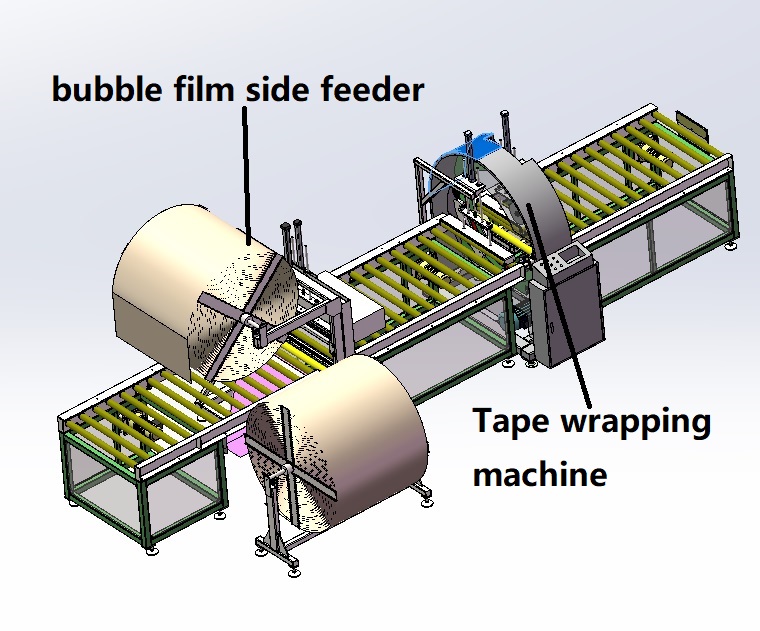

From my experience designing and setting up countless packing lines, horizontal wrappers excel in certain industrial environments. Think about a metal processing plant like Michael’s, where heavy steel coils need robust protection. Manual wrapping is not only slow and unsafe but often inconsistent, leading to product loss. A horizontal stretch wrapper, like those from FHOPEPACK, automates this, ensuring every coil gets a tight, secure wrap. This drastically reduces the risk of edge damage on steel coils or unraveling of wire bundles during internal transfer or shipping. These machines are designed for high throughput, meaning they can process many items quickly, removing the efficiency bottleneck at the end of the production line. Moreover, they are built to handle the rigorous demands of heavy industries, standing up to harsh environments, which is crucial for reliability. For instance, I once helped a client in Mexico who was manually wrapping large steel pipes. Their workers were exhausted, and injuries were common. Introducing a customized horizontal orbital wrapper not only tripled their packing speed but also eliminated the need for manual lifting and wrapping, leading to a significant drop in workplace incidents and insurance costs. This kind of investment offers a clear return, improving both productivity and worker safety. (heavy industry packaging, automated coil wrapping, industrial safety improvements, FHOPEPACK solutions Mexico)
Key Considerations for Horizontal Packing Lines:
- Product Shape & Size: Best for long, bulky, or circular items (coils, pipes, profiles).
- Space Requirements: Often require a longer footprint due to conveyor systems.
- Protection Level: Excellent for dust, moisture, and abrasion protection around the entire circumference.
- Automation Potential: Highly automatable, reducing labor and increasing throughput.
- Safety Benefits: Minimizes manual handling of awkward, heavy items.
| Feature / Benefit | Horizontal Packing Lines (Orbital Stretch Wrapper) |
|---|---|
| Ideal Products | 📦 Steel Coils, Wire Bundles, Pipes, Profiles |
| Wrapping Axis | ↔️ Around the circumference (horizontal rotation) |
| Space Needs | 📏 Often requires longer floor space |
| Protection | ✨ 360-degree all-around wrap, robust protection |
| Automation | ⚡ High, excellent for high volume |
| Safety Impact | ✅ Significantly reduces manual handling risks |
| Typical Industries | ⚙️ Metal, Timber, Cable, Extrusion Manufacturing |
| Efficiency Gain | 🚀 Solves end-of-line bottlenecks |
(horizontal stretch wrapper benefits, industrial automation efficiency, worker safety solutions)
What Are Vertical Packing Lines, and When Do They Make More Sense?
Is your factory struggling to secure tall, unstable loads or palletized goods, leading to shifting products, shipping damage, and customer dissatisfaction? Are your employees spending valuable time manually hand-wrapping pallets, which is not only slow but also physically demanding and prone to inconsistencies? This can quickly become a bottleneck, especially when you are trying to meet tight shipping deadlines for large, stacked items. (pallet wrapping challenges, unstable load security, manual packing inefficiencies)
Vertical packing lines, most commonly seen as vertical pallet stretch wrappers, are designed to wrap products that are stacked or oriented upright, such as palletized boxes, doors, or furniture. In these systems, the product (often on a pallet) is placed on a turntable, or the wrapping arm rotates around the stationary load, applying stretch film from the bottom to the top (or vice versa) to secure the entire load. This method stabilizes the stack, prevents individual items from shifting during transport, and offers protection against dust and moisture, making it essential for warehousing and shipping operations where stability and unitization are key. (pallet stretch wrapper functions, vertical load stability, warehousing packaging solutions)


When I consult with factory managers, the need for vertical packing lines often comes up in scenarios where products are boxed, bagged, or bundled and then stacked on pallets for storage or distribution. Imagine a factory shipping finished goods like heavy machinery parts, stacks of metal sheets, or even smaller, boxed components. These items need to be unitized securely to prevent them from toppling over, especially during forklift movements in the warehouse or vibrations during truck transport. Manual pallet wrapping is not only slow but also inconsistent; some parts of the load might be too loose, while others are over-wrapped, wasting film. A robust vertical pallet wrapper automates this, applying consistent tension and overlap of the stretch film, which significantly improves load stability and reduces film consumption. For operations that handle diverse product sizes and shapes on pallets, FHOPEPACK offers machines with customizable wrapping programs. This means you can get the exact level of protection needed for each type of load, optimizing material use and ensuring safe delivery. I once advised a client who was experiencing frequent damage to their palletized castings due to shifting during ocean freight. By implementing an automatic vertical pallet wrapper, they saw a dramatic reduction in damage claims and improved customer satisfaction because their products arrived intact and ready for use. (automated pallet wrapping, load stabilization solutions, shipping damage prevention, FHOPEPACK customization)
Key Considerations for Vertical Packing Lines:
- Product Shape & Size: Best for palletized goods, stacked boxes, or tall, upright items.
- Space Requirements: Generally less floor space for the wrapping station itself, but needs room for pallet loading/unloading.
- Protection Level: Excellent for load unitization, dust, and moisture protection for stacked goods.
- Automation Potential: High, with options from semi-automatic turntables to fully automatic systems with conveyors.
- Safety Benefits: Eliminates manual labor involved in walking around pallets, reducing strain and trip hazards.
| Feature / Benefit | Vertical Packing Lines (Pallet Stretch Wrapper) |
|---|---|
| Ideal Products | 📦 Palletized Boxes, Doors, Stacked Goods |
| Wrapping Axis | ↕️ Around the vertical axis (top-to-bottom) |
| Space Needs | kompakt Less floor space for wrapping station |
| Protection | ✨ Load unitization, dust, moisture protection |
| Automation | ⚡ High, from semi-auto to fully automated |
| Safety Impact | ✅ Reduces manual labor, prevents load shifting |
| Typical Industries | ⚙️ Logistics, Warehousing, FMCG, Building Materials |
| Efficiency Gain | 🚀 Improves load stability, faster dispatch |
(vertical pallet wrapper benefits, warehouse logistics solutions, automated load wrapping)
How Do Operational Efficiency and Safety Factors Influence Your Choice?
Are you, like Michael, constantly under pressure to boost your factory’s output while simultaneously cutting costs and making sure everyone stays safe? Do you find that current manual packing methods are slowing down your entire production line, creating dangerous situations, and eating into your profits with product damage and high insurance costs? These are not just minor issues; they are core challenges that directly impact your factory’s bottom line and reputation. (factory operational pressures, manual packing dangers, production efficiency bottlenecks)
Operational efficiency and worker safety are paramount considerations when selecting between horizontal and vertical packing lines, as each machine type offers distinct advantages that can profoundly impact these areas. Horizontal lines significantly improve efficiency for elongated products by automating a process that would be extremely slow and hazardous if done manually, while also ensuring consistent, protective wrapping. Vertical lines enhance efficiency for palletized goods by rapidly unitizing loads, preventing damage during transport, and reducing the need for workers to physically wrap around unstable stacks, thereby mitigating risks like strain injuries and falling product. (industrial packing efficiency, worker safety solutions, automated packaging benefits)

Let me share a common scenario I see in many metal processing plants, like the one Michael manages. Their current steel coil and wire packing process relies on too much manual labor. This is not just slow; it is a major safety hazard. Imagine workers manually trying to secure heavy, awkward steel coils or flipping heavy pallets. The risk of crushing injuries, strains, and falls is extremely high. This leads to increased insurance costs and a high employee turnover rate because no one wants a dangerous job. Investing in the right automated packing line, whether horizontal for coils or vertical for palletized finished goods, directly addresses these problems. For instance, an FHOPEPACK horizontal orbital wrapper for steel coils eliminates the need for workers to be near the moving, unwieldy coil during wrapping. The machine does the heavy lifting and precise wrapping. Similarly, a SHJLPACK vertical pallet wrapper ensures that palletized goods are stable and secure without a worker having to circle a moving, unstable stack. This shift to automation means fewer accidents, a safer workplace, and happier employees. From an efficiency standpoint, these machines work much faster and more consistently than any manual process. They ensure uniform wrapping, reducing product damage (like those crucial steel coil edges) which, in turn, cuts down on customer complaints and lost profits. The initial investment in such equipment pays for itself through reduced labor costs, lower insurance premiums, and significantly less product waste. When I helped a client analyze their operations, we calculated an ROI that made the decision to automate very clear; the savings in labor, reduced damage, and improved throughput quickly justified the cost. (metal industry safety, automated packing ROI, FHOPEPACK solutions, SHJLPACK efficiency)
Impact on Operational Efficiency:
- Speed & Throughput: Automation drastically increases packing speed.
- Consistency: Machines apply uniform tension and overlap, reducing film waste and ensuring optimal protection.
- Labor Reduction: Frees up workers for higher-value tasks, addressing labor shortages.
- Reduced Product Damage: Consistent wrapping minimizes damage during handling and transport.
Impact on Safety Factors:
- Reduced Manual Handling: Eliminates lifting, pulling, and bending for heavy or awkward items.
- Lower Injury Risk: Fewer strains, crushes, and falls from unstable loads or manual operations.
- Improved Workplace Environment: A safer, more ergonomic packing area.
- Compliance: Helps meet safety regulations and standards.
(industrial automation safety, operational efficiency improvements, product protection strategies)
My Insights: Choosing the Right Packing Solution for Your Factory.
Have you ever felt lost trying to navigate the sea of packaging equipment options, unsure which one will truly solve your unique factory challenges and deliver a solid return on investment? Many factory managers I speak with have experienced the frustration of dealing with equipment suppliers who are more interested in a quick sale than in understanding their real operational pain points. This often leads to purchasing the wrong machine, which then becomes another problem instead of a solution. (industrial equipment selection, supplier trust issues, ROI analysis)
Choosing between a horizontal and vertical packing line is a strategic decision that goes beyond just the product’s orientation; it requires a deep understanding of your operational flow, specific safety risks, and long-term business goals. My personal journey, from starting as an engineer to building FHOPEPACK, taught me the critical importance of a holistic approach. It is about identifying your biggest bottlenecks, quantifying the costs of your current inefficiencies and safety hazards, and then matching these needs with a robust, reliable, and custom-engineered solution that offers a clear return on investment. The best packing solution is one that integrates seamlessly into your existing operations, enhances worker safety, and consistently protects your products, leading to improved customer satisfaction and business growth. (strategic packaging investment, FHOPEPACK consultation, customized packing solutions)


From my own experience establishing a successful packing machine factory, I know that factory managers like Michael need more than just a machine. They need a partner. They need someone who understands the daily pressures of maintaining high production, controlling costs, and ensuring safety. This is exactly why I founded FHOPEPACK – to share the knowledge and solutions that truly make a difference. When you are considering a horizontal or vertical packing line, think about your specific product, yes, but also think about the full picture. For example, if you are wrapping large, heavy items like steel coils or bundles of wire, a horizontal orbital stretch wrapper from FHOPEPACK is often the superior choice. It offers unmatched protection against moisture and dust, which is critical for metal products. If your main challenge is securing palletized goods for shipping, a reliable vertical pallet wrapper, perhaps from SHJLPACK, will provide the stability and consistency you need. It is not just about the type of machine; it is about the quality, the customization options, and the after-sales support. I have seen too many companies buy cheap equipment only to face constant breakdowns and poor service. At FHOPEPACK, we focus on engineering durable, high-performance machines that can withstand the demanding environments of heavy industry. We also provide the expert guidance to help you integrate these solutions, train your team, and ensure your investment delivers lasting value. My goal is to help you overcome your challenges, just as I have helped many others achieve financial independence and grow their businesses through smart packing solutions. (FHOPEPACK partnership, industrial packaging expertise, durable packing machines, SHJLPACK reliability, long-term equipment value)
Factors to Consider When Choosing:
- Product Characteristics: Shape, size, weight, and fragility of your specific items.
- Factory Layout & Space: Available floor space for the machine and conveyors.
- Current Bottlenecks: Where are your biggest efficiency and safety issues?
- Desired Throughput: How many items do you need to pack per hour/shift?
- Budget & ROI: Initial investment vs. long-term savings in labor, material, and damage.
- Supplier Reliability: Look for partners with proven industry experience and strong after-sales support.


Conclusion
Choosing between horizontal and vertical industrial packing lines is a strategic decision for any factory aiming for higher efficiency and safety. Each system offers unique benefits tailored to different product types and operational needs. By carefully assessing your specific challenges and goals, you can select the solution that best optimizes your processes and ensures long-term success, supported by reliable partners like FHOPEPACK. This investment in the right orbital stretch wrapper or pallet wrapper can truly transform your operations.












