
Vertical vs. Horizontal Coil Handling: How to Choose
The choice between vertical and horizontal coil handling is not a preference about equipment style. It is a material-flow decision that affects how the coil enters the line, how it is stabilized, how it is wrapped, and how it is stacked or shipped.
This guide helps operations, engineering, and project teams choose the handling orientation from the real product and downstream requirements for an automatic coil packing line.
| Factor | Vertical handling | Horizontal handling |
|---|---|---|
| Coil position | Eye axis vertical | Eye axis horizontal |
| Stability | Lower edge concentrated; may need support | Coil face may carry load; surface contact matters |
| Wrapping access | Eye-through possible when the eye is accessible | Side faces and outer circumference easier to reach |
| Stacking and shipping | Often matches vertical storage | Often matches crane or forklift handling |
| Orientation change | May need an upender to turn horizontal | May need an upender to turn vertical |
Define vertical and horizontal handling
Vertical handling means the coil stands with its eye axis vertical, so the coil is often viewed as “eye to sky.” Horizontal handling means the coil lies with its eye axis horizontal, often viewed as “eye to wall” or “eye to side.”
The required orientation can change during the line. A coil may arrive vertically from a slitting line and need to be turned horizontal for wrapping, stacking, or crane handling.

The image shows a vertical steel coil wrapping machine, with the coil standing so its eye axis is vertical. This is the orientation that must be checked against stability, surface contact, and the final discharge requirement.
Start with the arrival and discharge orientation
Record how the coil arrives and how it must leave. If the source process, wrapping station, and warehouse each require a different orientation, the layout must include an upender or turning step rather than assuming the coil can remain in one position.
Each orientation change adds cost, floor space, and a safety boundary. The best layout minimizes unnecessary turns.

The image shows a CRCA slit coil packing line with people working around it. This is the kind of line where arrival, wrapping, and discharge orientation must be confirmed for each product family before the handling direction is fixed.
Consider stability and damage risk
A vertical coil concentrates load on the lower edge and may need support to prevent tipping. A horizontal coil may place the coil face on a supporting surface, which can affect surface-sensitive material unless the contact area and protection are correct.
For narrow coils, slitting coils, or unstable coils, the stability requirement can be more important than the wrapping-machine preference.
Match the wrapping method
The wrapping method must match the orientation and the areas that need protection. Eye-through wrapping is often used when the coil is handled with the eye accessible so material can pass through the inner diameter. The chosen orientation determines whether the inner bore, side faces, or outer circumference can be reached cleanly.
Do not select an orientation to fit a preferred wrapper. Select the orientation that makes the required package testable.
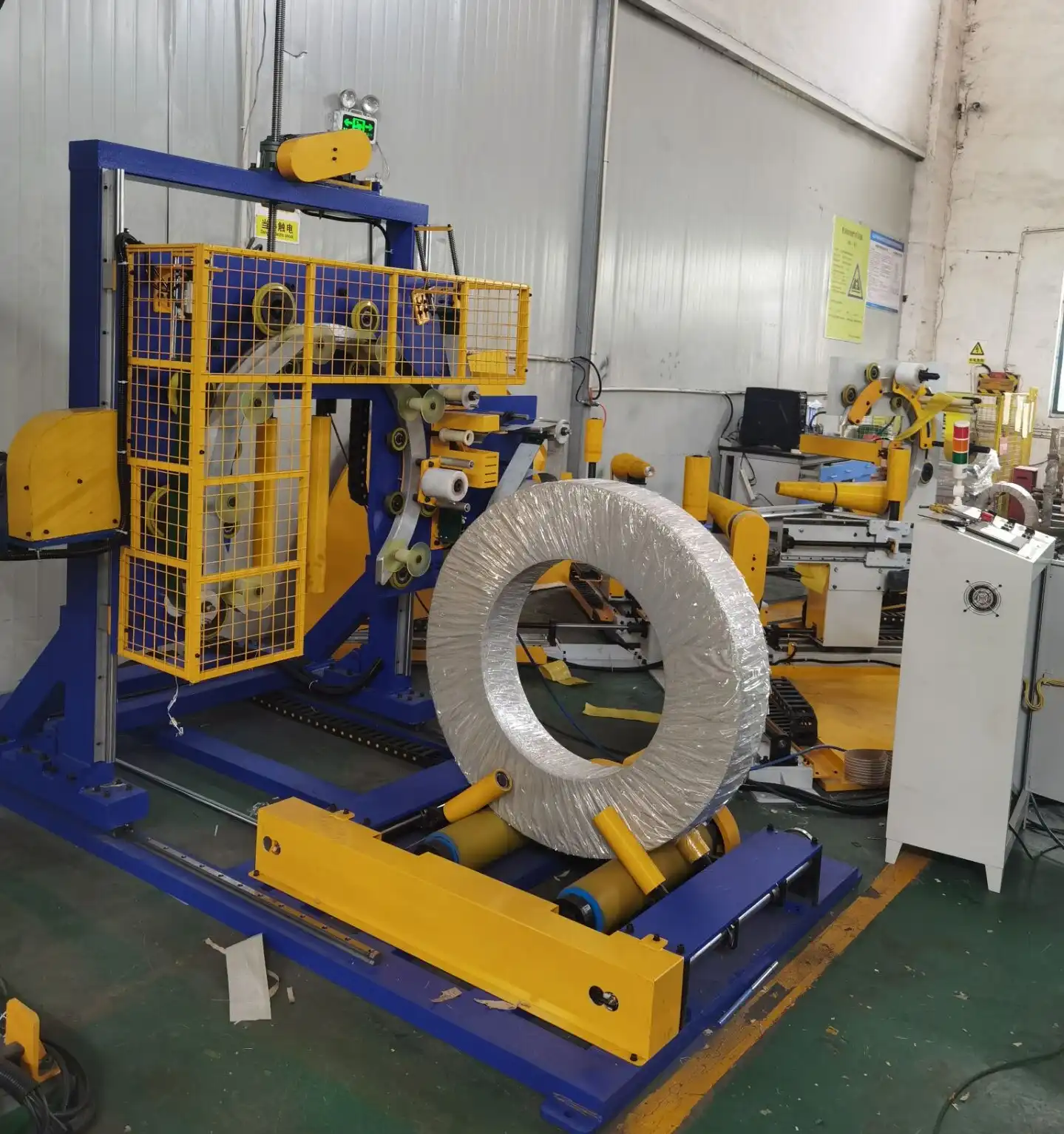
The image shows a movable steel wire coil wrapping machine. A mobile station can be useful when the orientation or product mix changes and a fixed line position would create an unnecessary handling constraint.
Compare the full line, not one station
Vertical and horizontal handling can affect:
- Loading and unloading method.
- Coil stability during transfer.
- Weighing and labeling access.
- Strapping position.
- Stacking or palletizing method.
- Crane or forklift access.
- Space and building height.
The comparison must cover those boundaries, not only the wrapping cycle.
That is why the orientation decision belongs to the automatic coil packing line scope, not to a single wrapper.

The image shows people reviewing a coil wrapping machine in a factory setting. That is how the orientation decision should be checked: at the line, with the real product mix, instead of comparing only machine preferences.
Use a decision path
If the coil arrives and leaves vertically, and the wrapping and stacking method supports vertical handling, keep vertical handling when stability and surface contact allow it.
If wrapping, strapping, weighing, or storage is more reliable with the eye horizontal, plan a controlled turning step.
If the product mix includes both orientations, define which families use which route and where the exception is handled.
A practical next step
Trace each product family from source to discharge and mark the required orientation at every station. Add an orientation change only where it removes a real constraint, and confirm that the change can be made safely without damaging the coil or losing its identity.
Watch a coil wrapping machine with stretch film and woven material in operation:








