
For 70–90 kg display freezers on wheels with heights of 36–75 mm and dimensions up to 1800 × 630 × 900 mm, the definitive offline packaging solution is a standalone 4‑side stretch wrapping machine. Two viable options exist: a modified turntable pallet wrapper with wheel locks, and a horizontal orbital ring wrapper. Both achieve stable 4‑side coverage but differ in floor space, load‑length handling, and capital cost—typically ranging from US$8,000 to US$22,000 based on supplier quotes.
🛠️ Evaluation Criteria
To select the best wrapping machine, evaluate five criteria: stability during wrap, wrap coverage, load size compatibility, floor space, and capital cost. Your freezers weigh 70–90 kg and have four wheels with a loaded height of 36–75 mm (measure under load for accuracy). The smallest unit is 1000 × 630 × 900 mm; the largest 1800 × 630 × 900 mm. You require only 4‑side wrapping (no top or bottom film) and a standalone offline operation—no conveyor integration. The wheels make the load mobile, so the machine must either lock them or rotate around them without moving the freezer.
| Criterion | Why It Matters |
|---|---|
| Stability | Freezer can shift during wrapping; wheel restraints or ring rotation prevent tipping. |
| Wrap Coverage | Film must cover all four vertical sides uniformly, from top to bottom (including wheel area). |
| Load Size Compatibility | The machine must handle widths of 630 mm and lengths up to 1800 mm without overhang. |
| Floor Space | Standalone offline means the machine sits on the floor; footprint affects warehouse layout. |
| Cost | A turntable modification is typically 30–50% less than a horizontal orbital wrapper (based on supplier quotes from Fhope and other industrial packaging vendors). |
🏗️ Option A: Modified Turntable Pallet Wrapper with Wheel Restraints
Option A is a standard ring turntable pallet wrapping machine modified with adjustable wheel locks and a low‑profile platform that accommodates wheel heights of 36–75 mm, delivering stable 4‑side wrapping for 70–90 kg freezers. The turntable rotates the load, while a vertical film carriage rises and descends to wrap the four sides. Wheel locks—custom clamps or recessed channels—hold the freezer in place during rotation.
-
Wrapping process – Place the freezer onto the turntable, engage the four wheel locks (manual or pneumatic), and start the wrap cycle. The turntable rotates at 12–18 RPM (typical for this machine type); the film carriage moves vertically at 0.2–0.5 m/s. Estimated cycle time per freezer is 40–60 seconds. Film tension is adjustable for the 70–90 kg weight range.
-
Load size limit – Common turntable diameters are 1200–1500 mm. A freezer that is 1800 mm long will overhang significantly. To accommodate the largest freezer, you need an extended‑diameter turntable (≥2000 mm) or a non‑rotating platform with a rotating arm (less common). Verify with the supplier whether an oversized turntable is available.
-
Advantages – Lower cost than orbital machines; familiar technology with many aftermarket parts; can wrap multiple sizes by adjusting wheel lock positions. Key Point: The wheel locks are manual unless you upgrade to pneumatic, adding an estimated US$800–US$1,500 (typical range based on equipment suppliers).
-
Disadvantages – Load length over 1500 mm risks overhang and instability; wheel locks add setup time; the turntable height (≈80–120 mm) may not clear the lowest wheels (36 mm) without a recessed platform. Turntable height and clearance vary by model and must be verified with the supplier.
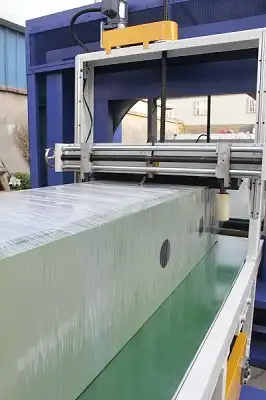
📈 Option B: Horizontal Orbital Ring Wrapper (Pass‑Through)
Option B is a horizontal orbital ring wrapper where the freezer remains stationary on a short fixed platform while a rotating ring applies film around its four sides, eliminating the need for wheel restraints and handling loads up to 1800 mm with ease. The machine uses a ring of film carriages that orbit the load at 25–40 RPM (typical for these machines). The load sits on a low‑profile steel frame (height ≤25 mm) that does not interfere with 36 mm‑high wheels.
-
Wrapping process – Operator places the freezer on the stationary platform. The ring starts rotating; a film carriage travels along the ring axis (or the ring itself moves horizontally) to cover the full length. Four‑side coverage is achieved by programming the ring to stop before the top and bottom. Estimated cycle time is 50–80 seconds per freezer, slower due to axial travel.
-
Load size compatibility – No turntable diameter limit; the ring opening is typically 1200 mm × 1200 mm to 2000 mm × 1500 mm. Your largest freezer (1800 × 630 × 900 mm) fits easily. Load length is limited only by the machine’s axial stroke (often up to 2500 mm). Key Point: The ring must have a minimum opening height of 1000 mm to clear the freezer top; verify with supplier.
-
Advantages – No overhang risk; no manual wheel locking; handles variable wheel heights (36–75 mm) automatically; consistent film tension. The stationary load reduces the chance of tipping. Floor space is roughly 2.5 × 2.5 m (footprint depends on model).
-
Disadvantages – Higher initial investment. For standalone offline use, you may need to add a short conveyor to load/unload, or use a forklift. Film consumption is slightly higher because the ring wraps extra layers at the corners—a 15–20% increase relative to turntable wrappers is typical based on manufacturer specifications, but exact differential should be confirmed in a test with your specific film and cycle settings. Throughput is slightly slower than a turntable for short loads.
🛡️ Comparison Table
| Criterion | Option A – Modified Turntable | Option B – Horizontal Orbital Ring |
|---|---|---|
| Stability | Requires manual wheel locks; risk of movement if locks fail | Load is stationary – no wheel locks needed; inherent stability |
| Wrap Coverage | 4‑side, film carriage covers full height including wheels | 4‑side, ring wraps uniform layers; film can be positioned precisely |
| Load Size Compatibility | Max length ~1500 mm on standard turntable; need extended table for 1800 mm; height ≤900 mm fine | Handles up to 1800 mm length with standard machines; height clearance ≥1000 mm recommended |
| Floor Space | Approx. 2.0 × 2.0 m (including operator access) | Approx. 2.5 × 2.5 m (larger footprint) |
| Capital Cost | US$8,000–$12,000 with wheel lock upgrade (typical range, verify with supplier) | US$15,000–$22,000 (typical range for standalone orbital) |
| Throughput | 40–60 seconds/load (faster for short loads) | 50–80 seconds/load (slower due to ring axial travel) |
| Ease of Operation | Operator must position and lock wheels each cycle | Operator positions load on platform; no locking steps |
| Film Consumption | Standard (pre‑stretch 200–250%) | Slightly higher—typically 15–20% more film due to ring overlap (estimate subject to machine calibration) |
⚙️ Selection Advice
Choose Option A (modified turntable) if your display freezers are predominantly under 1500 mm length, you have a limited budget (under US$12,000), and you are willing to train operators to use manual wheel locks. For freezers that are always ≤1,500 mm, the turntable solution is cost‑effective and fast. Key Point: Verify that the turntable height plus wheel lock recessing can accommodate the 36 mm minimum wheel height—otherwise the freezer may scrape.
Choose Option B (horizontal orbital ring) if your fleet includes the 1800 mm‑long freezers, you want to eliminate manual locking, or you are concerned about load tipping. The orbital wrapper handles all sizes without overhang and requires no wheel‑lock maintenance despite the higher upfront cost. It is also more scalable if you later add different freezer models.
Cost‑saving tip: For a mixed fleet, consider a turntable with a rotating‑arm design (load stays stationary)—it bridges the two options but at a cost closer to Option B. Request a quote from Fhope for both machine types using your specific freezer dimensions and wheel heights.
🛠️ Purchase‑Decision Checklist
-
[ ] Confirm maximum freezer length: if >1500 mm, orbital is recommended.
-
[ ] Measure wheel height at loaded condition (36 mm may be unloaded—check if wheels compress).
-
[ ] Decide on budget: Option A under US$12k, Option B under US$22k (estimated, confirm with suppliers).
-
[ ] Evaluate floor space: orbital requires ~25% more area.
-
[ ] Check film type: use 20–23 micron cast stretch film (a common machine‑grade film made by cast extrusion, offering good cling and puncture resistance), pre‑stretch 200–250% (pre‑stretching mechanically elongates the film before application to increase yield and reduce material use).
-
[ ] Request a test video from the supplier with same freezer dimensions and wheel conditions.
-
[ ] Ask about pneumatic wheel lock upgrade cost for Option A.
🛡️ Compliance Note: This equipment is designed to meet ISO and ASTM requirements. Verify with the manufacturer.
🏗️ FAQ
Q: Can these machines wrap freezers with casters (swivel wheels)?
A: Yes, but caster locks may be needed. For Option A, clamps should grip the wheel brackets. For Option B, the load is stationary so casters will not rotate during wrapping. Verify with supplier.
Q: What film width is recommended for 4‑side wrapping?
A: Use 500 mm wide film on a carriage with adjustable overlap. For the height of 900 mm, two film passes (top and bottom) are typical. Parameters: film thickness 20–25 µm, pre‑stretch 200–250%.
Q: Do I need a conveyor for standalone operation?
A: No – both options can be loaded manually with a pallet jack or directly placed by forklift. A simple low‑profile ramp may help for the orbital machine.
Q: Can I upgrade to 6‑side wrapping later?
A: Option B (orbital) can be adapted with a film covering unit for top/bottom wrap. Option A would require adding a top‑press device. Both are possible but increase cost.
Q: What power supply is available in Bolivia?
A: Typical industrial supply is 380 V / 50 Hz, 3‑phase. Confirm with your facility. Both machines can be configured accordingly.
Disclaimer: All specifications—including dimensions, cycle times, film consumption estimates, and costs—should be confirmed directly with the machine supplier. Turntable height, ring opening sizes, and wheel lock designs vary by manufacturer and model. Always test with your actual freezer dimensions and wheel conditions before purchase.








