
Steel Coil Packing Line in Spain: What Role Does Efficiency Play in Selection?
Imagine the bustling activity of a large steel mill in Spain. Hundreds of tons of steel coils move daily. Each coil represents immense value. It holds the promise of future bridges, cars, and buildings. But here is the problem: if these coils do not get packed correctly and efficiently, that value can quickly diminish. Delays, damaged products, or even safety incidents are real risks. This is a constant pressure point for production directors. I have seen it many times throughout my journey in this industry.
Efficiency is not just a buzzword; it is the backbone of profitability, safety, and reputation for any steel coil packing line in Spain. Choosing a packing line without prioritizing efficiency is like trying to drive a car with a flat tire. It will slow down your entire operation. It will lead to higher costs, unhappy customers, and potential safety hazards. From my experience, a focus on efficiency ensures smooth operations and strong business growth.

Understanding this vital role of efficiency is key. It helps you make the right decisions for your business. Let’s explore why this is true and how you can achieve it.
Why is operational efficiency critical for steel coil packing lines in Spain?
Think about the daily demands on a Spanish steel mill. Production schedules are tight. Customer expectations are high. Every minute counts. What happens if your packing line cannot keep up?
Operational efficiency is critical because it directly impacts output, cost control, and market competitiveness for steel coil packing lines in Spain. Without it, bottlenecks form, labor costs increase, and customer satisfaction drops. In a 24/7 production environment, any inefficiency quickly leads to significant losses.
My time building FHOPEPACK has taught me this: a slow or unreliable packing process creates a domino effect. It affects everything downstream.
-
Production Bottlenecks and Throughput:
- Inefficient packing means coils pile up. The production line has to slow down or even stop.
- This reduces the total amount of product you can ship.
- Lost output directly translates to lost revenue. You are making less money from your fixed assets.
- For example, if a line designed for 60 coils per hour only packs 40, you lose 20 coils of potential sales every hour. This adds up very fast.
- I once worked with a client who faced this exact issue. They had invested heavily in their upstream processes. But their manual packing was the weak link. We redesigned their line. This brought their packing speed in line with their production. This single change boosted their overall factory output by 30%. It was a game-changer for them.
-
Increased Operating Costs:
- Manual packing requires more workers. In Spain, labor costs are significant.
- If workers take longer to pack a coil, you pay more for the same output.
- There is also the cost of mistakes. Poorly packed coils may need re-packing. This wastes materials and labor.
- Energy consumption can also be higher if machines run for longer periods to meet targets due to slow processes.
- Consider the constant need for a 24-hour, two-shift operation. Any extra minute spent on each coil means many extra hours across the week. This directly impacts your labor budget.
-
Customer Satisfaction and Reputation:
- Customers expect their orders on time. Delays from inefficient packing lead to unhappy customers.
- They also expect perfectly protected products. If packing quality suffers because of rushed or inconsistent manual work, coils can get damaged during transport.
- Damaged goods lead to complaints, returns, and even contract penalties.
- Building a good reputation takes years. Losing it can happen in a single bad shipment.
- In the export market, like for Spanish steel mills shipping worldwide, strict standards apply. CE/ISO certifications are vital. Efficient packing helps meet these rules consistently.
- I always tell my clients that their packing process is the last touchpoint before the product reaches the customer. It is a direct reflection of their quality standards.
-
Workplace Safety and Ergonomics:
- Manual handling of heavy steel coils is dangerous. Workers are at risk of injury.
- Repetitive tasks, like manual strapping or wrapping, cause fatigue and can lead to long-term health issues.
- Efficient, automated systems reduce human interaction with heavy machinery. They lower the risk of accidents significantly.
- This improves worker morale and reduces costs related to injuries and lost workdays.
- For example, a fully automated turning station removes the need for workers to physically handle hot or heavy coils. This is not just about speed; it is about protecting your team.
Efficiency, then, is not merely about speed. It is about a smart, safe, and cost-effective way of working. It is about making sure that every step in the packing process adds value, not problems.
How does automation improve efficiency and quality in coil packaging?
Many steel mills still rely on manual or semi-manual processes. But the challenges of labor shortages, inconsistent quality, and high customer demands are pushing them to rethink. Can machines really do it better?
Automation fundamentally improves efficiency by increasing speed and consistency, while enhancing quality through precise, repeatable operations in coil packaging. Automated systems reduce human error, optimize material usage, and ensure compliance with strict packaging standards, leading to faster throughput and superior protection.
From my early days working on packing lines, I saw how much depended on human effort. This had limits. Automation changes these limits.
-
Consistent Speed and Throughput:
- Machines do not get tired. They work at a constant, high speed, 24/7 if needed.
- This ensures a steady flow of packed coils. It prevents bottlenecks.
- It also allows for predictable production planning. You know exactly how many coils will be ready.
- Consider a full automatic coil packing line. It handles the entire process: turning, wrapping, strapping, labeling, and stacking. This reduces idle time between steps. It speeds up the whole operation.
- I remember one factory struggling to meet demand for diverse coil types. Manual switching was a nightmare. We introduced an automated system. It could adapt quickly to different coil sizes and packaging types with just a few clicks. This cut changeover times drastically and boosted their overall output.
-
Superior Packing Quality:
- Automated systems apply consistent tension to wrapping films. They ensure tight, secure strapping.
- This means uniform anti-rust, anti-scratch, and moisture-proof protection.
- Manual packing often results in uneven tension. This can lead to loose wraps or straps.
- With automation, every coil gets the same high-quality finish. This protects the product during transport. It makes sure the customer receives a perfect product.
- For export clients who need CE/ISO certified packing or barcode labels, automation makes it simple to meet these precise requirements every time. It ensures that labels are applied correctly and securely.
-
Reduced Labor Requirements and Enhanced Safety:
- Automated lines do tasks that workers used to do. This reduces the number of people needed on the packing floor.
- Workers can move to higher-skilled roles, like monitoring machines or maintenance.
- More importantly, automation removes workers from dangerous tasks. These tasks include lifting heavy coils or working near moving machinery.
- This lowers the risk of workplace injuries significantly. It creates a safer environment for everyone.
- My own journey started as an employee. I saw first-hand the physical toll of manual packing. It drove me to find better, safer ways to do things. Automated solutions are the answer. They reduce the labor intensity and improve worker retention.
-
Optimized Material Usage:
- Automated systems can precisely control the amount of packing material used.
- They reduce waste from over-wrapping or incorrect strapping.
- This saves money on consumables like PET/steel straps and stretch film.
- For example, a machine applies the exact number of wraps needed for optimal protection. A human might add extra layers “just in case.” This small difference adds up over thousands of coils.
- This also leads to more sustainable operations, which is an increasingly important factor for many businesses in Spain and across Europe.
-
Data Collection and Traceability:
- Modern automated lines can collect data on each packed coil.
- This includes packing time, material usage, and even specific parameters.
- This data helps in quality control and process optimization.
- It also provides traceability. You can track exactly how and when each coil was packed. This is invaluable for addressing customer queries or quality audits.
In short, automation takes the guesswork and variability out of packing. It replaces them with precision, speed, and safety. This is how steel mills can meet the toughest demands.
What are the direct financial impacts of an inefficient packing process?
For any business, the bottom line is key. Production directors like Ivan Petrov always look at numbers. An inefficient packing process might seem like a small detail. But its financial impacts can be massive.
An inefficient packing process directly leads to significant financial losses through increased operational costs, lost revenue from reduced output, material waste, and penalties from customer complaints or damaged goods. These factors erode profit margins and undermine long-term business sustainability.
I have seen companies struggle for years because they ignored these hidden costs. Let me break down how these financial impacts manifest.
-
Higher Labor Costs:
- More manual work means more wages. If your packing line is slow, you need more people to keep up with production.
- Overtime hours become common. This costs even more.
- Staff turnover also adds costs. You spend money on recruiting and training new workers. High-intensity manual jobs often have high turnover rates.
- Consider a steel mill operating 24/7. Even a small increase in staffing for the packing area, across two shifts, adds up to hundreds of thousands of Euros annually. This is a direct hit to your profits.
- When I helped a client automate their coil handling, they could reallocate several workers. This reduced their packing team by 30%. The savings quickly paid for the new machine.
-
Increased Material Waste and Repacking Costs:
- Manual wrapping can be inconsistent. Workers might use too much film or strap, leading to waste.
- Poorly applied materials may fail during transport. This means the coil needs re-packing.
- Repacking costs not only material but also labor and time. It is a double penalty.
- Damaged packing during shipment also means higher insurance claims. It leads to loss of product value.
- I often see how automated systems, with their precise control, can reduce film usage by 10-15% simply by optimizing stretch and overlap. This might seem small per coil, but multiply it by thousands of coils annually, and the savings are substantial.

Automated steel slit coil packaging line Boost Your Productivity
-
Revenue Loss from Delayed Shipments and Lost Orders:
- If coils are not packed fast enough, shipments get delayed.
- This can lead to penalties specified in contracts, especially for large orders.
- More importantly, unhappy customers may take their business elsewhere. They might choose a competitor with more reliable delivery.
- Losing a key customer due to consistent delays can have a devastating impact on annual revenue.
- In a competitive market like Spain, speed to market is often a key differentiator. Being slow means losing out.
-
Costs Associated with Product Damage and Returns:
- Inadequate packing quality leads to coils getting scratched, dented, or exposed to moisture.
- These damaged products might be rejected by the customer. They might require discounts.
- Returns involve transport costs, inspection costs, and potential re-processing costs.
- For high-value products like galvanized or color-coated coils, even minor damage can lead to significant financial write-offs.
- My clients often tell me that preventing just one or two major damage claims each year can easily justify the investment in a better packing line. It is about protecting the value you create.
-
Higher Maintenance and Downtime:
- Older, less efficient machines might break down more often.
- Downtime means lost production. It also means costs for repairs and spare parts.
- Manual processes, paradoxically, can also lead to more downtime if worker fatigue causes errors or slower speeds.
- Investing in reliable, efficient equipment with good maintenance support reduces these unexpected costs.
The true cost of inefficiency is often hidden. It accumulates slowly. But it can cripple a business. Understanding these financial impacts helps managers justify investment in advanced packing solutions.
How can steel mills ensure long-term efficiency with the right partner?
Investing in a new steel coil packing line is a big decision. It requires a significant capital outlay. This is not just about buying a machine. It is about building a system that will perform reliably for years. So, how do you pick a partner that ensures long-term efficiency?
Steel mills ensure long-term efficiency by selecting a partner who offers comprehensive, customized solutions, proven reliability, and robust after-sales support. This includes providing turnkey engineering, thorough training, and readily available spare parts, fostering a relationship built on trust and continuous improvement.
When I founded FHOPEPACK, my vision was to be that kind of partner. I learned from my own experiences what makes a supplier truly valuable.
-
Customized Solutions and Turnkey Engineering:
- Every steel mill has unique needs. This includes different coil sizes, weights, product types, and space constraints.
- A good partner does not offer a one-size-fits-all solution. They work with you to design a packing line that fits your specific operation.
- They should offer turnkey engineering. This means they handle everything. This includes design, manufacturing, installation, and commissioning. It makes the process smooth and hassle-free for the mill.
- For example, a Spanish mill producing diverse coils (cold rolled, galvanized, color-coated) needs a system that can adapt easily. A partner who understands this can design a line with flexible tooling and quick changeover capabilities.
- I always insist that our FHOPEPACK team thoroughly understands the client’s existing production flow. We look at everything. This way, we ensure our solution integrates seamlessly and truly boosts their overall efficiency.
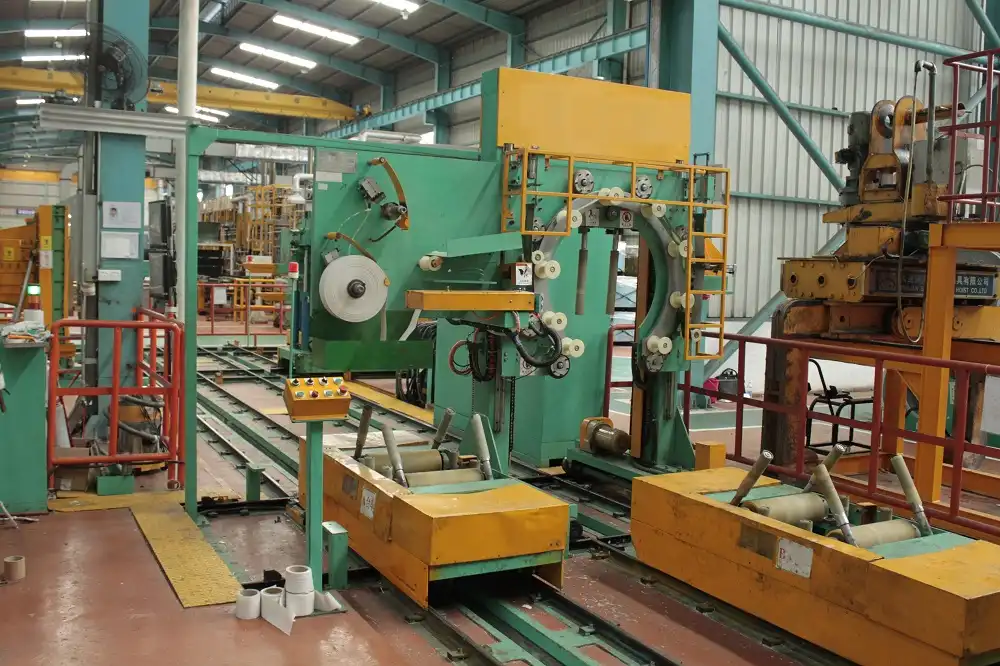
Vertical-coil-packaging-line
-
Proven Reliability and Continuous Operation:
- Steel mills run 24/7. The packing line must be just as robust.
- Look for a partner with a track record of building durable, high-quality machines.
- Ask for references from other steel mills. Check their equipment’s lifespan and uptime.
- Reliability means fewer breakdowns and less costly downtime. It means consistent efficiency.
- My experience working in a packing machine factory before starting FHOPEPACK taught me the importance of robust engineering and using high-quality components. It pays off in the long run.
-
Comprehensive After-Sales Support:
- A packing line is a long-term asset. It needs ongoing support.
- A strong partner provides fast and effective technical support. This includes remote diagnostics and on-site assistance.
- They should offer preventive maintenance programs. This helps avoid problems before they happen.
- They must also have a reliable supply of spare parts. Delays in getting a part can shut down your line.
- For a busy production director, knowing that help is just a phone call away is invaluable. This is something we prioritize at FHOPEPACK. We want our clients to feel supported long after the sale.
-
Training and Skill Transfer:
- New automated systems need skilled operators and maintenance staff.
- A good partner provides thorough training. This ensures your team can operate and maintain the equipment effectively.
- This empowers your team. It reduces reliance on external support for routine tasks.
- It helps transfer knowledge. This allows your team to troubleshoot minor issues. It also helps them optimize performance.
- I believe in empowering our clients. Training is not just a checkbox; it is a critical investment in your team’s capabilities.
-
Partnership Approach and Shared Goals:
- The best relationships are true partnerships. Both sides work together towards shared goals.
- A good partner is invested in your success. They listen to your feedback. They help you adapt to future challenges.
- They offer insights and share their expertise, helping you continuously improve.
- This is the core of what FHOPEPACK stands for. My goal has always been to share knowledge and help businesses grow, just as I grew my own. We are not just selling machines; we are offering solutions and a commitment to long-term success.

Automatic steel coil packing line Made in China
Choosing the right partner means looking beyond the initial price tag. It means evaluating their ability to deliver sustained efficiency, reliability, and support. This investment protects your operations and ensures your growth.
Conclusion
Efficiency is the cornerstone for any steel coil packing line in Spain. It drives profitability, ensures safety, and maintains product quality. Automated solutions provide the consistency and speed needed for today’s demanding market. Choosing a partner like FHOPEPACK, who offers tailored solutions, reliable equipment, and strong after-sales support, is key to achieving long-term success and getting the best coil packing line.








