
Single-Station vs Fully Automatic Steel Wire Packing Line — ROI Comparison?
You face constant pressure. Production bottlenecks slow you down. Safety concerns keep you up at night. And product damage eats into your profits. You know your packing process needs an upgrade. But which packing line is right for your metal processing factory?
Choosing the right packing solution for your steel wire operations means carefully looking at both single-station and fully automatic systems. A single-station line offers a cost-effective entry into automation, suitable for lower volumes or specific tasks. However, a fully automatic system provides complete end-to-end efficiency, vastly improving throughput, safety, and product protection, especially for high-volume factories seeking significant long-term return on investment (ROI).
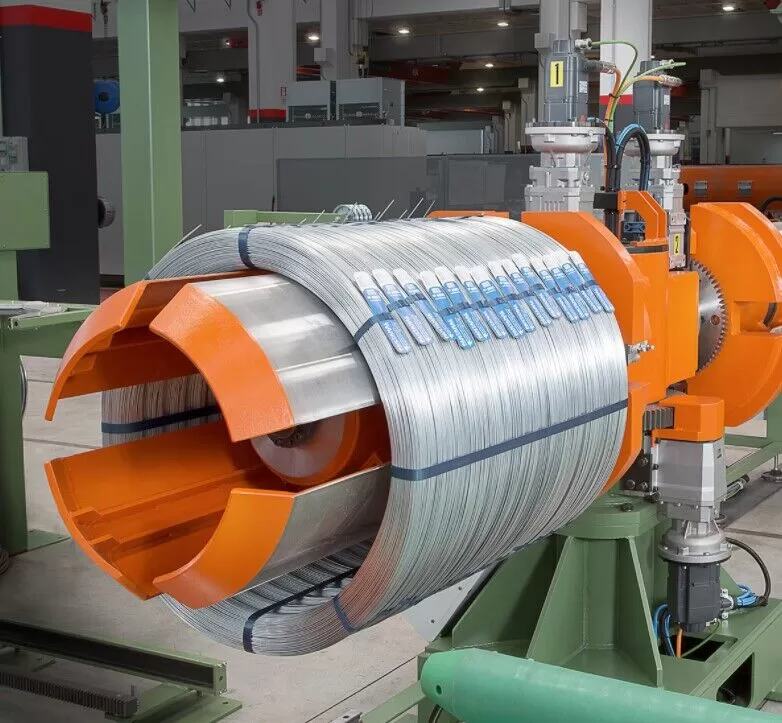
Many factory managers like you, perhaps even in Mexico where efficiency is key, feel this dilemma. They want to invest wisely. They need a partner who understands their operational hurdles. As Randal Liu, founder of FHOPEPACK, I have built factories and helped many clients grow their businesses. I understand the challenges you face every day. Let’s break down the differences and help you find the best path forward.
1. What are the core differences between a Single-Station and a Fully Automatic Steel Wire Packing Line?
Your current manual steel wire packing is slow. It takes too much time and manpower. This creates a bottleneck. You want to speed things up. But you also need to understand the basic choices.
The main difference between a single-station and a fully automatic steel wire packing line lies in their level of automation and human intervention. A single-station line automates one specific packing step, still requiring manual loading, unloading, or transfer. In contrast, a fully automatic line integrates multiple machines and processes, handling the entire packing sequence from start to finish with minimal human input, offering continuous operation and higher output.
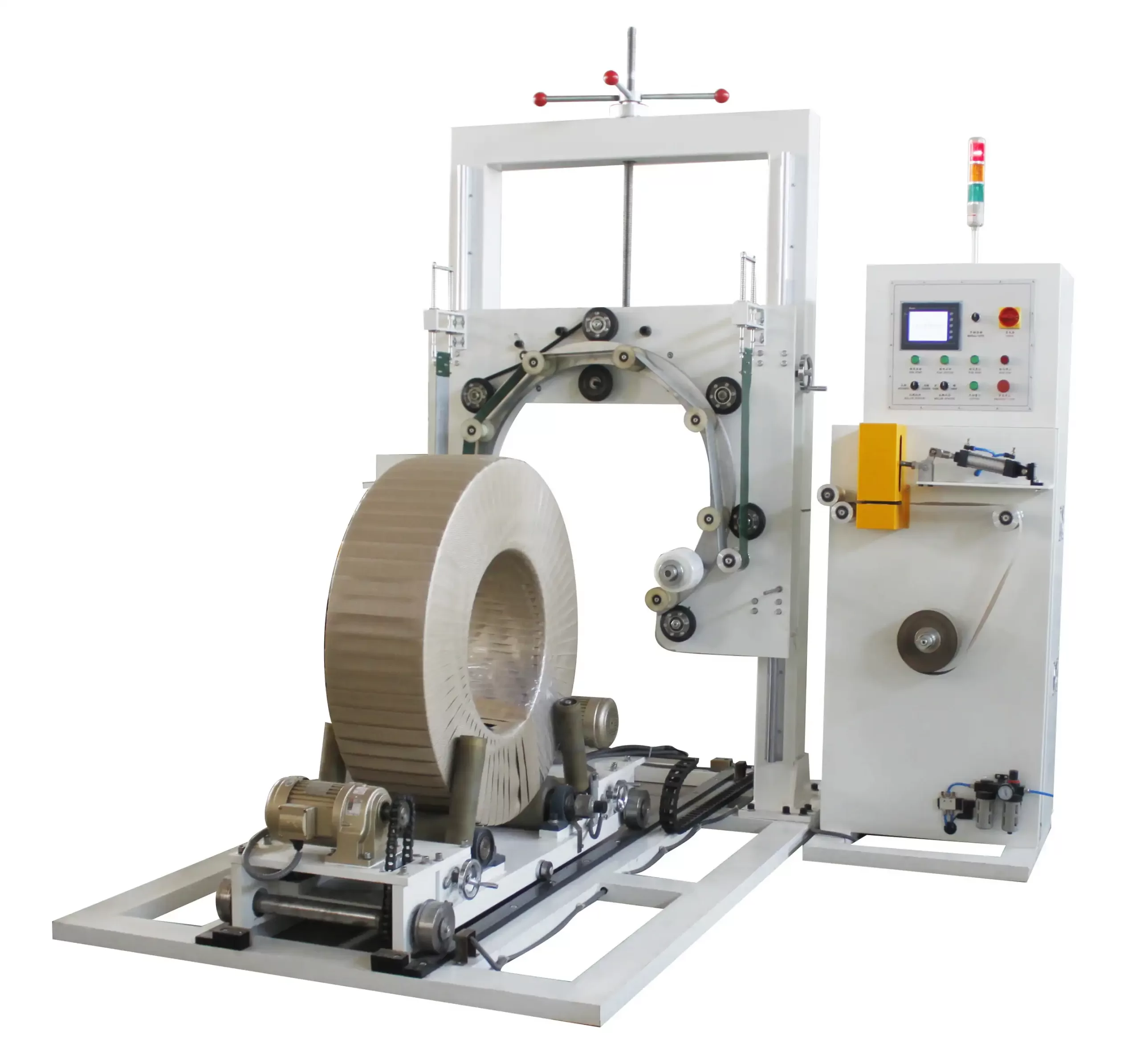
Let’s dive deeper into these core differences. It is like comparing a specialized tool to a complete assembly line. Each has its place. Understanding them helps you make a smart choice for your factory, especially when you are a factory manager in the heavy manufacturing sector. You need solutions that truly fit your needs. (packing machine types, automation levels)
Key Distinctions in Steel Wire Packing Systems
When you look at packing solutions, you consider several factors. These systems handle different parts of the packing process. They also use different amounts of labor. This affects your daily operations.
-
Single-Station Packing Line:
- Focus: This system usually handles one specific packing task. It might be strapping, wrapping, or banding.
- Operation: An operator loads the steel coil onto the machine. The machine performs its automated task. Then, the operator unloads the coil. This means human workers are still very involved in the overall process.
- Cost: The initial investment is lower. You buy fewer machines. This makes it attractive for smaller operations or when you have budget limits.
- Flexibility: It offers good flexibility for different product sizes or types. You can change settings easily. But it cannot handle many products at once.
- Output: The production speed is moderate. It depends on how fast your operators work. It can only do one coil at a time.
- Example: A semi-automatic strapping machine for steel coils. An operator places the coil, the machine straps, then the operator moves the coil away. This reduces some manual effort but not all of it.
- Best for: Factories with lower production volumes. Companies that want to automate just one specific bottleneck. Businesses with tighter budgets for initial investment. (semi-automatic packing, basic automation)
-
Fully Automatic Steel Wire Packing Line:
- Focus: This system manages the entire packing sequence. It covers all steps. This often includes conveying, aligning, wrapping, strapping, labeling, and stacking.
- Operation: Steel coils enter the line. They move automatically through each station. Sensors and programmed logic control everything. There is very little need for human hands. Operators only monitor the system or handle exceptions.
- Cost: The initial investment is higher. You buy more complex machines and integration. But it offers big long-term savings.
- Efficiency: It runs continuously. It achieves very high throughput. This is perfect for mass production. It greatly reduces packing time.
- Safety: It removes workers from dangerous tasks. No more manual lifting of heavy steel coils. This significantly lowers accident risks and insurance costs.
- Consistency: Every package is identical. Machines perform tasks with precision. This reduces product damage and improves package quality.
- Example: A system that takes steel coils directly from the production line. It automatically wraps them, straps them, stacks them onto pallets, and prepares them for shipping. All without an operator touching the coils.
- Best for: Large-scale manufacturers. Companies needing high volume and speed. Businesses focused on maximum safety and consistent product quality. (full automation, high-speed packing)
In my experience, many clients start small. They add one machine at a time. But as their business grows, they hit new limits. Then, they need to think about a fully automatic line. The decision depends on your current scale and future goals. (packing line comparison, manual vs automated packing)
2. How do Single-Station Packing Lines address efficiency and safety challenges?
You want to improve your factory’s output. You also need to keep your workers safe. Manual processes for steel coils are risky. You’ve seen the injuries. You pay the insurance. A single-station machine seems like a good first step. But how much can it really help?
Single-station packing lines offer a partial solution to efficiency and safety challenges by automating specific, labor-intensive tasks within the packing process. For example, a semi-automatic strapping machine can quickly apply secure straps to steel coils, reducing the time an operator spends manually securing bundles and mitigating some risks associated with heavy lifting and repetitive strain injuries. However, these systems still rely on significant manual intervention for other steps, meaning their impact on overall line efficiency and comprehensive safety is limited compared to fully automatic solutions.

Let me explain this with an example. When I started my packing machine factory, we began with simpler machines. They were good for specific tasks. They immediately showed improvements in those areas. But they did not solve every problem. You need to know where these systems shine and where they fall short. This helps you manage expectations. (steel coil strapping benefits, semi-auto packing safety)
Benefits and Limitations of Single-Station Solutions
You are a factory manager. You always look for practical improvements. Single-station machines offer tangible benefits. They target specific pain points. But they also have clear limitations.
-
Benefits for Efficiency:
- Targeted Improvement: These machines can solve a specific bottleneck. For example, a single-station wrapping machine wraps coils much faster than a person can. This speeds up that one step.
- Reduced Labor for Specific Tasks: An operator does not need to manually wrap or strap each coil. The machine does the heavy lifting or the repetitive motion. This frees up some labor for other tasks.
- Faster Cycle Times (Per Task): The machine performs its specific function quickly and consistently. This makes the individual packing step much faster than by hand.
- Lower Initial Cost: You invest less money upfront. This makes it an easier decision for budget-conscious factories. It is a good way to test automation without a huge commitment. (cost-effective automation, packing efficiency)
-
Benefits for Safety:
- Reduced Heavy Lifting: Workers no longer need to manually lift or position heavy steel coils for wrapping or strapping. The machine often has mechanisms for this. This reduces the risk of back injuries or strains.
- Fewer Repetitive Motions: The machine performs the repetitive tasks. This lessens the chances of carpal tunnel syndrome or other overuse injuries for your employees.
- Safer Work Environment: Moving workers away from the immediate handling of heavy, unstable coils makes the area safer. There are fewer pinch points or crushing hazards for human hands. (worker safety packing, heavy coil handling)
-
Limitations to Consider:
- Limited Overall Efficiency Gain: While one step gets faster, other steps might still be manual. The overall production line speed can still be slow. This means the bottleneck just moves to the next manual step.
- Ongoing Manual Labor: You still need operators to load, unload, or transfer coils between stations. This means labor costs remain significant. You still face human error risks.
- Partial Safety Improvement: The direct interaction with the machine might be safer. But workers still move heavy coils around the factory floor. This still poses risks from forklifts or manual pushing.
- Not Ideal for High Volume: If you have many steel coils to pack every hour, a single-station machine cannot keep up. It will become a new bottleneck very quickly. It requires constant human feeding.
- Product Damage Risk Remains: If internal transport is still manual, there is still a risk of damaging steel coil edges. This leads to customer complaints and lost profits. (packing line bottlenecks, manual transfer risks)
So, a single-station system is a good starting point. It solves some immediate problems. But it won’t revolutionize your entire operation. It’s a step, not the full journey. For comprehensive improvements, you need to think bigger. (packing machine investment, production line improvements)
3. Why is a Fully Automatic Steel Wire Packing Line a game-changer for high-volume operations?
Your factory needs to increase output. You handle large quantities of steel wire. The current system cannot keep up. You also worry about product quality and worker safety. You wonder if a fully automatic line is worth the higher cost. What makes it so different?
A fully automatic steel wire packing line is a game-changer for high-volume operations because it eliminates virtually all manual intervention, enabling continuous, high-speed, and precise packing of steel coils. This drastically improves throughput, reduces labor costs, and minimizes product damage and safety risks associated with manual handling. For factories like yours, especially in Mexico, a fully automated system ensures consistent quality and allows for rapid scaling of production, driving significant long-term profitability and competitive advantage.
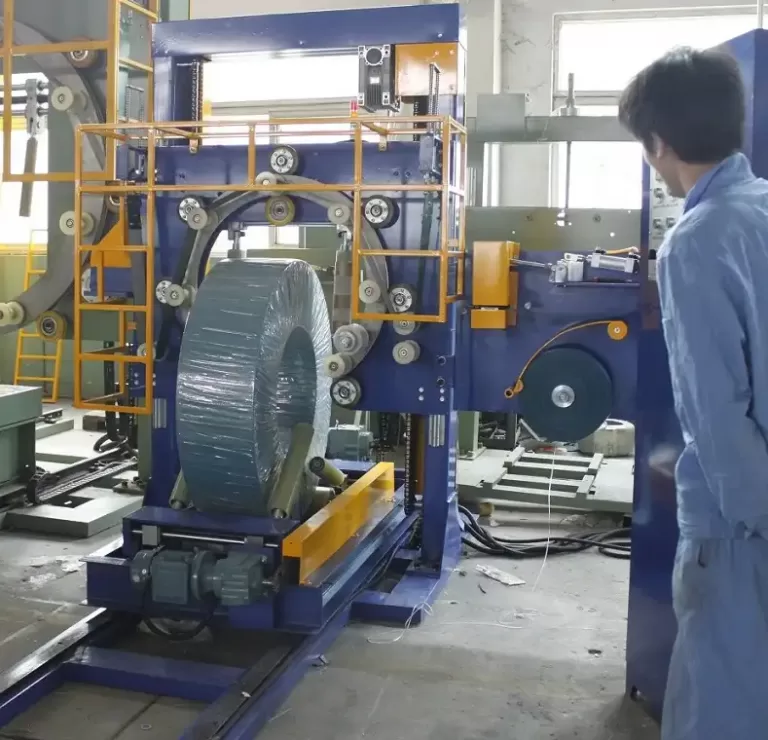
When I helped clients set up fully automated lines, I saw a dramatic change. One client, a steel wire manufacturer, faced constant delays. Their manual packing could not match their production speed. They also had many complaints about damaged coil edges. After implementing an automatic line, their output doubled. Their damage rate dropped to almost zero. It was a clear success story. This is why it is called a “game-changer.” (automatic packing benefits, high volume solutions)
The Transformative Impact of Full Automation
Let’s look at how a fully automatic system changes everything. It is not just about doing things faster. It is about doing them better, safer, and more profitably. This is especially true for factory managers in heavy industry.
-
Unmatched Efficiency and Throughput:
- Continuous Flow: Coils move seamlessly from one process to the next. There are no stops for manual loading or unloading. This means the line runs constantly.
- Higher Speed: Machines work much faster than humans. They do not get tired. They maintain peak performance. This leads to significantly higher packing rates per hour.
- Reduced Bottlenecks: The entire packing process is synchronized. This eliminates slowdowns at specific points. The whole line operates at its maximum potential.
- Example: Imagine packing 60 steel coils per hour automatically. A manual process might only manage 10-15 coils per hour with multiple workers. This huge difference impacts your delivery times and overall output. (high efficiency packing, automated throughput)
-
Enhanced Safety for Workers:
- Minimal Human Interaction with Heavy Loads: Workers are no longer involved in lifting, moving, or turning heavy steel coils. This removes them from high-risk situations.
- Elimination of Repetitive Tasks: Machines perform all the repetitive actions. This prevents strain injuries for your employees.
- Compliance and Reduced Claims: A safer environment means fewer workplace accidents. This leads to lower insurance premiums and better employee morale. You meet safety regulations easily.
- Improved Work Environment: Workers can focus on monitoring and maintenance. They do not do dangerous physical labor. This creates a better, more modern workplace. (workplace safety automation, packing machine operator)
-
Superior Product Quality and Protection:
- Consistent Wrapping and Strapping: Machines apply packaging materials with precise tension and placement. Every coil is packed exactly the same way. This improves package integrity.
- Reduced Damage during Handling: Automatic conveyors and transfer systems move coils gently. There are no sudden drops or rough handling. This prevents scratches, dents, or edge damage to your valuable products.
- Better Presentation: Uniformly packed coils look professional. This reflects well on your brand. It also reduces customer complaints related to packaging quality.
- Secure for Transport: Automated packing ensures coils are perfectly secured for shipping. They are less likely to shift or get damaged during transit. (product damage prevention, consistent packaging)
-
Significant Cost Savings and ROI:
- Lower Labor Costs: You need fewer workers for the packing process. This means lower payroll expenses over time.
- Reduced Material Waste: Precise machine operation minimizes mistakes and waste of wrapping film or straps.
- Decreased Product Rejects: Fewer damaged products mean less scrap and fewer returns. This directly impacts your bottom line.
- Long-Term Profitability: The initial investment pays off through increased production, reduced costs, and higher customer satisfaction. This leads to better profitability. (ROI automated packing, cost reduction manufacturing)
A fully automatic line is a strategic investment. It transforms your operations. It moves you from reacting to problems to proactively driving growth and efficiency. This is what you need as a factory manager facing high production demands. (factory automation strategies, business growth solutions)
4. What is the true Return on Investment (ROI) when choosing between these two systems?
You are a pragmatic factory manager. You need to see clear numbers. Every investment must make sense financially. You need to justify the cost. So, how do you calculate the true ROI for a single-station versus a fully automatic steel wire packing line?
The true Return on Investment (ROI) for steel wire packing lines depends heavily on your production volume, labor costs, and the value of preventing product damage. A single-station system offers a quicker, smaller ROI by addressing specific bottlenecks with lower initial costs. However, a fully automatic line, despite its higher upfront investment, delivers a much larger and faster long-term ROI through massive labor savings, significantly increased throughput, near-zero product damage, and enhanced safety. This makes it a superior choice for high-volume operations aiming for comprehensive operational transformation.
Calculating ROI is not just about initial price. It is about the long-term gains. It is about how much money you save and how much more you earn. This affects your factory’s overall profitability. Let’s look at the numbers and factors you need to consider. (packing machine ROI, investment justification)
Calculating Your Packing Line Investment: A Financial Perspective
As a factory manager, you are constantly balancing costs and benefits. Here is how to break down the ROI for each packing line option.
-
Factors Affecting ROI:
- Production Volume: How many steel coils do you pack per day, week, or month? Higher volumes strongly favor automation.
- Labor Costs: What is the hourly wage for your packing personnel, including benefits and overhead? This is a major factor in manual vs. automatic.
- Product Damage Rate: What percentage of your steel coils get damaged during current packing or internal transport? What is the cost of these damaged goods?
- Insurance Costs: How much do workplace injuries cost you in insurance claims and increased premiums?
- Space Requirements: How much floor space does each system need? What is the value of that space?
- Maintenance Costs: What are the expected upkeep costs for each system?
- Installation Time: How quickly can the system be up and running? (packing line cost analysis, labor cost savings)
-
ROI for Single-Station Packing Lines:
- Initial Investment: Lower (e.g., $10,000 – $50,000 for a semi-automatic strapping or wrapping machine).
- Labor Savings: Partial. You might reduce one or two operators per shift, or shift their roles. But you still need human oversight for other steps.
- Efficiency Gains: Moderate. The automated step is faster, but other manual steps can still be slow.
- Safety Improvement: Targeted. Reduces specific manual handling risks.
- Product Damage Reduction: Limited. Damage can still occur during manual loading/unloading or transfer.
- Payback Period: Often shorter (e.g., 6-18 months) due to lower initial cost and immediate, though smaller, operational savings.
- Best For: Factories with limited capital, smaller production runs, or those wanting to test automation step by step. This helps you target specific bottlenecks without a huge financial leap.
- Example Scenario:
- Manual packing requires 3 workers, each making $15/hour. Total: $45/hour.
- A single-station machine reduces this to 2 workers, plus the machine’s running cost ($5/hour). Total: $35/hour.
- Savings: $10/hour. If operating 8 hours/day, 20 days/month: $1,600/month.
- Machine cost: $20,000. Payback: $20,000 / $1,600 = 12.5 months.
- ROI: (Monthly Savings * 12) / Initial Cost. (semi-automatic ROI, packing equipment cost)
-
ROI for Fully Automatic Steel Wire Packing Lines:
- Initial Investment: Higher (e.g., $100,000 – $500,000 or more, depending on complexity).
- Labor Savings: Substantial. You can often reduce the packing team by 50% to 80% or more. This leads to massive long-term labor cost reductions.
- Efficiency Gains: Very high. Continuous operation means maximum throughput and minimal downtime.
- Safety Improvement: Comprehensive. Removes almost all human interaction with heavy or dangerous parts.
- Product Damage Reduction: Significant. Precise machine handling minimizes almost all damage.
- Payback Period: Often longer initially (e.g., 18-36 months) due to higher upfront cost. But the rate of return accelerates significantly after that. The total ROI over the machine’s lifespan is much higher.
- Best For: High-volume manufacturers, factories committed to growth, those prioritizing safety, quality, and long-term cost savings. This is a strategic investment in the future of your factory.
- Example Scenario:
- Manual packing requires 5 workers, each making $15/hour. Total: $75/hour.
- Automatic line reduces this to 1 worker (monitoring), plus machine running cost ($15/hour). Total: $30/hour.
- Savings: $45/hour. If operating 8 hours/day, 20 days/month: $7,200/month.
- Machine cost: $200,000. Payback: $200,000 / $7,200 = 27.8 months.
- Additional benefits not in simple calculation: Increased production capacity means you can take on more orders, leading to higher revenue. Reduced product damage means fewer losses and happier customers. Lower injury rates mean fewer indirect costs. These add up quickly. (fully automatic ROI, packing line financial analysis)








