
Inline vs Standalone Automatic Coil Packing Machines: Which is Right for Your Factory?
As a factory manager, you’ve likely faced the constant pressure of boosting output while keeping costs in check. Perhaps you’re dealing with slow, manual packaging processes that create bottlenecks, or maybe you’re concerned about the safety risks involved in handling heavy steel coils and wire bundles. These challenges are not unique, and they often lead to product damage, customer complaints, and a constant search for better solutions. (production efficiency challenges, manual labor bottlenecks)
Choosing the right automatic coil packing machine, whether an inline system or a standalone unit, depends heavily on your specific factory layout, production volume, and long-term automation goals. Both types aim to enhance efficiency and safety in your end-of-line operations, but they achieve these benefits through different integration methods and operational flexibilities.
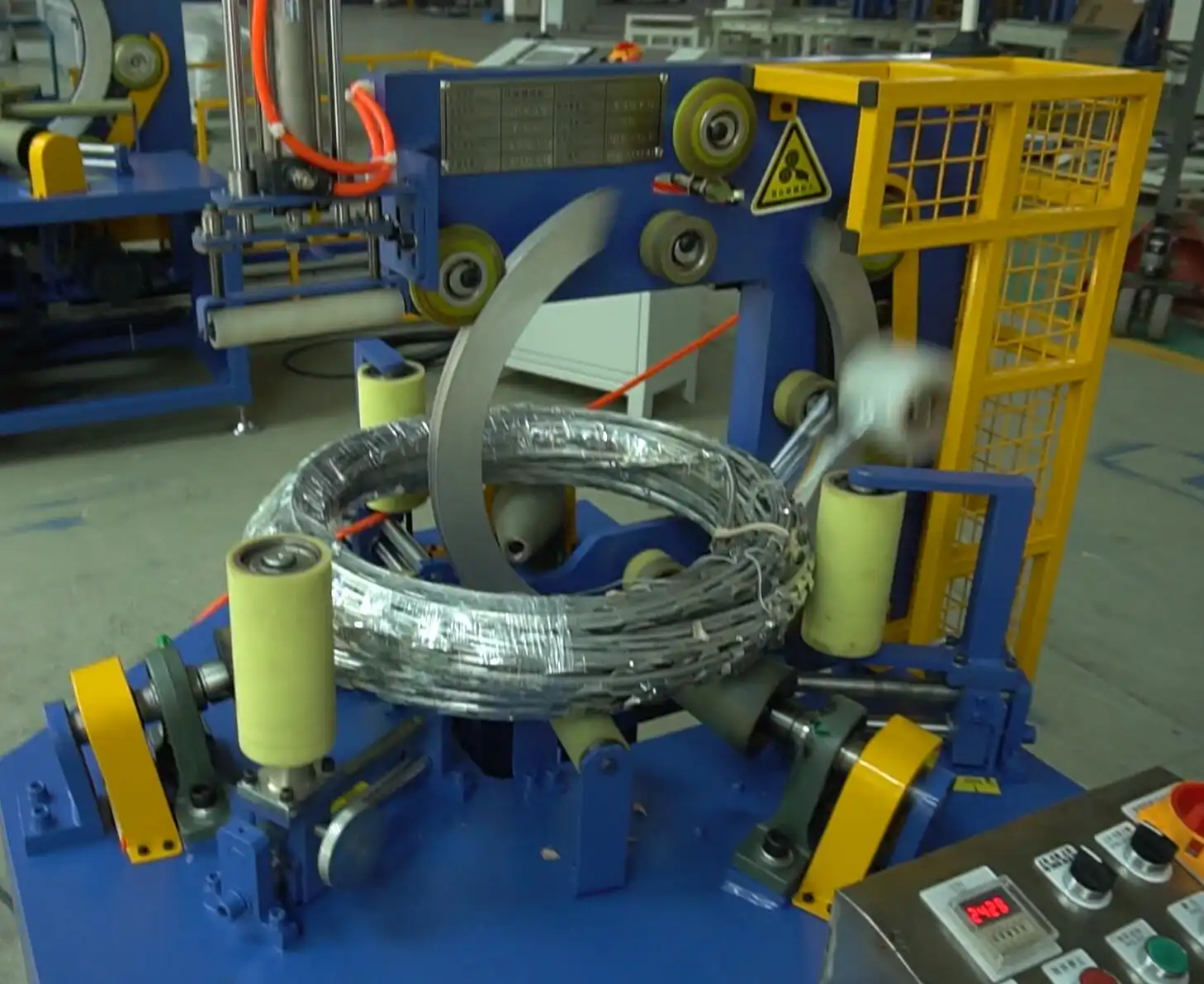
I’ve spent years on the factory floor and built FHOPEPACK from the ground up, and I know that making the right equipment decision can transform your business. Let’s dive deeper into these two powerful approaches to coil packing automation and help you understand which path aligns best with your operational needs and growth ambitions. (industrial automation insights, end-of-line packaging)
1. Why Should Factories Like Yours Invest in Automatic Coil Packing?
Are you tired of seeing your production line slow down at the very last step? Manual coil packing, especially for heavy products like steel coils or wire bundles, is often inefficient and prone to human error. It creates unnecessary bottlenecks, wastes valuable time, and can even contribute to product damage during handling. (packaging bottlenecks, manual packing limitations)
From my experience, the core reason to invest in automatic coil packing is to achieve higher throughput, improve worker safety, and ensure consistent, high-quality product presentation. This shift allows your factory to move past labor-intensive methods, mitigating the risks of injury and boosting your overall operational efficiency significantly.
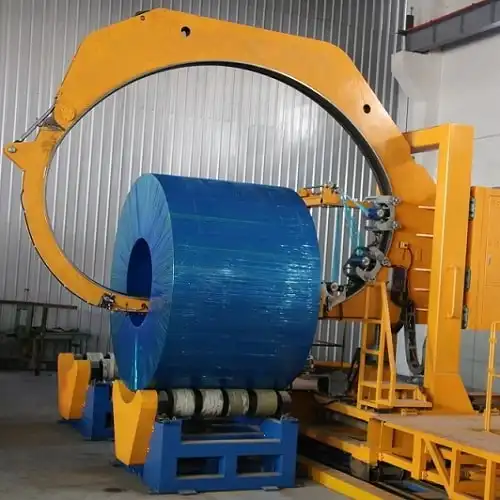
Dive Deeper: Addressing Michael Chen’s Core Challenges with Automation
When I speak with factory managers like Michael Chen, their concerns often revolve around efficiency, safety, and cost. Let me explain how automatic coil packing directly addresses these critical pain points.
-
Eliminating Efficiency Bottlenecks ⏱️ Michael often tells me his current steel coil and wire packing processes rely on too much manual labor. This is slow and inefficient, dragging down overall production and delivery speeds. An automatic system, whether inline or standalone, works at a consistent, much faster pace. It doesn’t get tired, it doesn’t need breaks, and it performs each packing cycle with precision. This means coils move through the end-of-line process smoothly, significantly reducing those frustrating delays. Imagine your coils moving seamlessly from the production line right into a perfectly wrapped state, ready for shipment, without a single pause caused by manual handling. This kind of streamlined operation directly translates to meeting demanding production targets and faster customer deliveries, which is crucial in today’s competitive market. (streamlined operations, production targets)
-
Enhancing Workplace Safety 🛡️ The safety concerns in Michael’s factory are paramount. Manually handling heavy coils or turning pallets not only limits efficiency but also carries a very high risk of workplace injuries. These incidents lead to high insurance costs and employee turnover. Automated packing systems fundamentally reduce the need for workers to directly interact with heavy, potentially dangerous objects. Machines take over the strenuous and repetitive tasks, moving, wrapping, and securing coils with robotic precision. This drastically lowers the risk of strain injuries, crushes, or other accidents. When I set up my factory, prioritizing safety was always a top concern, and automation was a key solution. A safer workplace means fewer accidents, lower costs related to worker compensation, and a more engaged, confident workforce. (worker safety improvements, industrial accident prevention)
-
Minimizing Product Damage and Loss 📦 Another challenge Michael faces is product damage during internal transfer and packing, especially to vulnerable areas like steel coil edges. This leads to customer complaints and lost profits. An automated packing machine applies wraps consistently and securely, protecting the product during handling, storage, and transit. The machine ensures that the wrapping tension is optimal, preventing movement that could cause scuffs or dents. This consistent protection safeguards your finished products, significantly reducing the chances of damage. Fewer damaged products mean fewer returns, happier customers, and, ultimately, a healthier bottom line for your business. Investing in this kind of protection pays for itself by maintaining product quality and brand reputation. (product quality preservation, reduced shipping damage)
-
Building Supplier Trust and Expertise 🤝 Michael has been wary of equipment suppliers who only focus on sales and lack adequate after-sales service. This is where FHOPEPACK stands apart. As someone who started on the factory floor and built a successful packing machine factory, I understand the need for reliable partnerships. We offer expert guidance not just to sell a machine, but to provide a comprehensive solution that genuinely addresses your operational challenges. Our team is committed to understanding your production bottlenecks, safety concerns, and efficiency dilemmas. We aim to be a long-term partner, offering professional insights and robust support, ensuring that your investment yields significant returns and contributes to your business growth. (reliable equipment partners, comprehensive support services)
2. What Exactly Is an Inline Automatic Coil Packing System?
Imagine a production line where your steel coils move seamlessly from the slitting or coiling process directly into the packing machine, without any manual intervention or breaks. That’s the essence of an inline automatic coil packing system. It is designed to be fully integrated into your existing manufacturing flow. (integrated production lines, continuous flow manufacturing)
An inline automatic coil packing system is a high-level automation solution where the packing machinery is integrated directly into the production line. Coils are automatically fed into the packing machine, wrapped, and then discharged, creating a continuous, uninterrupted flow from production to finished packaging, maximizing throughput and minimizing manual handling at every stage.

Dive Deeper: The Unbroken Chain of Efficiency
An inline system is about creating an unbroken chain of operations. It is a strategic choice for factories with high production volumes and a desire for maximum automation.
-
Seamless Integration into Production 🔗 An inline system connects directly to your existing production line, such as after a slitting machine or a coiler. This means coils are automatically transferred from one process to the next without the need for forklifts, cranes, or manual labor. This seamless connection eliminates staging areas and reduces transit time between stages. For Michael’s factory, where efficiency bottlenecks are a major concern, this continuous flow can drastically improve overall line speed and reduce cycle times. Think of it as a perfectly choreographed dance where each machine knows its role and executes it without a hitch, ensuring that your product never stops moving until it’s perfectly packed and ready. (production line integration, continuous process flow)
-
High Throughput and Consistency 📈 Because coils move automatically through the system, an inline packer can achieve very high packing speeds and consistent output. The machine operates at a predetermined pace, ensuring that every coil is wrapped identically, meeting precise specifications for tension and overlap. This consistency is crucial for product quality and customer satisfaction. In my factory, we always pushed for machines that could deliver high throughput without sacrificing quality, which is what an inline system is built for. This helps factories like Michael’s handle large orders efficiently and maintain a reputation for consistent, high-quality products. (high-volume production, consistent packing quality)
-
Reduced Labor Costs and Enhanced Safety 💲 The primary benefit of full automation is the significant reduction in direct labor required for packing. Instead of multiple workers manually handling and wrapping coils, an inline system might only need one operator to monitor the process. This not only cuts down on wage costs but also dramatically enhances safety. Workers are moved away from the heavy machinery and repetitive tasks, reducing the risk of workplace injuries that Michael is so keen to eliminate. This investment directly addresses the goal of reducing operational costs while simultaneously creating a much safer working environment for your valuable employees. (labor cost reduction, automated safety solutions)
-
Ideal for Specific Production Scenarios ⚙️ Inline systems are best suited for factories that produce a high volume of similar-sized coils continuously. If your factory has a dedicated line for a particular product type and you want to fully automate its end-of-line process, an inline solution is highly effective. It is designed for processes that run for extended periods with minimal changeovers. This kind of dedicated efficiency helps in achieving lower cost-per-unit for large production runs, making it an attractive option for large-scale manufacturers focusing on specialized product lines. (high-volume manufacturing, specialized production lines)
3. When Does a Standalone Automatic Coil Packing Machine Make More Sense?
Not every factory has the layout or the production rhythm for a fully integrated inline system. Sometimes, flexibility is more important than absolute, continuous flow. This is where a standalone automatic coil packing machine becomes incredibly valuable. It offers a different kind of efficiency. (flexible packaging solutions, adaptable production environments)
A standalone automatic coil packing machine operates independently of the main production line, offering greater flexibility in terms of placement and application. Coils are brought to the machine for packing, allowing it to serve multiple production lines or handle various coil sizes and types without disrupting the core manufacturing process.

Dive Deeper: Flexibility and Adaptability for Diverse Operations
For factories with varied production or space constraints, a standalone unit can be the ideal solution. It brings automation to you, rather than requiring you to re-engineer your entire line.
-
Unparalleled Flexibility and Versatility ✨ The biggest advantage of a standalone machine is its flexibility. It doesn’t need to be hardwired into a continuous production flow. Coils can be brought to the machine from different production lines or even from storage, packed, and then moved to dispatch. This versatility allows the same packing machine to serve various departments or handle a diverse range of coil types and sizes throughout the day. For factories like Michael’s, which might process different types of steel or wire products, this means one investment can provide automated packing for a wider array of products. It’s like having a dedicated packing station that adapts to your needs, rather than your needs adapting to the packing station. (versatile packing equipment, multi-line support)
-
Easier Implementation and Lower Initial Investment 💰 Integrating a standalone unit typically involves less disruption to your existing factory layout and processes. You don’t need to reconfigure an entire production line. This often translates to a faster installation period and a lower initial capital investment compared to a complex inline system. For Michael, who needs a clear ROI, the quicker deployment and more manageable cost can be very appealing, allowing for a phased approach to automation. It’s a way to introduce automated efficiency without a massive overhaul, making it a more accessible entry point into modern packing technology. (cost-effective automation, rapid deployment solutions)
-
Space Optimization for Varied Layouts 🗺️ Standalone machines are excellent for factories with limited space or non-linear layouts. You can place the machine in an area that makes the most logistical sense for your material flow, even if it’s not directly at the end of a single production line. This allows for smart space utilization without demanding extensive factory re-engineering. I’ve seen many factories struggle with space, and a standalone unit provides a practical solution to automate packing in challenging environments. This offers operational managers like Michael the freedom to optimize their factory floor without being constrained by rigid equipment requirements. (factory space optimization, logistical flexibility)
-
Handling Diverse Coil Types and Batches 🔄 If your factory handles a variety of coil weights, diameters, or widths, and frequently switches between different product batches, a standalone machine is often more adaptable. Changeovers for different product specifications are typically simpler to manage, as the machine is not tied to a continuous, single-product stream. This adaptability makes it suitable for job shops or manufacturers with a diverse product portfolio, ensuring that all types of coils can benefit from automated, secure packing. This capability directly supports Michael’s need to maintain quality and efficiency across different product lines. (multi-product packing, flexible batch processing)
4. How Do I Decide Between Inline and Standalone for My Production Line?
Making the right choice between an inline and standalone automatic coil packing machine can feel like a big decision. It directly impacts your operational efficiency, safety protocols, and ultimately, your bottom line. You want a solution that truly solves your challenges, not just adds new complexities. (strategic equipment selection, operational efficiency impact)
The decision hinges on several key factors, including your factory’s current production volume, existing layout, product diversity, and long-term automation goals. An inline system excels in high-volume, continuous production, while a standalone unit offers flexibility for varied products and layouts, allowing you to prioritize the specific needs of your operations.
Dive Deeper: A Strategic Framework for Your Automation Investment
From my years of experience helping clients achieve financial independence through smart equipment choices, I’ve developed a clear framework for making these decisions. Let’s analyze the factors that will guide Michael in selecting the optimal system.
-
Production Volume and Throughput Needs 📊
- Inline System: Best for factories with consistently high production volumes and a need for maximum throughput. If you’re producing thousands of similar coils daily and want to minimize cycle times, inline is your choice. It’s designed for relentless efficiency.
- Standalone System: More suitable for moderate production volumes or factories that handle various batches throughout the day. If your output fluctuates or you have multiple production lines feeding a single packing station, standalone offers the necessary adaptability.
-
Factory Layout and Space Availability 🏭
- Inline System: Requires significant space for integration into a continuous line. It often needs a dedicated pathway and can involve reconfiguring parts of your existing layout to achieve a smooth flow.
- Standalone System: Offers more flexibility in placement. It can be positioned in an existing clear space, serving as a centralized packing hub without major structural changes to your factory floor.
-
Product Diversity and Changeover Frequency 🔀
- Inline System: Ideal for manufacturing a narrow range of products with minimal changeovers. Its efficiency comes from repetition and consistency.
- Standalone System: Superior for factories producing a wide variety of coil sizes, weights, or materials, requiring frequent changeovers. It allows for quick adjustments between different product specifications.
-
Budget and Return on Investment (ROI) 💲
- Inline System: Generally represents a higher initial investment due to its complexity and integration requirements. However, the long-term ROI can be substantial for high-volume operations through significant labor savings and increased throughput.
- Standalone System: Typically involves a lower initial investment, making it an accessible entry point into automation. The ROI is achieved through improved safety, reduced product damage, and enhanced efficiency in more flexible production environments. Michael’s focus on clear ROI makes this a critical consideration.
-
Long-Term Automation Vision 🔮
- Inline System: If your ultimate goal is a fully automated, lights-out factory where human intervention is minimal across the entire production chain, an inline system aligns perfectly with that vision.
- Standalone System: If you’re looking to incrementally automate your processes, starting with critical bottlenecks, or if your future plans include modular expansion, a standalone unit provides a solid foundation.
Decision Matrix for Michael’s Factory
| Feature | Inline Automatic Coil Packing | Standalone Automatic Coil Packing |
|---|---|---|
| Production Volume | Very High, Continuous | Moderate to High, Batch-oriented |
| Integration | Fully integrated into main production line | Independent, flexible placement |
| Flexibility | Lower (optimized for specific product flow) | Higher (can handle diverse products/lines) |
| Initial Cost | Higher (due to complexity & integration) | Lower (more accessible) |
| Space Needs | Significant, potentially requires layout changes | Adaptable to existing layouts, less disruptive |
| Best For | Dedicated lines, high throughput, minimal changeovers | Varied products, multiple lines, space constraints |
| Key Benefit | Maximum efficiency, uninterrupted flow, lowest cost per unit | Versatility, easier implementation, focused automation |
By carefully evaluating these points against your factory’s unique situation, you can confidently choose the automatic coil packing solution that will drive your business forward. Michael, remember that FHOPEPACK is here to provide the expert guidance you seek, ensuring your investment truly solves your problems and propels your business growth. (factory automation strategy, optimal packing solution)
5. Beyond the Machine: What Lasting Impact Will the Right System Have?
Investing in an automatic coil packing machine, whether inline or standalone, is much more than just buying a piece of equipment. It’s a strategic decision that reverberates throughout your entire operation, affecting everything from employee morale to customer satisfaction. The impact goes far beyond the immediate production line. (long-term operational benefits, strategic business growth)
Integrating the right automatic coil packing solution fundamentally transforms your manufacturing process by enhancing safety, significantly boosting productivity, ensuring consistent product quality, and improving your factory’s overall profitability. This investment positions your business for sustained growth and a stronger competitive edge in the market.
Dive Deeper: The Ripple Effect of Smart Automation
When I work with clients, I don’t just focus on the machine itself, but on the ripple effect it creates across their business. The right packing solution can be a catalyst for comprehensive improvement.
-
Elevated Worker Morale and Reduced Turnover 😊 Michael’s challenge with high worker turnover and safety risks can be significantly mitigated. When dangerous, repetitive, and physically demanding tasks are taken over by machines, human workers can be redeployed to more skilled, safer, and mentally stimulating roles. This shift not only reduces the risk of injury but also improves job satisfaction. Employees feel valued when their safety is prioritized, and they have opportunities for upskilling. A happier, safer workforce is a more productive and loyal workforce, directly addressing the issue of employee retention. This positive change in the work environment is an often-underestimated benefit of automation. (employee well-being, workforce development)
-
Enhanced Brand Reputation and Customer Loyalty ⭐ Consistent, high-quality packaging means fewer product damages during transit and better presentation upon arrival. This directly impacts customer satisfaction and strengthens your brand reputation. When customers consistently receive perfectly packaged coils, it builds trust and loyalty, leading to repeat business and positive referrals. Michael’s concern about customer complaints due to product damage will become a thing of the past. A reliable packing process reflects positively on your entire operation, showcasing your commitment to excellence from production to delivery. (customer satisfaction improvement, brand image enhancement)
-
Data-Driven Insights for Continuous Improvement 📈 Modern automatic packing machines often come equipped with sensors and software that collect valuable operational data. This data can provide insights into packing speeds, material usage, and potential bottlenecks. Analyzing this information allows you to continuously optimize your processes, identify areas for further efficiency gains, and make informed decisions about future investments. This capability for data-driven improvement is a powerful tool for any factory manager looking to maintain a competitive edge. It turns your packing line into a source of intelligence, not just a processing unit. (operational data analysis, process optimization)
-
Future-Proofing Your Manufacturing Operations 🚀 The world of manufacturing is constantly evolving, with increasing demands for speed, efficiency, and sustainability. By investing in automatic coil packing, you are future-proofing your operations, making them more resilient to labor shortages and rising operational costs. This strategic move positions your factory to adapt to market changes, embrace new technologies, and maintain a leadership position in your industry. It’s about building a robust, sustainable foundation for long-term success, ensuring that your factory remains competitive for years to come. (sustainable manufacturing practices, competitive advantage)
Conclusion
Choosing between inline and standalone automatic coil packing machines is a strategic decision for optimizing your factory’s efficiency, safety, and profitability. Both systems offer distinct advantages tailored to different operational needs, ultimately securing a more robust steel coil packing line for your business.








