
How to choose the strapping machine for the copper coil?
Are you losing sleep over the risk of damaging your high-value copper coils during packaging? Every coil that leaves your production line represents a massive investment, and the slightest scratch, stain, or deformation can result in a rejected shipment, costing you thousands. Your team is walking on eggshells, and the manual strapping process is painfully slow, creating a bottleneck that jeopardizes your delivery schedules. You are caught in a constant battle between protecting your product and meeting your deadlines. The only way to win this battle is with an automatic strapping machine that is meticulously engineered to handle the unique sensitivity of copper.
To choose the right strapping machine for copper coil, you must select a system that guarantees surface protection, precision tensioning, and absolute cleanliness. Key features include non-marring contact surfaces like polyurethane rollers, an electronic tension control system to prevent deformation, and a design that avoids any chemical or oil contamination. The choice of strapping material, typically high-quality PET, is also critical to prevent surface reactions.
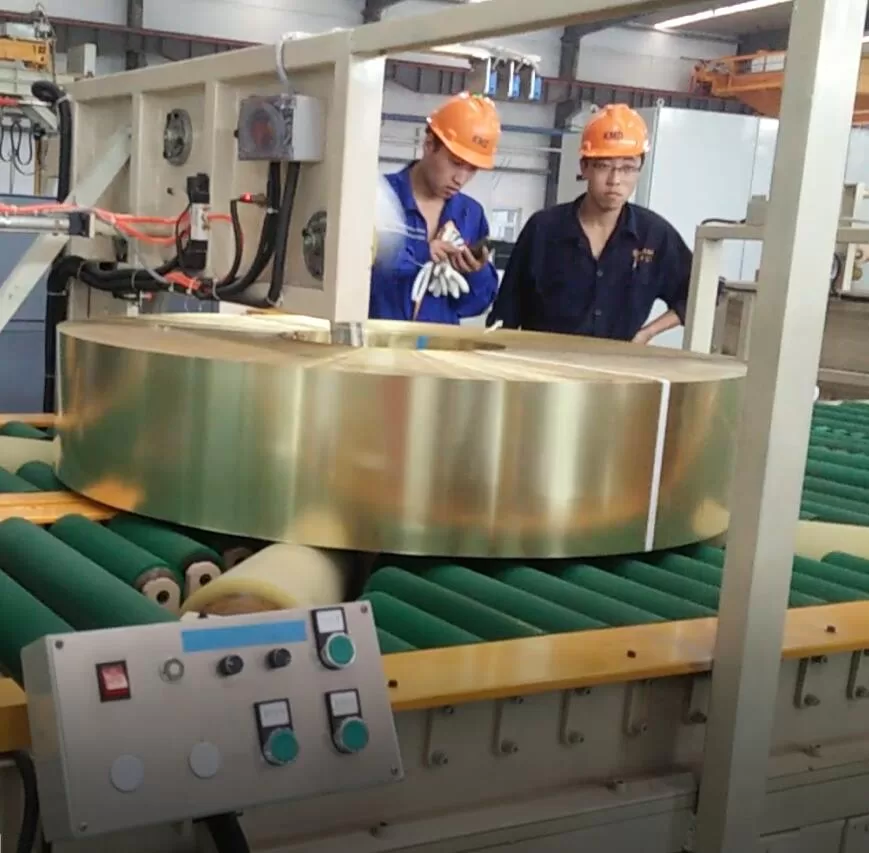
In all my years as an engineer and factory owner, I’ve learned that no material demands more respect than copper. Its value is not just in its weight; it’s in its flawless, conductive surface. I’ve seen firsthand how a poorly chosen machine can turn profits into scrap metal in the blink of an eye. This guide is built on that experience. We’re going to go beyond the sales brochures and talk about what really matters when you’re entrusting your most valuable product to a machine. We will cover the specific features that protect copper, ensure a secure load, and give you the peace of mind you deserve.
Why is strapping copper coil a high-stakes operation?
Do you think the challenges of strapping copper are the same as for steel or aluminum? That’s a mistake that can have severe financial consequences. The immense value and extreme sensitivity of copper put it in a class of its own. A minor scratch that might be acceptable on a steel coil is a cause for rejection with copper. A tension mark that aluminum might withstand can easily deform a soft copper coil. Failing to appreciate these high stakes leads to choosing inadequate equipment, resulting in damaged inventory, lost revenue, and angry customers.
Strapping copper coil is a high-stakes operation due to the material’s high monetary value combined with its extreme softness and chemical reactivity. Unlike steel, copper is easily scratched and dented. Unlike aluminum, it is highly susceptible to staining and corrosion from fingerprints, oils, or contact with other metals. Any damage can lead to the entire coil being scrapped, making the choice of a protective strapping machine a critical financial decision.

I once consulted for a company producing high-grade copper foil for the electronics industry. They were losing nearly 10% of their finished product in the final packaging stage. The culprit? A standard strapping machine that was leaving microscopic scratches and slight oil residues on the coils. For their customers, this wasn’t a cosmetic issue; it was a functional defect that could affect the performance of a printed circuit board. They were losing a fortune because they didn’t understand that packaging copper is not just about containment; it’s about preservation. Let’s explore exactly why copper demands this higher level of care.
A Material in a Class of Its Own
Copper’s unique combination of properties makes it a packaging challenge unlike any other.
1. Extreme Softness and Malleability
Copper is one of the softest pure metals used in industrial applications. This is great for drawing it into wires, but a nightmare for packaging.
- Denting and Edge Damage: The edges of a copper coil are incredibly susceptible to being crushed or deformed. Even a moderate amount of strap tension, if applied incorrectly, can pinch the edges, creating a defect that runs deep into the coil.
- Surface Impressions: The face of the coil is just as sensitive. Any sharp point or rough surface on the strapping machine can leave a permanent impression on the product. This requires a machine where every single contact point is engineered to be smooth and soft.
2. High Value and High Scrap Cost
This is simple economics. Copper is expensive.
- Cost of Damage: A one-ton steel coil might be worth a thousand dollars. A one-ton copper coil can be worth ten times that, or even more. The financial penalty for damaging a copper coil is an order of magnitude higher than for other metals. You are not just strapping a product; you are gift-wrapping a bar of gold.
- Customer Standards: Customers buying copper, especially for electronics, aerospace, or architectural uses, have zero-tolerance for imperfections. The visual and functional standards are the highest in the industry.
3. Chemical Reactivity and Staining
This is what truly separates copper from aluminum.
- Oxidation and Tarnishing: Copper reacts with oxygen, oils, and chemicals in its environment. A fingerprint can leave a permanent mark. A drop of the wrong lubricant from a machine can cause a green stain that renders the coil useless. The machine must be designed to be impeccably clean.
Here’s how copper stacks up against other metals in terms of packaging challenges:
| Challenge | Steel | Aluminum | Copper |
|---|---|---|---|
| Softness/Denting Risk | Low | High | Very High |
| Scratch Risk | Low | High | Very High |
| Stain/Corrosion Risk | Medium (Rust) | Low | Very High (Tarnish/Stains) |
| Value / Cost of Damage | Low | Medium | Very High |
Understanding these stakes is the first step. You are looking for a machine that operates less like a strapping tool and more like a precision instrument.
What machine features are essential for protecting a copper surface?
Are you terrified that a new automatic machine will be too rough for your delicate copper coils? You envision steel rollers scratching the surface and a heavy strapping head leaving marks, destroying the very value you worked so hard to create. This fear of the machine itself is valid if you choose the wrong one. It can make you stick to slow, manual methods that are costing you time and money. The solution is to demand a machine with a specific suite of features engineered for one purpose: to touch the copper as gently as possible.
To protect a copper surface, an automatic strapping machine must have all contact points made from or coated with soft, non-reactive materials. This includes polyurethane (PU) coated conveyors and turntable surfaces, UHMW plastic side guides, and a padded strapping head. Furthermore, the machine should be designed for easy cleaning to prevent any cross-contamination that could stain the copper.
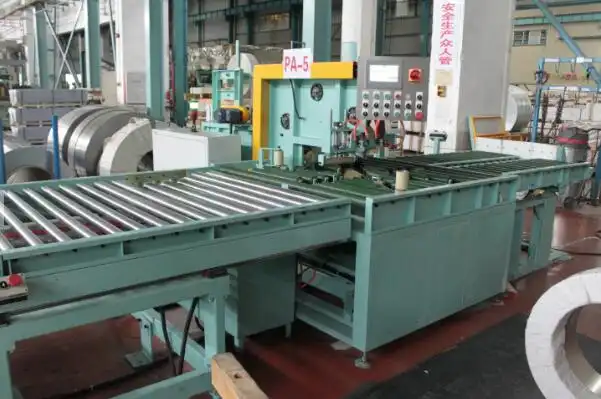
I’ve seen suppliers who think painting a machine a different color makes it a “specialty” model. That is not a solution. Protecting copper requires a deep, engineering-level commitment to gentle handling. It’s about the specific materials chosen for every point of contact. When I evaluate a machine for a copper application, I run my hand over every surface the coil will touch. If I feel anything but a smooth, soft, non-metallic surface, I know it’s the wrong machine. Let’s look at the specific features that make up a true “copper-safe” design.
The “White Glove” Treatment: An Engineering Approach
Imagine your machine needs to handle the product as if it were wearing white gloves. Every component must be designed with this principle in mind.
1. A Completely Non-Marring Path
The journey of the coil through the machine must be free of any hard or rough surfaces.
- PU Coated Rollers: This is the absolute minimum requirement. The conveyor rollers must be coated with a thick layer of soft polyurethane. For copper, I recommend a slightly softer durometer (hardness) than what might be used for aluminum.
- Plastic Guides: All side guides that center the coil should be made from smooth plastics like UHMW-PE. They should be broad and have rounded edges to distribute pressure evenly.
- Turntable Protection: If the machine uses a turntable to rotate the coil for multiple straps, its entire surface should be covered with a protective plastic or polyurethane sheet. There should be no exposed bolt heads or metal seams.
2. A Design Focused on Cleanliness
Because copper is so reactive, cleanliness is a critical machine feature.
- Elimination of Contaminants: The machine should be designed to minimize or eliminate the use of hydraulics near the product, as leaks are a major stain risk. Electric actuators are a much cleaner option for many functions.
- Easy-to-Clean Surfaces: The machine frame should be designed with smooth surfaces that are easy to wipe down. Avoid designs with lots of nooks and crannies where dust and dirt can accumulate. Some high-end applications even call for stainless steel construction in key areas to prevent any risk of rust particles contaminating the copper.
3. A Gentle Strapping Head
The component that does the work must be the gentlest of all.
- Padded Protection: The press on the strapping head that holds the strap must have a soft, replaceable pad.
- Lightweight Design: The head itself should be as lightweight as possible to minimize the pressure it exerts on the coil surface when it rests there. A “floating head” design is highly recommended.
Here’s a checklist to use when evaluating a machine’s surface protection capabilities:
| Component | Standard Machine | Required for Copper |
|---|---|---|
| Conveyor System | Steel rollers | PU-coated rollers and/or plastic mat-top chain |
| Guiding System | Steel bars | Broad, smooth UHMW plastic guides |
| Hydraulics | Used extensively | Minimized or eliminated in favor of electrics |
| Machine Frame | Painted carbon steel | Easy-to-clean design, possibly stainless steel |
| Cleanliness | Standard industrial | Designed for frequent, easy cleaning |
By focusing on these features, you ensure the machine is not just a tool, but a guardian of your product’s quality.
How do you achieve secure strapping without deforming the coil?
Are you caught in a frustrating cycle of straps being either too loose to be secure or so tight that they damage the soft edges of your copper coils? Finding that perfect balance with manual tools is nearly impossible, leading to either unsafe loads or costly product deformation. This forces you to be overly cautious, slowing down the entire packaging process. The only way to solve this riddle is to use a strapping machine with a highly advanced and precise tensioning system, combined with smart strap placement.
To achieve secure strapping without deformation, you must use a machine with a precision electronic tension control system driven by a load cell or servo motor. This allows you to program and apply a specific, low tension force consistently. Combining this with the strategic placement of straps and, in some cases, the automatic application of cardboard or plastic edge protectors, ensures the coil is both secure and undamaged.
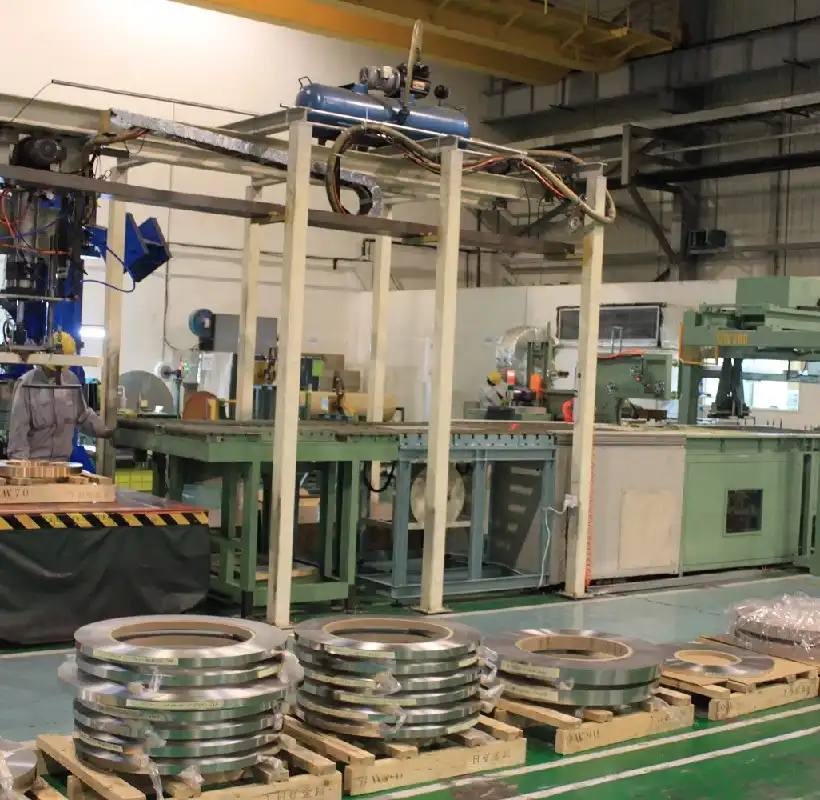
As an engineer, I find this to be the most interesting challenge. It’s a classic optimization problem: maximize security while minimizing force. Brute force doesn’t work here. You need intelligence and finesse. The solution lies in the brain of the machine—its tensioning system—and in using accessories that help distribute the force you apply. Let’s explore the technologies and techniques that make this possible.
The Art and Science of Gentle Tension
Achieving perfect tension is a combination of the right technology and the right strategy.
1. Precision Tensioning Technology
The heart of the solution is the strapping head’s motor and control system.
- Servo Motor Control: The gold standard for this application is a strapping head that uses a servo motor for tensioning. Servos provide the most precise control over speed, acceleration, and force. They can be programmed to apply a very specific tension and hold it perfectly.
- Load Cell Feedback: A system with a load cell provides closed-loop feedback. The load cell actually measures the tension in the strap in real-time and tells the motor to stop at the exact programmed setpoint. This is far more accurate than systems that just estimate tension based on motor current.
- HMI Control: The operator must be able to easily set and adjust the tension value on a simple HMI screen. This allows you to create different “recipes” for different copper products, ensuring each one gets the perfect tension every time.
Let’s compare the different tension systems:
| Tension System | How it Works | Suitability for Copper |
|---|---|---|
| Mechanical Clutch | A physical clutch slips at a pre-set torque. | Unacceptable. Inconsistent and not precise. |
| Standard Electric Motor | Tension is based on motor current cutoff. | Poor. Better than a clutch, but still has low accuracy. |
| Servo Motor / Load Cell | A smart motor with real-time force feedback. | Excellent. The only choice for high-value, soft materials. |
2. Force Distribution Strategies
Sometimes, even the perfect tension is too concentrated on a delicate edge. In these cases, you need to spread the load.
- Automatic Edge Protectors: For the most sensitive coils, a fully automatic packaging line can include a station that automatically places edge protectors before the coil enters the strapper. These can be made of heavy cardboard or plastic and are placed on the coil’s corners, directly under the strap. The strap then tightens on the protector, not on the copper itself. This distributes the force over a much wider area.
- Strategic Strap Placement: The number and location of straps also matter. Applying two or three straps with low tension is often better than one strap with high tension. A good strapping system will allow you to program different strapping patterns for different products.
By combining precision technology with smart strategies like edge protectors, you can create a strapping process that is both 100% secure and 100% damage-free.
What type of strapping material is best for copper coils?
Are you unsure which type of strap to use on your valuable copper coils? Using the wrong material can be a disaster. A steel strap will scratch the surface and can cause corrosion. The wrong type of plastic strap might not be strong enough or could react with the coil’s surface over time. This uncertainty can lead you to stick with what you’ve always used, even if it’s not the ideal choice. To make the right decision, you must evaluate strapping materials based on three criteria: non-reactivity, surface softness, and tensile strength.
The best strapping material for copper coils is high-quality Polyethylene Terephthalate (PET) strap. PET offers an excellent balance of high tensile strength to secure the heavy coil and low elongation to keep the load stable. Crucially, it is chemically inert and will not react with or stain the copper surface. Steel strapping should never be used on bare copper due to the high risk of scratching and galvanic corrosion.

This is a critical choice that directly impacts the quality of your final product. I once worked with a client who was using a cheap, low-grade plastic strap. Over a few weeks in their warehouse, a chemical plasticizer in the strap was leaching out and leaving a faint, dull line on the copper coils. They had to scrap an entire truckload. This taught me that the quality of the consumable—the strap itself—is just as important as the quality of the machine. Let’s compare the options so you can choose wisely.
Comparing Your Strapping Options
For copper coils, your choice is almost exclusively between two types of plastic strap: PET and Polypropylene (PP). Steel is not a viable option.
1. Steel Strapping (The Wrong Choice)
Let’s get this out of the way first. Do not use steel straps on bare copper.
- Scratching: The sharp edges of a steel strap will invariably scratch the soft copper during tensioning.
- Galvanic Corrosion: This is the bigger, hidden danger. When two dissimilar metals like steel and copper are in contact in the presence of even a small amount of moisture (humidity in the air), they form a “battery.” The steel will cause the copper to corrode, creating a deep, permanent stain.
2. Polypropylene (PP) Strapping
PP is a common, flexible plastic strap.
- Pros: It is soft, flexible, and generally inexpensive. It is very good for light-duty bundling.
- Cons: PP has high elongation, meaning it continues to stretch after it has been tensioned. For a heavy copper coil, this can cause the load to become loose over time. It also has lower tensile strength compared to PET. For very heavy coils, you might not be able to achieve the required security with PP strap.
3. Polyethylene Terephthalate (PET) Strapping
This is the material of choice for heavy, sensitive products.
- Pros: PET offers the best of both worlds. It has very high tensile strength, approaching that of steel in some cases. At the same time, it has low elongation, so once it’s tensioned, it stays tight. It is also chemically inert and has excellent surface properties, meaning it won’t scratch or react with the copper.
- Cons: It is typically more expensive than PP strap, but for a high-value copper coil, the added security and peace of mind are well worth the small extra cost.
Here is a clear comparison for your application:
| Feature | Steel Strap | PP Strap | PET Strap |
|---|---|---|---|
| Surface Damage Risk | Very High | Low | Very Low |
| Corrosion/Stain Risk | Very High | Low | Very Low |
| Tensile Strength | Very High | Medium | High |
| Elongation (Stretch) | Very Low | High | Low |
| Suitability for Copper | NO | Fair (for light coils only) | EXCELLENT |
The choice is clear. By investing in high-quality PET strapping, you are ensuring that the strap itself does not become a point of failure. It is the final piece of the puzzle in creating a secure and damage-free packaging system for your copper coils.
What is the most overlooked threat to your copper coils during packaging?
So, you’ve done everything right. You’ve chosen a machine with soft-touch surfaces, precision electronic tensioning, and you’re using high-quality PET straps. You feel like you’ve covered all the bases. But what if I told you there’s a silent, invisible threat that can still ruin your coils, a threat that most plant managers completely overlook? It’s not the machine itself, but the environment and the utilities that feed it. The biggest overlooked threat is contamination.
The most overlooked threat to copper coils during packaging is contamination from the machine’s environment and utilities. Microscopic oil droplets in the compressed air lines, dust and debris from nearby processes, or residue from cleaning agents can be deposited onto the copper surface by the machine, leading to delayed-action staining and corrosion that may only appear days or weeks later, often after the product has reached the customer.

I will never forget a frantic call I got from a manager at a high-end copper wire facility. His biggest customer was rejecting entire shipments due to “unexplained spotting” that appeared on the wire after a few weeks. They had a top-of-the-line strapping machine, and they were baffled. I flew out to the plant, and we spent a whole day investigating. We finally traced the problem to the plant’s main compressed air supply. It was old, and a fine mist of compressor oil was getting past the filters. The strapping machine used this compressed air for its cooling system, and it was depositing a nearly invisible film of oil onto the coils.
The War on Contamination
This experience taught me that for copper, the machine doesn’t operate in a vacuum. You must control its environment with the same rigor you apply to your production process.
1. The Threat from the Air
Your compressed air supply is a major potential source of contamination.
- Oil and Water: Standard compressed air contains water vapor and often trace amounts of lubricant oil from the compressor. Both are poison to a clean copper surface.
- The Solution: The compressed air line feeding your strapping machine must have a high-quality, multi-stage filtration system. This should include a coalescing filter to remove oil aerosols and a desiccant dryer to remove water vapor. You should also have a regular maintenance schedule for checking and replacing these filters.
2. The Threat from the Environment
Your packaging area is not a clean room, but for copper, it needs to be treated with a higher level of care.
- Airborne Dust and Debris: Dust from other processes (grinding, cutting, etc.) can settle on the machine and be transferred to the coil.
- The Solution: Where possible, isolate the copper packaging line from dirtier parts of the plant. Implement a strict housekeeping and cleaning schedule for the machine and the area around it. Use lint-free cloths and approved, non-reactive cleaning agents.
3. The Threat from Within
The machine itself needs to be kept clean.
- Strap Dust: The strapping material itself can generate a fine dust as it runs through the machine’s tracks.
- The Solution: The machine should be designed for easy cleaning. A regular “blow-down” procedure (using clean, dry air) should be part of the operator’s daily routine to clear any accumulated dust from the strap path.
Treating cleanliness as a critical machine specification is the final step to mastering the art of packaging copper. It’s the expert-level detail that separates an acceptable process from a truly world-class one.
Conclusion
To choose a copper coil strapper, prioritize protecting its value. Select machines with soft-touch surfaces, precision tensioning, and a focus on cleanliness. Always use high-quality, non-reactive PET strapping.








