
How Orbital Wrapping Machine Protects Furniture Boards in UAE Manufacturing?
Do you run a furniture manufacturing plant in the UAE? Are you tired of seeing your beautifully crafted furniture boards get damaged before they even reach the customer? The problem is real. Scratches, dents, and scuffs during transit or storage can turn a perfect product into a costly return. This hurts your reputation and your bottom line. It is a pain point I understand from my years in the packing machine industry.
An orbital wrapping machine wraps long, flat products like furniture boards with stretch film in a continuous, tight motion. This creates a strong, all-around protective barrier against dust, moisture, and physical damage, specifically designed to secure boards for safe transport and storage within the demanding UAE manufacturing and logistics environment.
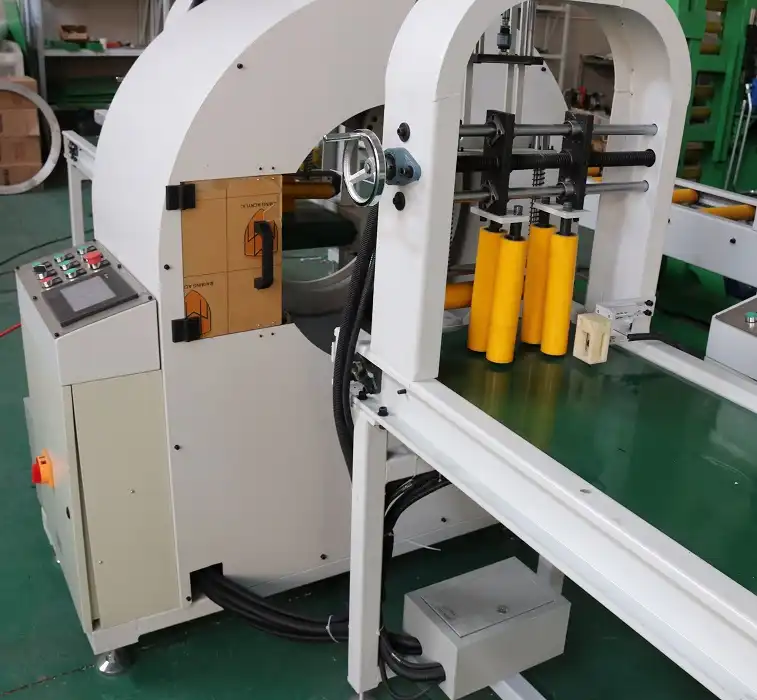
You know the pressure. Keeping production flowing and products safe is crucial. Manual packing methods often fall short, risking both product quality and worker safety. But there is a better way. Let us explore how modern orbital wrapping solutions are changing the game for furniture manufacturers in the UAE.
Why is Protecting Furniture Boards So Important for UAE Manufacturers?
Have you ever considered the true cost of damaged goods? It is more than just replacing a board. It involves lost time, unhappy customers, and a tarnished brand image. For UAE furniture manufacturers, this challenge is even bigger due to high quality demands and long supply chains.
Protecting furniture boards is vital for UAE manufacturers because it directly impacts product quality, customer satisfaction, and overall profitability in a competitive market that often involves exporting products over long distances, requiring robust and consistent protection.
The UAE is a hub for high-quality goods, and furniture is no exception. Customers here, and those receiving exports from the region, expect perfection. Any defect, no matter how small, can lead to rejection or a bad review. This is not just about avoiding immediate losses. It is about building a trusted brand. My journey in the packing machine business showed me how much even small damages can erode trust. When I started my factory, I learned that every detail in the production and packing process matters. A damaged product is a sign of a weak link in the chain. For furniture boards, these risks are everywhere:
- During Production: Boards move through different stages. They can get scratched or chipped in the factory itself.
- In Storage: Dust, humidity, or accidental bumps can affect unprotected boards. The UAE climate can be harsh, with high temperatures and dust. This makes good protection even more important.
- During Transport: This is often the riskiest part. Boards can shift, rub against each other, or face impacts. Whether by road, sea, or air, the journey can be rough. A good wrap keeps everything secure.
We can look at some specific reasons why this protection is a must-have:
Key Reasons for Robust Furniture Board Protection
Protecting furniture boards is not just a good idea; it is essential for business success.
| Aspect | Importance for UAE Manufacturers | Impact of Poor Protection |
|---|---|---|
| Customer Satisfaction | Meeting high expectations for quality and delivery. Happy customers come back and recommend you. | Disappointed customers, negative reviews, loss of future business. 😠 |
| Brand Reputation | Building a name for reliability and quality in a competitive market. Trust is hard to earn. | Damaged image, perceived as low quality, difficulty attracting new clients. 📉 |
| Cost Savings | Avoiding expenses from replacements, re-shipping, and processing returns. These add up fast. | Increased operational costs, reduced profit margins, waste of materials and labor. 💰 |
| Logistics Efficiency | Ensuring smooth transit without delays from damage inspection or repacking. Time is money. | Delays in delivery, complicated claims processes, strained relationships with logistics partners. 🚚 |
| Market Access | Complying with international shipping standards and client requirements. Expanding your reach. | Inability to meet standards, restricted market opportunities, fines. 🌍 |
This table shows that protecting your furniture boards is a strategic move. It helps you keep customers happy, grow your brand, save money, and operate smoothly. From my experience, factories that invest in protection always see better returns in the long run. They build a reputation for quality that sets them apart.
What Problems Do Current Board Packing Methods Create in UAE Factories?
Many factories in the UAE still use older, manual ways to pack furniture boards. These methods seem cheap at first glance. But they often bring hidden costs and big problems. These problems can slow down production and put workers at risk.
Current manual or semi-automatic packing methods for furniture boards in UAE factories often lead to slow packing speeds, high labor costs, inconsistent wrapping quality, and significant safety hazards for workers handling heavy and awkward products, directly impacting efficiency and profitability.

I have seen it many times in different industries. Factories try to save money on packing, but they end up paying more in other ways. When I was building my packing machine factory, I made sure every machine we designed solved a real problem. The challenges with traditional packing for furniture boards are clear.
- Slow Speeds and Bottlenecks: Manual wrapping is slow. Workers can only do so much in an hour. This creates a bottleneck at the end of the production line. Finished boards wait, slowing down everything. Your fast production machines are great, but if packing cannot keep up, you lose efficiency.
- High Labor Costs and Availability: Hiring enough people for manual packing is expensive. In the UAE, labor costs can be high. Also, finding skilled workers who are willing to do repetitive, physically demanding tasks is not always easy. My clients often shared how finding reliable labor was a constant struggle.
- Inconsistent Protection: Humans are not machines. One worker might wrap a board tightly, another might not. This leads to uneven protection. Some boards are safe, others are vulnerable. This inconsistency is a big risk for quality control.
- Safety Risks: Furniture boards can be heavy, long, and awkward to handle. Workers doing manual wrapping are at risk of back injuries, strains, and other accidents. This increases insurance costs and can lead to lost workdays. Safety is always a top concern, no matter the industry. I have always pushed for solutions that protect both the product and the people.
Let us look closer at these issues.
Common Problems with Traditional Board Wrapping
Factories need to understand these issues to make a change.
| Challenge | Description | Negative Impact |
|---|---|---|
| Manual Labor Dependence | Relying heavily on workers to perform repetitive and physically demanding wrapping tasks. | High labor costs, staffing issues, inconsistency in wrap quality. 💰 |
| Slow Throughput | Manual processes cannot keep pace with high-speed production, causing delays and production bottlenecks. | Reduced overall factory output, missed deadlines, decreased competitiveness. ⏳ |
| Inconsistent Wrapping | Human error leads to varied tension, overlap, and coverage, leaving parts of the board exposed. | Increased product damage during transit or storage, customer complaints. 📦 |
| Worker Safety Hazards | Risk of injuries (back strain, cuts) from lifting, turning, and wrapping heavy, large boards manually. | Higher insurance premiums, worker absenteeism, potential legal liabilities. 🚑 |
| Material Waste | Inefficient use of stretch film due to poor technique or over-wrapping to compensate for inconsistency. | Higher material costs, environmental concerns, reduced profit margins. ♻️ |
These problems are not unique to furniture. I have seen similar issues in factories packing steel coils and wire. The core issue is trying to fit manual methods into a modern, high-speed production environment. This creates friction and costs. Recognizing these problems is the first step toward finding a better solution.
How Exactly Does an Orbital Wrapper Secure Furniture Boards?
You have seen the problems. Now, let us talk about the solution: the orbital wrapping machine. This technology is a game-changer for protecting long products like furniture boards. It works differently from other wrapping machines. This difference makes it ideal for your specific needs.
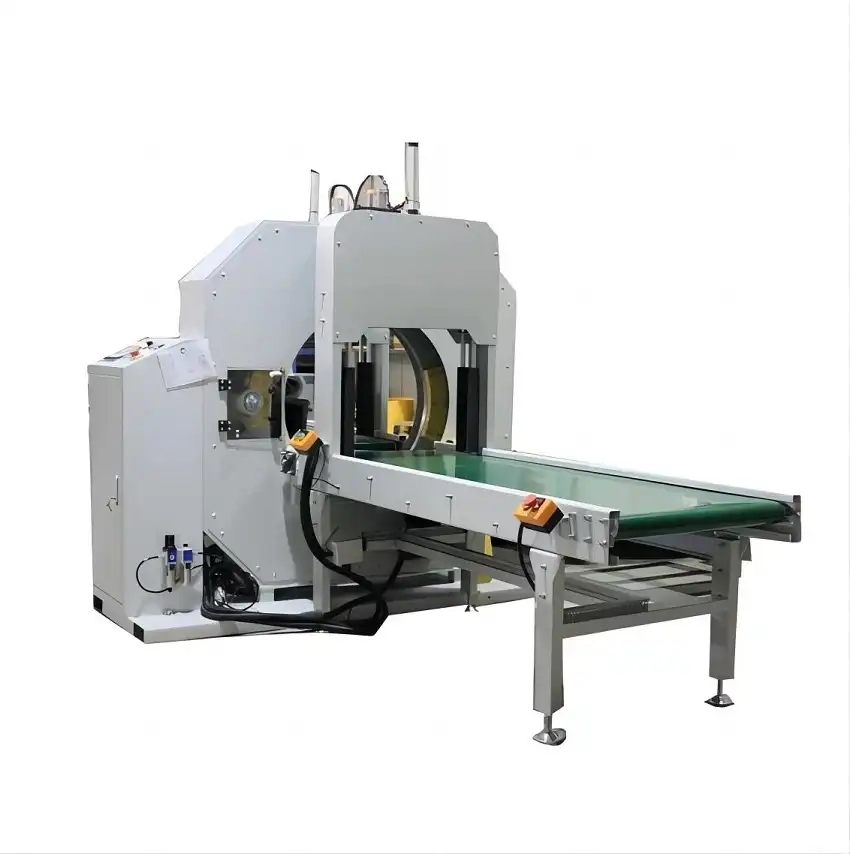
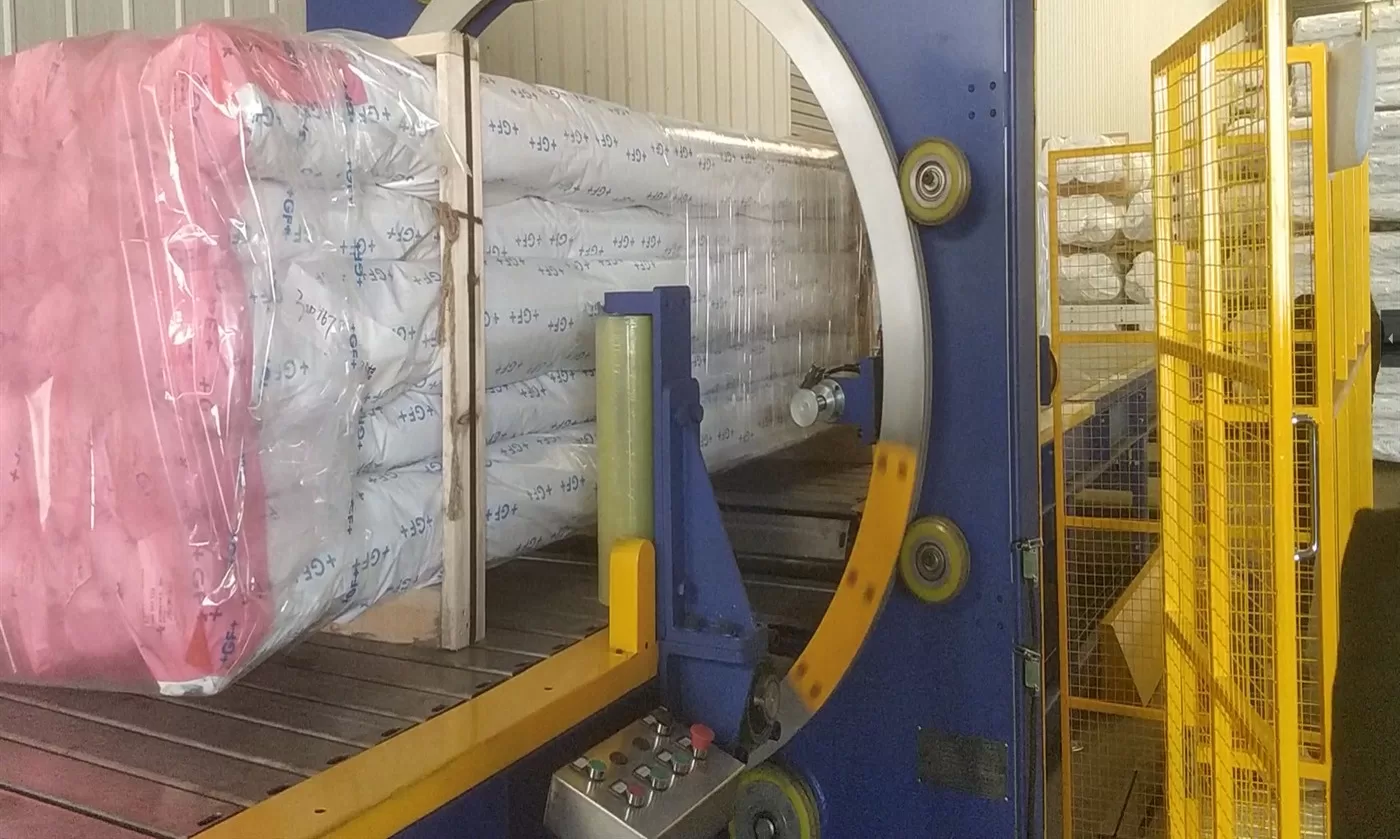
An orbital wrapping machine secures furniture boards by passing them horizontally through a rotating ring that continuously dispenses and wraps stretch film around the board’s entire perimeter. This creates a tight, overlapping, and uniform protective layer, effectively binding and sealing the boards to prevent damage and contamination during handling and shipping.

When I first learned about orbital wrappers, I immediately saw their potential for so many industries. It is a clever design that solves many common packing challenges. Think of it like this: instead of the product rotating (like with a turntable wrapper), the wrapping film rotates around the stationary or slowly moving product.
- Horizontal Feed: Furniture boards, being long and flat, are fed horizontally through the center of the machine. This is very efficient.
- Rotating Ring: Inside the machine, there is a large ring that spins rapidly. This ring holds a roll of stretch film.
- Continuous Wrapping: As the board moves through the ring, the film unwinds from the roll and wraps around the board. The ring spins, and the film overlaps itself. This creates a complete, 360-degree enclosure.
- Adjustable Tension: The machine can adjust how tightly the film is stretched. This means you get a snug fit. It holds the boards together and protects them from movement. My designs always focused on control, because precise tension means better protection and less film waste.
- Full Coverage: Unlike vertical stretch wrappers that might leave sides exposed or require multiple passes, the orbital wrapper covers all sides in one smooth process. This is key for robust protection against dust, moisture, and impact.
Let us break down the key features that make this machine so effective for furniture boards.
Key Features of Orbital Wrapping for Furniture Boards
These features explain why it works so well.
| Feature | How it Works for Furniture Boards | Benefit for UAE Manufacturers |
|---|---|---|
| Horizontal Operation | Boards are fed flat through a horizontal ring, matching their natural orientation. | Easy integration into production lines, no need for vertical tilting. ✅ |
| 360-Degree Wrap | The rotating ring wraps film around all sides of the board simultaneously. | Complete protection against dust, moisture, and impact from every angle. 🛡️ |
| Adjustable Film Tension | Sensors and controls regulate how tightly the stretch film is applied. | Optimal load containment, prevents shifting, reduces film usage. 🔄 |
| Automated Process | Minimal human intervention needed once the boards are loaded onto the conveyor. | Reduced labor costs, increased packing speed, consistent results. ⚙️ |
| Customizable Ring Sizes | Available in various ring diameters to accommodate different board dimensions. | Flexibility to wrap a wide range of furniture board sizes and bundles. 📏 |
| Integrated Conveyors | Often comes with infeed and outfeed conveyors for smooth material flow. | Seamless connection to existing production lines, enhanced efficiency. ➡️ |
The beauty of the orbital wrapper is its simplicity and effectiveness. It takes a complex problem – fully protecting a long, flat item – and solves it with a continuous, controlled wrapping motion. This method ensures that your furniture boards arrive at their destination looking exactly how they left your factory. I have always believed in engineering solutions that work reliably, day in and day out.
What Specific Benefits Do Orbital Wrappers Offer UAE Furniture Production?
You want to know the bottom line. How does investing in an orbital wrapping machine truly help your UAE furniture factory? The benefits go beyond just protection. They touch every part of your operation, from the factory floor to your customer’s doorstep.
Orbital wrappers offer UAE furniture production increased efficiency through automation, significantly enhanced product protection that reduces damage and waste, improved worker safety by minimizing manual handling, and substantial cost savings from optimized material use and reduced labor, leading to higher profitability and customer satisfaction.
I have seen countless factories transform their operations by embracing automation. It is not just about buying a machine. It is about investing in a solution that solves multiple problems at once. When I helped clients set up their packing lines, the biggest wins always came from integrating smart, reliable machines.
- Higher Packing Speed and Throughput: Orbital wrappers work much faster than manual packing. They can wrap dozens of boards in the time it takes a worker to do a few. This means your packing line keeps up with production, eliminating bottlenecks. Your products get out the door quicker.
- Reduced Product Damage and Waste: The tight, consistent wrap from an orbital machine protects boards from scratches, moisture, and dust. This drastically cuts down on damaged goods. Fewer damaged goods mean fewer returns, fewer replacements, and happier customers. This directly saves you money.
- Improved Worker Safety: Heavy manual lifting and wrapping of large boards are dangerous. An orbital wrapper automates this. Workers just need to load the boards onto a conveyor. This reduces the risk of injuries, creating a safer workplace. This was a core value when I started FHOPEPACK; safety for both product and people.
- Lower Labor Costs: With automation, you need fewer workers for the packing process. This means lower wages, benefits, and training costs. Over time, these savings add up. The machine pays for itself faster than you might think.
- Optimal Film Usage: Orbital wrappers are designed to use stretch film efficiently. They apply the right amount of tension and overlap. This means less film waste compared to manual wrapping, where film is often overused or poorly applied. This saves on material costs.
Let us summarize these clear advantages.
Core Advantages of Orbital Wrapping for UAE Furniture Factories
These are the reasons why an upgrade makes sense.
| Benefit | Direct Impact on UAE Furniture Production | Measurable Outcome |
|---|---|---|
| Increased Productivity | Automated wrapping at higher speeds than manual methods. | Shorter packing times, higher daily output, faster order fulfillment. 🚀 |
| Enhanced Product Integrity | Consistent, tight, 360-degree wrap protects against physical damage and environmental factors. | Fewer damaged goods, reduced returns, improved customer satisfaction. ✨ |
| Improved Workplace Safety | Less manual handling of heavy or awkward furniture boards. | Lower risk of worker injuries, reduced insurance costs, better morale. 👷 |
| Significant Cost Savings | Reduced labor requirements, optimized stretch film consumption, and less product waste. | Lower operational expenses, higher profit margins, faster ROI. 💲 |
| Consistent Quality | Machine-controlled wrapping ensures every board is protected to the same high standard. | Reliable product presentation, stronger brand reputation, fewer quality control issues. ✅ |
| Space Efficiency | Modern designs integrate well into existing production lines without requiring excessive space. | Optimized factory layout, better workflow, potential for increased storage density. 🏭 |
These benefits make a strong case for integrating an orbital wrapping machine into your UAE furniture manufacturing process. It is about moving from an old way of doing things to a smart, efficient, and safe approach.
How Can UAE Furniture Factories Best Integrate Orbital Wrapping?
You are convinced of the benefits. Now, the big question is: how do you bring this technology into your factory in the UAE? It is not just about buying a machine. It is about finding the right solution and making it work seamlessly with your existing setup.
UAE furniture factories can best integrate orbital wrapping by first assessing their specific production volume and board dimensions, then selecting a machine with appropriate ring size and automation level, ensuring it connects smoothly with existing conveyors, and finally, training staff for optimal operation and maintenance to maximize ROI and minimize disruption.
My experience running and building packing machine factories taught me that every factory is unique. What works for one might not be perfect for another. This is why a careful approach to integration is key.
- Assess Your Needs: Start by looking at your current operations. How many boards do you pack per day? What are their typical sizes and weights? What are your peak production times? Understanding these details helps you choose the right machine.
- Choose the Right Machine: Orbital wrappers come in different sizes and with varying levels of automation. Some are more basic, while others offer full automation with automatic film cutting and clamping. The ring size is important to match your largest board. Think about future growth too. I always advise clients to consider what their needs will be in 3-5 years, not just today.
- Seamless Integration: The new machine needs to fit into your existing production line. This often means connecting it to your current conveyor systems. A good supplier can help with custom solutions to make sure the flow of boards is smooth. This prevents new bottlenecks.
- Training and Support: Any new machine needs proper training for your staff. They need to know how to operate it safely and efficiently. Good technical support from the supplier is also vital for maintenance and troubleshooting. My commitment at FHOPEPACK has always been to provide solutions that empower, not complicate.
- Consider ROI: Before making the investment, calculate your potential return on investment (ROI). Factor in savings from reduced labor, less product damage, and increased throughput. This business case will show you the real value.
Let us detail the steps for successful integration.
Steps for Successful Orbital Wrapper Integration
Follow these steps for a smooth transition.
| Step | Description | Key Consideration for UAE Factories |
|---|---|---|
| 1. Needs Assessment | Analyze current packing volume, board dimensions (length, width, height), and desired throughput. | Match machine capacity to production targets and future growth plans. 📈 |
| 2. Machine Selection | Choose an orbital wrapper with the correct ring size, automation level (semi-auto vs. fully auto), and features. | Durability for UAE climate, energy efficiency, ease of maintenance. ☀️ |
| 3. Layout & Integration | Plan the placement of the machine and ensure it connects efficiently with existing conveyors. | Space availability, workflow optimization, safety clearances. 📐 |
| 4. Installation & Setup | Professional installation by the supplier’s technical team to ensure correct calibration. | Minimal disruption to current production, adherence to safety standards. 🛠️ |
| 5. Staff Training | Comprehensive training for operators and maintenance personnel on machine use and basic upkeep. | Language support, clear manuals, hands-on practice. 🧑🏭 |
| 6. Ongoing Support | Secure a reliable service and parts agreement with the supplier. | Local service availability in UAE, quick response times. 📞 |
| 7. Performance Review | Monitor the machine’s efficiency, film consumption, and impact on product damage regularly. | Track ROI, identify areas for further optimization. 📊 |
By following these steps, UAE furniture factories can make sure their investment in an orbital wrapping machine is successful. This thoughtful approach minimizes risks and maximizes the benefits, ensuring a smooth transition to a more efficient and safer packing process.
Conclusion
Embracing orbital wrapping technology is a smart move for any UAE furniture factory aiming for higher efficiency and better product protection. It directly tackles slow processes, high costs, and safety concerns. By investing in a reliable orbital stretch wrapper, you secure your products, streamline operations, and boost your business’s reputation and profitability.








