
How Do Steel Coil Packing Lines Reduce Labor Dependence in French Industry?
Are you running a steel mill in France, or anywhere else for that matter, and constantly worried about keeping up with demand? Do you find yourself struggling with a shortage of skilled labor, inconsistent packing quality, or safety concerns on your packing floor? You are not alone. Many production managers, like Ivan, face these exact challenges every day. The pressure to deliver high-quality products on time, while managing operational costs, is immense. This is where the right packing solution can make all the difference.
Steel coil packing lines significantly reduce labor dependence in industries like France’s by automating repetitive, physically demanding, and skilled tasks such as coil handling, wrapping, strapping, and labeling. This automation minimizes the need for direct human intervention, improves safety, ensures consistent quality, and allows existing staff to focus on more complex, value-added roles within the production process.

You see, the goal is not just to replace people with machines. It is about creating a smarter, safer, and more efficient workflow. As someone who has spent years in the packing machine industry, from the factory floor to leading FHOPEPACK, I understand these pressures deeply. Let us explore how modern steel coil packing lines achieve this transformation, helping businesses like yours thrive.
How Do Automated Coil Packing Systems Take Over Manual Work?
Are your workers still manually strapping, wrapping, or moving heavy steel coils? This is a common scene in many facilities, but it comes with a high cost in terms of time, efficiency, and human fatigue. These manual tasks are often slow, prone to errors, and require constant physical effort. They create bottlenecks in the production line, especially when dealing with high volumes.
Automated coil packing systems take over manual work by integrating a series of machines that perform each step of the packing process sequentially and automatically. This includes tasks like coil centering, horizontal or vertical wrapping, PET or steel strapping, automatic labeling, and precise stacking. By automating these processes, the system reduces the need for human operators to physically handle materials or execute repetitive tasks, ensuring a faster, more consistent output.
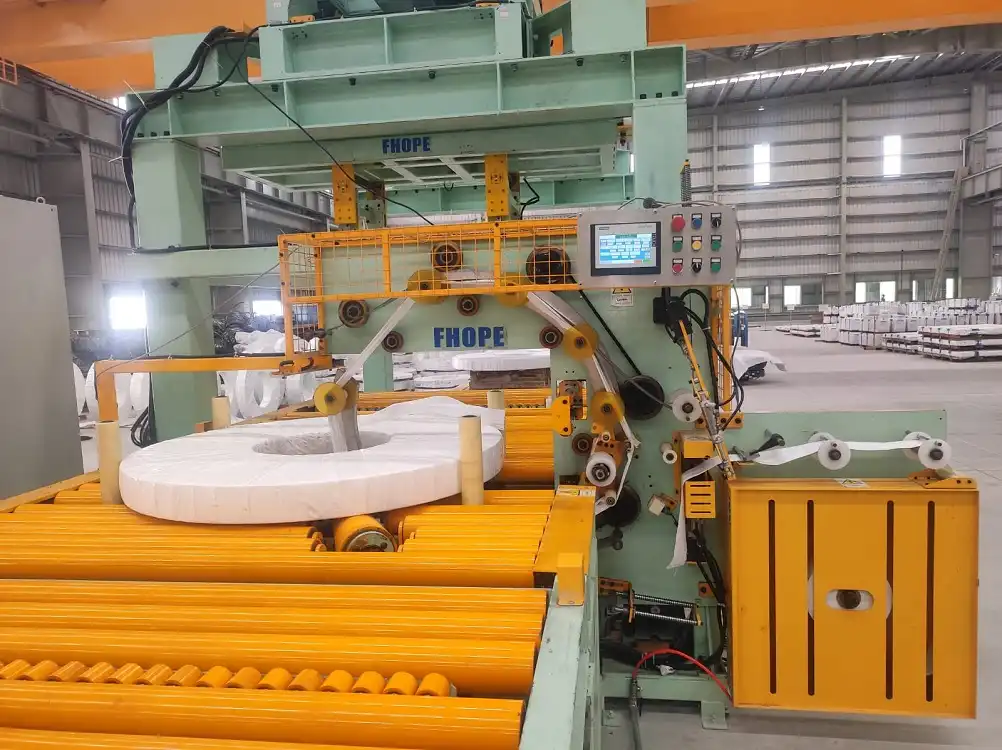
When I first started in the packing machine industry, I saw many workers struggling with these very tasks. Their dedication was clear, but the physical toll was undeniable. This is why FHOPEPACK focuses on solutions that empower businesses to move beyond outdated manual methods. These systems bring a structured, predictable approach to packing.
-
🔢 Automatic Coil Handling and Conveyance: Coils, often weighing several tons, move along the packing line automatically on robust conveyor systems. These systems can include coil upenders and downenders that precisely position the coil for subsequent packing stages. Workers no longer need to use forklifts or overhead cranes for every single coil movement within the packing area. This greatly reduces labor for material handling. It also minimizes the risk of product damage from improper lifting. This step alone frees up significant human resources. It also ensures a steady flow into the next stages, preventing delays.
-
🔄 Automated Wrapping and Bundling: Modern packing lines feature fully automatic orbital wrappers or stretch wrapping machines. These machines apply a protective layer of film (stretch film, VCI film, or rust-proof paper) around the coil. They do this without any direct human intervention. The machine measures the coil’s dimensions, adjusts the wrapping parameters, and cuts the film automatically. Similarly, automatic strapping machines apply PET or steel straps with consistent tension. These machines secure the package for transit. This replaces multiple workers who would otherwise manually wrap and strap each coil. This guarantees uniform packing quality every time.
-
🏷️ Integrated Labeling and Data Management: Gone are the days of manually printing and affixing labels to each coil. Automated systems include print-and-apply labelers that integrate with the factory’s production management software. These machines print customer-specific information, barcodes, and shipping details directly onto labels. They then apply them precisely to the packed coil. This not only saves significant labor hours but also virtually eliminates human error in labeling. Accurate labeling is crucial for inventory tracking and logistics. This system ensures all coils are correctly identified.
-
📦 Robotic Stacking and Palletizing: For coils that need stacking or palletizing, automated solutions can include robotic arms or specialized stacking equipment. These machines carefully lift and place coils onto pallets or into storage configurations. This reduces the need for workers to perform strenuous lifting and stacking tasks. This enhances safety and also optimizes storage space. This final step means that from the moment a coil leaves the slitting line, it can be handled, packed, and prepared for shipment with minimal human input.
How Do They Make Packing Safer and Less Labor-Intensive?
Packing steel coils manually is a physically demanding job. Workers often deal with heavy lifting, repetitive motions, and the constant risk of injury from moving machinery or unstable loads. This environment contributes to high staff turnover and difficulty in retaining skilled labor, especially for night shifts or in colder conditions. This makes the job less appealing over time.
Steel coil packing lines make the process safer and less labor-intensive by removing human operators from direct contact with heavy, moving coils and dangerous machinery. They use automated systems for lifting, turning, wrapping, and strapping, which significantly reduces the risk of musculoskeletal injuries, crushed limbs, and other accidents. This mechanization also lowers the physical strain on workers, making the entire packing operation more sustainable and attractive for the workforce.

When I speak with clients, concerns about worker safety always come up. It is a top priority for any responsible production director. Providing a safe working environment is not just good practice; it is essential for morale and productivity. FHOPEPACK’s solutions are designed with this in mind, aiming to protect people while boosting output.
-
👷 Elimination of Manual Handling Risks: One of the biggest hazards in coil packing is the manual handling of heavy steel coils. Workers often need to use cranes or forklifts to move coils, then manually push and pull them into position for wrapping or strapping. This poses a constant risk of accidents, like coils falling or crushing injuries. Automated conveying systems remove workers from this danger zone. Coils move precisely along the line without human hands touching them. This dramatically lowers the potential for severe injuries. It also reduces the need for workers to be near moving parts, creating a safer work environment for everyone.
-
🧘 Reduction of Repetitive Strain Injuries: Tasks like manual strapping or hand-wrapping coils involve highly repetitive motions. These tasks, when performed over long shifts, can lead to chronic musculoskeletal disorders. These injuries are common in industrial settings and result in lost work days and long-term health problems for employees. Automated strapping and wrapping machines take over these repetitive tasks entirely. They perform them with consistent speed and force. This frees workers from the strain and allows them to perform supervisory roles or more varied, less strenuous duties. This directly contributes to a healthier workforce and reduced injury claims.
-
⚙️ Enhanced Safety Features and Interlocks: Modern automated packing lines come equipped with advanced safety features. These features include emergency stop buttons, safety light curtains, interlocking gates, and robust guarding. These systems are designed to detect human presence in hazardous areas and immediately halt machine operation to prevent accidents. This creates a protective bubble around the machinery. It ensures that workers are safe even when performing maintenance or overseeing operations. These built-in safety mechanisms are far more reliable than human vigilance alone, which can falter during long shifts.
-
📉 Lowering General Physical Labor: Beyond specific injury risks, manual coil packing is simply very physically taxing. It requires sustained energy and strength. This contributes to worker fatigue, which in turn can lead to more mistakes and accidents. By automating the bulk of the physical work, the overall labor intensity of the packing area decreases significantly. Workers can manage the system from a control panel, monitor processes, and intervene only when necessary. This makes the job less strenuous and more appealing to a broader range of individuals. It also helps retain experienced staff who might otherwise seek less physically demanding roles.
How Do They Ensure Consistent Quality with Fewer Human Errors?
Have you ever faced customer complaints about damaged goods or inconsistent packing? This is a direct consequence of relying too heavily on manual packing. Each worker might have slightly different techniques, leading to variations in film tension, strap tightness, or overall packaging integrity. This inconsistency not only impacts your brand reputation but also leads to increased material waste and potential claims.
Automated steel coil packing lines ensure consistent quality with fewer human errors by applying precise, repeatable processes for every single coil. Machines are programmed to maintain exact parameters for wrapping tension, strap placement, and labeling accuracy, eliminating the variability inherent in manual operations. This consistency guarantees a uniform, high-standard package that protects the product, meets customer specifications, and reduces the likelihood of shipping damage or returns.
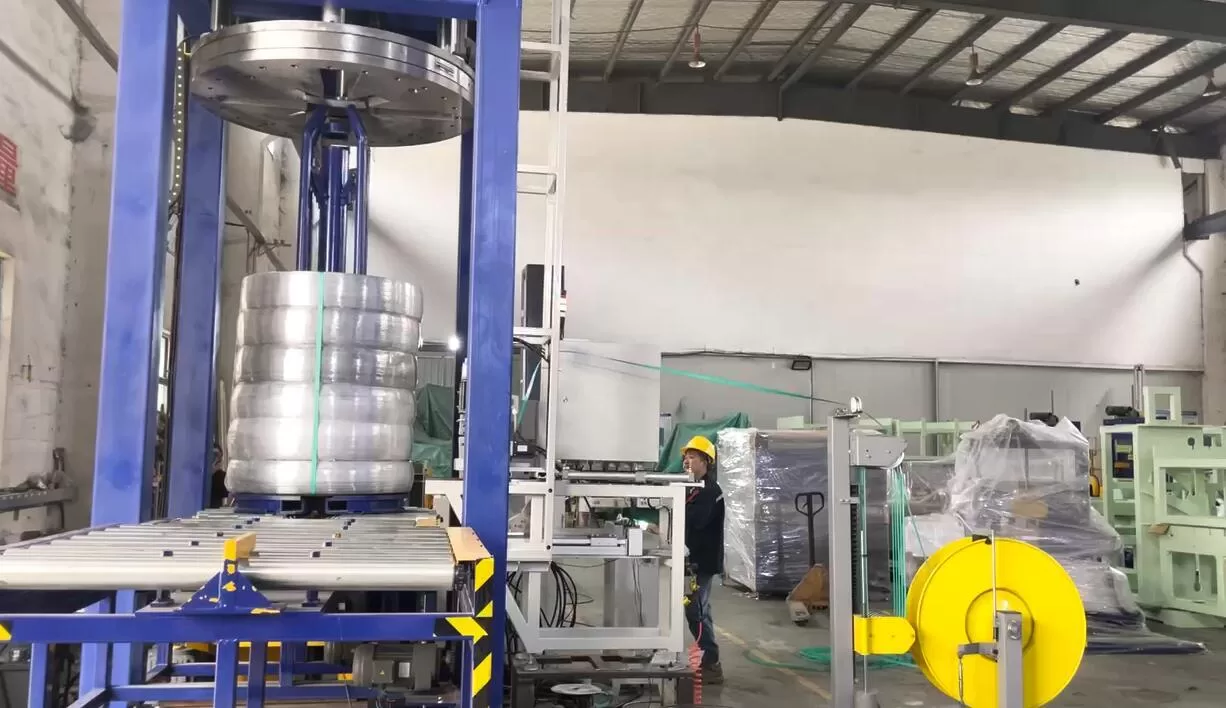
I have seen businesses struggle for years with inconsistent packing. This directly impacts their bottom line. A poorly packed coil can result in product damage during transit, leading to costly reworks, customer dissatisfaction, and even contract penalties. FHOPEPACK understands that quality is paramount, and our solutions are built to deliver it reliably.
-
📏 Precision in Material Application: When packing coils manually, it is difficult to maintain uniform film tension or strap tightness. One worker might pull harder than another, or their technique might vary over a shift. This leads to loose wraps or straps that fail to protect the coil adequately. Automated wrapping machines use sophisticated control systems to apply film with consistent, adjustable tension around the entire circumference of the coil. Similarly, automatic strapping machines apply straps at exact locations with precise, measured tension. This ensures the package is always secure. This uniformity is impossible to achieve with human hands.
-
✔️ Elimination of Human Oversight Errors: Humans are prone to mistakes, especially when performing repetitive tasks under pressure or during long shifts. Forgetting to apply a protective layer, misplacing a label, or using the wrong strapping material can happen. Automated systems follow a programmed sequence without deviation. They are not affected by fatigue or distraction. Sensors confirm each step is completed correctly. If a step is missed or an error occurs, the system can flag it or stop the process. This dramatically reduces the chance of oversight errors. It ensures every coil meets the required packing standard.
-
🛡️ Reliable Protection Against Damage: A consistently packed coil offers superior protection against common transit damages. For example, consistent tension in stretch film creates a robust barrier against moisture and dust. Secure strapping prevents coils from unwinding or shifting during transport. These factors are critical for maintaining product integrity. They are especially important for high-value items like cold-rolled, galvanized, or pre-painted coils. Automated lines consistently deliver this level of protection. This means fewer claims, happier customers, and a better reputation for your steel mill.
-
📝 Adherence to International Standards: For clients who export, meeting international packing standards (like CE or ISO) is non-negotiable. Manual packing can make certification difficult due to inherent variability. Automated lines, with their repeatable precision, make it much easier to consistently meet and document these strict requirements. They can integrate barcode application and specific material usage for traceability. This ensures compliance with various regulatory demands. This capability is vital for expanding into international markets. It opens up new opportunities for businesses in countries like France.
How Do These Lines Handle Diverse Steel Coils Automatically?
Imagine running a steel mill that produces cold-rolled, galvanized, and pre-painted coils, all with different diameters, weights, and packaging requirements. Manually switching between these diverse needs can be a logistical nightmare. It often involves retooling, extensive human judgment, and a high risk of error. This slows down production and makes flexibility a challenge.
Automated steel coil packing lines handle diverse steel coils automatically by incorporating flexible designs, intelligent control systems, and quick-change mechanisms. These features allow the system to adapt to varying coil dimensions (diameter, width, weight), material types, and specific customer packing requirements (e.g., PET vs. steel strapping, different film types) with minimal human intervention or downtime for adjustments.
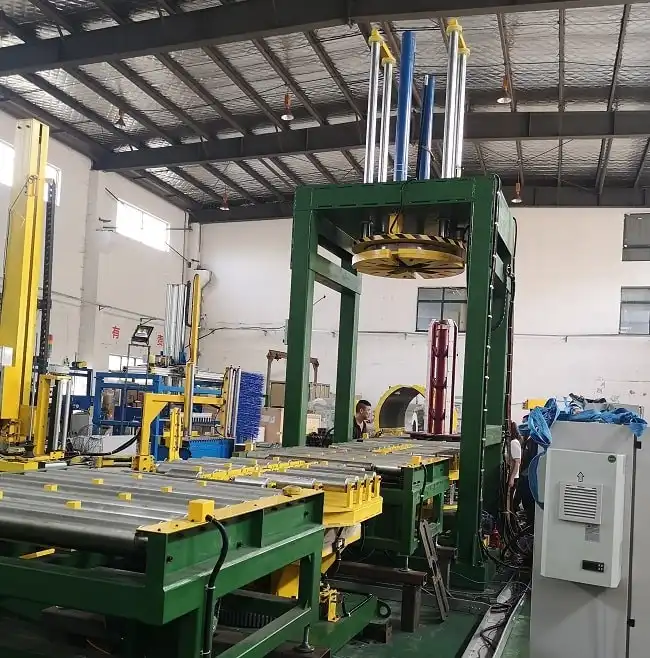
The demand for product diversification is a constant trend in the steel industry. Meeting varied customer needs while maintaining efficiency is a key challenge. At FHOPEPACK, we understand that a packing solution must be versatile. It must adapt to your evolving product portfolio. This flexibility is what truly makes a packing line an asset.
-
📐 Adaptive Sizing and Measurement: Modern automated packing lines are equipped with sensors that automatically detect the diameter, width, and even weight of incoming coils. This data is fed into the system’s PLC (Programmable Logic Controller). The PLC then adjusts machine parameters accordingly. This means the wrapping arm will move to the correct position, the strapping head will adjust its height, and the film tension will be optimized for that specific coil. Workers do not need to manually measure or input dimensions. This saves time and eliminates measurement errors, ensuring a perfect pack every time, regardless of coil size.
-
🛠️ Quick-Change Tooling and Material Handling: Some systems offer quick-change mechanisms for different strapping heads (e.g., to switch between PET and steel strapping) or for loading various types of wrapping materials (e.g., VCI paper, stretch film, shrink film). While some manual intervention might be needed for material loading, the changeover process for tooling is highly streamlined. This reduces the downtime associated with switching between different packing specifications. It makes the line much more agile in handling mixed product batches. This allows for a wider range of products to be packed on the same line.
-
💻 Programmable Packing Recipes: Advanced control systems allow operators to store “packing recipes” for different product types or customer specifications. For example, “Cold Rolled Export” might specify two PET straps, VCI film, and a specific label format. “Galvanized Domestic” might require three steel straps and standard stretch film. Operators simply select the appropriate recipe from a touchscreen interface. The system then automatically configures all relevant machine settings. This dramatically reduces the complexity and time involved in switching between diverse packing demands. It also minimizes the risk of human error in setting up the machine.
-
🌍 Compliance for Diverse Markets: Different markets and customers have unique requirements. Automated lines can consistently apply specialized packaging like corrosion-inhibiting films for humid climates, or extra layers of protection for long-distance sea freight. They can also integrate specific labeling for different regions. For example, a French steel mill exporting to North America might need imperial measurements on labels or specific safety warnings. The automated system ensures these specific requirements are met without manual oversight for each individual coil. This level of customization and compliance is hard to achieve with manual methods.
What Does This Mean for Production Continuity and Workforce Stability?
Frequent breakdowns, bottlenecks, and high staff turnover can severely disrupt your production schedule. When your packing process relies heavily on manual labor, any shortage of skilled workers or unexpected absences can bring your entire operation to a halt. This impacts delivery times and customer satisfaction. It also creates a stressful environment for your remaining staff.
Automated steel coil packing lines significantly enhance production continuity and workforce stability by providing reliable, 24/7 operational capability, reducing reliance on a large manual workforce, and improving the overall work environment. This means fewer production stoppages due to labor issues, more predictable output, and a more engaged, stable workforce that can focus on system management rather than strenuous physical tasks.
My goal at FHOPEPACK has always been to help businesses build sustainable operations. This means looking beyond immediate output and considering the long-term health of the production process and the people involved. A robust packing line is an investment in both. It protects your business from common industrial vulnerabilities.
-
⏰ 24/7 Operational Capability: Automated packing lines are built for continuous operation. They can run two or three shifts around the clock with minimal supervision. This is especially vital for high-volume steel mills that need to maintain constant output. Unlike human workers, machines do not get tired, require breaks, or take sick days. This ensures a steady, uninterrupted flow of packed coils. This greatly improves overall plant efficiency and capacity utilization. It helps meet tight production deadlines.
-
📉 Reduced Impact of Labor Shortages: The manufacturing sector, including steel production, often faces challenges in attracting and retaining labor for physically demanding jobs. By automating core packing functions, businesses can significantly reduce their dependence on a large pool of manual laborers. This means that even if there are labor shortages in the local market, the packing operation can continue smoothly. It protects the business from staffing-related production disruptions. It also frees up existing staff to be trained for more technical, supervisory, or maintenance roles.
-
📈 Predictable Output and Throughput: Automated systems perform tasks at a consistent speed and with predictable cycle times. This allows for much more accurate production planning and scheduling. You know exactly how many coils can be packed per hour or per shift. This predictability is crucial for managing inventory, optimizing logistics, and setting realistic delivery expectations with customers. It removes the variability introduced by manual labor, leading to a more streamlined and reliable supply chain. This helps prevent unexpected delays and improves overall operational control.
-
🔄 Improved Workforce Morale and Retention: When machines handle the dangerous and repetitive tasks, the work environment becomes safer and less strenuous. This makes the jobs more appealing. Workers can transition to roles that involve monitoring, problem-solving, or system maintenance. These roles require higher skills and offer more intellectual engagement. This leads to higher job satisfaction and better employee retention. Instead of struggling to find people willing to do tough manual labor, companies can invest in upskilling their existing workforce. This creates a more stable, loyal, and skilled team for the long term.
My Insight
Looking back at my journey in the packing machine industry, from an employee in a factory to founding FHOPEPACK, I have seen firsthand how much impact automation can have. It is not just about selling machines. It is about providing solutions that help businesses, big or small, to truly grow. I remember working on packing lines where every single coil was a test of strength and endurance for the workers. Now, with advanced technology, we can change that.
For a production director like Ivan, who needs to ship hundreds of tons daily, the choice to automate is clear. He is not just buying a machine; he is investing in a strategic partnership. He needs a supplier who understands the complete picture. This means someone who can provide a full “turnkey” solution, from design to installation, and offer ongoing support. This includes training for his team and readily available spare parts.
My experience has taught me that true success comes from understanding the client’s unique challenges. We make sure our solutions fit perfectly with their existing production lines. This is why at FHOPEPACK, we do not offer one-size-fits-all products. We focus on customized packing solutions. These solutions address specific needs like handling different coil sizes, ensuring specific packaging standards (like CE/ISO for export), or integrating with existing production management systems. We ensure the investment translates into tangible benefits: higher efficiency, improved safety, unmatched quality, and a significant reduction in labor dependence. This approach not only helps businesses achieve financial independence but also empowers their workforce. It allows them to focus on innovation and growth rather than repetitive, strenuous tasks.
Conclusion
Automated steel coil packing lines are transforming the steel industry by addressing critical challenges like labor shortages, safety concerns, and quality consistency. They achieve this by automating strenuous tasks, improving worker safety, ensuring consistent packaging quality, and offering flexibility for diverse product needs. This leads to uninterrupted production and a more stable, skilled workforce. Investing in a modern coil packing line provides a clear path to greater efficiency, cost savings, and a competitive edge in global markets.








