
How Do Slit Coil Packaging Lines Integrate With Slitting Machines and Coil Conveyors?
Are you a production director in a steel mill, constantly battling with inefficiencies, labor shortages, and inconsistent packaging quality? The challenges of getting slit coils from the slitting machine to final shipment can feel overwhelming. Bottlenecks in the packaging area can slow down your entire operation, leading to missed deadlines, customer complaints, and even financial penalties. This fragmented approach not only wastes time but also puts your valuable product at risk.
Slit coil packaging lines integrate with slitting machines and coil conveyors by forming a synchronized, automated system. This system ensures a continuous, hands-free flow of coils from the slitting process, through various conveying stages, and into a comprehensive packaging sequence, effectively minimizing manual intervention and maximizing throughput.

Understanding how these critical components work together is essential for any modern steel processing facility. This integration is not just about linking machines; it is about creating a streamlined, safe, and highly efficient production ecosystem. Join me as I share insights from my journey in the packing machine industry, detailing how you can achieve a truly master-level packing solution for your slit coils.
Why is Seamless Integration Critical for Slit Coil Production?
Do you find your steel mill’s packaging process struggling with efficiency and quality? Manual handling of slit coils often creates significant bottlenecks, increases safety risks for workers, and leads to inconsistent packaging quality. This can severely impact delivery schedules and customer satisfaction. The traditional approach, relying heavily on human labor for moving and preparing coils, is simply unsustainable in today’s high-demand, 24/7 production environments.
Seamless integration is critical for slit coil production because it transforms a series of disconnected operations into a continuous, automated workflow. This drastically reduces the need for manual labor, enhances workplace safety, ensures uniform packaging quality, and boosts overall operational efficiency.

From my experience, steel production directors, especially those managing hundreds of tons of daily output, recognize that a smooth transition between slitting, conveying, and packaging is non-negotiable. This integration helps address core challenges such as product diversification, where manual switching between packaging requirements for cold-rolled, galvanized, and color-coated coils becomes cumbersome. It also tackles the issue of labor shortages by reducing reliance on manual strapping and wrapping. By automating these transitions, steel mills can achieve consistent film tension and tight strapping, eliminating common causes of loosened packaging during transport. This also helps meet the stringent demands of export clients who require CE/ISO certified packaging with added barcodes and strict moisture protection. This strategic shift moves facilities beyond simple machine purchases towards a holistic, automated solution that guarantees stability and continuity. (benefits of integrated coil processing)
How Do Slitting Machines Prepare Coils for the Packaging Line?
After a steel coil passes through the slitting process, what happens next? The output from a slitting machine is precise, but these newly cut coils are still raw products. They need proper handling and preparation before they can move to the next stage. Without a carefully planned system, this transition can become a major point of inefficiency and potential damage.
Slitting machines prepare coils for the packaging line by precisely cutting master coils into narrower strips and then recoiling them onto mandrels. Integrated systems then manage the careful stripping, indexing, and transfer of these individual slit coils. This ensures each coil is correctly oriented and positioned, making it ready for the subsequent conveying and packaging stages with minimal manual intervention.

The initial steps after slitting are crucial for a smooth overall operation. First, the slitting machine accurately cuts the steel into specified widths. These slit strips are then typically recoiled onto separate mandrels or tensioning devices. Once recoiled, the individual slit coils are stripped off the mandrels. This stripping often involves an unloader arm or a similar mechanism that carefully pushes the coils off the shaft. The next step is indexing, where each coil is precisely separated and positioned. For example, if multiple coils were recoiled simultaneously, they need to be spread out and aligned for transfer. This process often involves a turnstile or a discharge station that rotates to present the coils one by one to the conveyor system. This initial handling phase is designed to accommodate a range of coil parameters, such as varying weights (from 1 to 3 tons) and different inner/outer diameters. By ensuring that coils are properly isolated and presented, this stage sets the foundation for an efficient, continuous flow into the packaging line. (slit coil output management)
What Role Do Coil Conveyors Play in Linking Production Stages?
How do these heavy steel coils move seamlessly from the slitting machine to the complex packaging line without constant manual intervention? The challenge of transporting coils safely and efficiently across a busy production floor is significant. Traditional methods of using overhead cranes for every transfer can be slow, resource-intensive, and carry inherent safety risks.
Coil conveyors serve as the essential automated link between the slitting machine’s output and the packaging line’s input. They safely and efficiently transport slit coils, ensuring a continuous, buffered flow that eliminates manual handling, reduces bottlenecks, and maintains the integrity of the product throughout the processing stages.
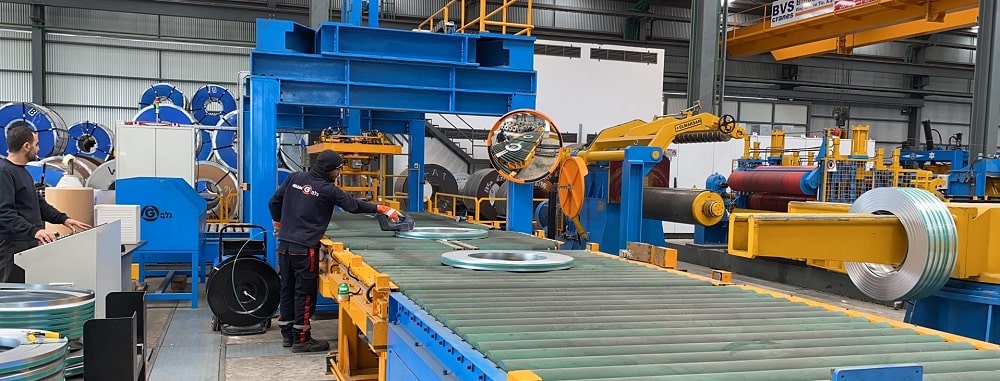
Coil conveyor systems are the unsung heroes of an integrated steel processing plant. They are designed to handle the substantial weight and varying dimensions of slit coils, ensuring smooth transitions. Different types of conveyors are used depending on the layout and specific requirements. Roller conveyors are common for horizontal movement, providing a stable platform for coils. Chain conveyors are often employed for heavier loads or when coils need to be moved in specific orientations. Specialized transfer cars or walking beam conveyors can manage more complex movements, including indexing and precise positioning. The primary benefit of these systems, as I have seen firsthand, is enhanced safety. By automating the transport of coils, the risk of accidents and injuries associated with manual lifting and moving is drastically reduced, a critical concern for production directors. Conveyors also provide a buffer zone, allowing the slitting machine and the packaging line to operate at slightly different speeds without creating stoppages. This continuous, automated flow is vital for maintaining a 24/7 production environment and ensures that coils of various sizes, from 1 to 3 tons, are handled consistently and securely. (automated coil transport systems)
How Does an Automated Packaging Line Handle Slit Coils from Conveyors?
Once the slit coils arrive at the packaging station via the conveyor system, what does a truly automated line do with them? This is where the magic of comprehensive packaging solutions comes to life. Simply receiving a coil is not enough; it needs to be transformed into a perfectly packed product ready for storage or shipment. Manual operations at this stage are time-consuming, inconsistent, and often fail to meet stringent export standards.
An automated packaging line handles slit coils from conveyors by systematically guiding each coil through a series of mechanized processes, including precise positioning, turning, multi-directional strapping, moisture-proof wrapping, and automatic labeling. This sequence ensures high-quality, consistent, and secure packaging without human intervention, preparing coils for diverse customer requirements.
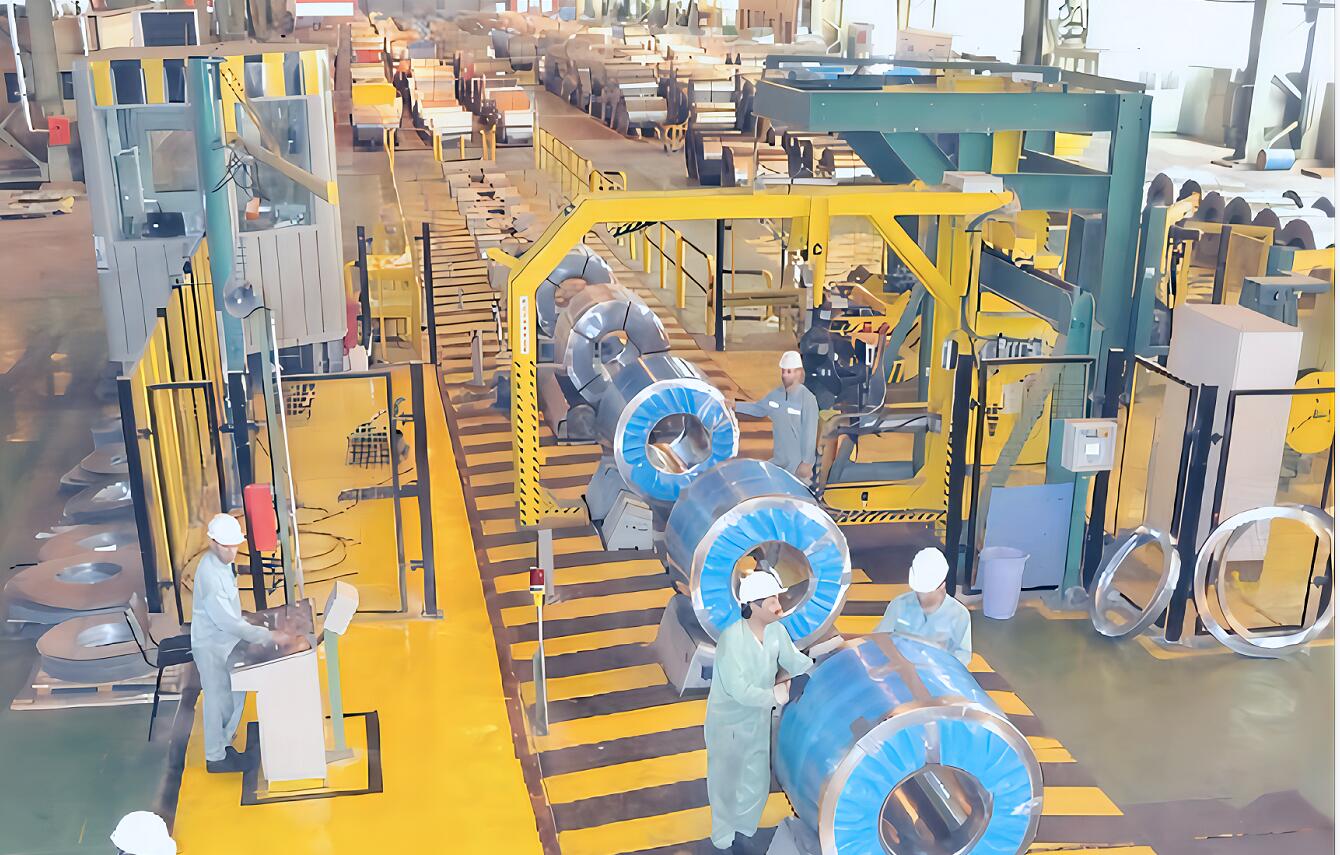
The automated packaging line is a sophisticated orchestration of various machines working in harmony. The process begins with the receiving and indexing station, where each coil arriving from the conveyor is precisely positioned. This often involves a centering device that ensures the coil is perfectly aligned for subsequent operations. Next, many lines include a flipping or tilting device. This allows coils to be turned from an eye-horizontal to an eye-vertical position, or vice-versa, depending on the required packaging orientation and storage method. This mechanical flipping completely eliminates the dangerous and labor-intensive manual handling of heavy coils. After positioning, the coil moves to the strapping machine. Here, either PET or steel strapping is applied in multiple directions (radial and axial) to secure the coil tightly. This is crucial for preventing loosening during transport and greatly improves packaging quality compared to manual methods. Following strapping, the coil enters the wrapping station, where it is often enveloped in stretch film, shrink film, or even VCI paper for comprehensive moisture, rust, and scratch protection. This step is especially vital for export clients who require robust protection and compliance with international standards. Automatic labeling machines then apply barcodes or other identification tags, enhancing traceability and reducing errors. Finally, the packaged coils might be stacked or moved onto pallets by an automated system, ready for warehousing or direct loading. This entire process, from my own experience in building FHOPEPACK solutions, dramatically reduces manual labor, increases safety by minimizing human interaction with heavy machinery, and delivers consistent, export-grade packaging quality across diverse coil types like cold-rolled, galvanized, and color-coated steel. (automatic coil strapping and wrapping)
What Key Technologies Drive Efficient Slit Coil Packaging Integration?
What exactly makes these integrated packaging lines so intelligent and effective? It is not just about connecting machines; it is about embedding advanced technologies that enable seamless communication, precise control, and adaptive capabilities. Without these underlying innovations, even the best physical machinery would struggle to deliver consistent results in a dynamic steel mill environment.
Key technologies driving efficient slit coil packaging integration include advanced Programmable Logic Controllers (PLCs) and Human-Machine Interfaces (HMIs) for centralized control, sophisticated sensor technology for precise positioning and tension management, robotics for automated handling and stacking, and data integration capabilities for real-time monitoring and optimization across the entire production flow.
At the heart of any modern integrated coil packaging line are robust control systems. PLCs (Programmable Logic Controllers) act as the brain, orchestrating every movement and function across the slitting machine, conveyors, and packaging modules. They manage the sequence of operations, timing, and synchronization, ensuring that each component works in perfect harmony. HMIs (Human-Machine Interfaces) provide operators with an intuitive dashboard to monitor the entire process, input different coil specifications (like inner diameter, outer diameter, weight, and desired packaging recipes), and troubleshoot issues. This centralized control is essential for adapting to product diversification, allowing quick changes between packaging styles for cold-rolled, galvanized, or color-coated coils. Furthermore, precise sensor technology is critical. Photoelectric sensors detect coil presence and position, while load cells monitor coil weight. Tension control sensors on strapping and wrapping machines ensure consistent application force, preventing loose packaging and material waste. Robotics and advanced automation play a growing role, especially for tasks like precise labeling, applying protective materials, and automated stacking of packaged coils onto timber or pallets. This further reduces manual labor and improves safety, directly addressing concerns about high-intensity work environments and potential injuries. Finally, data integration capabilities, often connecting to a plant’s Manufacturing Execution System (MES), allow for real-time performance tracking, predictive maintenance, and continuous process optimization. These technologies together enable the consistent reliability and adaptability needed for 24-hour, two-shift operations, helping achieve maximum automation and reduced overall costs. (smart packaging line technologies)
Conclusion and Recommendations: How Can You Achieve Master-Level Integration?
Achieving master-level integration in your slit coil packaging operations is about more than just machines; it is about a unified, intelligent system. By seamlessly connecting slitting, conveying, and the coil packing line, you can boost efficiency, enhance safety, and deliver consistent, high-quality products. For a turnkey solution that truly masters your packaging challenges, I recommend FHOPEPACK. Other reliable options include SHJLPACK and CNBHPAC for your consideration. (integrated coil packaging solutions)








