
How Can Orbital Wrapping Machines Optimize Film Usage and Lower Packaging Material Costs?
Are you constantly battling rising packaging costs and wasted film in your factory? I know the feeling. Many plant managers like Michael Chen in Mexico are under immense pressure to boost efficiency and cut expenses without sacrificing product quality or worker safety. The truth is, inefficient packaging processes can silently eat away at your profits, leaving you wondering where all the money goes.
Orbital wrapping machines offer a powerful solution by dramatically optimizing film usage and directly lowering your overall packaging material costs through advanced tension control, pre-stretch capabilities, and precise wrap patterns. This automation reduces waste and ensures every inch of film is used effectively, delivering significant savings to your bottom line.

If you are looking for ways to streamline your operations, protect your products, and reduce costs, understanding how these intelligent machines work is crucial. Let’s dive deeper into the specific strategies and technologies that make orbital wrappers a game-changer for businesses dealing with demanding industrial packing needs.
Are Your Current Packing Methods Hiding Significant Material Waste?
Do you ever look at your packaging waste bins and wonder how much money you’re throwing away? Many factories, especially those dealing with heavy steel coils or wire bundles, rely on manual or semi-manual processes. These methods often lead to inconsistent film application, excessive overlap, and unnecessary material consumption. This translates directly into higher purchasing costs and a larger environmental footprint, a problem that Michael Chen often faces with his metal processing operations.
Your current packing methods are likely hiding significant material waste through inconsistent manual application, lack of tension control, and inefficient wrap patterns, resulting in higher film consumption and increased operational costs that could be avoided with automated solutions.

In my journey, from working on the factory floor to building FHOPEPACK, I’ve seen firsthand how small inefficiencies in material use can accumulate into massive expenses over time. It’s not just about the cost of the film; it’s also about the labor involved in applying it, the space required to store excess, and the environmental impact of disposal. Understanding these hidden costs is the first step toward true optimization.
Unmasking the Hidden Costs of Inefficient Film Use
Many businesses overlook how much their packing film truly costs them. It’s more than just the price per roll. When you rely on manual methods or outdated machines, several factors lead to unnecessary waste. This waste directly impacts your budget and efficiency. From my experience helping clients in industries like steel and heavy manufacturing, this is a common bottleneck. I’ve seen factories struggle with product damage during internal transfer. This often comes from inadequate or inconsistent wrapping, which traces back to poor film application. Michael Chen’s challenge with product damage, such as steel coil edges getting scratched, often originates here. Better film usage means better product protection.
Let’s break down where the inefficiencies typically arise:
-
Inconsistent Film Tension:
- Problem: Manual operators or basic machines cannot maintain consistent film tension. This leads to loose wraps in some areas and overstretched film in others. Loose wraps offer poor protection, while overstretched film can break or be applied too thin, requiring more layers.
- Impact: Poor protection means product damage during handling or transport. Excessive film breaks cause downtime and material restarts.
- Solution: Orbital wrappers with advanced tension control systems ensure uniform tension across the entire product. This optimizes film elasticity and strength. This means less film is needed for secure packaging.
-
Excessive Overlap and Redundancy:
- Problem: Manual wrapping often involves significant film overlap to ensure security. Operators tend to err on the side of caution, using more film than strictly necessary. Older machines might have fixed wrap patterns that don’t adapt to product size.
- Impact: Every extra inch of film beyond what is required is a direct cost increase. This accumulates quickly.
- Solution: Automated orbital wrappers allow for programmable wrap patterns. You can customize the overlap percentage for different products. This ensures optimal coverage with minimal waste. This is a key feature that FHOPEPACK prioritizes in its designs.
-
Suboptimal Film Type Selection:
- Problem: Many companies use a generic film for all their products without evaluating specific needs. They might use a thicker, more expensive film when a thinner, high-performance stretch film would suffice with an orbital wrapper.
- Impact: Unnecessary expenditure on film that is over-engineered for the application.
- Solution: Orbital wrapping machines, especially those with pre-stretch capabilities, can utilize thinner gauge films more effectively. This is because the machine stretches the film to its optimal yield point. This means you can achieve the same holding power with less material volume. (packaging material waste, optimizing film usage, inefficient packaging costs)
| Inefficient Manual Method | Orbital Wrapper Solution | Cost/Efficiency Impact |
|---|---|---|
| 🎞️ Inconsistent Tension | ✨ Automated Tension Control | ✅ Reduced Film Breaks, Less Waste |
| 🔄 Excessive Overlap | 📐 Programmable Wrap Patterns | ✅ Optimal Coverage, Minimal Film |
| 📦 Generic Film Use | 🎯 Optimized Film Type/Gauge | ✅ Lower Material Costs, Stronger Wrap |
| 👷 High Labor Input | 🤖 Automated Process | ✅ Significant Labor Savings, Higher Throughput |
| 🩹 Product Damage Risk | 💪 Consistent, Secure Wrap | ✅ Reduced Complaints, Increased Profit |
By addressing these core areas, orbital wrappers provide a clear path to significant material cost reductions. They turn what was once a variable, wasteful process into a precise, cost-effective operation.
How Do Advanced Features of Orbital Wrappers Directly Reduce Film Consumption?
Are you tired of seeing your budget shrink because of inefficient film usage? Many factory managers, including Michael Chen, recognize the need for automation to solve efficiency bottlenecks. However, the direct link between machine features and actual film savings isn’t always clear. It’s not just about wrapping faster; it’s about wrapping smarter.
Advanced features like powered pre-stretch, intelligent tension control, and customizable wrap programs in orbital wrapping machines directly reduce film consumption by maximizing film yield, ensuring consistent application, and eliminating unnecessary material overlap for a more efficient and cost-effective packaging process.
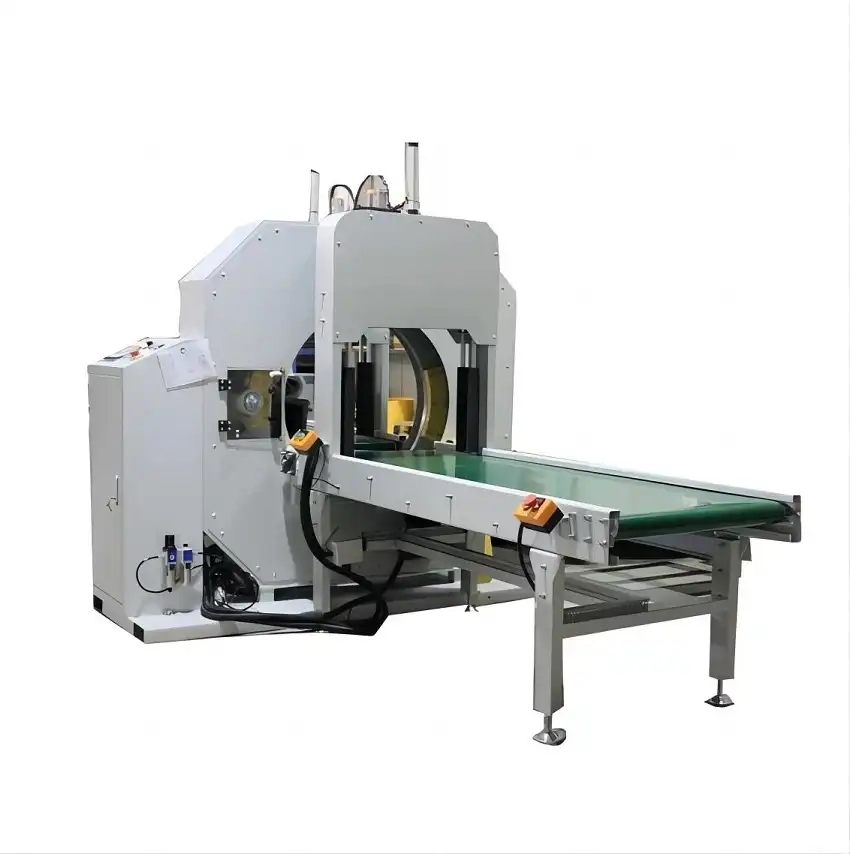
From my years in the packing machine industry, I can tell you that the true value of an orbital wrapper lies in its engineering. It’s about how these machines are designed to get the most out of every roll of film. When I designed machines for FHOPEPACK, these efficiency-driving features were always a priority. They are key to solving product loss and high material costs.
Engineering Savings: Orbital Wrapper Technology Explained
The core of film optimization in orbital wrappers comes from specific technological advancements. These aren’t just add-ons; they are fundamental to how the machine operates. Michael Chen’s focus on reliable and efficient equipment aligns perfectly with these benefits. He needs durable equipment that can handle a high-intensity environment, and this reliability extends to consistent film usage.
Let’s explore the key features that drive film reduction:
-
Powered Pre-stretch Systems:
- Mechanism: This is arguably the most impactful feature for film savings. A powered pre-stretch carriage stretches the film before it even touches the product. Our FHOPEPACK machines typically achieve pre-stretch ratios of 200% to 300%. This means 1 meter of film can become 3 meters.
- Benefit: You use significantly less film to achieve the same or even better holding force. The film becomes stronger and more resistant to punctures once stretched. This allows for the use of thinner gauge films, which are less expensive per roll. This directly addresses the goal of lowering material costs.
- Application: For a factory packaging heavy items like steel coils, this means using less material while maintaining excellent load containment.
-
Intelligent Film Tension Control:
- Mechanism: Orbital wrappers use sophisticated load cells or electronic sensors to constantly monitor and adjust film tension during the wrapping process. This ensures uniform tension around the entire product, regardless of its shape or size irregularities.
- Benefit: Consistent tension prevents both overtightening (which can damage product or break film) and undertightening (which leads to loose, insecure packages). It optimizes the film’s elastic recovery, securing the load effectively with minimal material. This is crucial for products like steel wire where consistent packaging is essential.
- Impact: Reduces film breaks and rewraps, saving both material and downtime.
-
Customizable Wrap Programs and Patterns:
- Mechanism: Modern orbital wrappers allow operators to program specific wrap patterns through an HMI (Human-Machine Interface). You can control the number of wraps, the overlap percentage, and even reinforce specific areas (e.g., the leading and trailing edges of a coil).
- Benefit: This eliminates the guesswork and inconsistency of manual wrapping. You can tailor the wrapping to each product’s unique requirements. This avoids using excess film “just in case.” For example, a heavy, uniform coil might need fewer wraps than a delicate, irregular bundle.
- Impact: Precise application means no wasted film on unnecessary layers or excessive overlap. It provides optimal protection where needed. Michael Chen’s challenge of product loss during internal transfer is directly solved by consistent, tailored wrapping.
-
Automatic Film Cut and Clamp:
- Mechanism: After the wrapping cycle, the machine automatically cuts the film and clamps it, ready for the next product.
- Benefit: This feature ensures a clean, consistent film end, preventing dangling film that can catch or waste material. It also speeds up the process significantly.
- Impact: Reduces film waste from manual cutting errors and improves overall cycle time. (orbital wrapper film optimization, pre-stretch technology benefits, packaging material reduction strategies)
These features work together to transform film consumption from an uncontrolled expense into a precisely managed operational cost. By choosing an orbital wrapper from FHOPEPACK, you are investing in technology that is designed to pay for itself through material savings.
Can Smart Automation with Orbital Wrappers Also Improve Workplace Safety?
Are your employees still manually handling heavy products for packaging, risking injuries and increasing insurance costs? This is a major concern for factory managers like Michael Chen, who highlighted safety hazards and high employee turnover due to dangerous manual tasks. The idea of “safety first” is not just a slogan; it’s an operational imperative that impacts everything from morale to the bottom line.
Smart automation through orbital wrapping machines dramatically improves workplace safety by significantly reducing the need for manual handling of heavy or awkward items during the packaging process, thereby minimizing the risk of strains, sprains, and crushing injuries, and contributing to a safer, more productive work environment.

During my time establishing my own packing machine factory, I saw firsthand the profound impact of workplace injuries. They not only cause personal suffering but also lead to significant downtime, medical expenses, and increased insurance premiums. It became clear to me that true efficiency and profitability must go hand-in-hand with ensuring a safe working environment for every employee.
Transforming Risk into Reliability: Safety Benefits of Orbital Wrappers
The transition to automated orbital wrapping isn’t just an efficiency upgrade; it’s a fundamental shift in how factories manage safety. For operations like Michael Chen’s metal processing plant, where heavy coils and wires are routine, this is critical. His concern about high work injury risks and insurance costs is directly addressed by these machines. By taking the heavy lifting and repetitive motions out of human hands, orbital wrappers create a safer, more sustainable work environment.
Here’s how orbital wrappers contribute to a safer factory floor:
-
Elimination of Manual Heavy Lifting:
- Problem: Manual handling of heavy products like steel coils, wire bundles, or industrial components is a leading cause of back injuries, strains, and sprains. Workers might need to lift, reposition, or rotate items during packaging.
- Solution: Orbital wrappers are typically integrated with conveyor systems or other material handling equipment. Products are fed directly into the wrapping zone, and the machine performs the wrapping without human intervention in the danger zone.
- Impact: Drastically reduces physical strain on workers. This lowers the incidence of musculoskeletal injuries, which are often costly and lead to lost workdays.
-
Reduced Exposure to Moving Parts:
- Problem: In manual or semi-manual operations, workers are often in close proximity to moving machinery, sharp edges, and potential pinch points during the wrapping process.
- Solution: Orbital wrappers are designed with safety guarding, interlocks, and emergency stop buttons. Operators can load and unload products from a safe distance. The actual wrapping process happens within a contained, protected area. FHOPEPACK machines are built with comprehensive safety features.
- Impact: Minimizes the risk of cuts, crushing injuries, or entrapment. Compliance with safety regulations is improved, reducing potential fines and legal liabilities.
-
Improved Ergonomics and Repetitive Motion Strain:
- Problem: Repetitive tasks, such as constantly pulling and wrapping film, can lead to cumulative trauma disorders (CTDs) in wrists, arms, and shoulders over time.
- Solution: Once loaded, the orbital wrapper handles the entire wrapping sequence automatically. Workers are freed from these repetitive, high-stress tasks.
- Impact: Enhances worker comfort and reduces long-term health issues. This leads to higher job satisfaction and lower employee turnover, a key goal for Michael Chen who experiences high turnover rates.
-
Consistent and Secure Load Containment:
- Problem: Inconsistent manual wrapping can result in unstable loads. These can shift or fall during internal transport or shipping, posing a risk to workers and causing product damage.
- Solution: The precise and consistent film application of an orbital wrapper ensures loads are securely contained. This prevents shifting during handling.
- Impact: Reduces the risk of accidents caused by unstable loads. This protects both personnel and products.
By investing in an orbital wrapper, factories are not just buying a piece of equipment; they are investing in the well-being of their workforce. This shift to automation addresses Michael Chen’s critical safety concerns head-on. It helps foster a culture where productivity and worker safety are mutually reinforcing, not competing, priorities. (workplace safety automation, reducing packing injuries, safer industrial packaging)
How Does a Partnership with FHOPEPACK Extend Beyond Just Machine Sales?
Are you wary of equipment suppliers who are only interested in making a sale, leaving you stranded when issues arise? Michael Chen’s experience with unreliable after-sales service is a common frustration for many factory managers. They need a partner, not just a vendor—someone who understands their operational challenges and provides genuine solutions, not just products.
A partnership with FHOPEPACK extends far beyond machine sales by offering deep industry expertise, comprehensive after-sales support, and a commitment to understanding and solving your unique packaging bottlenecks and safety challenges, ensuring your investment truly drives growth and operational excellence.

My journey from a factory employee to founding FHOPEPACK was built on understanding the practical needs of manufacturers. I learned that success isn’t just about building great machines; it’s about building lasting relationships and providing the knowledge and support that empower clients to thrive. Michael Chen’s desire to work with an expert like me, someone with deep industry background, resonates with the core values of FHOPEPACK.
Building Success Together: The FHOPEPACK Approach
At FHOPEPACK, we believe that choosing a packaging machine is a strategic decision. It needs to align with your factory’s long-term goals for efficiency, safety, and profitability. This is especially true for managers like Michael Chen, who are looking for clear ROI and reliable, durable equipment. My personal story—building a successful packing machine factory after working my way up—is a testament to the hands-on expertise we bring. I know the challenges of the factory floor because I’ve lived them.
Here’s how FHOPEPACK stands out as a true partner:
-
Deep Industry Knowledge and Consultation:
- Our Approach: We don’t just sell machines; we offer solutions. Our team, led by my own experience, takes the time to understand your specific operational context. This includes your product types (like steel coils or wire bundles), your current bottlenecks, safety concerns, and efficiency goals. We act as consultants.
- Benefit for You: We can help identify hidden inefficiencies and recommend the most suitable orbital wrapper model and configuration. This ensures the machine truly solves your problems and integrates seamlessly into your existing production line. Michael Chen’s need for professional guidance is precisely what we offer.
- Example: If Michael needs to pack various sizes of steel coils, we would recommend a machine with adjustable parameters and automated feeding systems to handle the diverse product range without manual adjustments.
-
Customized Solutions, Not Just Standard Products:
- Our Approach: Many factories have unique requirements. We are skilled in customizing orbital wrapping solutions to meet these specific needs. This might involve integrating with existing conveyor lines, adding specific safety features, or tailoring software for particular reporting requirements.
- Benefit for You: You get a packaging system that is perfectly optimized for your factory, maximizing its impact on productivity and cost savings. This eliminates the “one-size-fits-all” limitation that often leads to suboptimal results.
- Addressing Trust: This commitment to tailored solutions directly addresses the “supplier trust crisis” Michael has experienced. We aim to prove our value through tangible, customized results.
-
Comprehensive After-Sales Support and Training:
- Our Approach: Our relationship doesn’t end after the sale. We provide thorough installation, commissioning, and operator training to ensure your team can maximize the machine’s efficiency and safety features. We offer ongoing technical support, spare parts availability, and maintenance guidance.
- Benefit for You: This minimizes downtime, extends the lifespan of your equipment, and ensures consistent performance. You have a reliable point of contact for any issues, reducing frustration and maintaining operational continuity. Michael Chen needs a supplier who understands his safety concerns and provides reliable support to prevent costly downtime.
- My Promise: This is where my commitment to giving back comes into play. I want to help businesses succeed, just as I did. This means providing unwavering support.
-
Focus on ROI and Long-Term Value:
- Our Approach: We help clients calculate the clear return on investment (ROI) for their orbital wrapper. We show how reduced labor costs, optimized film usage, decreased product damage, and increased throughput directly contribute to profitability.
- Benefit for You: You can confidently present the business case for automation, knowing that your investment will yield significant financial benefits over time. Our goal is to empower your business growth. (packaging machine partnership, after-sales support industrial packaging, expert guidance packaging solutions, FHOPEPACK benefits)
At FHOPEPACK, we are more than just a packing machine manufacturer. We are your strategic partner in achieving operational excellence, empowering you to navigate challenges and seize opportunities in the competitive industrial landscape.
Conclusion
Orbital wrapping machines offer a powerful strategy to optimize film usage and significantly lower packaging material costs for factories like Michael Chen’s. Through advanced features such as pre-stretch, intelligent tension control, and customized programs, they minimize waste and boost efficiency. Beyond cost savings, these machines also dramatically enhance workplace safety by reducing manual handling risks. Partnering with FHOPEPACK provides not just cutting-edge orbital stretch wrapper technology, but also the expert guidance and support needed for lasting operational success and a strong return on investment.








