
🛠️ Standard Overview
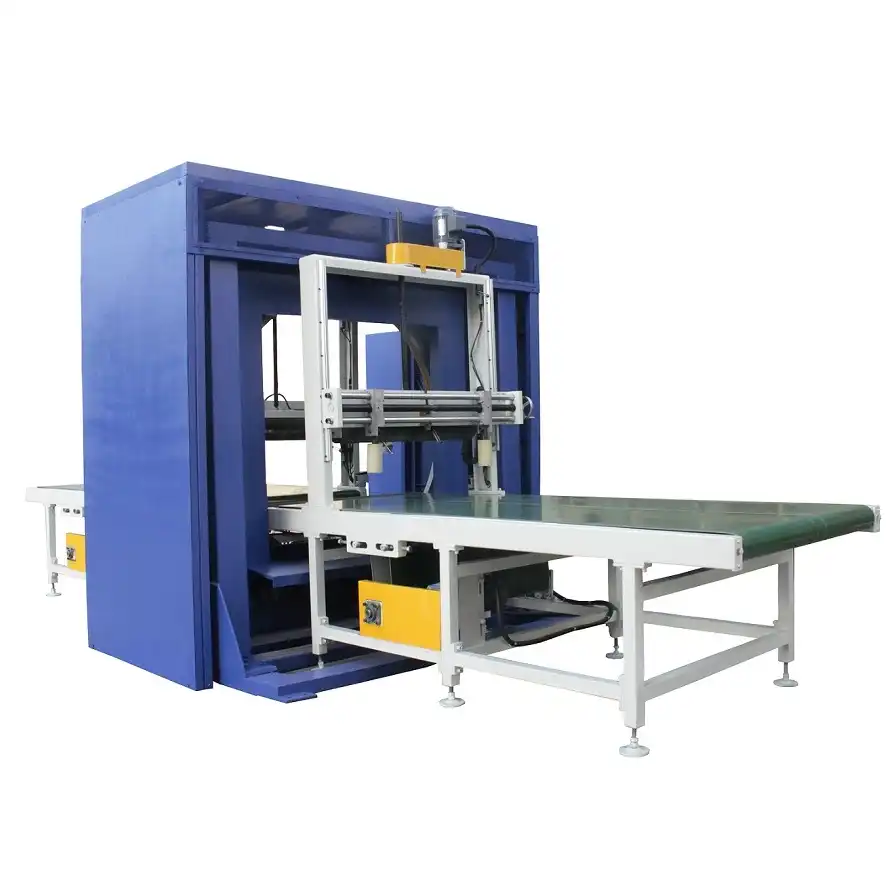
For cabinet manufacturers requiring end-line packaging with stretch film only (no bubble wrap or EPE), the industry-preferred solution is a horizontal orbital or rotary ring stretch wrapper that applies film around stationary loads. These machines are standard for long, irregularly shaped products such as cabinets, doors, and furniture panels, as confirmed by suppliers including SHJLPACK, Robopac USA. Stretch film wrapping offers cost-effectiveness, consistent quality, and higher productivity compared to manual methods with bubble wrap.
Key operational principles:
-
Orbital wrappers: Product is stationary while a rotating ring encircles it, applying stretch film from a roll mounted on the ring.
-
Rotary arm wrappers: Product remains stationary; a moving arm rotates around it – suited for heavy or unstable loads.
-
Horizontal rotating ring wrappers: High-speed automatic option for long profiles, considered most productive and safe for cabinet applications (Robopac USA).
-
Turntable wrappers: Product rotates on a turntable – suitable only for stable palletized loads, not recommended for long cabinets.
Machine automation levels:
-
Semi-automatic: Operator loads/unloads the package; wrapping cycle is automatic.
-
Automatic: Entire process (infeed, wrapping, outfeed) runs without operator intervention.
All cited suppliers recommend stretch film wrapping as the primary method for cabinet end-line packaging. No additional protective materials like bubble wrap or corrugated pads are needed when the film is applied with proper tension and overlap.
🏗️ Key Changes
Switching from multi-material protection (bubble wrap, EPE foam, corrugated) to a stretch-film-only system reduces material costs and waste disposal, but introduces trade-offs in minimum package length handling, edge protection, and upfront machine investment. Based on supplier literature, stretch film is more cost-effective and widely available than bubble wrap. However, three critical differences must be addressed:
| Factor | Traditional (bubble/EPE) | Stretch film only (orbital wrapper) |
|---|---|---|
| Material cost per cabinet | Higher (bubble wrap is 3–5× more expensive per sq. ft. than stretch film – estimate based on industry averages; verify with supplier) | Lower – stretch film cost quoted per roll (typical $0.002–$0.004 per sq. ft.) |
| Throughput | Manual: ~10 cabinets/hour (one operator) | Automatic: up to 60 cabinets/hour (depending on package length and machine speed) |
| Corner protection | High (bubble absorbs impact) | Requires tension control and optional edge guards for sharp corners |
| Minimum package length | No mechanical limit | Typically ≥600 mm for standard machines; shorter lengths need custom conveyor design |
Key point: The most significant design change is handling very short packages (e.g., 400 mm length). Standard orbital wrappers have a conveyor gap that requires a minimum package length of approximately 600 mm. For shorter packages, a custom conveyor with a reduced gap is necessary, which may limit film width and increase cost. This trade-off must be evaluated against the actual production mix.
📈 Business Impact
Implementing a horizontal orbital stretch wrapper directly reduces per-cabinet packaging labor by an estimated 60–70% (based on supplier claims) and eliminates bubble wrap procurement, with typical payback periods of 12–24 months depending on production volume. The following business factors are derived from supplier documentation and industry norms; actual figures require supplier quotation.
Three decision drivers:
-
Volume breakeven: At 100 cabinets/day, the machine often pays back in <18 months (supplier estimates). Lower volumes may favor semi-automatic models.
-
Material cost savings: Stretch film is significantly cheaper than bubble wrap. Annual savings on material alone can reach $5,000–$15,000 for a medium-sized shop (estimate – confirm with your material supplier).
-
Quality consistency: Machine-applied film tension is uniform (±10% overlap), reducing customer complaints about loose packaging. Top press-down device prevents cabinet movement during wrapping.
Risk: The machine must handle both very short and long cabinets. If the custom solution for short packages is not properly engineered, throughput will drop or film waste will increase. Always request a factory acceptance test (FAT) with representative packages before shipping – this is a non-negotiable requirement to verify performance across your full product range.
🛡️ Compliance Actions
To ensure the machine meets operational requirements and applicable safety standards (e.g., CE marking, ISO 12100), the buyer must confirm power supply, air pressure, and film roll specifications with the supplier, and conduct a Factory Acceptance Test (FAT) with representative package samples. Additionally, machinery imported into Mexico must comply with NOM-001-SEDE (electrical installations) and NOM-004-STPS (safety for machinery) – consult local regulations.
Below is a compliance checklist derived from typical supplier inquiry responses:
| Requirement | Supplier confirmation needed | Action required from buyer |
|---|---|---|
| Stretch film only (no bubble/EPE) | Yes – standard for cabinet wrapping | Provide film sample for FAT |
| Short package handling (if below standard minimum length) | Yes – custom conveyor required | Accept higher cost & narrower film width if needed |
| Non-scratch conveyor surface | Yes (PVC belt or PU rollers) | Specify surface type in purchase order |
| Top press-down for variable heights | Yes – adjustable device | Confirm cylinder stroke and force |
| FAT before shipment | Required | Prepare min. & max. mock-up packages |
| English manual + electrical/pneumatic diagrams | Yes | Request before payment |
| Warranty (minimum 1 year) | Standard | Negotiate spare parts package |
| Remote technical support | Yes | Set up VPN or remote access if needed |
Key point: The buyer must provide at least two representative test packages (smallest and largest dimensions) for the FAT. The supplier should produce a 3D layout showing conveyor length, working direction, and floor space (estimated 6 m × 2.2 m × 2.2 m for typical orbital wrapper). Machine ships in one 20‑foot container (approx. 1.5 t gross weight). Ensure installation clearance per layout.
⚙️ Timeline & Deadlines
Based on typical custom machine delivery cycles from experienced suppliers (18+ years in industry), lead time from order to shipment is 8–12 weeks, including design, fabrication, FAT, and shipping. No mandatory regulatory deadline applies, but the machine should be operational before any customer-mandated packaging change.
Typical milestones (estimates – confirm with your supplier):
| Milestone | Estimated duration | Remarks |
|---|---|---|
| Order & down payment | Day 0 | 30–50% deposit (typical) |
| Engineering & layout drawing | 2–3 weeks | 3D layout, electrical/pneumatic diagrams |
| Fabrication | 4–6 weeks | Customization for short packages adds time |
| FAT (factory acceptance test) | 1–2 days | Buyer present or via video |
| Shipping (20‑ft container) | 2–4 weeks | FOB or CIF – confirm incoterms |
| Installation & commissioning | 1–2 weeks on-site | Remote support available |
Key point: Approve layout drawings within 2 weeks of order to avoid delays. If the main packaging range is >600 mm length, standard solution applies. If packages ≤400 mm are common, custom approach needed with trade-off in film width and price – decide before order placement.
🛠️ Purchase-Decision Checklist
Use this checklist when evaluating supplier quotes for a horizontal orbital stretch wrapper for cabinets (stretch film only):
-
[ ] Ring diameter – must clear tallest package + conveyor height. Request recommendation based on your maximum cabinet dimensions.
-
[ ] Conveyor length – infeed and outfeed must accommodate longest cabinet (often >2.5 m). Total floor space estimate from supplier.
-
[ ] Minimum package length handling – if below 600 mm, confirm custom conveyor gap and film width limitation.
-
[ ] Top press-down device – adjustable for full height range (e.g., 20 mm to 700 mm).
-
[ ] Non-scratch conveyor surface – specify PVC belt, PU rollers, or rubber-coated rollers.
-
[ ] Film specifications – width, core diameter (typically 76 mm), roll OD. Ensure commercial availability in your region (e.g., Mexico).
-
[ ] Control features – PLC/HMI with English interface; automatic film cut, clamp, feed, seal; photoelectric length detection.
-
[ ] Safety – emergency stops, guards, sensors per local regulations.
-
[ ] FAT requirement – supplier must test with your actual package samples before shipment.
-
[ ] Documentation – electrical/pneumatic diagrams, maintenance manual, spare parts list.
-
[ ] Warranty & support – minimum 1-year warranty; remote technical support; recommended consumables list.
🏗️ FAQ
Q: Can a standard horizontal orbital wrapper handle very short packages (e.g., 400 mm) without customization? A: No. Standard machines have a conveyor gap that requires a minimum package length of approximately 600 mm. For shorter packages, a custom conveyor with a shorter gap is needed, which may limit film width (e.g., to 100–120 mm). Consult your supplier for feasibility and cost.
Q: What is the recommended stretch film thickness for cabinet wrapping? A: Not specified in typical supplier literature. Industrial stretch film for orbital wrappers commonly ranges 17–23 microns. Verify with the supplier – they may recommend a gauge based on film width, tension settings, and desired load containment force.
Q: How does the machine handle very low cabinets (e.g., 20 mm height)? A: The adjustable top press‑down device applies downward force to prevent movement during wrapping. The conveyor surface (PVC belt or PU rollers) provides friction. Suppliers confirm capability for heights as low as 20 mm, provided the press-down clearance is adjustable.
Q: Does the machine support reinforced wrapping at ends? A: Yes. Many orbital wrappers offer a “reinforced wrapping” or “end‑of‑package spot wrap” option, where the ring pauses at the start/stop positions to apply extra film layers, improving load stability and protection.
Q: What are the power and compressed air requirements? A: Typical orbital wrappers consume approximately 3.0 kW electrical power and require compressed air at 5–6 bar, 6 L/min consumption. Confirm with your supplier – three‑phase power may be needed depending on machine size.
Q: What safety standards apply to this machinery? A: For EU compliance, the machine should be CE marked per Machinery Directive 2006/42/EC and follow ISO 12100 for risk assessment. In Mexico, comply with NOM-001-SEDE (electrical) and NOM-004-STPS (safety). Ask the supplier for a Declaration of Conformity and safety documentation.








