
Coil Wrapping Machine in Indonesia: What Are the Key Differences in Speed and Output?
Running a factory in Indonesia means constant pressure to produce more, faster, and with better quality. I know this feeling well. You face tight deadlines, increasing labor costs, and the ongoing challenge of keeping your production line moving. If your coil packing process feels like a bottleneck, slowing everything down, it can be incredibly frustrating. This slow pace affects your delivery times and ultimately your bottom line.
Coil wrapping machines show key differences in speed and output based on their design, automation level, and the specific coil properties they handle. These variations directly impact production efficiency and overall operational costs in the Indonesian manufacturing sector.

You are looking for more than just a machine; you want a real solution. You want equipment that works, that lasts, and that truly helps you grow your business. Let’s dive into the specifics of coil wrapping machines in Indonesia, especially focusing on how speed and output can transform your operations.
1. What types of coil wrapping machines offer different speeds and outputs for Indonesian factories?
Are you struggling with slow, manual coil wrapping that just cannot keep up with your production targets? This problem is common in many Indonesian factories. It leads to missed deadlines and increased labor costs. You want to make your operations more efficient, but choosing the right machine feels overwhelming.
Different coil wrapping machine types, such as horizontal, vertical, and orbital wrappers, each offer distinct speed and output capabilities. These types meet varied production demands and coil specifications common in Indonesian industries.

When I first started in the packing machine industry, I saw firsthand how much a factory’s output depended on its wrapping process. From working on the factory floor to building my own successful packing machine business, I learned that understanding machine types is crucial. It is not just about buying a machine; it is about investing in the right tool for your specific needs. For factories in Indonesia, where production demands are high and labor efficiency is key, selecting the correct coil wrapping machine type makes a huge difference. Each type has its own design that influences how quickly and how many coils it can wrap.
Understanding Coil Wrapping Machine Types and Their Performance
Indonesia’s manufacturing sector, especially in steel and heavy industries, demands specific solutions. The choice of a coil wrapping machine directly impacts production flow, labor costs, and product integrity. Let’s look at the main types and their performance in terms of speed and output.
-
Horizontal Coil Wrapping Machines: These machines wrap coils as they move horizontally along a conveyor or are loaded onto a rotating platform.
- Speed: Generally offers moderate to high speeds. They are ideal for high-volume production lines. The wrapping ring rotates quickly, allowing for continuous operation.
- Output: Can handle a large number of coils per hour, especially when integrated with automated loading and unloading systems. They are excellent for continuous flow.
- Suitability for Indonesia: Very suitable for large-scale steel mills or metal processing plants in Indonesia that produce many coils of similar sizes. The initial investment might be higher, but the long-term ROI from increased efficiency is significant. I have seen clients transform their output simply by automating this stage.
-
Vertical Coil Wrapping Machines: These machines wrap coils that are positioned vertically. The wrapping ring moves around the coil’s circumference while it stands upright.
- Speed: Moderate speed. They are often chosen for specific coil handling needs rather than pure speed.
- Output: Can handle a good volume, but might be slightly slower than horizontal machines for continuous, high-speed lines because of the loading orientation.
- Suitability for Indonesia: Best for facilities that produce a variety of coil sizes, including larger or more fragile coils, where stable vertical handling is preferred. They are also good for space-constrained factories as they use less floor space.
-
Orbital Coil Wrapping Machines: These machines pass the wrapping material around the coil through a central eye, allowing the coil to remain stationary while being wrapped.
- Speed: Typically slower than horizontal machines for high-volume, continuous lines. However, they are very effective for wrapping individual, heavy, or oddly shaped coils.
- Output: Output per hour can be lower. But they excel in specialized applications or when coils vary greatly in size.
- Suitability for Indonesia: Excellent for specialized manufacturers in Indonesia dealing with diverse product ranges, such as wire rod, small pipe coils, or aluminum coils. They provide superior protection for these specific products, reducing damage during transit. This reduces customer complaints, which Michael Chen pointed out as a key challenge.
Choosing between these types involves more than just looking at a spec sheet. It means understanding your factory’s specific throughput needs, the range of coil sizes you handle, and the level of automation you want. For example, a fully automated horizontal line can handle hundreds of coils in a shift. Meanwhile, an orbital wrapper might process fewer but offer much better protection for delicate coils. My experience taught me that the right machine is the one that solves your specific problems, not just the fastest one on the market. Often, Indonesian factories benefit most from a solution that balances speed with versatility and durability. This ensures the machine can withstand the rigorous demands of a busy production environment.
2. How do coil size and material impact the ideal wrapping speed and output in Indonesia?
Are you consistently facing challenges because your current wrapping process cannot handle your diverse coil sizes and materials efficiently? This can lead to bottlenecks and increased product damage. It forces you to choose between speed and product integrity, costing you both time and money.
The size and material of coils significantly dictate the optimal wrapping speed and achievable output. Larger, heavier coils or those made from delicate materials require slower, more precise wrapping, which affects the overall throughput for Indonesian manufacturers.
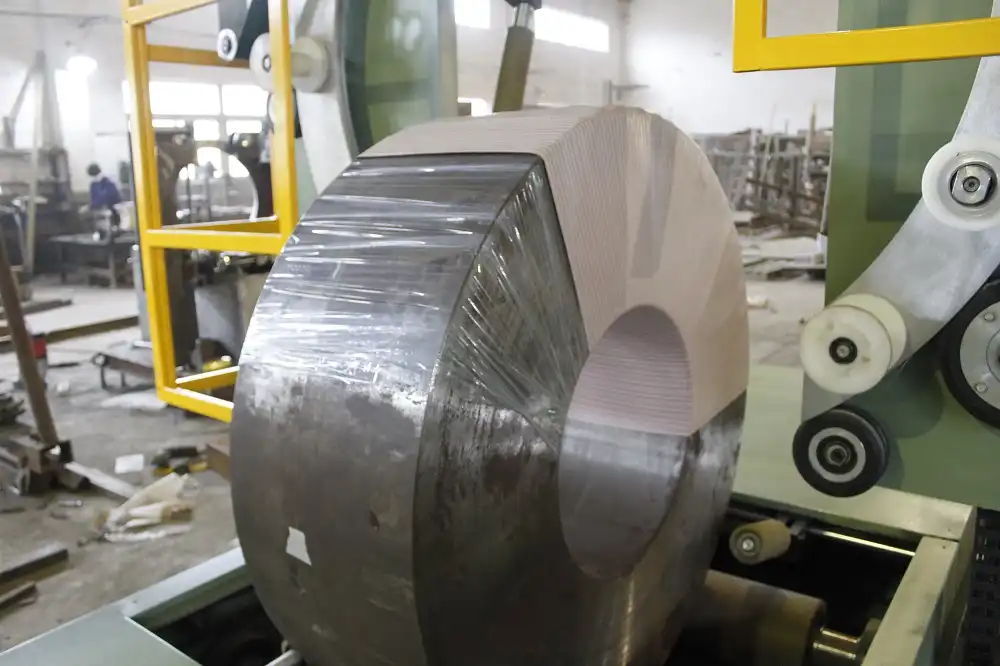
In my journey from a packing machine engineer to building FHOPEPACK, I have seen countless factories in Indonesia and other regions struggle with this exact issue. They buy a machine, hoping it solves their problems, only to find it underperforms for certain coil types. I learned that the “one-size-fits-all” approach rarely works in packing. To truly optimize operations, especially in diverse manufacturing landscapes like Indonesia, you must match the machine’s capabilities to the specific characteristics of your coils. This is how you achieve true efficiency and avoid unnecessary costs.
Impact of Coil Characteristics on Wrapping Performance
The physical properties of the coils you produce have a profound effect on how fast and how much your wrapping machine can output. Ignoring these factors leads to inefficiencies, product damage, and frustrated customers.
Let’s break down how coil size and material play a role:
-
Coil Size (Diameter, Width, Weight):
- Smaller Coils: Generally, smaller, lighter coils can be wrapped at higher speeds. They require less power to rotate or move. The wrapping material needs less time to complete a full revolution. This allows for higher coils per hour output. However, handling many small coils might require more advanced automation for loading and unloading to truly maximize speed. Without this, manual handling can create a bottleneck.
- Larger, Heavier Coils: These coils demand slower wrapping speeds. The inertia of a heavy coil means it takes more time to accelerate and decelerate safely. Also, the structural integrity of the wrapping machine, especially the ring and support rollers, must be robust enough to handle the weight. Attempting to wrap large coils too quickly can lead to machine wear, unstable wrapping, or even safety hazards. For example, a large steel coil from an Indonesian steel mill needs careful, controlled wrapping. This means the overall output for these specific large coils will be lower than for smaller ones.
- Wider Coils: Wider coils may require more wrapping material passes to ensure full coverage, or a wider wrapping material. This can reduce the effective speed for full coverage.
-
Coil Material:
- Steel/Metal Coils: These are typically robust and can withstand considerable tension during wrapping. The wrapping speed is mainly limited by the coil’s size and weight. The focus is on secure, tight wrapping to prevent uncoiling or damage.
- Delicate Materials (e.g., Aluminum, Stainless Steel with sensitive surfaces, Painted Coils): These materials require gentler handling and often slower wrapping speeds. High tension can scratch or deform the surface. The wrapping material choice is also critical, often requiring a soft inner layer. This means slower speeds to ensure product quality and avoid rejections. Michael Chen mentioned product damage as a challenge; for these materials, slower speed is a direct solution to prevent such losses.
- Wire Rod/Banding: These coils often have a smaller diameter but can be very dense. The wrapping needs to be secure to prevent the wires from spilling. The machine needs to handle the weight and ensure consistent wrap overlap, which might impact the maximum speed.
Here is a table summarizing the impact:
| Coil Characteristic | Impact on Wrapping Speed | Impact on Output (Coils/Hour) | Common Indonesian Industry Example |
|---|---|---|---|
| Small Diameter | Higher | Higher | Small wire coils, thin strip |
| Large Diameter | Lower | Lower | Heavy steel coils |
| Light Weight | Higher | Higher | Aluminum coils |
| Heavy Weight | Lower | Lower | Hot rolled steel coils |
| Robust Material | Higher (tension tolerant) | Higher | Standard steel coils |
| Delicate Material | Lower (surface protection) | Lower | Stainless steel, painted coils |
My advice to factories in Indonesia is always to analyze your product mix carefully. If you primarily deal with large, heavy steel coils, investing in a robust machine designed for their handling, even if it runs at a moderate speed, will be more beneficial than a high-speed machine designed for smaller items. You need a machine that can handle your largest or most delicate product without causing damage or breaking down. This practical approach, balancing speed with the specific needs of your materials, is what leads to long-term operational success and higher ROI.
3. Are faster coil wrapping machines always the better choice for businesses in Indonesia, and what are the trade-offs?
Are you being pushed by increasing market demands to find faster packing solutions, but you are worried about the hidden costs and potential drawbacks of high-speed machines? Many factory managers in Indonesia face this dilemma. The desire for speed is strong, but the fear of breakdowns, maintenance headaches, or even unsafe operations is just as real.
Faster coil wrapping machines are not always the optimal choice for Indonesian businesses. While they boost throughput, they often come with trade-offs like higher initial costs, increased maintenance complexity, specific skill requirements for operators, and potential compromises on wrapping quality or safety if not properly matched to the operation.

When I was building my own factory and helping clients grow theirs, I learned that “faster” does not always mean “better.” I have seen businesses invest heavily in the fastest machines, only to find them sitting idle due to frequent breakdowns or requiring specialized, expensive parts. This often negated any gains in speed. My philosophy is to look at the whole picture. For businesses in Indonesia, where long-term reliability and manageable operational costs are crucial, understanding the trade-offs of speed is as important as understanding its benefits.
Navigating the Speed-Efficiency-Cost Trilemma in Indonesia
The pursuit of maximum speed in coil wrapping machines is understandable, especially in competitive markets like Indonesia. However, a purely speed-driven decision can overlook critical operational factors. Here, I want to explore the common trade-offs.
-
Higher Initial Investment and Operating Costs:
- Faster machines are more complex. They often incorporate advanced motors, sensors, and control systems to achieve high wrapping speeds and precision. This technology directly translates to a higher purchase price.
- Increased Power Consumption: More powerful motors are needed to achieve faster wrapping speeds, leading to higher electricity bills. This is a significant factor in Indonesia where energy costs are always a consideration for overall operational expenses.
- Specialized Maintenance: High-speed machines have more moving parts and operate under greater stress. They require more frequent and often specialized maintenance. Sourcing spare parts for advanced components can be costly and time-consuming, especially in remote parts of Indonesia. This can lead to longer downtime, which Michael Chen knows means huge losses.
-
Maintenance and Durability Concerns:
- Wear and Tear: Operating at higher speeds puts more strain on all mechanical components – bearings, gears, rollers, and the wrapping ring itself. This accelerates wear and tear, potentially leading to more frequent breakdowns.
- Sensitivity to Environment: High-precision, high-speed machines can be more sensitive to factory floor conditions like dust, humidity, or temperature fluctuations, which are common in many Indonesian industrial environments. A robust, simpler machine might be more durable in such conditions.
-
Operator Skill and Safety:
- Training Requirements: Operating and troubleshooting faster, more complex machines requires a higher skill level. Training staff in Indonesia for these advanced systems can be an additional cost and challenge.
- Safety Risks: While modern machines have safety features, the inherent risks associated with faster-moving parts are higher. Ensuring strict safety protocols and robust machine guards becomes even more critical. Michael Chen highlights safety as a major concern; a machine that is too complex or fast for existing operational practices can inadvertently increase risks.
-
Wrapping Quality and Product Integrity:
- Consistency Challenges: At very high speeds, maintaining consistent wrapping tension and overlap can become challenging. This might lead to uneven wrapping, loose coils, or even damage to the product, particularly for delicate materials.
- Damage Risk: For certain products, especially those with sensitive surfaces or irregular shapes, excessive speed can increase the risk of product damage during the wrapping process. It’s a delicate balance.
My Perspective: Finding the Right Balance When advising clients in Indonesia, I always emphasize a holistic view. Before aiming for the absolute fastest machine, consider these points:
- Actual Throughput Needs: Do your upstream and downstream processes truly support ultra-high-speed wrapping? If the rest of your line cannot keep up, a super-fast wrapper will simply create a bottleneck elsewhere or sit idle.
- Product Variation: If you handle a wide range of coil sizes and materials, a moderate-speed machine that offers versatility and reliability for all products might be better than a very fast machine optimized for only one type.
- Cost-Benefit Analysis: Calculate the true ROI. Include not just the initial purchase price, but also ongoing maintenance, energy consumption, and potential downtime costs. Sometimes, a slightly slower, more robust, and easier-to-maintain machine provides a better return over its lifespan.
For many Indonesian factories, especially those dealing with heavy steel or wire, a machine that offers reliable, consistent, and moderately high speed, coupled with durability and ease of maintenance, often provides the best long-term value. It mitigates the risks of high upfront costs and complex operational challenges, while still significantly improving efficiency over manual methods. This approach aligns perfectly with Michael Chen’s desire for reliable solutions and a strong ROI.
4. How can you accurately measure and optimize coil wrapping machine speed and output for your Indonesian operation?
Are you struggling to get a clear picture of your coil wrapping machine’s true performance? You know it’s wrapping coils, but you are not sure if it is working at its peak efficiency. This lack of clear data makes it hard to identify bottlenecks, justify new investments, or even set realistic production goals for your factory in Indonesia.
Accurately measuring and optimizing coil wrapping machine speed and output for your Indonesian operation involves systematic data collection, analysis of key performance indicators (KPIs), and continuous process improvement. This requires tracking metrics like coils per hour, wrapping cycle time, and machine uptime to identify areas for enhancement.

During my years in the packing machine industry, first as an engineer and then running my own factory, I learned that what you do not measure, you cannot improve. Many companies focus on “making do” with existing equipment. However, simply understanding your current performance is the first step toward significant gains. I have seen how factories in Indonesia, once they start truly measuring, can unlock huge improvements in their wrapping operations. This is not just about raw numbers; it is about smarter operations that reduce waste and boost profitability.
Strategies for Measuring and Optimizing Performance
For factories in Indonesia, maximizing the efficiency of their coil wrapping operations is key to staying competitive. Here are actionable steps to measure and optimize your machine’s speed and output effectively.
-
Define Clear Key Performance Indicators (KPIs):
- Coils Per Hour (CPH): This is the most straightforward measure of output. Track how many coils are successfully wrapped and ready for shipment within an hour.
- Wrapping Cycle Time: Measure the time from when one coil starts being wrapped until the next one begins. This includes loading, wrapping, and unloading time. This helps identify the slowest part of the cycle.
- Machine Uptime: The percentage of time the machine is actually running and wrapping coils, versus downtime for maintenance, changeovers, or breakdowns. Michael Chen emphasized reliability, and uptime is a direct measure of this.
- Material Consumption per Coil: How much wrapping material (film, paper, stretch wrap) is used per coil. Optimizing this reduces material costs.
- Defect Rate: The percentage of coils that require re-wrapping or are rejected due to poor wrapping quality. This directly impacts product loss, a challenge Michael Chen faces.
-
Implement Systematic Data Collection:
- Manual Logging: Start with simple log sheets where operators record cycle times, number of coils, and any downtime reasons. This is a basic but effective first step.
- Automated Sensors and PLC Data: Modern coil wrapping machines often have Programmable Logic Controllers (PLCs) that can log operational data. Integrate sensors to automatically count coils, record running times, and track error codes. This provides more accurate and consistent data.
- Factory Management Software (MES): For larger operations in Indonesia, integrating machine data into a Manufacturing Execution System can provide real-time insights and comprehensive analytics across your entire production line.
-
Analyze Data and Identify Bottlenecks:
- Pareto Analysis of Downtime: Categorize all reasons for machine downtime (e.g., material change, mechanical breakdown, operator error, waiting for next coil). Use Pareto charts to identify the most frequent or longest-duration causes.
- Process Mapping: Visually map out the entire coil wrapping process, from coil arrival to final dispatch. This helps in identifying where delays occur and where resources might be underutilized or overstretched.
- Benchmark Against Standards: Compare your actual CPH against the machine’s rated capacity and industry benchmarks for similar operations in Indonesia. If there’s a significant gap, investigate why.
-
Implement Optimization Strategies:
- Streamline Loading/Unloading: The actual wrapping process might be fast, but manual loading or slow conveyor systems can reduce overall output. Invest in automated loading arms, powered conveyors, or buffer systems to feed coils more quickly.
- Regular Maintenance Schedules: Preventative maintenance is critical to minimize unexpected breakdowns and maintain optimal machine speed. Stick to manufacturer recommendations for lubrication, inspection, and parts replacement. My experience shows that planned maintenance is far cheaper than reactive repairs.
- Operator Training and Empowerment: Ensure operators are fully trained on optimal machine settings, quick troubleshooting, and efficient material changeovers. Empower them to suggest improvements.
- Material Optimization: Experiment with different wrapping materials or tension settings to achieve the desired wrap quality with the least amount of material and at the fastest possible speed.
- Adjust Machine Settings: Sometimes, a machine is not running at its optimal speed because the settings are generic. Calibrate tension, rotation speed, and overlap specifically for each coil type you handle, based on the data you’ve collected.
By systematically applying these measurement and optimization techniques, factories in Indonesia can move beyond guesswork. They can make data-driven decisions. This leads to real improvements in efficiency, significant cost reductions, and a stronger competitive edge. It helps achieve goals like Michael Chen’s: reducing manual labor, improving safety, and getting a clear ROI on equipment investments.
Conclusion
Improving coil wrapping speed and output in Indonesia depends on selecting the right machine, understanding coil specifics, and continuous optimization. My experience shows that balancing speed with reliability and thoughtful measurement drives real growth and profit.








