
Automatic Coil Packing Machine Price Guide | What Affects Cost?
Are you a factory manager like Michael, constantly battling with slow production lines, high labor costs, and the looming threat of workplace injuries from manual packing? The pressure to boost output, control expenses, and ensure safety is immense, right? You know that any downtime means huge losses, and worn-out equipment is simply not an option. You’re looking for solutions that last and truly solve your operational headaches. (Manual packing challenges)
An automatic coil packing machine isn’t just a piece of equipment; it’s a strategic investment designed to revolutionize your end-of-line processes for heavy industrial products like steel coils, wire coils, and metal strips. These machines automate the wrapping, strapping, and handling of various coiled materials, significantly improving efficiency, safety, and product integrity. The cost of an automatic coil packing machine can range from $20,000 for basic models to over $500,000 for fully integrated, high-capacity custom systems, with the price primarily affected by the machine’s type, level of automation, features, customization, and after-sales support. (Automated coil packaging benefits)

Understanding the initial price tag is just the beginning. To make a truly informed decision, especially when facing production bottlenecks and safety concerns, you need to dig deeper into what drives these costs. Let’s explore the key factors that influence the price of these vital machines and how FHOPEPACK helps you find the right solution, not just a machine.
1. What exactly is an automatic coil packing machine, and why do I need one?
Imagine your factory floor, bustling with activity. Then you hit the packing area. If it’s anything like what Michael described – a bottleneck where manual labor struggles with heavy coils, slow speeds, and constant safety risks – then you have a problem. This is where automation steps in. (Factory efficiency problems)
An automatic coil packing machine is specialized industrial equipment designed to efficiently and securely package various types of coils, such as steel coils, copper coils, aluminum coils, and wire coils, using materials like stretch film, paper, or woven tape. You need one to overcome critical operational challenges such as labor-intensive processes, high risks of worker injury from manual handling, slow packing speeds that limit overall production throughput, and frequent product damage during internal transport or storage. It directly addresses the need for faster, safer, and more consistent packaging operations. (Industrial coil packaging solutions)
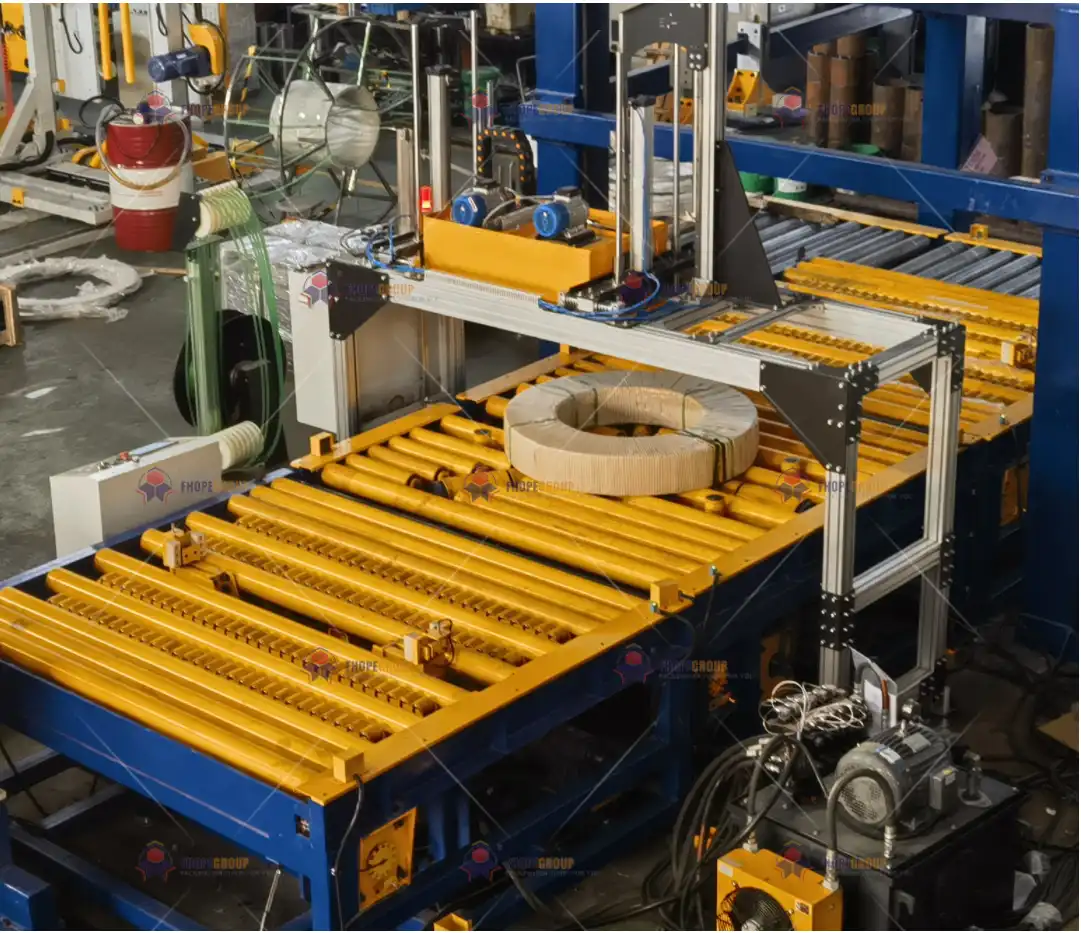
Why Your Factory Can’t Afford Not To Automate Coil Packing
I’ve seen firsthand, from my days as an employee to building FHOPEPACK, the profound impact of automation. For someone like Michael, who manages an entire metal processing plant, the advantages of an automatic coil packing machine go far beyond just wrapping coils. It’s about transforming the entire end-of-line logistics.
- Solving Efficiency Bottlenecks: Michael’s current manual steel coil and wire packing process is slow and inefficient. An automated machine can pack coils many times faster, ensuring that the packing department no longer limits the overall production speed. This means more products out the door, faster delivery, and happier customers. I’ve designed systems where throughput increased by over 300% simply by automating the final packing stage. (Packing line automation benefits)
- Enhancing Worker Safety: Moving heavy coils manually is extremely hazardous. Workers face risks of crushed limbs, back injuries, and other serious accidents. An automated system drastically reduces the need for human interaction with heavy loads. It takes the coil from the production line, packages it, and can even prepare it for transport, all with minimal human intervention. This directly improves worker safety and reduces worker’s compensation claims and employee turnover—a huge win for Michael’s operations. (Workplace safety improvements)
- Reducing Product Damage: Every dent or scratch on a steel coil during internal transfer or packing can lead to customer complaints and financial losses. Automatic machines apply consistent tension and coverage, protecting the product’s integrity. The precise wrapping prevents edge damage and surface scratches, ensuring that coils arrive at the customer in perfect condition. This boosts customer satisfaction and reduces costly rejections. (Product quality preservation)
- Achieving Cost Savings: While there’s an initial investment, the long-term savings are significant. You reduce labor costs by reallocating staff to other tasks, minimize material waste through optimized wrapping, and cut down on product damage. These savings, combined with increased output, contribute directly to the factory’s profitability. (Industrial cost reduction strategies)
- Ensuring Consistency and Quality: Manual packing is prone to human error and inconsistency. An automated machine delivers uniform, high-quality packaging every single time. This consistency not only protects your product but also reinforces your brand’s commitment to quality. (Consistent packaging quality)
My experience has shown that investing in such machinery isn’t just about replacing a worker; it’s about building a more resilient, efficient, and safer operation. It’s about empowering your business to grow, just as I’ve helped many of my clients achieve. This is a crucial step for factories aiming for higher productivity and a competitive edge. (Factory operational resilience)
2. What are the main types of automatic coil packing machines, and how do their designs impact cost?
When Michael looks for a packing solution, he’s not just buying a machine; he’s investing in a specific operational capability. The design and type of an automatic coil packing machine fundamentally determine its capabilities and, consequently, its price. There isn’t a one-size-fits-all solution, and understanding the differences is crucial for budgeting. (Coil packing machine variations)
The main types of automatic coil packing machines are horizontal orbital stretch wrappers, vertical orbital stretch wrappers, and specialized strapping or banding machines, each designed for different coil orientations and packaging needs. Their designs significantly impact cost because horizontal wrappers, ideal for packaging coils with their “eye” up or on a pallet, often involve complex conveyor systems and larger footprints. Vertical wrappers, used for coils where the “eye” is horizontal, are typically more compact but still require robust handling mechanisms. Specialized strapping or banding machines, sometimes integrated with wrappers, add cost due to precision engineering for heavy-duty applications. Customization, automation level, and material handling features inherent in each design are primary cost drivers. (Industrial packaging equipment types)

Deciphering Coil Packing Machine Types and Their Price Implications
From FHOPEPACK’s perspective, guiding clients like Michael through these options means understanding their specific production flow and product characteristics.
2.1 Horizontal Orbital Stretch Wrappers (Eye-to-Sky Coils)
- Design: These machines wrap coils around their outer diameter while the coil lies flat (eye-to-sky or eye-to-wall on a pallet). They typically feature a rotating ring that dispenses stretch film as the coil passes through on a conveyor.
- Applications: Ideal for larger steel coils, aluminum coils, and brass coils that are transported and stored horizontally or stacked on pallets.
- Cost Impact:
- Higher due to integrated conveyor systems: The machine often includes heavy-duty conveyors, loading/unloading mechanisms, and sometimes coil tilters.
- Larger footprint: Requires more floor space, which can be a factor in crowded factories.
- More complex automation: Often part of a complete packing line, integrating with weigh scales, labeling, and robotic handling.
- Price Range: Generally starts from $50,000 for semi-automatic models and can go well over $300,000 for fully automatic, high-capacity systems. (Horizontal coil wrapping costs)








