

Manual bundling of steel bars and rods for export or storage is a primary source of line inefficiency, material waste, and product damage. This article addresses three concrete bottlenecks: how to automate head and tail covering, which wrapping method (paper sheet vs. orbital film) suits different production profiles, and how to match machine capacity to bundle sizes without overspending. Based on a real inquiry from a Peruvian steel processor (illustrative), we analyze root causes, quantify impacts, and provide actionable recommendations.
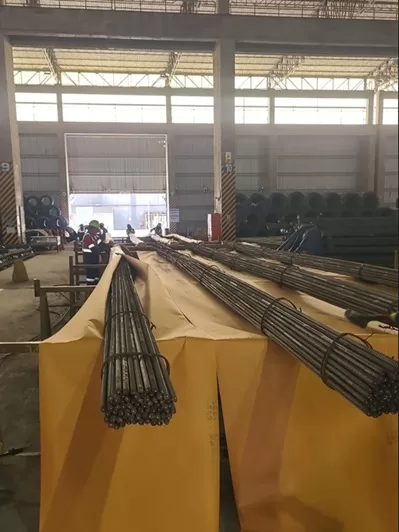

🛠️ Problem 1: Manual Head & Tail Covering Slows Your Line and Wastes Material

If your bundling line relies on workers to tape or wrap the exposed ends of steel bundles, you are losing roughly 3–5 minutes per bundle, and every 10–15 bundles, material waste exceeds 8% due to torn paper or misaligned film — based on typical cycle times for manual covering of 6–12 meter bundles. This is the single biggest bottleneck for processors producing bars in standard lengths of 6m, 9m, and 12m.
Cause: Manual head and tail covering requires a person to physically walk around a bundle that can weigh up to 2 metric tons. For a bundle of 30–40 cm diameter, the worker must cut, align, and manually secure a paper sheet or film around both ends. This takes 2–3 minutes per end, often requiring a second person to hold the bundle steady. Because each worker’s technique differs, no two bundles achieve the same coverage — leading to inconsistent sealing and moisture ingress.
Impact: Inconsistent sealing leads to rust streaks on the first 10–15 cm of the bar, customer complaints, and rejected shipments. A single worker can cover only 12–15 bundles per shift. For an 80-ton daily output of 2-ton bundles (40 bundles), that requires at least three full-time workers just for head and tail covering. Assuming a labor cost of $15–$25 per hour (varies by region), direct labor alone for this task runs $360–$600 per shift or $130,000–$220,000 annually — without counting material waste and quality losses.
Recommended action: Switch to an automatic head and tail covering station integrated either before or after the main wrapping machine. Two options work:
-
Automatic bundle covering by paper sheet → then head & tail covering in a secondary station. This costs less upfront (est. $25,000–$40,000 for the station; figures are illustrative and vary by manufacturer and customization), but adds 30–40 seconds per bundle cycle.
-
Automatic bundle wrapping by orbital wrapper (a machine with a rotating ring that wraps film around the stationary bundle) with integrated head and tail covering in one pass. This achieves higher throughput (under 2 minutes per full bundle, head and tail included). Budget range: $80,000–$150,000 for a full customized line.
Key Point: For bundles under 12 meters and 2 tons, choose paper sheet covering if your line does not already handle film waste. Choose orbital wrapper + head & tail if you need consistent, fast output with no secondary handling.
🏗️ Problem 2: Orbital Wrapping Machines Can’t Handle Odd Bundle Lengths Without Custom Programming

A standard orbital wrapper designed for fixed-length bars (e.g., 6m only) will stall or miswrap when your product mix includes 6m, 9m, and 12m bundles without automatic length detection. This forces manual programming of overlap and ring speed for each length, adding 2–4 minutes of downtime between batches — reducing throughput by 15–20% per shift, costing an estimated $150–$300 per shift in lost production (based on typical line output value).
Cause: The orbital ring rotates around a stationary bundle. If the bundle length varies, the machine must know when to start and stop the film carriage at each end. Without a PLC (Programmable Logic Controller — a ruggedized computer that controls machine actions based on sensor inputs) with variable length programming and a sensor array (typically 2–4 photoelectric sensors — devices that use light beams to detect the presence of an object), the machine assumes one fixed length.
Impact: A mis-timed start can leave the head uncovered for the first 10 cm, defeating the purpose of automatic covering. Worse, the film can snag on the bundle tail, causing a 5–10 minute jam. Over a full shift, this accumulated downtime reduces throughput by 15–20%. Assuming an hourly line cost of $200 (labor, depreciation, energy), that translates to $240–$320 in lost value per shift — adding up to $62,400–$83,200 annually for a two-shift operation.
Recommended action: When specifying an orbital wrapper, require the following parameters in your request for quotation:
-
PLC must accept variable length inputs from 3m to 14m.
-
Ring travel speed: adjustable from 30 to 80 rpm — 30–40 cm diameter bundles require lower ring speed to avoid film breakage.
-
Film tension control: independent for head, body, and tail zones.
-
At a minimum, two photoelectric sensors — one for bundle detection, one for tail detection.
Key Point: Confirm that the machine can wrap a 2-ton, 40 cm diameter, 12m bundle in under 3 minutes including head and tail covering. If the vendor quotes more than 4 minutes, ask for a secondary conveyor to shuttle the bundle while the ring runs — common on high-speed lines.
📈 Problem 3: Paper Sheet vs. Orbital Film — Which System Matches Your Risk Tolerance and Budget
Your choice depends on three factors: risk of edge damage, available labor, and film disposal costs. For a processor bundling steel bars for export, the wrong choice can double your packaging cost per ton. Below is a comparative analysis based on typical industry data (actual costs may vary by region and supplier).
| Factor | Paper Sheet System | Orbital Wrapper + Film |
|---|---|---|
| Head & tail coverage cost per bundle | $0.50–$0.80 (paper + labor) | $0.30–$0.50 (film, less labor) |
| Edge protection for sharp bars | Excellent — paper wraps tightly without film tears | Moderate — film can puncture on sharp edges above 10mm radius unless padded |
| Setup time for new bundle length | 2–3 minutes (manual adjustment of paper feeder) | Under 30 seconds (PLC auto-adjusts) |
| Film/paper waste disposal | Paper is recyclable, low cost | Film waste requires compacting; disposal cost 3–5x per kg |
| Downtime risk from jams | Low — paper jams rare (<1 per 50 bundles) | Moderate — film tangles account for 2–4% of total run time |
| Capital cost (illustrative) | $25,000–$45,000 for paper station + wrapper | $80,000–$150,000 for full orbital line |
Recommended action by business profile:
-
If you process under 50 tons per day and have 2–3 dedicated workers: start with paper sheet covering. It is cheaper, lower risk, and paper waste is easier to manage. You can add orbital wrapping later.
-
If you process 80+ tons per day (like the Peruvian inquiry, used as an illustrative example) and export bars: invest in the orbital wrapper + head & tail covering. The labor cost saving alone (2 workers × $15–$25/hour × 8 hours = $240–$400 per shift) pays back the premium within 18 months.
-
If your bars have sharp burrs (common on rebar): ask for a film puncture test before ordering. If the vendor cannot guarantee zero film breaks on your specific bar profile, insist on a paper pre-wrap station before the orbital ring.
🛡️ Expected ROI Summary Table for the Three Problems
| Problem | Annual Cost Without Automation (Illustrative) | Typical Solution Cost | Estimated Payback Period |
|---|---|---|---|
| Manual head & tail covering (3 workers, 80 tons/day) | $130,000–$220,000 labor + material waste | $25,000–$150,000 (station or full line) | 6–18 months |
| Downtime from length changeovers (15–20% throughput loss) | $62,000–$83,000 per year (two shifts) | $5,000–$10,000 for PLC upgrade + sensors | 2–4 months |
| Wrong packaging method mismatch | Up to $0.50 per bundle extra cost | Cost of switching system variable | Varies; decision guide above |
Note: All cost and time figures are estimates based on typical production data and market ranges; actual values depend on specific manufacturer, region, and line configuration.
⚙️ Purchase-Decision Checklist for Automatic Bundling & End Sealing Systems
Use this checklist when evaluating vendor proposals. Each item must be confirmed in writing.
| # | Check Item | Pass / Fail Criteria |
|---|---|---|
| 1 | Bundle volume capacity | Machine must claim ≤3 minutes per full bundle for 2-ton, 12m length |
| 2 | Variable length programming | PLC must accept 3m to 14m as standard, no extra module cost |
| 3 | Head & tail coverage included | Machine must have automatic covering — not a manual add-on station |
| 4 | Voltage compatibility | Confirm 380V/60Hz for LATAM or 480V/60Hz for North America — no conversion required |
| 5 | Film tension range | Must be adjustable 10N to 50N for 30–40 cm diameter bundles |
| 6 | Paper sheet option available | Must be able to switch to paper without replacing the whole wrapping module |
| 7 | Sensor redundancy | Minimum 2 photoelectric sensors for length detection, 1 for tail detection |
| 8 | Emergency stop and safety gate | Must comply with ISO 13849-1 (safety control systems) — verify certification with vendor |
| 9 | Custom film / paper size | Must accept 500mm to 750mm wide film and 600mm to 900mm wide paper |
| 10 | Vendor video proof | Request customized video showing your bundle size and weight being wrapped — not a generic demo |
🛠️ FAQ: Automatic Bundling & End Sealing for Steel Bars and Rods
Q: What is automatic bundling and how does it work for steel bars? Automatic bundling uses machines to wrap steel bar bundles with protective film or paper without manual intervention. The process typically involves a conveyor, a wrapping ring (orbital or rotating arm), and automatic head/tail covering stations controlled by a PLC.
Q: Can one machine handle both 6m and 12m bundles without manual adjustment? Yes — provided the PLC has variable length programming and at least two photoelectric sensors. The operator enters the length or the machine auto-detects it. A proper system switches without stopping the conveyor.
Q: What is the typical film overlap percentage for bundling steel bars? For steel bars, target 50–60% overlap on the body and 80–100% on head and tail. That ensures zero exposed metal when the bundle is unloaded. Film tension must be reduced at the ends to prevent edge tearing.
Q: Is paper sheet covering slower than film wrapping? Generally yes — paper sheet adds 30–60 seconds per bundle for each end. But total cycle time is still under 4 minutes, acceptable for most mid-volume lines. The trade-off is lower film waste cost and better edge protection for sharp bars.
Q: Do I need a conveyor upgrade before installing an orbital wrapper? Not always — if your existing conveyor has minimum 3m straight section (for 6m bundles) and can support 2 tons distributed evenly, you only need a motorized roller drive to align the bundle center. Plan $2,000–$5,000 for conveyor modifications (illustrative).
Q: What is the warranty period for these machines? Typical industry range: 12 months from installation or 18 months from shipment, whichever is shorter. Verify with the supplier whether head & tail covering modules are included — some vendors exclude them from standard warranty.
Q: How do I test the system before buying? Ask for a customized video showing your actual bundle dimensions (30–40 cm diameter, 2 tons, 12m length) being wrapped and end-sealed. If the vendor cannot provide that, request a factory acceptance test (FAT) at their workshop before shipment. This is standard practice for customized solutions.












