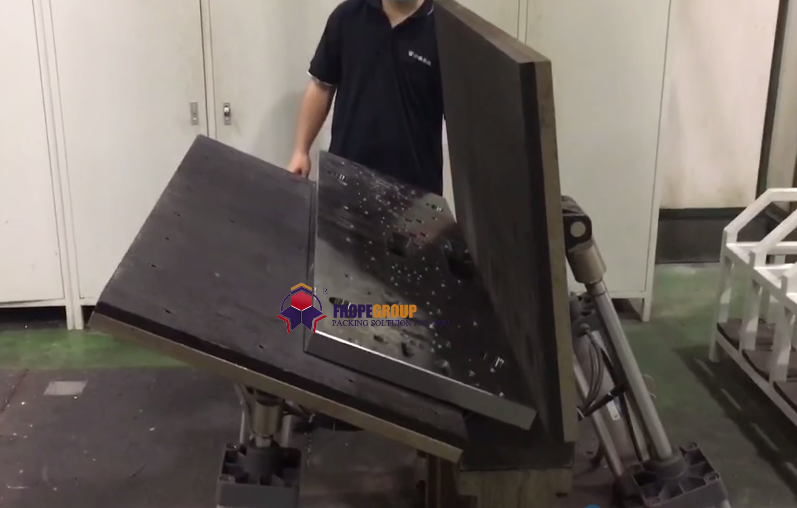
Резюме The ROI of safety in a toolroom comes from turning heavy molds on the floor instead of in the air. Our 90-degree mold upender holds the mold on a rigid L-shaped cradle and turns it a quarter turn in about 60–90 с for the 10 t model. Machine capacities span from 3 т до 40 т, where mold weight, load footprint, and center-of-gravity displacement dictate machine sizing and floor anchoring.
Содержание
- Как деспот превращает форму в лепку
- Опрокидывающий или мостовой кран
- Выбор модели
- Таблица модели 10 т
- Таблица рентабельности инвестиций
- Безопасность и стандарты
- Контрольный список выбора
- Часто задаваемые вопросы по инженерным вопросам
- Следующий шаг
- Связанное чтение
- Источники
Как деспот превращает форму в лепку
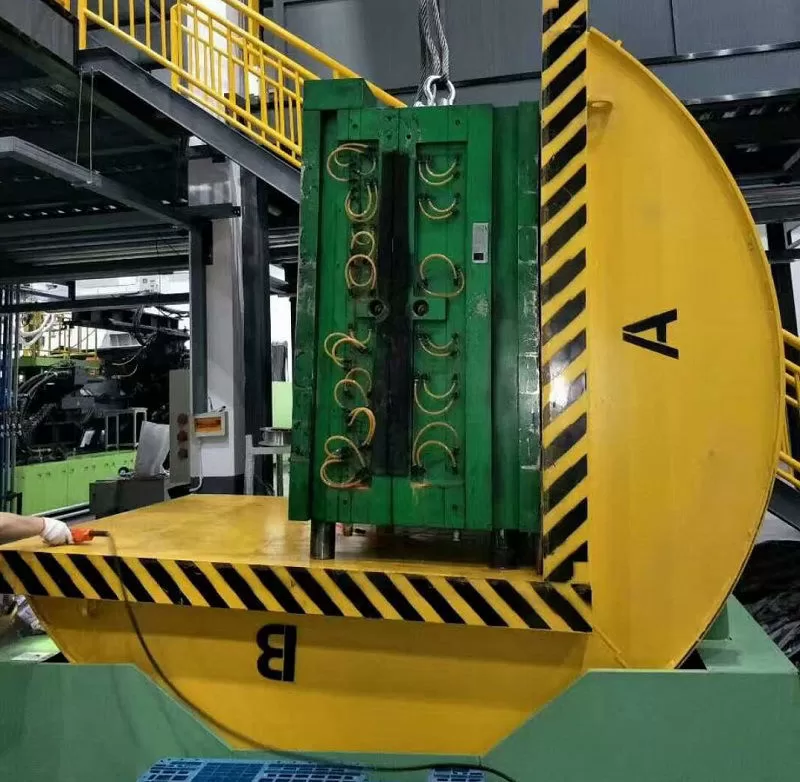
Our 90-degree mold upender supports the tool inside an engineered L-shaped cradle consisting of a horizontal load bed and a vertical retaining plate set at a precision 90° angle. As the drive rotates the cradle through a 90-degree arc, the mold weight transfers progressively from the load bed onto the back plate. The mold comes to rest stably on its adjacent side face, mechanically supported through every degree of rotation without shock loading.
The workpiece remains captive on the machine table throughout the cycle, eliminating the need for rigging crews to stabilize a suspended load. Heavy-duty protective bellows shield the internal mechanical drive and hydraulic components from toolroom debris, while the low-profile base frame transmits deadweight and dynamic turning forces directly into the plant floor.
Опрокидывающий или мостовой кран
Flipping heavy injection molds or stamping dies with an overhead crane requires complex slinging, high-tension rigging, and controlled crane travel to roll the block over. During an airborne flip, the mold inevitably swings and experiences sudden center-of-gravity shifts, exposing operators to pinch points and crushing zones.
| Параметр оценки | Overhead Crane Flipping | 90-Degree Mold Upender |
|---|---|---|
| Workpiece Location | In the air, suspended on synthetic or wire slings | Secured on the grounded L-shaped cradle |
| Динамика нагрузки | Sudden shift and swing during turnover roll | Controlled, positive support through the full 90° arc |
| Позиция оператора | Within the drop zone to guide and reposition slings | At a remote push-button console outside the perimeter |
| Наличие кранов | Crane blocked for the entire rigging and turnover cycle | Crane only needed for simple vertical loading and unloading |
| Повторяемость процесса | Variable; heavily dependent on rigger technique | Mechanized and uniform quarter-turn cycle every time |
The overhead crane is still utilized to place the mold onto the upender table and remove it after rotation. What changes is the turnover maneuver itself: high-risk airborne rolling is replaced by a controlled, floor-based mechanical rotation.
Выбор модели
Selecting an industrial upender begins with the maximum gross die weight, followed by verifying physical mold dimensions against the table bed.
| Модель | Максимум. нагрузка | Время поворота |
|---|---|---|
| ФПМТ-03 | 3 т | 50–90 с |
| ФПМТ-05 | 5 т | 50–90 с |
| ФПМТ-10 | 10 т | 60–90 с |
| ФПМТ-20 | 20 т | 70–90 с |
| ФПМТ-30 | 30 т | 70–90 с |
| ФПМТ-40 | 40 т | 60–100 с |
The machine capacity must be sized for the heaviest tool in the inventory. Table dimensions are custom-built to match specific mold footprints. For example, a tooling facility handling die blocks up to 8 t typically selects the FPMT-10 model, providing a safe working margin for future tool sets.
Таблица модели 10 т
The 10-tonne configuration is designed for medium-to-heavy plastic injection molds, die-casting tools, and stamping die sets.
| Параметр | 90-Degree Mold Upender 10T |
|---|---|
| Максимальная номинальная нагрузка | 10 т (10 000 кг) |
| Usable Table Length | 3,000 мм |
| Usable Table Width | 2,000 мм |
| Table Resting Height | 500 мм |
| Угол поворота | 90° bidirectional |
| Архитектура привода | Primary mechanical drive with auxiliary electric/hydraulic controls |
| Объем гидравлического масла | 15 литров |
| Общий вес машины | Approximately 10 t (10,000 kg) |
The mold base must rest securely within the 3,000 × 2,000 mm footprint, aligned so that the center of gravity remains reasonably centered over the cradle. Tool geometry, offset centers of gravity, and lifting hook clearances are verified before final table fabrication. With a low working height of 500 mm, bay overhead clearance is preserved for straight crane picks.
Таблица рентабельности инвестиций
The capital investment payback of a dedicated mold upender stems from recovered crane time, reduced direct labor hours, and the mitigation of catastrophic tool damage:
- Flips per day: Log the daily total of mold rotations across maintenance, tooling changes, and inspection bays.
- Crane flip duration: Measure the total elapsed time per flip using a crane—including rigger staging, slow turning, and sling removal—multiplied by the number of technicians involved.
- Upender cycle duration: Calculate direct vertical load/unload crane time, plus the constant 60–90 s rotation cycle on the 10 t unit operated by a single technician.
- Labor hours recovered:
(Crane flip time − Upender flip time) × Flips per day × Crew headcount. - Recovered crane capacity: Freeing the bay crane from prolonged flipping operations eliminates bottlenecks for adjacent machining centers and press lines.
- Risk and asset protection: Factor in avoided mold face damage, alignment pin shear, and structural sling failure costs.
This calculation is reviewed during application engineering to project the payback horizon based on exact toolroom shift cycles.
Безопасность и стандарты
By moving mold rotation from suspended slings to a floor-mounted cradle, personnel are removed from hazardous crush zones. Operators control the machine via pendant or remote panel, safely outside the operating envelope. Machine reliability is backed by a 24-month (2-year) comprehensive manufacturer warranty.
System engineering complies with international equipment directives:
- ISO 12100: 2010: Безопасность машин. Общие принципы проектирования. Оценка риска и снижение риска.
- ЕН 415-10:2014: Safety requirements for packaging machines and associated equipment.
- Electrical controls, interlocks, and local industrial safety codes (such as OSHA 1910 lockout/tagout readiness) are incorporated into final system drawings.
Контрольный список для выбора пресс-формы для литья под давлением
- Maximum gross mold weight and dimensional footprint (Length × Width × Height).
- Center of gravity location for asymmetric molds or core-pull tooling.
- Required turning degree: 90° for standard quadrant tipping; 180° for full die split and mold opening procedures.
- Operational frequency (estimated cycles per shift / day).
- Crane hook clearance and bay loading interface.
- Toolroom slab thickness, civil foundation, and pit-mount requirements.
Часто задаваемые вопросы по инженерным вопросам
Q: How long does a standard 90-degree turn take? A: A full 90-degree cycle takes 60–90 s on the FPMT-10, and 50–90 s on the lighter FPMT-03 and FPMT-05 models.
Q: Which model should be selected for an 8 t mold? A: The FPMT-10 is the recommended model. Its 10 t rated capacity and 3,000 × 2,000 mm platform accommodate 8 t loads with ample structural reserve.
Q: Is an overhead crane still required in the toolroom? A: Yes. The crane performs straight vertical hoisting to place the mold onto the upender and retrieve it after turning. The dangerous airborne roll is completely replaced by the machine.
Q: Can table dimensions be customized for non-standard die sets? A: Yes. While standard dimensions for the 10 t unit are 3,000 × 2,000 mm, table length, width, and surface cutouts are engineered to match custom die footprints.
Q: What warranty coverage is provided with the machine? A: All standard mold upenders carry a 24-month (2-year) structural and drive warranty.
Следующий шаг
To size an upender for your tooling facility:
- Submit layout drawings: Send mold dimensions, maximum weights, and daily cycle counts to info@fhopepack.com.
- Receive engineering review: Receive an equipment proposal within 48 hours, including machine footprint, electrical requirements, and ROI projection.
- Finalize layout integration: Confirm floor loading, foundation specs, and crane approach paths with our technical team.
Связанное чтение
- 90-градусный формовочный пресс 10Т
- Ассортимент формовочных пресс-форм
- Пресс-форма вверх
- Наклонный механизм для опрокидывания катушек
- Подъемник с конвейером
Источники
- Модельный ряд, время поворота, гарантия: страница о разрушении плесени
- Размер и угол поворота стола 10 т: 90-градусный формовочный пресс 10T страница
- Область применения стандартов: ISO 12100: 2010, EN 415-10: 2014
Последнее обновление: 21.09.2026