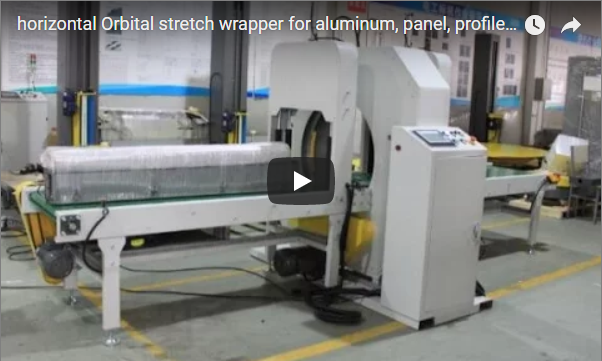
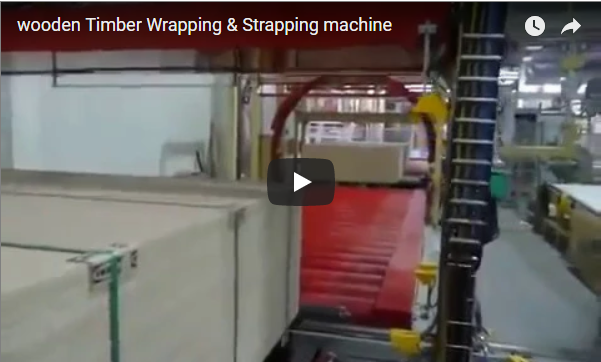
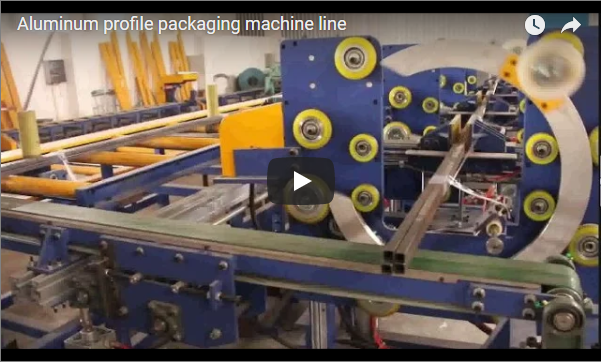
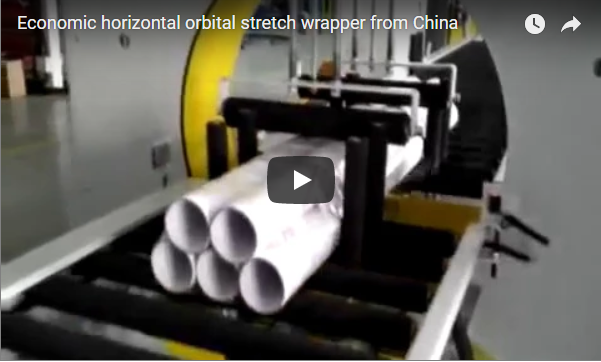
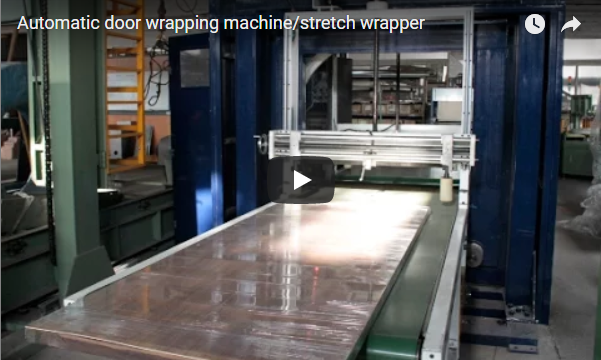
Rezumat This video shows a horizontal stretch wrapping machine in a full automatic cycle: a rectangular load travels in on a transition conveyor, film is applied from an overhead ring/beam assembly, and the wrapped load exits on the main conveyor. The visible cycle runs from load entry (around 0–12s of footage) to wrapped output (around 48–56s), with no operator intervention shown. Control panels, film specs, and throughput figures are not visible — verify those with the manufacturer.
Ce arată videoclipul
The footage follows one rectangular workpiece through a complete wrapping cycle on a horizontal wrapping machine. Here is the sequence, based on frames sampled roughly every 4 seconds:
- 0–12s (load entry). A brown, rectangular block — likely a wooden case or corrugated box — sits on a horizontal conveyor section. A green signal tower on the left shows a steady green light, meaning the line is ready. A yellow metal safety fence encloses the wrapping mechanism on the right.
- 16–24s (film application starts). The load is transferred into the machine’s center zone. Film from the spool assembly begins to unroll and drop down over the top of the load.
- 28–36s (wrapping in progress). Film covers the load’s sides as it advances slightly on the conveyor. The spool assembly rotates at high speed — visible motion blur confirms fast-moving parts. Guide rollers steer the film path.
- 40–44s (wrap forms). The load is essentially fully enclosed in transparent stretch film. Film edges begin to gather and overlap.
- 48–56s (output). The wrapped load moves onto the main green output conveyor, ready for the next step. The machine appears to settle, waiting for the next cycle.
- 60–88s (second pass). The footage continues with another load: a lighter-colored rectangular block with a visible hollow opening on one side is fed in on the transition conveyor. An overhead beam assembly lowers, film drapes over the top, the load advances slightly, and the wrap completes. The finished piece rests stationary on the main conveyor at the end.
No operator appears at any point. The whole sequence from entry to wrapped output runs hands-free.
Note de observație directă
The following block stays close to the raw visual analysis, with only grammar-level edits, so you can verify what the machine actually does before reading further:
- Main frame is a light gray/white painted metal structure; the safety fence is bright yellow metal mesh; bottom support beams are gray-white painted.
- A horizontal transition conveyor section (green belt/metal surface) sits at the machine’s center.
- The wrapping system includes a large spool with bearing housings, plus multiple guide rollers/pulley groups above and in front of the spool to direct the film path.
- An overhead beam/cantilever structure sits above the load position; it lowers before wrapping and rises after the wrap forms.
- A signal tower column on the left displays red/yellow/green lights; green is lit during operation.
- A yellow square box on the right column may be an e-stop or sensor junction box — its function cannot be confirmed from the footage.
- The workpiece is a rectangular block, length roughly equal to the conveyor width (about 1.2m in relative proportion), height roughly 0.3–0.4m, depth roughly 0.25m, with a rough wood-like or corrugated surface.
- At the end of wrapping, the load shows a “transparent plastic film + rigid base” structure with visible wrinkles and stretch streaks in the film.
- No readable text, nameplates, warning labels, or watermarks appear anywhere in the footage; no readable characters were confirmed on any component.
Prezentare generală a procesului
The machine’s workflow can be broken into four stations:
| Etapă | Ce se întâmplă | Dovezi vizibile |
|---|---|---|
| 1. Hrănire | Load arrives via upstream/transition conveyor and stops at the wrap position | Load stationary in center zone, 0–12s |
| 2. Film delivery | Spool starts; film drops from above and contacts the load top | Film visibly unrolling, 16–24s |
| 3. Ambalare | Load advances slightly while rotating film closes around top and sides; guide rollers maintain film path | Film covering sides, 28–44s |
| 4. Descarcare | Wrapped load exits on the main green conveyor | Wrapped load on output belt, 48–56s and 80–88s |
The transitional conveyor belt is the part that gives this machine its name. It hands the load from your upstream line into the wrap zone and hands it back out to the main line, so the wrapper can sit inline without manual loading. That matters if you plan to connect the wrapper directly to a case packer, strapper, or palletizing cell.
Why horizontal wrapping matters
Horizontal wrappers exist for loads that do not fit the classic pallet pattern: long profiles, panels, doors, furniture components, extrusions, or — as shown here — mid-sized rectangular cases. Instead of wrapping a whole pallet on a turntable, the machine wraps each individual unit as it passes through. The visible benefits, all qualitative and all supported by the footage:
- Consistent coverage. Film wraps evenly on all faces of each load; you can see uniform, layered film with stretch marks on the finished pieces.
- Inline automation. The load never stops moving through the line for long; entry and exit are handled by conveyors, not hands.
- Unit protection. Stretch film stabilizes the load against scuffing and shifting during storage and transport.
For buyers comparing options, this type of machine sits between a general stretch wrapping machine for pallets and specialized systems like a mașină de înfășurat cu braț rotativ sau un mașină de ambalat cu inel rotativ, which handle different load geometries and line speeds.
Ceea ce nu arată videoclipul
Be aware of these gaps before making a purchase decision. None of the following appear in the footage, so treat them all as verificați cu producătorul:
- Rated throughput (units per hour) and actual cycle time per load
- Minimum and maximum package size limits
- Motor power, air/voltage requirements, PLC or HMI brand and model
- Film specifications: width, thickness, material (PE/PVC/PP), and changeover procedure
- Safety certifications (CE, UL, etc.) and whether the fence door has an interlock
- Whether the film end is cut and sealed automatically — the report notes no clear hot-seal head is visible, so sealing may depend on a downstream step
- Error alarms, film-break detection, or self-diagnostics
- The exact machine model number and control panel layout
The footage also shows no operator interaction, no emergency stop being tested, and no demonstration of the fence door being opened. That is normal for a promotional clip, but it means the safety logic needs direct confirmation.
Criterii de potrivire: este această mașină potrivită pentru linia dumneavoastră?
Use this quick checklist to decide whether to shortlist this type of wrapper:
- ✅ Your products are rigid, rectangular units (cases, panels, wood blocks, hollow boards) similar in proportion to the load shown.
- ✅ You want per-unit wrapping inline, not full-pallet wrapping.
- ✅ Your line can feed and discharge via conveyor — the machine’s transitional belt expects handoff from an upstream conveyor.
- ⚠️ If your loads are irregular, soft, or very light, a horizontal wrapper may not hold or wrap them cleanly — ask the manufacturer about suitability.
- ⚠️ If you need automatic cut-and-seal of the film tail, confirm it exists; the footage does not show it.
Note de securitate
The machine is fully fenced with yellow metal mesh guarding, and the signal tower provides line-status visibility — both are good baseline features. However:
- No emergency stop button is clearly identifiable in the footage.
- No light curtain or door interlock is visible, and the fence door lock mechanism is not shown.
- The rotating spool and moving rollers are behind the fence, but confirm door interlocking (“open door = stop”) in person before commissioning.
These are gaps in what the video shows, not necessarily gaps in the machine. Ask for the safety documentation as part of your RFQ.
FAQ
1. Does the load rotate, or does the wrapping head rotate? The load stays essentially stationary on the conveyor while the film assembly delivers film around it; a slight forward movement of the load is visible during wrapping. The exact rotation mechanism should be confirmed with the manufacturer.
2. Can it handle products of different sizes? The video shows one mid-sized rectangular load type. Size range limits are not shown — verify with the manufacturer.
3. Is there an operator required? No operator appears anywhere in the footage; the sequence from feed to discharge runs automatically. Startup, film changeover, and fault recovery procedures are not shown.
4. Is the film sealed at the end? The report notes film edges gathering and overlapping but no clearly visible hot-seal head. Whether tail sealing or cutting is integrated is not observable — check with the manufacturer.
5. What control interface does the machine use? No HMI, buttons, or display are clearly visible; only a small yellow box that may be a control or sensor module. Panel details must be confirmed with the manufacturer.
6. Ce certificări are? No certification marks are visible in the footage. Request CE or applicable certificates directly.
Listă de verificare pentru verificarea cumpărătorului
Before requesting a quote, ask the manufacturer for:
- Cycle time and throughput at your product dimensions
- Min/max load dimensions and weight
- Film width/thickness range and changeover time
- Control system (PLC/HMI) and available alarms
- Safety: fence door interlock, e-stop locations, applicable certificates
- Whether film tail cut/seal is automatic or manual
- Instalare, instruire și asistență pentru piese de schimb
Citire conexă
- Prezentare generală a mașinii de ambalat în folie stretch
- Mașină de ambalat paleți semi-automată
- Mașină automată de ambalat paleți
- Mașină de împachetat cu braț rotativ
Urmatorul pas
If this horizontal wrapping machine with transitional conveyor belt looks like a fit for your line, the fastest way to firm up the unknowns above is to send us your product dimensions, target speed, and upstream layout. Visit our pagina de contact and our team will confirm specs, film options, and safety configuration for your application.
Source and method: this article is based solely on the embedded video. Analysis was performed by a vision model on sampled frames; the video contains background music only, with no narration or speech to transcribe. All timing references are approximate, based on the frame sampling interval.
Publicat: 03-09-2026