Sumário executivo
An automatic pipe and tube packing line feeds rigid pipes and tubes onto a conveying track, moves them through a central bundling station, and stacks the finished bundles at the outfeed, with metal straps applied to keep each bundle intact. Operators position the tubes and supervise the pass while the machine runs. Pipe size, bundle dimensions and line layout are confirmed per project.
Conteúdo
- Why pipe and tube packing
- O que a máquina faz
- Machine layout and parts
- Ciclo e controle
- O que as imagens mostram
- Configuração típica
- Lista de verificação de seleção
- Operação e segurança
- Perguntas frequentes sobre engenharia
- Próxima etapa
- Leitura relacionada
- Fontes e normas
Why pipe and tube packing
Long pipes and tubes spread out quickly on a production floor. Stacked loose, they roll, fan out at the ends and pick up surface marks before they reach the next process. A strapped bundle stays together as one unit and can be lifted, stored and shipped without re-tying.
The line forms the bundle in a single pass, so a run of pipes leaves the line neat without extra hand tying. Bundle size and strap pattern are confirmed per project.
O que a máquina faz
The machine is a pipe and tube packing line laid out end to end. Rigid pipes and tubes are laid on the infeed, conveyed through the machine, formed into a bundle and strapped, then moved to the outfeed section for collection.
The line runs under operator supervision on both sides. Feed rate and line length are confirmed per project.
Machine layout and parts
The line is a long steel frame with rollers that carry the tubes from the feed side to the far end. The bundling station sits in the middle, and the stacking section is at the outfeed.
The bundling station holds the forming and strapping tooling plus the strap feed. An overhead hoist with pulleys helps handle long bundles. A white control cabinet with push buttons and indicator lamps is mounted at the side.
Operators work at both ends of the line. One organizes the incoming tubes while the other checks the finished bundles.
Ciclo e controle
At the start of each pass, tubes are laid on the feed side of the track. The rollers carry them into the bundling station, where the straps are applied around the bundle.
The finished bundle travels on to the stacking section and is set down in order. The control cabinet starts and stops the line, and its lamps show the running state.
Each pass is supervised, and the operator checks that the bundle is seated before it leaves. Cycle timing and bundling settings are confirmed per project.
O que as imagens mostram
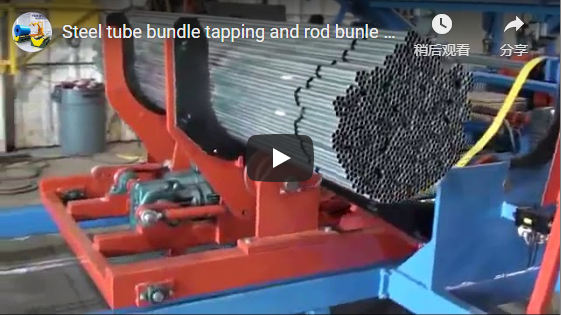
Our footage shows operators on both sides of the line. One worker organizes shorter tubes near the feed while another monitors the outfeed as the machine conveys the tubes through.
The line moves the tubes from the feed side to the stacking section, and a flashing lamp on the control cabinet marks the running cycle. The units seen in the frames are metallic tubes on a blue-painted frame.
Rigid plastic and PVC pipe runs can be processed with the matching guide and strapping tooling. Softer or flexible pipe is buffered before strapping so the metal band does not cut the wall. Your pipe size, bundle dimensions and strap pattern are confirmed per project.
Configuração típica
The figures below list functional design boundaries rather than numeric values, and are confirmed per project.
| Parâmetro | Faixa típica, confirmada por projeto. |
|---|---|
| Ver | rigid pipes and tubes laid on the infeed track |
| Processo | conveying, bundling and strapping in one line |
| Transferência | infeed section in, stacking section out |
| Pacote | metal straps applied around the tube bundle |
| Controlar | Botões de pressão e lâmpadas indicadoras no painel de controle |
| monte | floor mounted, in line with the pipe line |
| alimentação eléctrica | 380 V trifásico 50 Hz ou 220 V monofásico para máquinas leves, selecionado conforme o projeto. |
| Supervisão | one operator on each side of the line |
Lista de verificação de seleção
| Questão | Confirme por projeto |
|---|---|
| Gama de tubos | diameter, length, wall thickness and end finish |
| Pacote | bundle diameter, strap type, width and tension |
| Line | feed speed, strapping dwell and stacking height |
| Controlar | panel layout and guarding around the line |
| Local | floor space and access at both ends |
| alimentação eléctrica | tensão, fase e frequência no local |
Operação e segurança
Lay the tubes flat on the infeed, start the pass, and supervise the line on both sides. Keep hands clear of the rollers and the bundling station while the machine is running.
Routine checks cover the conveying track, the strapping tooling and the control cabinet, following the machine manual. Operators wear safety helmets on the line, and the bundle is checked before it leaves the outfeed.
Perguntas frequentes sobre engenharia
Q: What does this machine do? A: It feeds pipes and tubes through the line, forms each run into a bundle and applies metal straps before the bundle leaves.
Q: Do we load each pipe by hand? A: Operators position the tubes by hand on the infeed, and the machine conveys, bundles and straps them automatically.
Q: How is the bundle strapped? A: Each tube run is formed into a bundle as it passes through the bundling station, and the straps are applied in the same step.
Q: What sizes can it handle? A: The line takes rigid pipes and tubes of different lengths; we confirm the exact size range per project when you send your batch details.
Q: What electrical supply does it need? A: The line runs on 380 V three phase 50 Hz as standard, and light machines can be arranged for 220 V single phase, selected per project.
Próxima etapa
- Email us at info@fhopepack.com with your pipe and tube sizes.
- We send a packing line proposal within 48 hours.
- We confirm the line layout and bundle settings for your pipes.
Leitura relacionada
- Vedação de Tubos e Canos de Plástico: Guia Completo
- Enrolamento e amarração de mangueiras em espiral: soluções para a indústria
- Envolvimento parcial de filme e embalagem por envoltório orbital
- Linhas de produtos de máquinas de embalagem FHOPE
Fontes e normas
- ISO 12100:2010 Segurança de máquinas, princípios gerais para projeto e avaliação de riscos
- EN 415-10:2014 Segurança de máquinas de embalagem, requisitos gerais
- EN ISO 13849-1:2023 Segurança de máquinas, partes de sistemas de controle relacionadas à segurança
FHOPE automatic pipe and tube packing line demonstration video. Reviewed as a general demonstration of pipe and tube bundling and strapping; pipe size, bundle size and line layout are confirmed per project.
Última revisão: 12/10/2026