title: Beyond Standard Bundling: Upgrading to Inline Shrink Packaging for Recycled PS Wall Panels seo_title: Inline Shrink Packaging Line for Wall Panels | FHOPE seo_desc: Protect PS wall panels from dust and transit damage. FHOPE inline shrink packaging line seals profiles and panel stacks up to 50 kg. slug: beyond-standard-bundling-upgrading-to-inline-shrink-packaging-for-recycled-ps-wall-panels
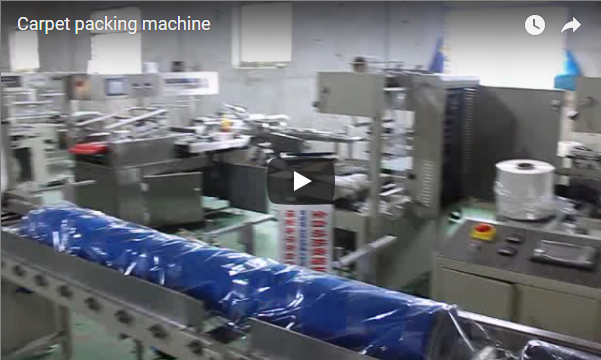
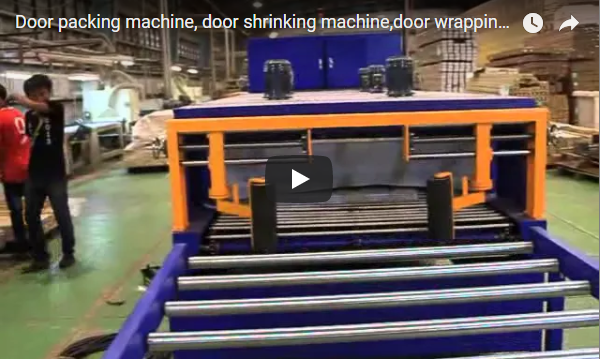
Streszczenie: Manual strapping leaves decorative PS wall panels and long profiles exposed to dust, moisture and handling marks during logistics; this inline shrink packaging line replaces that step in the same line. Film wraps each flat panel or profile stack, and a heat tunnel seals it into a clean, scratch-free pack. The line handles pack lengths from 300 to 3000 mm, stacks up to 50 kg, runs at 9 to 12 m/min on the longest pack, and holds the maximum packing count to 12 packs per minute. The video shows the cycle on a long wood-slat bundle, with a printed box-shaped item running through the same section.
Spis treści
- What Inline Shrink Changes vs Bundling
- The Line in Three Stages
- One Line for Profiles and Panels
- Choosing the Machine by Cross-Section
- Film and Heat Shrink
- Line Data and Utilities
- Często zadawane pytania dotyczące inżynierii
- Następny krok
- Źródła
- Powiązane artykuły
What Inline Shrink Changes vs Bundling
Standard bundling pulls straps around a stack. The stack is held together, but the surface is still exposed: dust settles on the top edge, moisture can reach the panels, and the corners take handling damage on the way out of the plant.
Shrink packaging closes that gap in the same line. The film seals the whole pack, so what leaves the factory is one clean, labelled unit instead of an open bundle. For recycled-PS wall panels, where a smooth face is part of the product promise, that seal matters as much as the stacking itself.
The Line in Three Stages
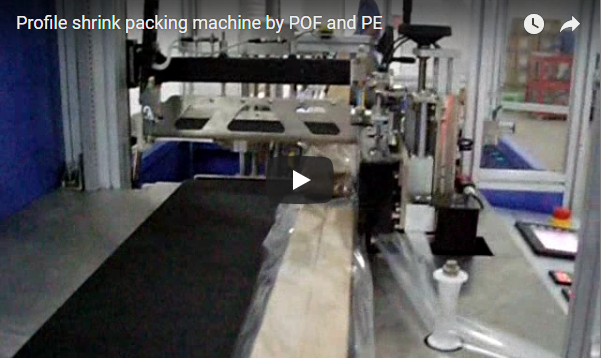
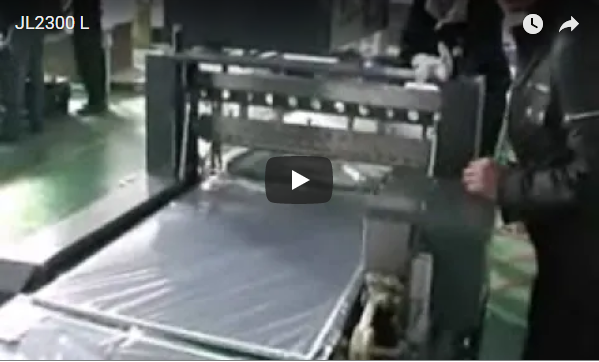
The video shows the working cycle in three clear stages:
- Zawinąć. A long bundle — light-coloured wooden slats laid side by side, over 2 m long — runs on a roller conveyor into the wrapping section. Clear film is drawn around it, still loose.
- Kurczyć się. The filmed bundle enters the white heat tunnel with blue curtains at both ends. The panel controller sets the heat; as the bundle travels through, the film tightens onto the profile.
- Wydajność. The shrunken bundle leaves the tunnel with the film flat against the product. An operator at the line exit takes the finished pack; film stays tight to the profile.
The same section also carries a printed box-shaped item, which confirms the line handles long rectilinear products of different materials — not only wood.
One Line for Profiles and Panels
Flat panels and long profiles share one problem: their length makes them awkward for standard wrapper rings. The answer is a line that works along the length instead of around the cross-section.
Film wraps around the product, a seal is made along the long edge, and the tunnel finishes the job. This is the profile-and-panel shrinking principle: wrap, seal, shrink. Because the seal runs the full length of the pack, product length does not limit the line; longer panels simply take more of the tunnel path.
Choosing the Machine by Cross-Section
The line type follows the pack cross-section, not the total length. As the profile and panel bagging and shrinking page explains, the side sealer suits products whose width plus height falls in a set range, while the profile shrink line takes narrower sections. For a panel stack the deciding numbers are width and height of the finished pack; your panel width and wall count fix those. Send the layout and we confirm the right stage.
Film and Heat Shrink
The line uses shrink film in a tunnel. The film is loose when it wraps the bundle; heat from the tunnel contracts it so it pulls tight onto every edge. Temperature is set on the control panel at the tunnel.
For panels that tolerate heat, the hot-air tunnel is the fastest path. For heat-sensitive insulation such as EPS, a bagging-and-sealing step without tunnel heating is the safer route, as the EPS panel sealing and shrinking page pokazy.
Line Data and Utilities
Line data is configured per project from the panel or profile cross-section, pack length and required throughput. The reference line handles pack lengths from over 300 mm up to 3000 mm for the best range. It stacks up to 50 kg and runs at 9 to 12 m/min on the longest pack. The maximum packing count is held to 12 packs per minute.
| Parametr | Wartość: | Znaczenie |
|---|---|---|
| Długość paczki | 300 do 3000 mm | best working range, longer accepted |
| Maximum pack weight | 50 kg | stack weight limit on the line |
| Temperatura tunelu | up to 240 C | max heat setting on the panel |
| Linia prędkości | 9 do 12 m/min | calculated on the longest pack |
| Maximum packing count | 12 opakowań/min | not exceeded per minute |
Provide the following parameters during RFQ sizing:
- Panel or profile width, height and length.
- Maximum pack weight.
- Target packs per minute or per shift.
- Available floor layout.
The install needs a standard electrical supply; the tunnel runs on mains heat with adjustable temperature on the panel. Utilities and guarding are confirmed at the engineering review.
Często zadawane pytania dotyczące inżynierii
Q: Does this replace my bundling machine entirely? A: It replaces the manual bundling step for packs that need surface protection. If strapping must stay for structural rigidity, the two can be combined in one line with the shrink stage after the straps.
Q: What length of panel can the line take? A: The standard infeed and tunnel dwell support continuous operation from 300 to 3000 mm pack length. Panels beyond 3000 mm are possible by selection per project, with extended conveyor sections and dwell adjustment confirmed with our engineers.
Q: What about heat-sensitive panels? A: For materials such as EPS or low-melt plastics, we offer a bagging-and-sealing version that closes the pack without tunnel heat, then shrink can be added later if the panel tolerates it.
Q: How do I choose between this and a door/panel shrink machine? A: If your product is a flat panel stack, both work; the choice is the pack cross-section and whether you need a full line. Send cross-section and length and we recommend the model.
Q: What should a buyer check on safety? A: The standards that apply depend on the destination market. For CE markets, ISO 12100 sets the risk-assessment method, and EN 415-10 covers the safety requirements of packaging machines. These two standards form the basis of the guarding and control scheme. Check heat-area interlocks around the 240 C tunnel, infeed and discharge guarding, and confirm emergency-stop and lockout points with the builder.
Następny krok
Lista kontrolna wyboru
To get a clear picture of a shrink line in your plant, the next step is a short sequence:
- Prześlij swój rysunek układu.
- Otrzymaj propozycję w ciągu 48 godzin.
- Umów się na wizytę kontrolną.
Write to info@fhopepack.com and our engineers will size the line to your panel.
Źródła
- Reference video (video ID 2cYdaJvsoAQ, FHOPE GROUP)
- Automatyczna linia do pakowania i obkurczania profili i paneli
- Uszczelnianie i obkurczanie paneli EPS za pomocą dmuchaw grzewczych
Ostatnia aktualizacja: 2026-10-11
Powiązane artykuły
- Motion Sealer Station
- Automatyczna linia do pakowania i obkurczania profili i paneli
- Uszczelnianie i obkurczanie paneli EPS za pomocą dmuchaw grzewczych
- Maszyna do pakowania w folię termokurczliwą z płyt drewnianych
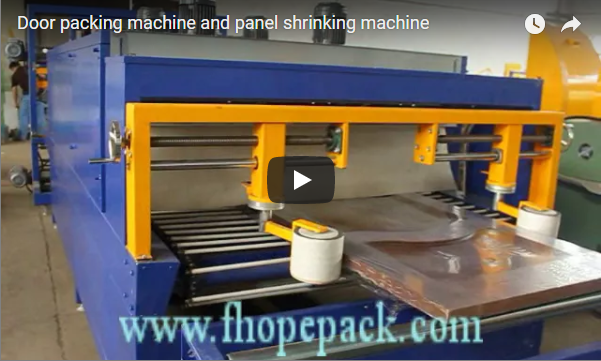
- Maszyna do pakowania drzwi i paneli w folię termokurczliwą: działanie i szerokość folii
- Opakowania mebli zgrzewane z 6 stron
- Automatyczna maszyna do pakowania w folię termokurczliwą POF z tunelem grzewczym