Streszczenie A coil tilter with a sliding table turns a coil or packed load 90° and lets the table travel out for loading by crane or fork-lift. In this clip our C-shaped tilter turns a film-wrapped load from upright to on its side between about 16 s and 40 s, then swings it back by about 56 s. Our mechanical upender with sliding table is rated for 5 T, single-way 90° turn-over, about L3000 × W2200 × H2600 mm, configured per project.
Spis treści
- Co pokazuje klip, w kolejności
- What a sliding-table coil tilter does
- Turn and return cycle time on the clip
- Specifications of our sliding-table upender
- Kontrola taktu
- Selection checklist for a coil tilter with sliding table
- Sterowanie i bezpieczeństwo
- Często zadawane pytania dotyczące inżynierii
- Następny krok
- Powiązane czytanie
- Źródła
Co pokazuje klip, w kolejności
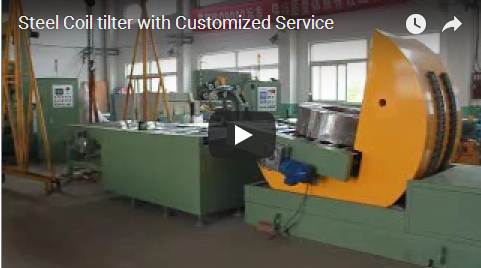
The clip shows one machine from one camera position: a yellow C-shaped frame, open on one side, standing on a heavy blue base. A film-wrapped load sits inside the C. Each end of the frame has a round lifting lug.
- 0 to 12 s. The load rests upright on the table and nothing moves.
- Około 16 sekund. The frame starts to turn about its lower pivot and the load leans with it.
- Około 20 do 32 sekund. The turn continues until the load lies on its side, held between the two arms of the C.
- Około 36 do 40 sekund. The frame reaches the end of its turn, with the opening of the C facing up.
- Około 44 do 56 sekund. The frame swings back and the load returns close to its upright starting attitude.
The table stays in its turning position throughout this sequence; table travel belongs to loading and unloading, before and after the turn.
What a sliding-table coil tilter does
A coil tilter turns a load through 90° between lying on its face and standing on its side. The sliding table adds one more function: the table on the base runs on rails, so it can travel out from under the frame for loading and unloading and travel back for the turn. That keeps the crane hook or the fork-lift away from the frame while the load is placed.
The C-shaped frame holds the load on two faces, the table and the back of the C. The load turns with the frame instead of sliding across it, which protects edges and film wrapping.
| Tilter element | Sized by |
|---|---|
| C-frame opening | Load height and width |
| Sliding table and rails | Load footprint and loading method |
| Pivot and drive | Load moment at 5 T |
| Uchwyty do podnoszenia | Moving and installing the frame |
Turn and return cycle time on the clip
| Wejdź na klips | Okno czasowe | Czas trwania: |
|---|---|---|
| At rest before the turn | od 0 do około 12 s | około 12 s |
| Turn from upright to on its side | około 16 do 40 sekund | około 24 s |
| Return toward upright | około 44 do 56 sekund | około 12 s |
The turn on the clip is slower than the return, which is usual: the drive slows the load into its side position, while the return carries less risk. Our page model is specified for a single-way 90° turn-over, where the frame turns the load once and the load leaves in its new attitude. The clip shows the frame returning, which is the two-way pattern. We choose one-way or two-way at the layout stage, because it changes the cycle.
Specifications of our sliding-table upender
| Upender i tilter ze stołem przesuwnym | Specyfikacja |
|---|---|
| Maksymalne obciążenie | 5 T |
| Turn-over | 90°, single way |
| wielkość maszyna | about L3000 × W2200 × H2600 mm |
| Waga maszyny | około 4 tony |
| Napięcie zasilania | Prąd zmienny 380 V, 60 Hz |
Kontrola taktu
For an illustrative target of 30 loads per hour, one load must leave every 120 s, from 3,600 ÷ 30. On the clip the turn takes about 24 s and the return about 12 s, about 36 s of motion. That leaves about 84 s for sliding the table out, unloading, loading, sliding it back and letting the load settle. When the table travel and the crane or fork-lift move fit in that window, one tilter covers the target.
Selection checklist for a coil tilter with sliding table
- Load OD, width or footprint, and weight up to 5 T.
- Arriving attitude and the attitude the next station needs.
- One-way turn-over, or turn and return.
- Loading method: crane, fork-lift or conveyor, and the table travel needed.
- Floor space for about L3000 × W2200 × H2600 mm, plus the table travel, which we fix at the layout stage.
- Takt, including table travel and loading.
Sterowanie i bezpieczeństwo
The swing of the C-frame and the travel of the sliding table are the danger zones. Keep everyone outside both while the tilter runs, and load only with the table in its loading position and the frame at rest. Stop, isolate and lock out the tilter before anyone works on the load, the table or the rails, and never leave a load turned with the drive isolated unless it is mechanically supported.
The standards that apply depend on the destination market. For CE markets, EN 415-10 covers general requirements for packaging machines and ISO 12100 sets the risk-assessment method, which fixes guarding and the emergency-stop arrangement.
Często zadawane pytania dotyczące inżynierii
Q: Why add a sliding table to a coil tilter? A: The table travels out from under the frame on rails, so the crane or fork-lift places the load clear of the C-frame. The table then travels back and the frame turns the load 90°.
Q: What load does the sliding-table upender take? A: Our page model is rated for 5 T, with a single-way 90° turn-over and a machine size of about L3000 × W2200 × H2600 mm.
Q: How long does the turn take? A: On the clip the turn takes about 24 s and the return about 12 s. Add table travel and loading time before comparing with your takt.
Następny krok
We size a sliding-table coil tilter in three steps:
- Prześlij swój rysunek układu with the load size, weight, turn angle, loading method and takt, to info@fhopepack.com.
- Otrzymaj propozycję w ciągu 48 godzin, including the frame and table arrangement and the cycle check against your takt.
- Zarezerwuj badanie na miejscu so we confirm the foundation, the table travel and the clearance around the frame.
Powiązane czytanie
- Upender i tilter ze stołem przesuwnym
- Coil upender and tilter machines
- Coil tilter and upender for palletised coils
- Rotatable 180 degree multipurpose tilter
Źródła
- Upender specifications: Upender and tilter with sliding table product page
- Czas trwania klipu: czasy klatek pobrane z klipu, 4 s między klatkami
- Maszyna w akcji: nasz film na YouTube
- Zakres norm: ISO 12100: 2010, EN 415-10: 2014
Ostatnia aktualizacja: 2026-10-05