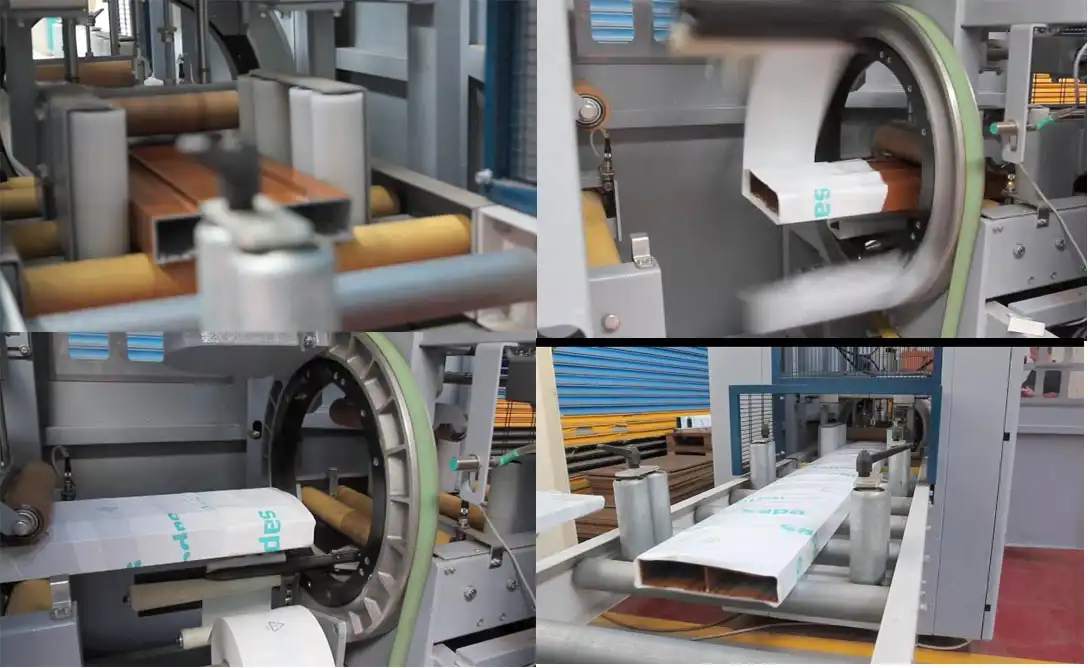
Why Furniture Is the Awkward Load
Furniture is the awkward case for orbital wrapping because the same machine has to carry a flat cabinet door, a glazed window frame and a bulky upholstered sofa, and each of the three fails in a different way.
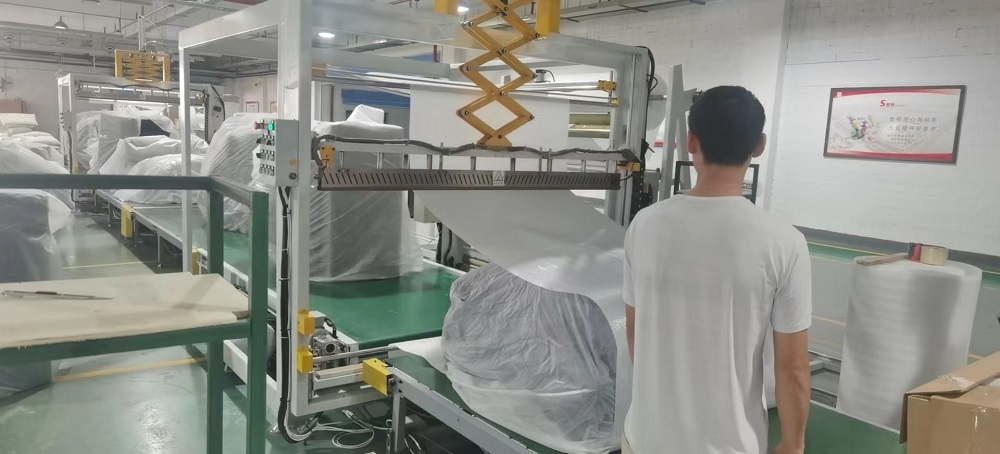
A flat door is stiff in its own plane and flexible across it, so it crosses the ring gap as a plate and needs support at the leading edge rather than along its length. A glazed frame is rigid but brittle, which makes film tension the controlling variable: enough to hold the assembly, not enough to rack the joinery. An upholstered sofa is the opposite problem — soft, irregular and compressible, so the wrap has to compact the fabric without pressing the internal frame out of square.
That spread is why the same platform appears in several bore sizes with different conveyor and clamp arrangements, and why the wrap recipe rather than the ring is what usually decides whether a furniture line runs cleanly.
Overlap and Radius Arithmetic
The page lists the sequence; what it does not list is the arithmetic that decides whether the wrap survives a truck ride. Three numbers set it: feed rate, ring speed and film width.
Overlap is a ratio: pitch per revolution divided by film web width. For a 250 mm web running at a feed rate that gives 200 mm of advance per revolution, the overlap is 20 percent; halving the advance doubles it to 60 percent. Delicate glazed cargo usually wants the higher figure, because a loose wrap lets the frame rack under its own weight in transit.
The radius side is what makes furniture different from pipe. A non-circular section swings the centre-to-contact distance four times per revolution, and a flat panel swings it furthest: for an 800 × 200 mm section the radius moves from the half-height to the corner diagonal, which is roughly a fourfold change. A friction brake alone cannot follow that, so the film path carries a dancer or accumulator that absorbs slack on the flat faces and releases it around the corners.
Ring Bore Geometry: Calculating Frame Clearance and Interferences
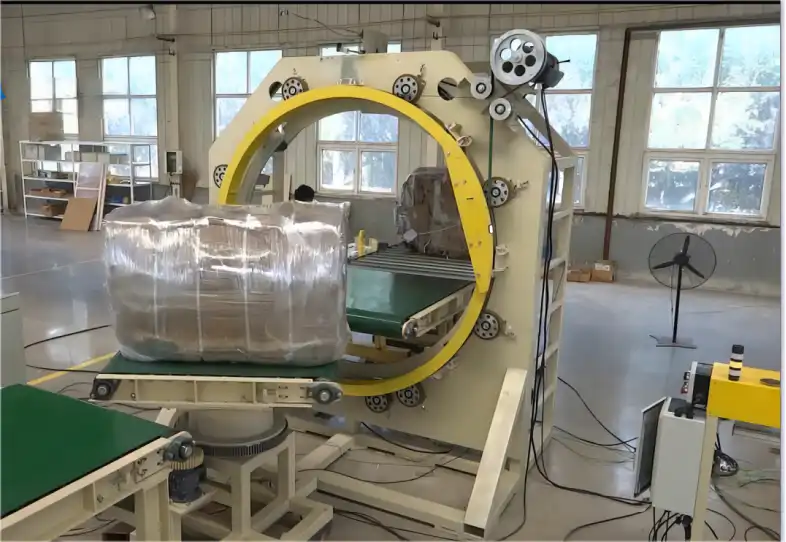
The ring inside diameter must swallow not only the furniture diagonal but also the film carriage and dynamic clearance — about 400 mm over the circumscribed OD on the FHOPE standard budget.
Governing Interference Formulation
The minimum inside diameter of the rotating ring (D_ring) is governed by:
D_ring >= sqrt(W^2 + H^2) + 2 * (C_carriage + S_clearance)
Gdzie:
-
W = Maximum furniture cross-sectional width (mm).
-
H = Maximum furniture cross-sectional height (mm).
-
OD_diagonal = sqrt(W^2 + H^2) = True outer diagonal cross-section (mm).
-
C_carriage = Radial carriage intrusion envelope (typically 180 to 250 mm for power pre-stretch modules).
-
S_clearance = Dynamic spatial safety buffer to absorb lateral load shifts and conveyor tolerance (typically 80 to 100 mm).
Engineering Calculation Example (Illustrative)
Consider an assembled chest of drawers measuring 1000 mm in width and 800 mm in height:
Note: The calculation above is an illustrative engineering example. Ring bore dimensions and carriage intrusion profiles must be verified against certified general arrangement drawings prior to fabrication.
Two Extremes: Glazed Frames and Upholstered Units
The two ends of the furniture range need opposite treatment, and a line that runs both has to satisfy both.
A glazed frame is brittle and rigid. The film tension that holds the assembly is also the load that racks the joinery, so the wrap is run with a dancer-controlled low tension and a denser overlap — more wraps at less tension, rather than fewer wraps pulled hard. The clamp matters as much as the film: a press roller bearing on the glazing itself will crack it, so the clamp lands on the frame stiles and never on the pane.
An upholstered unit is the reverse. It compresses, so the wrap has to be pulled tight enough to compact the fabric into a stable block; a loose wrap on a sofa lets the cushions shift inside the film and the unit arrives out of shape. The clamp pressure is correspondingly higher, but it is spread across a wide low-durometer roller so the fabric is compressed rather than marked.
Where one line serves both, the recipe carries the tension, overlap and clamp pressure as a set, and the changeover is a recipe selection rather than a mechanical adjustment.
Load Handling and Conveyor Engineering: In-Feed, Out-Feed, and Gap Bridging
Long, heavy units need stable linear handling to prevent deflection and marring.
In-Feed Staging and Lateral Alignment
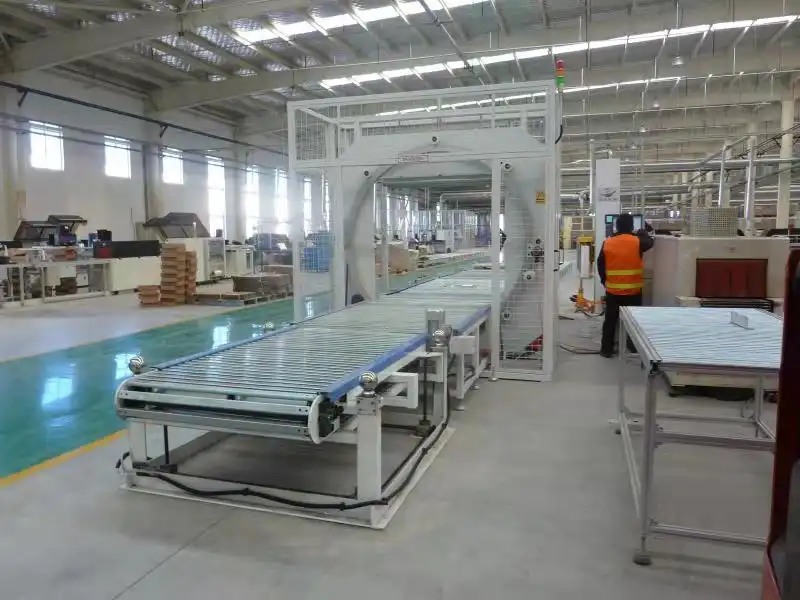
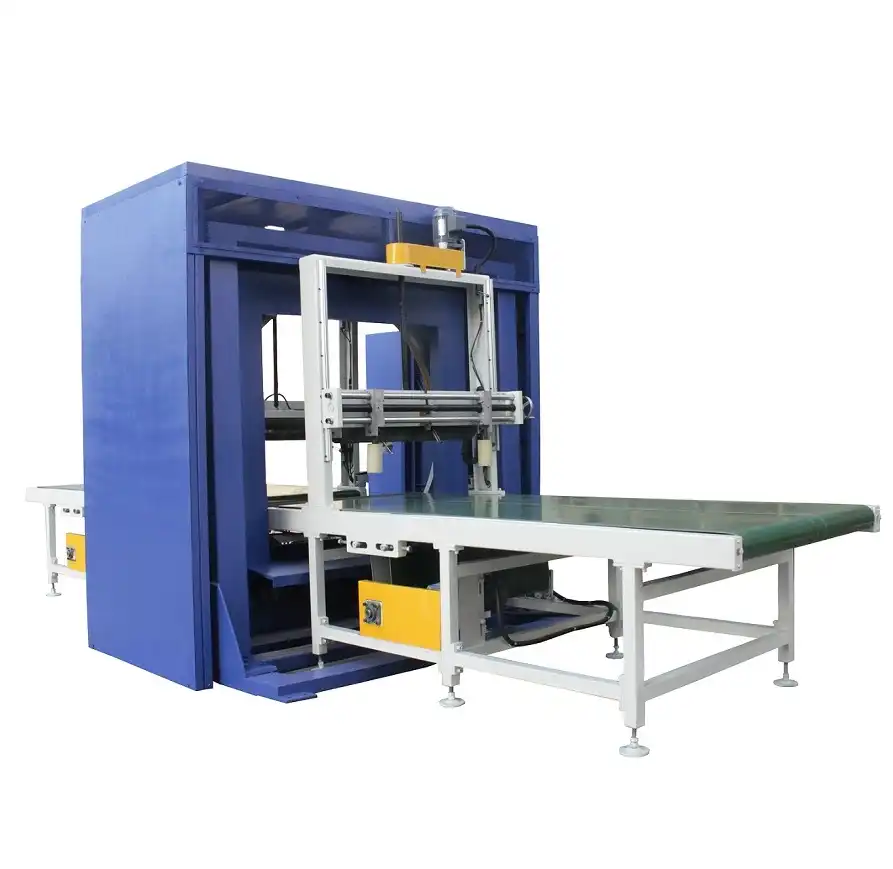
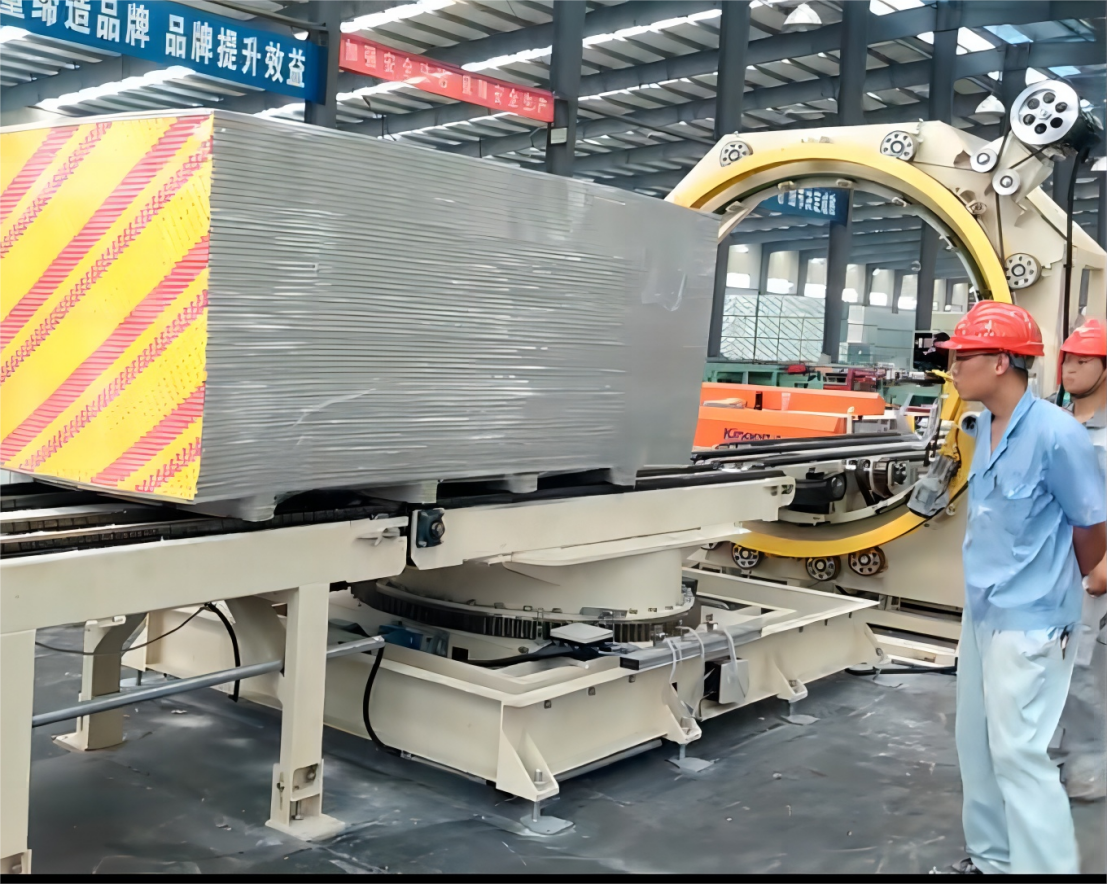
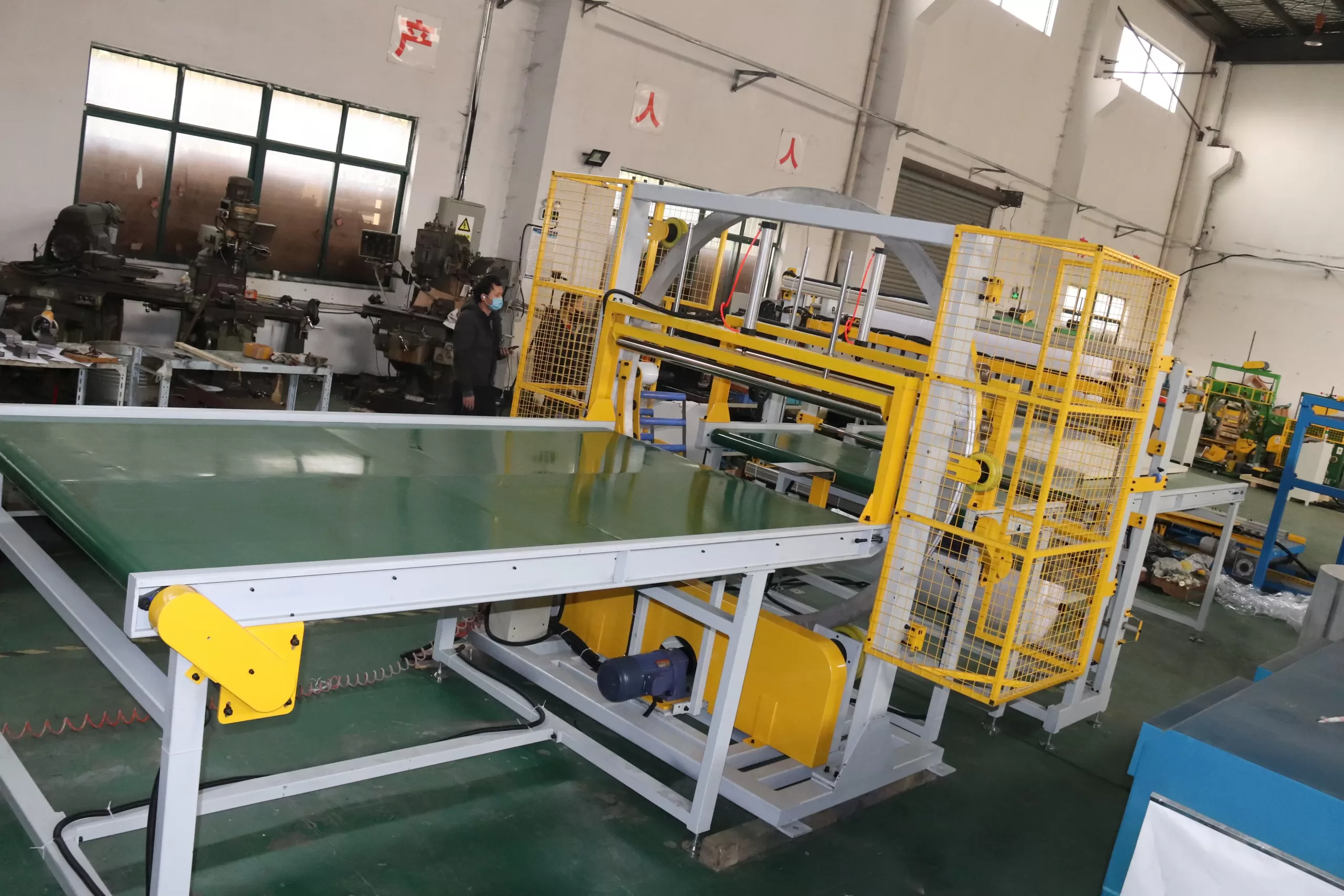
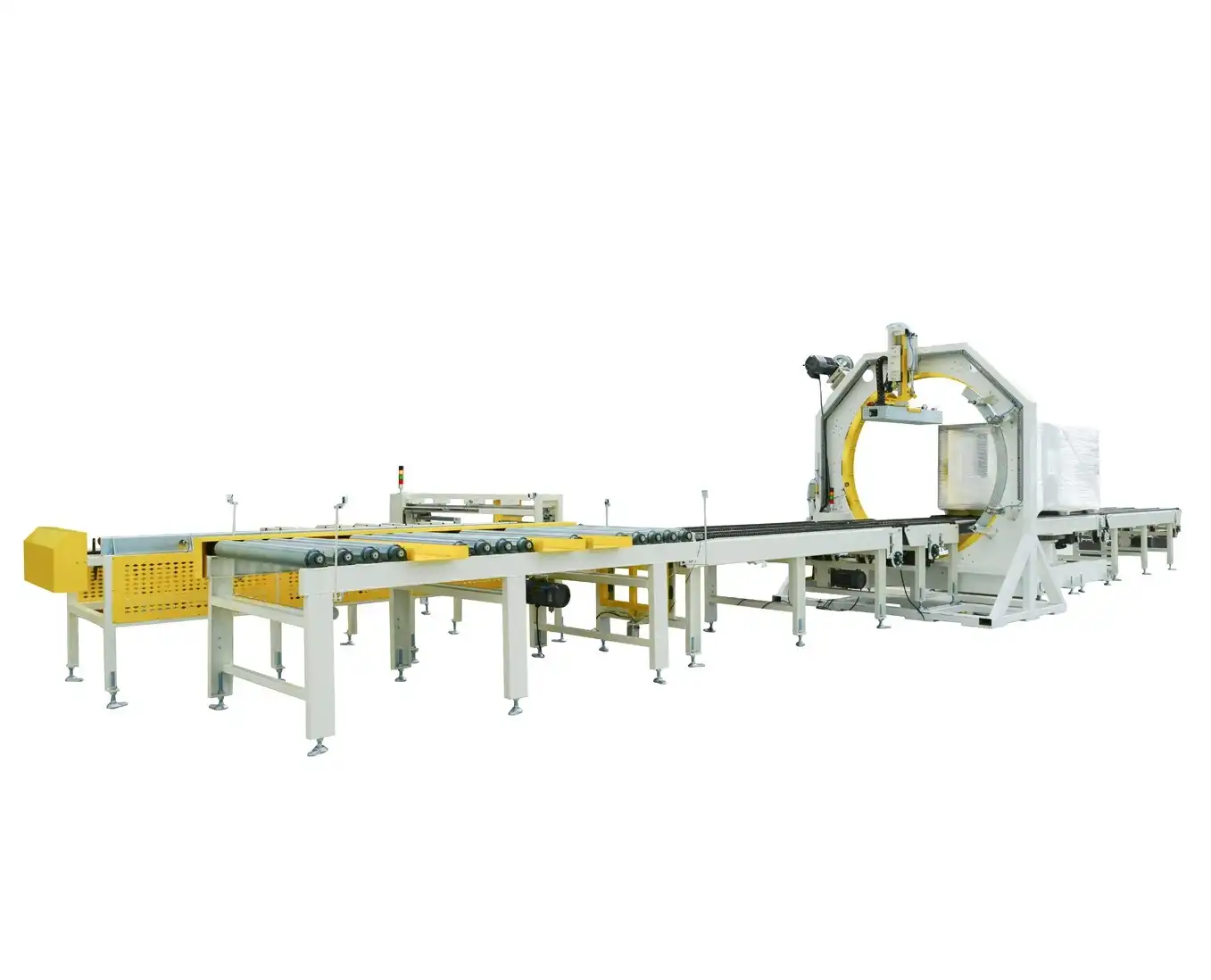
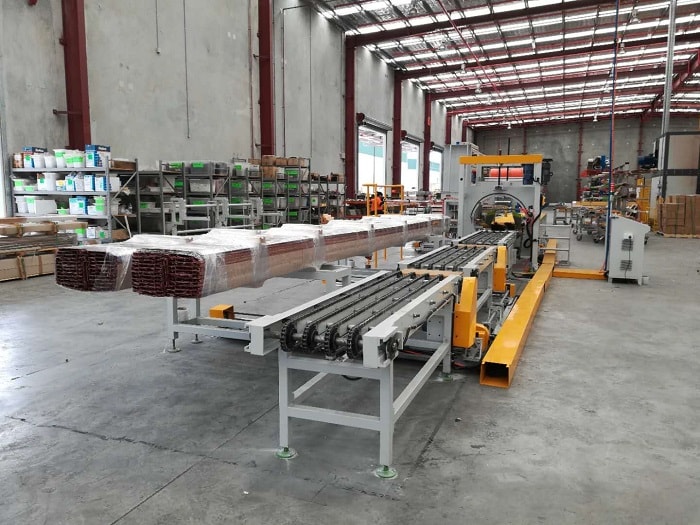
The 2500 mm powered roller in-feed deck is the stabilization bed: rubberized rollers protect lacquered bases and centering side-guides align heavy assemblies on the ring axis, preventing eccentric loads and bearing imbalance.
Ring Gap Bridging and Cantilever Deflection
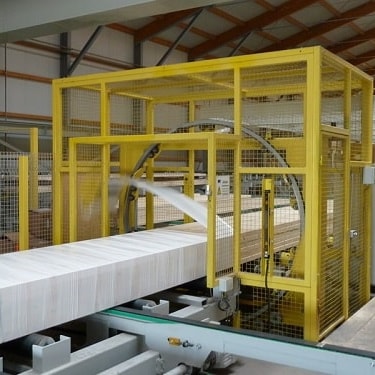
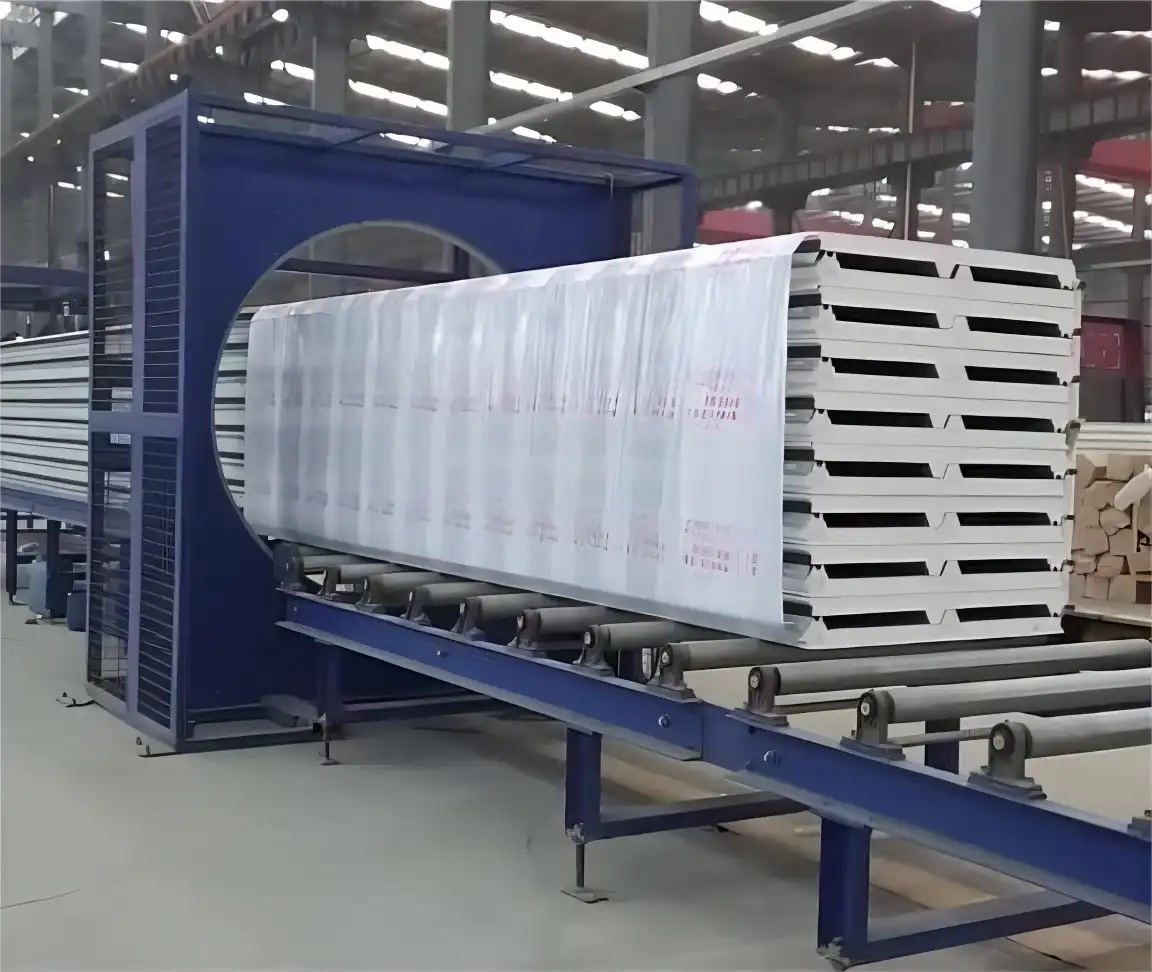
As the furniture advances through the rotating ring, it must span the physical mechanical gap separating the in-feed and out-feed tables. If unaddressed, flexible assemblies like long MDF panels or cantilevered dining tables sag into this void, colliding with the rotating ring frame.
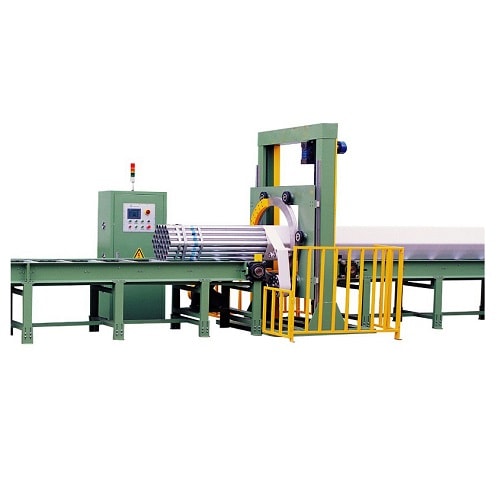
FHOPEPACK platforms utilize pneumatic bridge supports or driven mini-cassette rollers inside the ring cavity. These intermediate rollers support the nose of long panels until the load contacts the discharge table, maintaining an even 850 mm pass line without surface distortion.
Discharge Conveyor and Downstream Takeaway
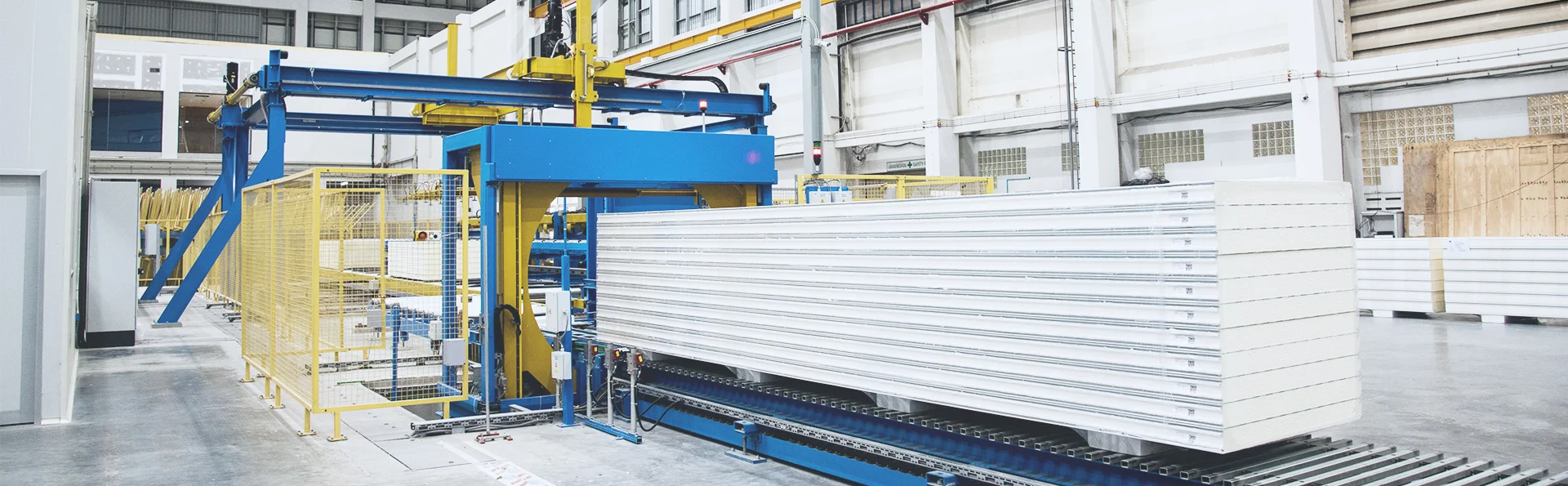
The 2500 mm out-feed conveyor receives the wrapped product, stabilizing the bound package as the trailing edge clears the orbital wrapping zone. The continuous roller drive pulls wrapped case goods clear of the cutting station, allowing automated transfer to downline gravity conveyors, transfer carts, or sorting tables.
Critical Machine Engineering Features
Machined Solid Ring and Polyurethane Drive Assembly
The ring is single-piece cast aluminum or stress-relieved steel, driven by polyurethane friction wheels and multi-groove V-belts — damping vibration, keeping noise below 74 dBA and prolonging gearmotor life.
Powered Pre-Stretch Carriage Modules
High-throughput installations use powered pre-stretch carriages instead of friction spindles; twin geared rollers stretch film 150% to 250% before application (1.0 m unrolled becomes 3.0 m at 200%).
This yield multiplication generates significant commercial advantages:
-
Reduces film consumption by 40% to 60% compared to basic core brakes.
-
Stiffens the film into a high-tensile membrane that locks jointed cabinetry together.
-
Lowers wrapping pressure against fragile hollow-core doors while maximizing clamping force along load corners.
Automated Pneumatic Clamp, Cut, and Wipe Mechanisms
Manual tail handling slows line output. FHOPEPACK horizontal wrappers integrate pneumatically actuated clamp-and-cut assemblies located within the lower chassis.
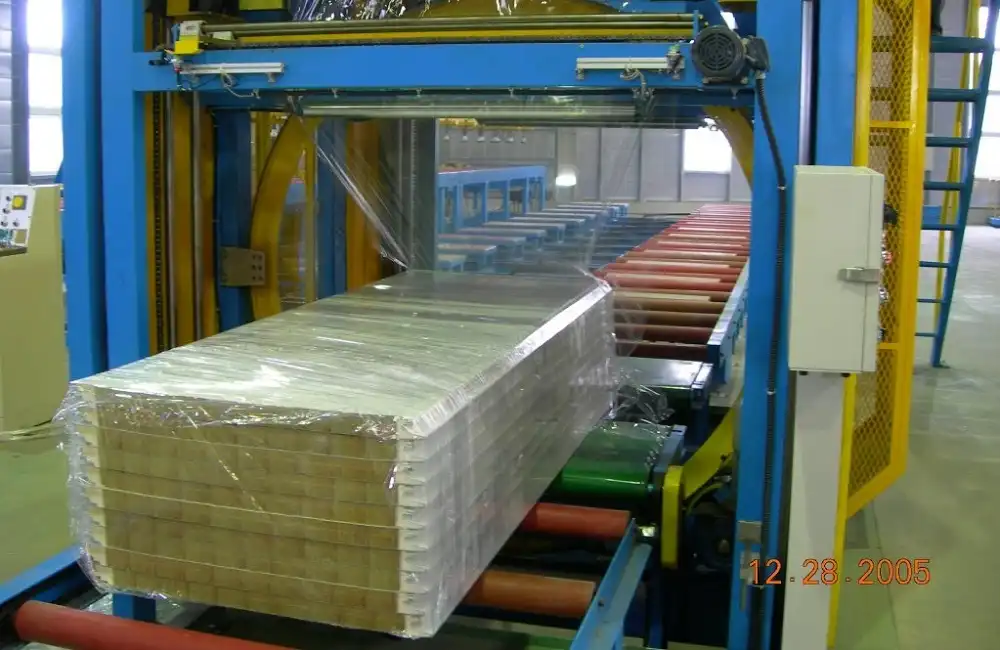
At the start of a cycle, the clamp holds the film tail until the orbital ring completes its initial securing passes. Upon cycle completion, a hot-wire knife or serrated steel blade cuts the web, and an air wipe or trailing roller seals the final film tail flat against the furniture face, eliminating manual operator intervention.
Packaging Configurations: Four-Sided Continuous vs. Six-Sided Sealed
The choice between four-sided spiral wrap and sealed six-sided containment follows your shipping route.
Macierz porównania procesów
|
Czynnik
|
Four-Sided Continuous Wrapping
|
Complete Six-Sided Sealed Wrap
|
|
Relacja filmowa
|
Top, bottom and both sides; ends open
|
All four faces plus end caps front and rear
|
|
Bariera
|
Scuffs, scratching, settling dust
|
Full block against container moisture, grime and rain
|
|
Koszt materiału
|
Baseline resin use
|
20–35% higher (foam/PE caps)
|
|
Prędkość cyklu
|
High (4–12 m/min line feed)
|
Moderate (end-sheet pauses)
|
|
Najlepszy dla
|
Domestic truck freight, inter-plant moves, pre-boxed cabinetry
|
Ocean export, flat-pack bundles, raw wood
|
Selecting the Proper Method
-
Wybierz pakowanie czterostronne when processing uniform panels, interior solid doors, and domestic furniture shipments where parts travel inside sealed box trailers to nearby distribution hubs.
-
Choose Six-Sided Enclosed Packaging when exporting luxury solid wood dining sets, glazed exterior window packages, or upholstered furniture subject to rough marine transshipment and high humidity.
Machine Safety, Industrial Directives, and Compliance Standards
Orbital stretch wrappers feature high-inertia rotating rings spinning alongside continuous conveyors. Safety engineering must protect operators without throttling production.
Safety and Design Directives
-
EN-415 6: Specific European standard governing safety requirements for horizontal wrapping machines. Enforces interlocking perimeter guards, pinch-point screening, and protective tunnel dimensions on in-feed and out-feed tracks.
-
EN ISO 12100: Comprehensive mechanical risk assessment methodology applied to moving carriages, rotating rings, and automated pneumatic cutting blades.
-
EN-60204 1: Electrical safety compliance governing drive controls, short-circuit current ratings, and emergency stop operational circuits.
-
ISO 13849-1 (PLd / SIL 2): Safety-related software and hardware control circuits. Emergency stops and optical perimeter barriers utilize dual-channel safety relays to trigger immediate dynamic motor braking during safety breaches.
-
ISO 4414: Pneumatic safety regulations governing automatic dump valves. The system exhausts stored pneumatic energy safely upon emergency stop activation, preventing unexpected knife actuation.
Engineering RFQ Input Matrix: System Sizing Checklist
Send our application engineering team the specifications below to size the system and ring bore:
|
Parametr inżynierski
|
Mandatory Specification Range
|
Purpose in Mechanical Layout Design
|
Consequences of Inaccurate or Missing Data
|
|
Max and min cross-section
|
Width and height, mm
|
Sets circumscribed diagonal OD and ring bore
|
Corner collision with the carriage, or an oversized ring
|
|
Product length envelope
|
Shortest and longest, mm
|
Sets conveyor length, roller spacing and gap bridging
|
Short pieces drop into the ring void; long units sag into the frame
|
|
Weight profile
|
Min and max, kg
|
Sizes roller wall, shafts, bearings and motor torque
|
Conveyors bow under load; oversized motors waste power
|
|
Substrate surface
|
Flat wood, glazed glass, fabric, leather
|
Sets dancer-arm tension, pre-stretch ratio and roller compounds
|
Crushed upholstery, warped joints or shattered panes
|
|
Wymagana przepustowość
|
m/min and pieces per hour
|
Sets conveyor drive power, inverter sizing and carriage rpm
|
Downline bottlenecks
|
|
Zakłady użyteczności publicznej
|
Voltage, Hz, phases and air pressure
|
Directs transformer selection, drive wiring and air prep
|
Electrical mismatch and pneumatic faults
|
Engineering SLA: Proposal Timeline
24
W ciągu 24 godzin:
ring-bore dynamic clearance calculation and preliminary interference check on your maximum envelope.
48
W ciągu 48 godzin:
complete 2D/3D General Arrangement layout, utility schedule and firm quotation.
Operator FAQs: Industrial Furniture Packaging Operations
Can an orbital wrapping machine package fragile, glazed cabinet doors without breaking the glass?
Yes. VFD ring drive and pneumatic dancer arms let operators dial tension down to a gentle hold, and polyurethane-sleeved rollers support the glazed door full-length, so the film binds glass and frame into one rigid unit without twisting stress.
How do we keep stretch film from crushing the soft corners of upholstered sofas?
Powered pre-stretch elongates film before it touches the load; it leaves the carriage pliable and recovers its memory gradually, clamping broad faces gently without crushing rounded fabric corners.
What scheduled maintenance keeps the wrapping line running smoothly?
Preventative maintenance centers on drive wear components and sensors:
-
Codziennie: check light curtains, e-stops and carriage film path for resin buildup.
-
Co tydzień
: clear roller debris and purge air-line filter condensate.
-
Miesięczny: measure ring support wheel wear, check belt tension, clean tracking sensors.
-
Kwartalny: lubricate ring support bearings, drive chains and pillow blocks.
Conclusion: Sizing Your Line for Safe Delivery
For furniture the bracket is diagonal at one end and fragility at the other: the worst envelope fixes the bore, the most breakable piece fixes the tension and the clamp. A wrapper sized for the average piece either fouls the largest one or racks the glazed one, and both failures appear after the machine is anchored rather than during the quotation.
Four figures decide that boundary: the maximum and minimum cross-sections, the length range including the longest assembled unit, the mass per metre on the conveyor, and the surface condition of the finish. Those produce the clearance check and the GA layout drawing; the tier name is only the label that follows. Furniture lines are usually the reason a plant buys its first ring, and then the second product family arrives.
Submit the furniture dimensions and the line capacity requirements to the FHOPEPACK engineering group for the clearance check and the GA layout drawing.