> **Samenvatting voor de directie**
> An automated coil packaging line takes a bare coil from the slitter or mill and discharges it wrapped, strapped and ready to ship, with no manual handling in between.
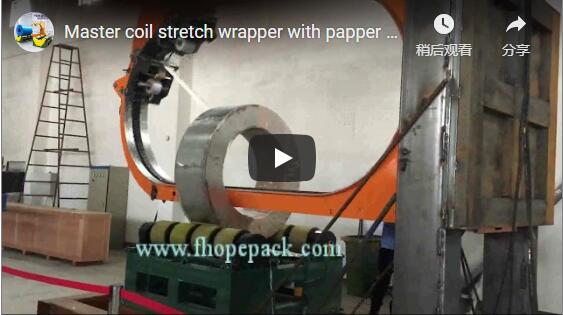
> Our line in this video starts with a 3D layout, then shows the real stations: a green eye-through wrapper covering the coil, an orange arm handling it, and strapping.
> Strap per coil follows from the **coil size** and the **band layout**. Both are set per project.
Inhoudsopgave
- Wat de video laat zien
- Stations in an automated coil packaging line
- Strap consumption per coil
- Het plannen van de indeling
- Bediening en veiligheid
- Selection checklist for an automated coil packaging line
- Veelgestelde vragen over techniek
- Volgende stap
- Gerelateerd lezen
- Bronnen
Wat de video laat zien
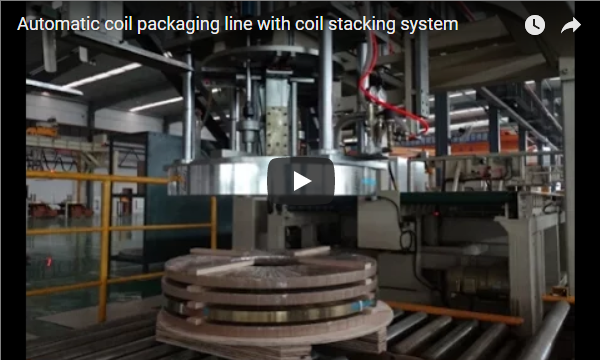
The video opens with a 3D animation of the plant layout: rows of silver coils, a loading station marked "Loading", and a lifter lowering a coil onto a support platform behind yellow-green guard mesh.
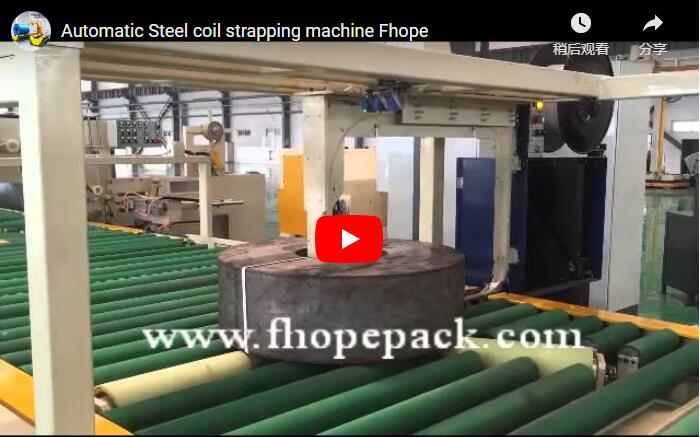
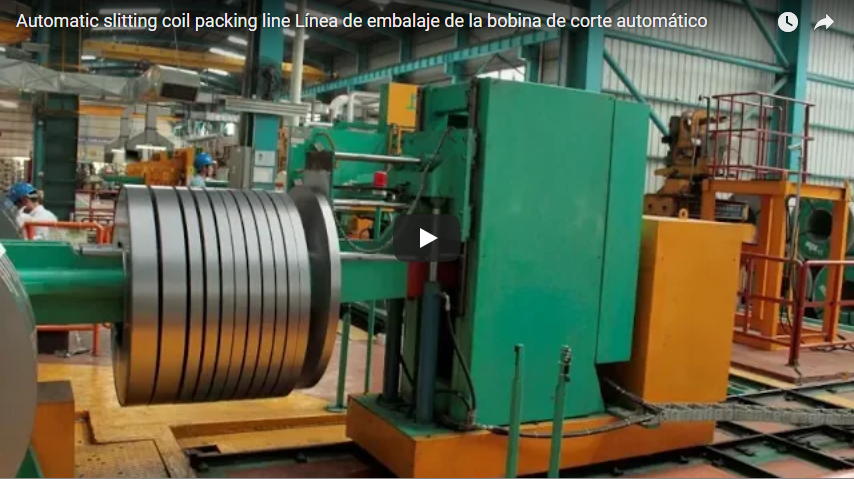
The real footage follows. A large green upright wrapper covers a bright metal coil in a beige wrapping layer through the eye. An orange arm then handles the wrapped coil on the line, with yellow and black edge markings on the floor and more coils waiting behind.
Stations in an automated coil packaging line
| Station | What it does |
|---|---|
| Loading | Takes the bare coil from the crane or coil car |
| Eye-through wrapping | Covers the coil through the eye and over the wall |
| Handling and turning | Moves or turns the coil between stations |
| Strapping | Adds radial and circumferential bands |
| Discharge | Hands the coil to stacking or dispatch |
Each station passes the coil to the next automatically, so the line runs at the pace of its slowest station.
Strap consumption per coil
Illustrative example for a 1,500 mm OD, 508 mm ID, 1,200 mm wide coil with 4 radial and 2 circumferential bands:
| Artikel | Waarde |
|---|---|
| Wall, (1,500 − 508) ÷ 2 | 496 mm |
| Radial band, 2 × (1,200 + 496) | 3,392 mm |
| Radial bands, 4 × 3.39 m | about 13.6 m |
| Circumferential band, π × 1,500 | about 4,712 mm |
| Circumferential bands, 2 × 4.71 m | about 9.4 m |
| Strap per coil, before seal overlap | about 23 m |
Voeg de overlap van de sluiting toe aan elke band wanneer u de band bestelt.
Het plannen van de indeling
| Vraag | Waarom het belangrijk is |
|---|---|
| How coils arrive | Sets the loading station: crane, coil car or conveyor |
| Wrap material | Paper, film or both on the wrapper |
| Bands per coil | Sets the number of strapping heads |
| Eye vertical or horizontal at dispatch | Decides if the line needs a turning station |
| Output per hour | Sets the slowest station and the buffer between stations |
For the strapping station on its own, see our [automatic steel coil strapping machine](https://www.fhopepack.com/videos/automatic-steel-coil-strapping-machine/). For lines that turn and stack heavy coils, see our [buyer's guide to stretch wrapping and downender stacking](https://www.fhopepack.com/videos/buyers-guide-integrating-automated-stretch-wrapping-and-downender-stacking-systems-for-heavy-steel-coils/).
We draw the layout in 3D first, as in our video, so the plant can check space and flow before building.
Bediening en veiligheid
Coils move automatically between stations, and wrappers and strapping heads run inside guarding. Keep people out of the guarded line while it runs, and enter only with the station stopped and isolated.
De geldende normen zijn afhankelijk van de bestemmingsmarkt. Voor CE-markten beschrijft ISO 12100 de risicobeoordelingsmethode en EN 415-10 de algemene eisen voor verpakkingsmachines.
Selection checklist for an automated coil packaging line
- [ ] Coil OD, ID, width and weight range.
- [ ] Spoelen per uur.
- [ ] Wrap material: paper, film or both.
- [ ] Radial and circumferential bands per coil.
- [ ] Eye position at dispatch.
- [ ] Building space, crane access and floor loading.
Veelgestelde vragen over techniek
Q: What stations does an automated coil packaging line have?
A: Loading, eye-through wrapping, handling or turning, strapping and discharge.
Q: How much strap does a coil take?
A: About 23 m for 4 radial and 2 circumferential bands on a 1,500 mm OD, 508 mm ID, 1,200 mm wide coil in our example.
Q: What sets the line speed?
A: The slowest station; buffers between stations keep the rest moving.
Q: What wrap materials can the line run?
A: Paper, film or both on the wrapper, set per project.
Q: How does coil delivery affect the line?
A: Whether coils arrive by crane, coil car or conveyor sets the loading station.
Q: Why start with a 3D layout?
A: So the plant can check space and coil flow before the line is built.
Q: Do I need a turning station?
A: Only if coils must leave eye vertical when they are wrapped eye horizontal, or the other way round.
Volgende stap
Wij plannen uw coilverpakkingslijn in drie stappen:
1. **Submit your layout drawing** with coil sizes, output and building layout to **info@fhopepack.com**.
2. **Receive a proposal within 48 hours**, with the station layout and strap plan.
3. **Book a site survey** to check the building space and crane access.
Gerelateerd lezen
- [Automatische spoelverpakkingslijn](https://www.fhopepack.com/Automatic-Coil-Packing-Line/)
- [Machines voor het omsnoeren van stalen coils](https://www.fhopepack.com/steel-coil-strapping-machinery/)
- [Video: steel coil, copper coil packaging machine for eye-through film wrapping](https://www.fhopepack.com/videos/steel-coil-copper-coil-packaging-machine-for-eye-through-film-wrapping/)
Bronnen
- Machine-inhoud: FHOPE-engineeringteam, 10-04-2026
- Strap example: our worked example, illustrative values
- Machine in action: [our video on YouTube](https://www.youtube.com/watch?v=C9rw7txhrl8)
- Normbereik: [ISO 12100:2010](https://www.iso.org/standard/51528.html), [EN 415-10:2014](https://www.nen.nl/en/nen-en-415-10-2014-en-191845)
Laatst beoordeeld: 04-10-2026