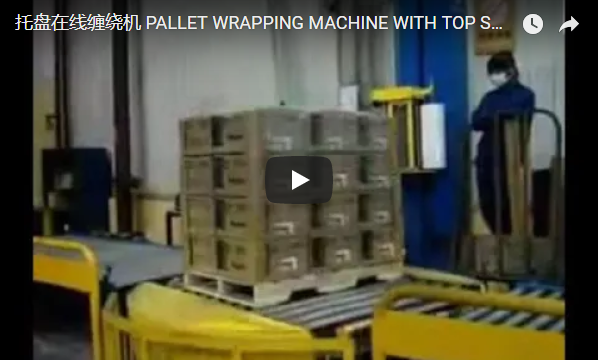
An automatic strapping machine secures brick stacks and pallets by feeding high-tensile strap around the load, compressing loose joints, tensioning, and sealing without manual intervention. Integrated directly into the handling line between the setting/cubing station and the dispatch conveyor, this heavy-duty system stabilizes fired clay bricks, concrete pavers, and foundry ingots for open-bed transport. By applying vertical compaction during the strap feed cycle, the system eliminates transit shifting and secondary manual handling while matching conveyor indexing speeds.
Overzicht
The heavy-duty strapping station utilizes a portal gantry frame straddling a powered roller or chain conveyor line. Engineered for abrasive building material environments, the installation integrates three synchronized assemblies: an overhead compression platen, a precision strapping arch with low-friction track deflectors, and an industrial-duty strapping head.
During the packaging cycle, the palletized brick cube is transported into the strapping envelope via a heavy-duty chain conveyor equipped with an integrated 90° indexing turntable. The structural top platen descends under monitored force to pre-compact the brick layers, purging air gaps and leveling uneven bed surfaces. Once pre-compression is established, high-tensile green PET (Polyester) strapping is indexed around the perimeter through hardened arch guides, drawn to a programmed tension profile, friction-welded, and severed cleanly. The finished pack exhibits rigid unitary stability capable of enduring acceleration forces during multimodal logistics.
Waar deze machine in het geheel past
The automated strapping station is positioned immediately downstream of the automatic palletizer or cubing station and directly upstream of the stretch hooding, orbital wrapping, or outdoor dispatch staging yard.
When structural materials such as fired clay bricks, dense aggregate blocks, or heavy metal ingots emerge from the stacking cells, they maintain dimensional alignment under static gravity but lack lateral and horizontal integrity. Dynamic yard transport and road vibration quickly break frictional grip between individual brick layers. In-line strapping applies critical horizontal and vertical containment force, preventing localized slippage, brick corner breakout, and full-stack toppling.
Operating fully in-line, palletized loads transfer continuously from the upstream stacking conveyors through the strapping arch without fork-truck transfer or intermediate resting tables. For facilities handling mixed SKU profiles, the portal clearance accommodates both tall, unpalletized multi-tier brick packs and low, high-density paver pallets through automated recipe selection on the human-machine interface (HMI).
Hoe de omsnoeringscyclus verloopt
The automatic cycle executes through an engineered four-stage kinematic sequence:
- Indexing and Position Interlocking: The pallet load conveys into the strapping window. Optical photo-eyes and rotary encoders identify stack leading and trailing edges, triggering line brakes to position the load at the exact target strap location (±5 mm).
- Arch Feeding and Platen Pre-Compression: The feeding wheels drive PET strap around the enclosed low-friction arch at velocities exceeding 4.5 m/s. Concurrently, the overhead platen descends to apply vertical pre-compression (typically 5,000 N to 15,000 N), stabilizing the stack prior to band tensioning.
- Controlled Tensioning and High-Frequency Friction Welding: The strap reverses out of the arch track, clamping onto the brick perimeter. The high-torque tensioning mechanism applies calibrated mechanical tension (up to 4,500 N). Once tension is verified by closed-loop motor torque feedback, dual oscillating friction elements melt the overlapping PET surfaces at molecular level, followed by immediate dwell cooling.
- Shearing and Conveyor Indexing: A hardened mechanical cutter severs the strap from the coil. The overhead platen retracts, and the conveyor advances the stack to the next strapping position—or triggers the 90° turntable for a cross-strapping sequence—before releasing the load downstream.
Every finished bundle receives uniform tension, identical weld crystallization, and repeatable strap pitch, eliminating the human errors and joint failures common in manual pneumatic tool applications.
Geconfigureerd per project
Strapping equipment operating in brick and block sectors requires line-specific engineering rather than standardized off-the-shelf sizing. The portal arch dimensions must clear the widest diagonal stack profile, the chassis must resist continuous abrasive dust ingress, and the tension head must balance edge retention against surface fracture.
| Item | Engineering Selection Basis | Factory Range / Unit |
|---|---|---|
| Arch Opening | Sized to maximum pack width and height + clearance allowance | 1,200 × 1,200 mm tot 2,400 × 2,600 mm |
| Top Press Platen | Hydraulic or electric servo; compacts pack prior to tension | 5,000 tot 20,000 N |
| Koordmateriaal | Heavy-duty embossed PET or high-tensile Polypropylene (PP) | 12.0 mm to 19.0 mm width (0.8–1.0 mm thickness) |
| Spanbereik van de band | Programmable closed-loop tensioning per SKU recipe | 500 tot 4,500 N |
| Afdichtingsmethode | High-frequency friction-melt or thermal-wedge welding | Seal efficiency ≥ 85% of strap break strength |
| Conveyor Infeed Height | Tailored to match client chain/roller conveyor transport line | 400 mm tot 850 mm (standaard) |
Throughput estimates follow an operational kinematic model rather than static idle cycles. An operational cycle of 12 to 15 seconds per single strap allows gross line throughput of 180 to 240 straps per hour. Final line capacity depends on whether packs require two parallel straps or a four-strap cross-tied pattern utilizing the integrated turntable.
Selectiechecklist voor een omsnoeringsstation
Before initiating system procurement, verify the following mechanical and plant criteria:
- Stack Envelope Geometry: Measure maximum and minimum bundle dimensions (Length × Width × Height), gross weight per pack (kg), and pallet foot/void patterns.
- Product Substrate Characteristics: Specify unit type (perforated clay brick, solid concrete block, refractory pavers) along with abrasive qualities and edge-crush thresholds.
- Line Integration Data: Confirm infeed and discharge top-of-roller (TOR) elevations, chain centerlines, conveyor transfer speed (m/min), and travel direction.
- Strap Consumable Specifications: Define existing packaging strap width, core internal diameter (standard 406 mm), coil outer diameter, and minimum tensile break load requirements.
- Upstream/Downstream Line Interlocks: Establish PLC communication protocols (Profiscratch, Ethernet/IP, dry contacts) for interlock control with stackers and wrapping cells.
- Installation Environment & Standards: Identify ambient conditions (exposure to outdoor cold or ceramic kiln heat) and applicable safety directives.
Bediening en veiligheid
Production installations require safety perimeter measures to protect plant operators from high-speed moving arches, overhead descending loads, and high-tension strapping loops. Optical light curtains, interlocked physical fencing, and perimeter muting sensors must enclose the machine envelope.
Maintenance protocols must enforce rigid Lock-Out/Tag-Out (LOTO) procedures:
- Never access the strapping arch, lance path, or weld head while main electrical and pneumatic systems remain energized.
- Strap coil changes and track clearing must occur only when the safety circuit is deactivated via an external control pendant.
- De-energize stored energy in top press counterweights and pneumatic accumulation reservoirs prior to manual intervention.
European and international deliveries are constructed in full alignment with ISO 12100 (Safety of Machinery – General principles for design and risk assessment) and NL-415 10 (Safety of packaging machines – General requirements). Safety Performance Levels (PLd/PLe according to ISO 13849-1) for emergency stops and interlocks are validated and recorded during factory commissioning.
Veelgestelde vragen over techniek
Q: Can this strapping station handle unpalletized brick packs? A: Yes. For void-pack designs where brick tines replace wooden pallets, the machine integrates a retractable under-pack lance or hollow-track guide that threads strapping directly through the brick voids.
Q: How does the system prevent strap tension from chipping soft or green brick edges? A: Tension profiles are managed via multi-stage software curves. Low-speed take-up is followed by digital torque-limited final tensioning. Additionally, edge-protection applicators (cardboard or plastic corner protectors) can be integrated upstream of the strapping cycle.
Q: Can the station handle both single-direction and cross-strapping on the same line? A: Yes. By incorporating an integrated chain conveyor turntable beneath the arch center, the pallet indexes into position, receives one or two parallel straps, rotates 90°, and receives intersecting straps to complete a cross-tied load.
Q: What sealing efficiency can be achieved on heavy PET strapping? A: The high-frequency vibration welding head produces consistent joint efficiency exceeding 80% to 85% of nominal strap break strength, verified under DIN EN ISO 527 tensile testing.
Q: What layout drawings are needed to generate an engineering proposal? A: A preliminary PDF or 2D/3D CAD (.DWG/.STEP) line drawing indicating conveyor centerlines, travel direction, infeed elevations, and maximum bundle dimensions is sufficient to generate an installation layout.
Volgende stap
To receive a detailed line layout and mechanical proposal for your project, please forward the following production parameters to our engineering team:
- Layout Tekening: Conveyor flow scheme, line elevations, and envelope constraints.
- Specificaties van het product: Maximum and minimum pack weights, layer counts, and brick dimensions.
- Consumable & Throughput Target: Current strap grade (width, thickness) and required pallets per hour (PPH).
Inquiries and data sheets should be directed to info@fhopepack.com. Our project engineering department provides preliminary layout proposals and line integrations within 48 business hours.
Gerelateerd lezen
- Automatische palletbandmachine voor transportbanden
- Flessenpalletbandmachine voor gelaagde plastic flessen
- Automatische machine voor het omsnoeren van stalen spoelen
- Verpakkingslijn voor gesneden coils voor servicecentra: omsnoeren, omwikkelen met oogjes en stapelen.
- Automatische bundel- en omsnoeringsoplossing voor stalen buizen