Overzicht
An aluminum profile basket stacking line takes profiles from the extrusion outfeed, counts them into layers, lifts each complete layer into a basket and feeds spacers between layers, so filled baskets move to the next process without hand loading. This article covers how the stacking sequence works, the manufacturer’s published stacker parameters, and a layer sizing method that tells you how many profiles fit per lift. It is written for plant and production engineers sizing an automatic stacking cell, and for purchasing managers who want to compare the stacker against manual basket loading.
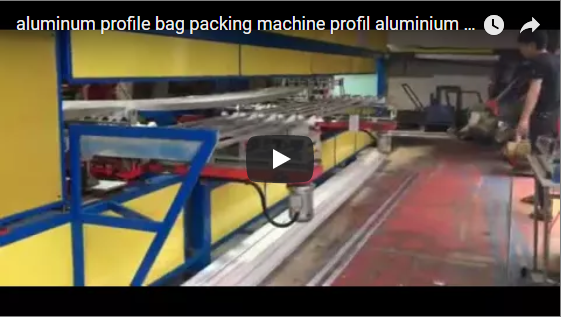
The video below shows the gantry stacker handling profiles:
How the Stacking Sequence Works
A gantry stacker runs on an overhead track above the conveyor and builds the basket one layer at a time:
| Stap voor | Wat gebeurt |
|---|---|
| Collectie | A transfer conveyor gathers profiles from the extrusion outfeed. |
| Tellen en laagjes maken | Het systeem identificeert de profielbreedte en berekent hoeveel profielen er in één laag passen. |
| Layer pick | De lift pakt de complete laag op. |
| Basket fill | The layer is set down in a wooden crate or steel basket at the stacking position. |
| Spacer feed | Tussen de lagen worden automatisch lamellen geschoven om de oppervlakken te beschermen. |
| Basket change | Empty baskets are positioned automatically when a layer stack is full. |
One operator supervises the cell in automatic mode, where a manual stacking line typically needs two people. Profiles are identified by section shape and size without manual reset, so one cell serves a mixed product range within the handling envelope.
Specificaties van de stapelaar
The manufacturer publishes the following reference values for the aluminum profile stacker on the official product page; confirm the figures on the quotation for your project, since lift load, speed and profile length can be customized to a defined layout:
| Parameter | Published reference value |
|---|---|
| Profiellengte | 3000 – 7000 mm |
| Maximale hijslast | 250 kg per tilbeweging |
| Maximaal gewicht per stuk | 100 kg |
| Hoofdliftsnelheid | 0.1–0.512 m/s |
| Left–right travel speed | 0.026–0.256 m/s |
| Supply | 380 V / 50 Hz |
| Controleer: | PLC met remunit; handmatige en automatische modi |
State your profile length range, linear weight in kg/m, basket inner size and profiles-per-minute outfeed rate to the manufacturer so the lift frame, conveyor length and cycle are sized on the approval drawing.
Layer Sizing: Profiles per Lift
Two limits set how many profiles go in one layer: the basket width and the maximum lift load. Size the layer from the weight limit, then check the width:
- stukgewicht = linear weight (kg/m) × profile length (m). A profile of 2.0 kg/m at 6 m weighs 12 kg.
- Profielen per lift = lift load ÷ piece weight, rounded down. 250 kg ÷ 12 kg gives 20 profiles per layer.
- Breedtecontrole — the counted layer must also fit the basket width; the system calculates this from the measured profile width.
- Automatische stapelaar voor aluminiumprofielen – The official stacker product page with the published parameters.
- Aluminum Profile Stacking Machine – Stacking and bundle-making machine in the same product family.
- Aluminum Profile Packing Lines – Downstream profile packing lines that follow the filled baskets.
| Lineair gewicht | Lengte | stukgewicht | Profiles per 250 kg lift |
|---|---|---|---|
| 1.0 kg / m | 6 m | 6 kg | 41 |
| 2.0 kg / m | 6 m | 12 kg | 20 |
| 5.0 kg / m | 7 m | 35 kg | 7 |
Compare the resulting cycles per hour with the extrusion outfeed rate. The lift and travel speeds above give the travel time per pick and return; add counting, slow set-down and spacer feed time, then confirm the balance of the cell with the manufacturer.
Surface Protection and Acceptance
Scratches normally come from profiles sliding against each other or against the basket. The stacker reduces them three ways: soft-contact handling during pick and set-down, automatic slat feeding between layers, and a low set-down speed on the main lift. Silicone or paper interleaving can also be specified as part of the layer treatment.
For acceptance planning, two points apply. The vendor’s stated practice for this machine family includes non-stop functional testing before delivery (up to about 24 hours where stated) with the control system and the emergency stop checked; treat this as the stated family practice, not this unit’s measurement. Where the destination market requires CE compliance, EN 415-10 is the packaging-machinery safety reference and an ISO 12100 risk assessment guides guarding around the gantry travel zone; confirm the delivered documentation covers your market.
FAQ
Q: What profile lengths can the stacker handle?
A: The published reference range is 3000–7000 mm. Shorter or longer profiles need a customized lift frame and conveyor; confirm the range per project.
Q: How heavy can one layer be?
A: Up to the published 250 kg per lift, with up to 100 kg for a single piece. Divide the lift load by the piece weight to get the maximum profiles per layer.
Q: Does the stacker need resetting for different profile shapes?
A: No — it identifies the profile width and section, then calculates how many profiles fit per layer, provided the length stays within the handling envelope.
Q: How many operators does the cell need?
A: One operator supervises the cell in automatic mode; manual stacking of the same output typically needs two people.
V: Welke veiligheidsnormen zijn van toepassing?
A: For CE markets, EN 415-10 is used as the packaging-machinery safety reference and an ISO 12100 risk assessment guides the guarding; confirm the documentation for your destination market.
Volgende stap
Send your layout drawing with profile length range, linear weight in kg/m, basket inner size and profiles-per-minute output to the manufacturer. The stacker is then sized and confirmed on a proposal with layer sizing, cycle checks and the cell layout.