Kopsavilkums
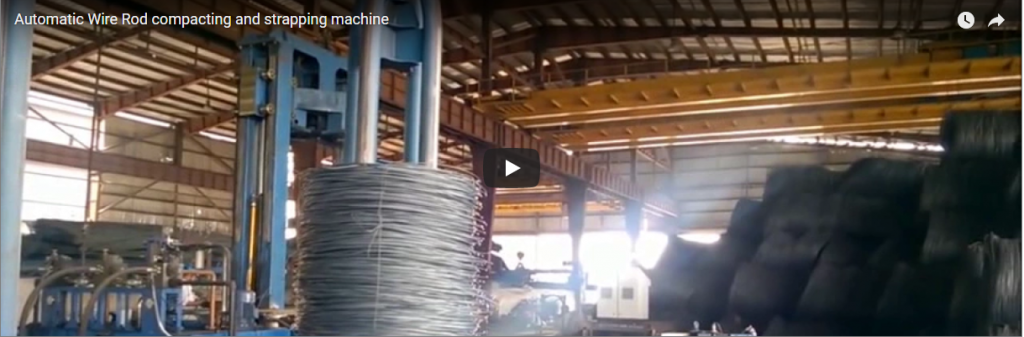
Coils directly transferred from the take-up stand exhibit low bulk density, variable winding pitch, and unstable package heights. During crane transfers and transit, unrestrained turns shift axially, leading to tangles and dimensional rejection. A semi-automatic wire coil compactor applies controlled axial hydraulic force to compress the coil directly on its carrier basket, locking the compacted state under continuous hydraulic hold while high-tensile straps are tensioned through the coil eye. This ground-based solution delivers the load density and stacking integrity of full automated lines at a fraction of the capital investment, utilizing existing shop-floor stem carriers.
Saturs
- Kāpēc pirms stropēšanas sablīvēt
- Mašīnu secība
- Blīvētāja dati
- Siksnu skaits un augstums
- PET siksna vai tērauda siksna
- Atlases kontrolsaraksts
- Drošība
- Inženierijas bieži uzdotie jautājumi
- Nākamais solis
- Saistītā lasāmviela
- Avoti
Kāpēc pirms stropēšanas sablīvēt
Applying strapping bands directly to a loose, uncompressed wire coil merely secures its non-uniform initial boundary. Under dynamic transit vibrations, inter-turn clearance closes naturally, inducing strap tension decay, loop slackening, and progressive lateral telescoping.
Pre-compacting under high hydraulic tonnage drives out inter-turn air voids and aligns the wire layers. Strapping the coil while it remains clamped under holding pressure ensures the straps capture the elastic rebound energy of the wire. Once the hydraulic ram retracts, the residual coil expansion locks tension into the straps, producing a rigid, self-supporting cylindrical bundle that optimizes container cube utilization and eliminates shifting during overhead crane handling.
Mašīnu secība
- Carrier Positioning: The wire coil, seated on its dedicated carrier basket or stem, is loaded into the compaction station via forklift, coil car, or overhead crane.
- Axial Centering: The basket’s central stem is aligned beneath the floating upper compaction platen.
- Hydraulic Compaction: The hydraulic cylinder traverses downward at controlled speed, executing auto-compaction until reaching target tonnage or stroke limits.
- Hydraulic Load Hold: The press maintains continuous clamping force via pilot-operated check valves, mechanically stabilizing the coil pack.
- Radial Strap Threading: The operator feeds strapping bands through the coil eye and basket clearance windows around the outer circumference.
- Tensioning and Jointing: A balanced pneumatic or battery-powered tool tensions, friction-welds (PET) or crimps (steel) each strap.
- Ram Retraction & Discharge: The platen ascends to its home limit switch, releasing the tensioned, compact coil for safe crane removal.
This semi-automatic architecture enables facilities to integrate their existing internal carrier fleets without capital-intensive conveyor redesigns.
Blīvētāja dati
| Tehniskā parametrs | Specifikācija/Vērtējums | Inženiertehniskā nozīme |
|---|---|---|
| Compaction Drive Mode | Heavy-duty hydraulic, auto-cycle | Stable continuous pressure application |
| Siksnu metode | Semi-automatic (manual feed & seal) | Flexible strap placement with zero head jams |
| Nominal Clamping Force | 100–200 kN (10–20 metric tons) | Adjustable for mild to high-carbon wire gauges |
| Compacted Height Range | Typically 750–850 mm (nominal 800 mm) | Optimized for standard maritime shipping crates |
| Permissible Strap Types | High-tensile PET / Cold-rolled steel | Adapted to surface finish and tensile duty |
| Platen Contact Surfaces | Virgin High-Density Polyethylene (HDPE) | Prevents wire scuffing and galvanization damage |
| Motion & Position Control | Proportional ramp down, multi-limit switches | Eliminates hydraulic shock and frame fatigue |
Final compacted stack height depends on wire tensile grade, loose pitch from the drawing capstan, and carrier stem clearance. For high-throughput requirements, heavy-duty automatic compactors operate at 210 bar line pressure with 30–40 second cycles, accommodating coil outer diameters from 1,000 to 1,800 mm and bundle masses of 500 to 2,000 kg.
Siksnu skaits un augstums
The required strap cut length corresponds to the rectangular cross-sectional perimeter of the toroidal coil wall, plus tooling overlap:
Strap Length ≈ 2 × H_compacted + 2 × W_wall + Joint Overlap
kur:
H_compacted= Axial height of the coil under full hydraulic clampingW_wall= Radial wall thickness of the coil =(Coil OD − Coil ID) / 2Joint Overlap= Allowance for tool feedwheel take-up and joint sealing (typically 150–200 mm)
Simplifying the perimeter calculation:
Strap Length ≈ 2 × H_compacted + (Coil OD − Coil ID) + Allowance
Inženiertehnisko aprēķinu piemērs:
- Compacted Height (
H_compacted): 800 mm - Ārējais diametrs (
OD): 1,100 mm - Iekšējais diametrs (
ID): 600 mm - Tool & Joint Allowance: 200 mm
Strap Length = 2 × 800 mm + (1,100 mm − 600 mm) + 200 mm = 2,300 mm (2.3 m)
A standard pattern of 4 radial straps positioned at 90° intervals consumes 9.2 metri of strapping per packaged bundle. High-carbon spring wire, low-friction annealed wire, or slippery oil-coated coils frequently mandate 6 straps (60° spacing) to prevent peripheral bulging during intermodal transit.
PET siksna vai tērauda siksna
Selecting between Polyester (PET) and High-Tensile Steel strapping involves mechanical matching with wire metallurgy:
- Poliestera (PET) siksnas: Offers superior elastic elongation (6% to 9%) and tension recovery. When wire bundles settle or undergo temperature shifts, PET dynamically contracts to maintain tension. PET produces zero oxidation staining on hot-dip galvanized or bright drawn finishes and eliminates sharp-edge cut hazards during manual debundling.
- High-Tensile Steel Strapping: Delivers high ultimate tensile strength with negligible elongation (stiff elastic modulus). It is preferred for heavy-gauge cold-heading rod, high-spring-back alloy coils, and sharp, burred edges that could split plastic banding.
Both strap media integrate interchangeably on this machine; adapting to steel strapping requires only pairing with a pneumatic notch/sealless tool rather than a friction-weld tool.
Atlases kontrolsaraksts
- Wire Metallurgy & Finish: Low/high carbon, bright drawn, hot-dip galvanized, annealed, or copper-coated.
- Dimensional Matrix: Maximum and minimum coil OD, ID, uncompacted height, and payload mass (kg).
- Carrier Basket Geometry: Stem diameter, vertical rib clearance, and crane pick-up pocket dimensions.
- Throughput Objective: Target coils processed per hour (determines cycle interlock speeds).
- Siksniņas specifikācija: PET versus steel, strap width/thickness, and required strap count (3, 4, or 6 radial ties).
- Automation Scope: Standalone semi-automatic unit or preparation for future inline motorized shuttle integration.
Drošība
FHOPE compactor designs comply with international packaging machinery directives:
- EN ISO 12100:2010: Comprehensive system risk assessment and reduction methodology.
- EN 415-10: Specific safety requirements for packaging machines, bundling systems, and presses.
- EN 60204-1: Industrial electrical safety, IP54 control cabinets, and emergency stop interlocks.
Hydraulic circuits incorporate dual pilot-operated anti-drop check valves directly mounted to the cylinder ports, mechanically arresting platen descent in the event of sudden hydraulic line failure. The dedicated strapping station allows full manual access around the basket circumference only when the machine confirms zero platen motion and verified pressure-hold status.
Inženierijas bieži uzdotie jautājumi
Q: Can we utilize our existing plant-floor carrier baskets? A: Yes. The base frame and platen geometries are engineered around your specific basket stem height, structural rib pitch, and handling clearance without requiring carrier fleet replacement.
Q: How much axial height reduction can be expected? A: Axial reduction typically ranges from 15% to 35%, yielding an average final height around 800 mm. Actual compression ratios depend on initial drop-fall pitch from the dead block/take-up frame, wire yield strength, and surface lubricity.
Q: Can the bundle undergo protective wrapping post-strapping? A: Yes. Compacted and strapped coils can be directly routed to a vertical or horizontal orbital wrapping system to apply VCI film, stretch film, or woven polypropylene, protecting the payload against moisture, oxidation, and transit scuffing.
Nākamais solis
- Submit Core Parameters: Forward your coil OD/ID, maximum loose height, bundle weight, basket drawing, and target hourly capacity to info@fhopepack.com.
- Technical Layout Generation: Our mechanical engineering team models the platen face, basket receiver, and strap routing clearance.
- Formal Specification Package: Receive a tailored engineering layout, cycle rate simulation, and commercial proposal within 24 hours.
Saistītā lasāmviela
- Stiepļu ruļļu blīvētājs un siksnu notīšanas mašīna (produkts)
- Stiepļu stieņu blīvētājs (produkts)
- Kā automātiski veikt tērauda stiepļu blīvēšanu un stropēšanu
Avoti
- FHOPE Engineering Technical Documentation: Semi-Automatic Wire Compaction & Carrier Systems
- EN ISO 12100:2010 Mašīnu drošība — Vispārīgie projektēšanas principi — Riska novērtēšana un riska samazināšana
- EN 415-10:2014 Iepakošanas mašīnu drošība — 10. daļa: Vispārīgās prasības
- EN 60204-1:2018 Mašīnu drošība. Mašīnu elektroiekārtas
Pēdējoreiz pārskatīts: 2026-10-20