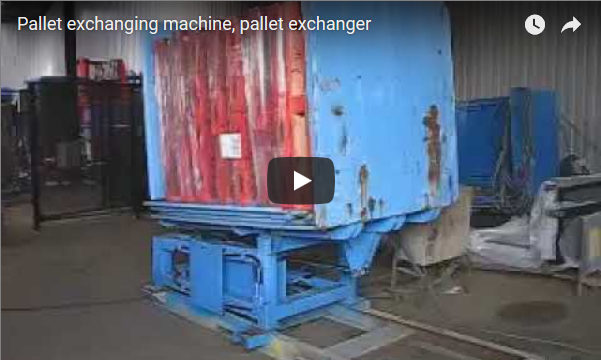
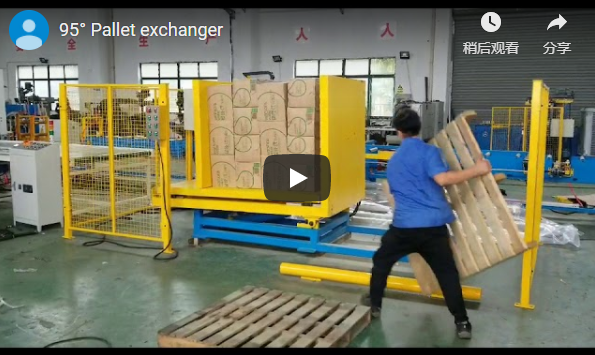
Kopsavilkums The pushing-type pallet changer transfers unitized carton or rigid loads from wooden shipping pallets to hygienic plastic pallets in a single linear stroke without load rotation. Hydraulic cylinder actuation drives the pusher face across the pallet interface, after which the empty pallet is automatically or manually discharged. Sizing the machine requires matching cylinder push stroke to maximum pallet depth, pusher face plate height to load stack height, and selecting load guides and infeed configurations that fit warehouse throughput.
Saturs
- Push-change sequence
- Izvēles, kas ietekmē iekārtas izmēru
- Cikla laiks
- Ko mēs iestatām katrai vietnei
- Atlases kontrolsaraksts
- Drošība
- Inženierijas bieži uzdotie jautājumi
- Nākamais solis
- Saistītā lasāmviela
- Avoti
Push-change sequence
The pushing-type pallet changer operates on a continuous horizontal transfer plane. Because the load remains upright throughout the transfer cycle, it eliminates product clamping tilt, tumbling risk, and internal fluid displacement:
| Solis | Mehāniskā darbība | Procesa apraksts |
|---|---|---|
| Ielādēt | Pallet positioning & alignment | The palletized carton load enters the transfer station and is squared against reference datum guides. |
| Push | Linear transfer stroke | A hydraulic cylinder drives the pusher plate forward, sliding the load smoothly across onto the receiving plastic pallet without rotating the stack [manufacturer rating]. |
| Palete ārā | Empty pallet release | The vacated wooden master pallet is stripped and cleared from the lower transfer station. |
| Izkraušana | Palletized discharge | The transferred load exits the station on the target plastic pallet via roller conveyor, pallet truck, or forklift. |
The pusher plate contact face is designed to distribute force uniformly across carton contact points, preventing local packaging crush, while integrated sensors verify pallet height and deck alignment before stroke initiation [manufacturer rating].
Izvēles, kas ietekmē iekārtas izmēru
Correct machine sizing balances structural mechanical envelopes with operational throughput targets:
| Izvēle | Ko tas izlemj | Engineering baseline |
|---|---|---|
| Grūšanas gājiens | Lielākais paletes dziļums | Stroke length must clear the deepest pallet deck plus transition bridge clearance (e.g., 1,200 mm depth plus discharge run). |
| Stūmēja augstums | Augstākā slodze | Pusher backplate must cover sufficient load height to prevent top-tier toppling during acceleration and sliding friction. |
| Skava vai vadotne | Slodzes stabilitāte stumšanas laikā | Side retainers or top stabilizer plates prevent carton drift or tier shingling across the pallet boundary. |
| Pabarot | Iekrāvējs, palešu ratiņi vai konveijers | Dictates floor-level entry design, roll-in ramps, or integration with upstream/downstream powered roller conveyors. |
For high-speed automated line designs, standard structural frames accommodate unit loads up to 1,000 kg with cargo dimensions up to 1,160 mm × 1,180 mm and pallet edge overhang down to 30 mm, operating at conveyor line speeds up to 16 m/min [manufacturer rating]. Stacks exceeding 2,200 mm in height transition to dedicated high-bay stabilization structures [manufacturer rating].
Cikla laiks
Cycle duration is a function of hydraulic stroke velocity, system acceleration/deceleration damping, and pallet handling speed.
Ilustratīvs piemērs:
| Punkts | Vērtība |
|---|---|
| Grūšanas gājiens (ilustratīvi) | 1,200 mm |
| Stumšanas ātrums (ilustratīvi) | 100 mm / s |
| Spiešanas laiks, 1,200 ÷ 100 | 12 s |
| Atgriešanas un palešu apstrāde (ilustratīva) | 28 s |
| Cikls, 12 + 28 | 40 s |
Note: The 40 s cycle represents an illustrative single-station worked benchmark. Actual throughput depends on hydraulic pump volumetric flow, operator pallet positioning, or connected automated pallet handling equipment.
Ko mēs iestatām katrai vietnei
Every machine configuration is tailored to the exact physical attributes of the facility and the packaging inventory:
| Iestatīšana | Atkarīgs no | Factory setup scope |
|---|---|---|
| trieka | Paletes izmērs | Hydraulic cylinder displacement and proximity limit switch positions configured to target pallet footprints. |
| augstums | Kravas augstums | Vertical pusher backplate surface area and upper retaining fence elevation set to prevent toppling. |
| Ceļveži | Kravas tips | Fixed or adjustable low-friction side guides selected for corrugated boxes, shrink-wrapped trays, or stacked bags. |
| Pabarot | Vietnes apstrāde | Floor-level pneumatic ramps for manual hand pallet trucks vs. floor-mounted powered conveyor beds. |
Atlases kontrolsaraksts
Confirm these key parameters before finalizing equipment engineering specifications:
- Infeed and outfeed pallet dimensions (length × width × deck height; wooden, plastic, or metal).
- Maximum and minimum unit load height and gross load weight (up to 1,000 kg standard envelope) [manufacturer rating].
- Load containment type (rigid cartons, interlocking boxes, or bagged material).
- Mechanism confirmation: linear horizontal push vs. rotational inverter (confirm loads cannot be inverted).
- Required cycle capacity (target loads per hour).
- Primary feed method (forklift drop-in, floor hand pallet truck, or automatic conveyor).
- Available plant floor layout footprint and vertical overhead clearance.
Drošība
Push-type changers utilize high-thrust hydraulic or mechanical actuation, requiring defined safety integration:
- Maintain full clearance from the pusher backplate swept volume while hydraulic power is engaged.
- Never enter the active loading chamber during staging, positioning, or cycle transfer.
- Implement strict Lockout/Tagout (LOTO) protocols according to OSHA requirements before accessing the bed to clear debris or misaligned pallets.
- For CE-regulated markets, machines comply with ISO 12100: 2010 (Safety of machinery — Basic concepts, general principles for design) and LV 415-10: 2014 (Safety of packaging machines — General requirements). Perimeter interlocked fencing and Class 4 optical safety light curtains prevent stroke initiation upon breach.
Inženierijas bieži uzdotie jautājumi
Q: What is a push-type pallet changer? A: It is an industrial transfer station that shifts unitized goods horizontally from one pallet to another using a motorized or hydraulic push plate, without inverting or tilting the product.
Q: How is the machine properly sized? A: Sizing is governed by maximum push stroke (pallet depth), vertical pusher face height (cargo stack height), lateral load-guiding requirements, and material handling feed interfaces.
Q: How long is a standard pallet change cycle? A: Total cycle time is determined by stroke length, linear travel velocity, and pallet handling speed. In our illustrative worked example (1,200 mm stroke at 100 mm/s plus 28 s return and exchange), cycle time is approximately 40 s.
Q: Can this machine integrate directly with automated conveyor lines? A: Yes. Stations can be engineered for forklift entry, manual hand pallet jack ramps, or integrated with high-speed automated roller/chain conveyor lines operating up to 16 m/min [manufacturer rating].
Q: Which pallet combinations can be swapped? A: The system handles transfers between disparate pallet platforms, such as wooden supplier pallets to cleanroom plastic pallets, internal captive aluminum pallets, or standard export skids.
Q: Which design standards apply to this machine class? A: For CE installations, equipment is designed and validated according to ISO 12100: 2010 un LV 415-10: 2014.
Nākamais solis
We engineer and deliver application-specific pallet changing systems in three practical steps:
- Iesniedziet savu izkārtojuma zīmējumu detailing pallet dimensions, maximum load heights, gross weights, and required hourly cycle volume to info@fhopepack.com.
- Saņemiet oficiālu piedāvājumu 48 stundu laikā, including equipment footprint layout, hydraulic/electrical specifications, and cycle estimates.
- Rezervējiet tehnisko objekta apsekojumu to verify floor anchoring capacity, infeed handling clearances, and line integration controls.
Saistītā lasāmviela
- Spiežams palešu mainītājs ar palešu savākšanu
- Palešu invertors kravu pagriešanai
- Iebūvēts palešu iesaiņotājs ar grozāmu platformu
- Automātiskās iepakošanas līnijas
Avoti
- FHOPE Pushing Type Pallet Changers Specification
- FHOPE High-Speed Automatic Pallet Changing Line Technical Envelope
- International Organization for Standardization: ISO 12100:2010 Safety of machinery — General principles for design
- European Committee for Standardization: EN 415-10:2014 Safety of packaging machines — Part 10: General requirements
- Approved House Engineering CTA: Technical proposal turnaround within 48 hours
Pēdējoreiz atjaunināts: 2026-10-29