What the Cycle Costs in Time
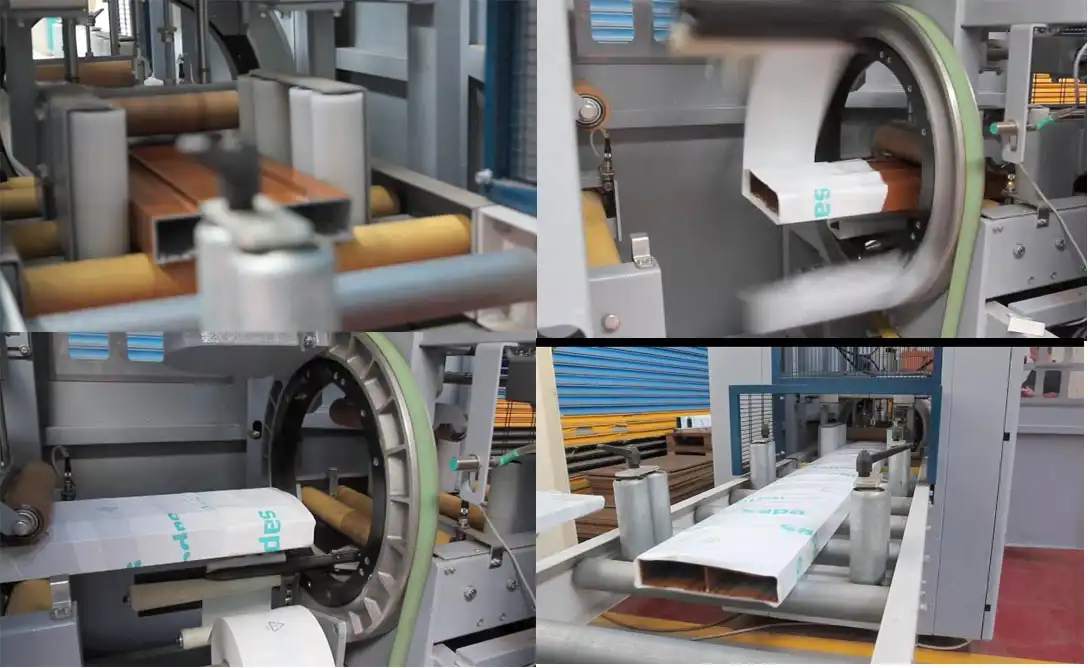
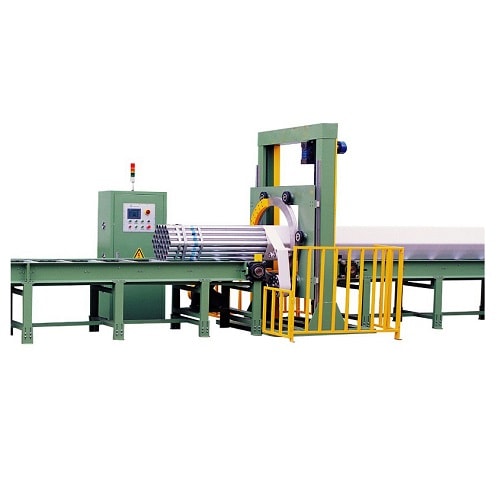
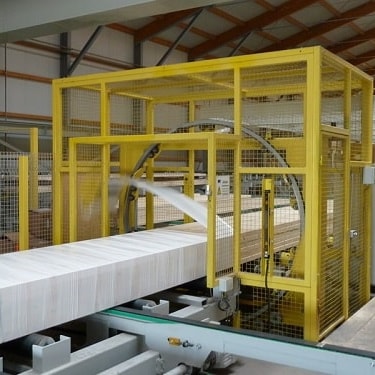
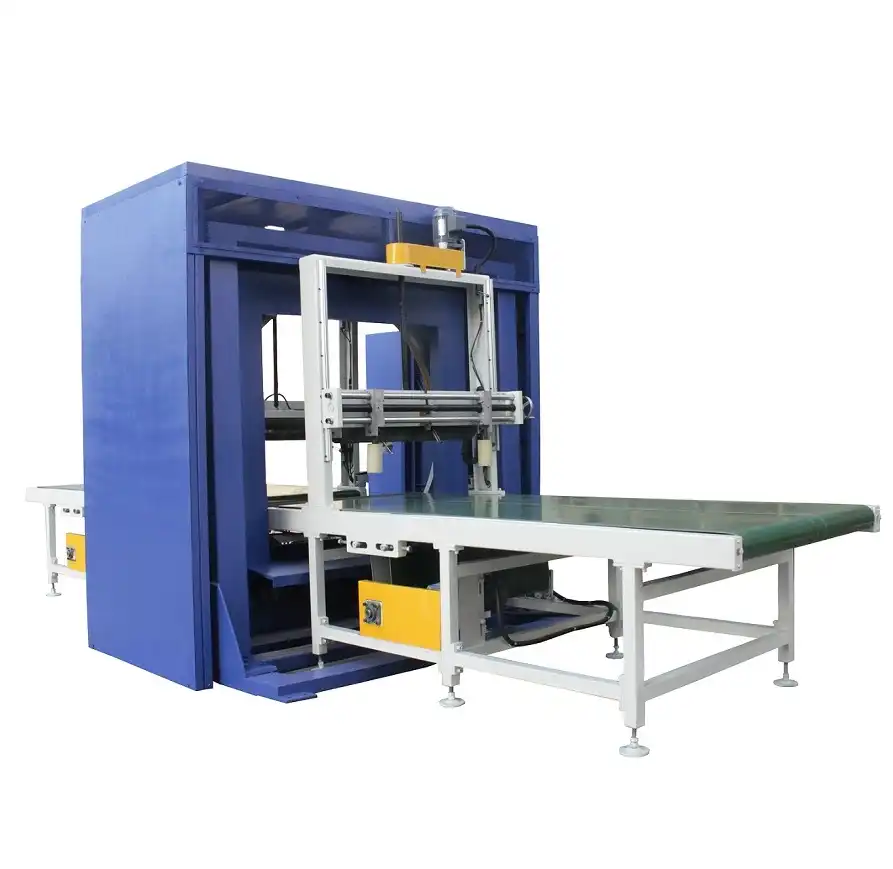
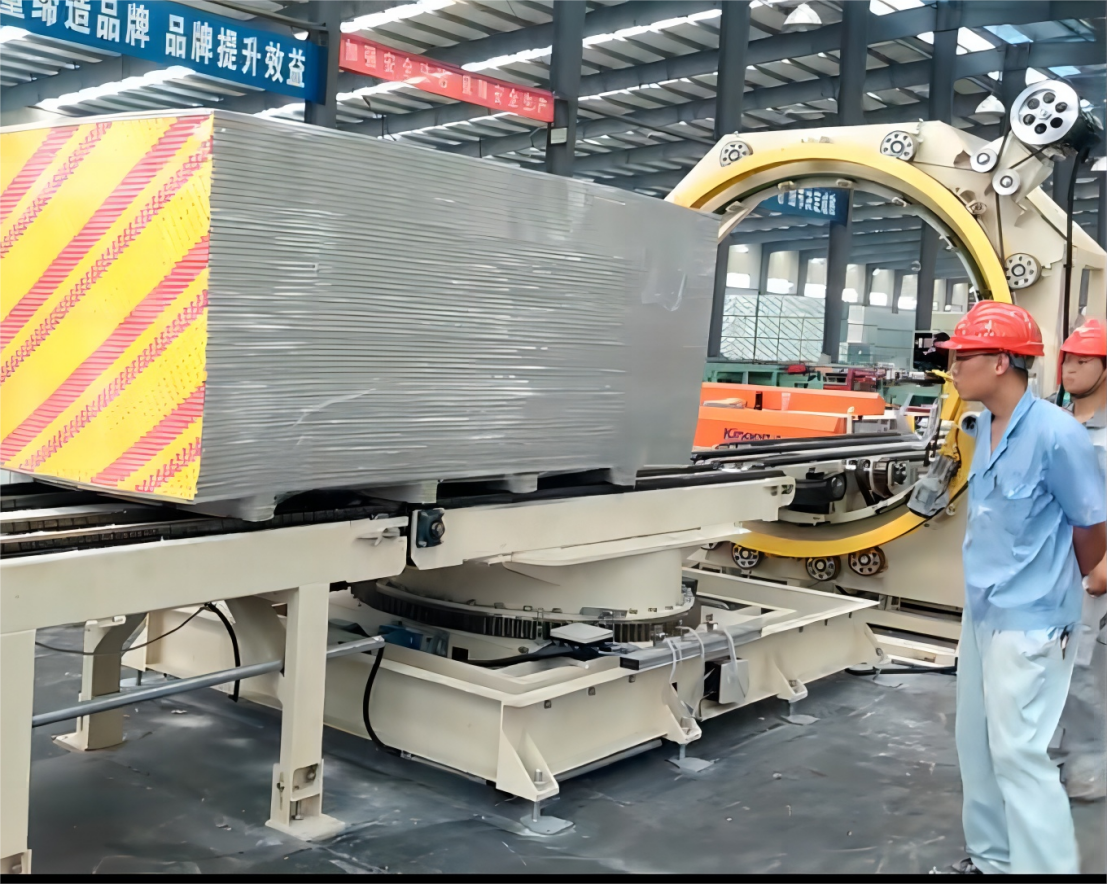
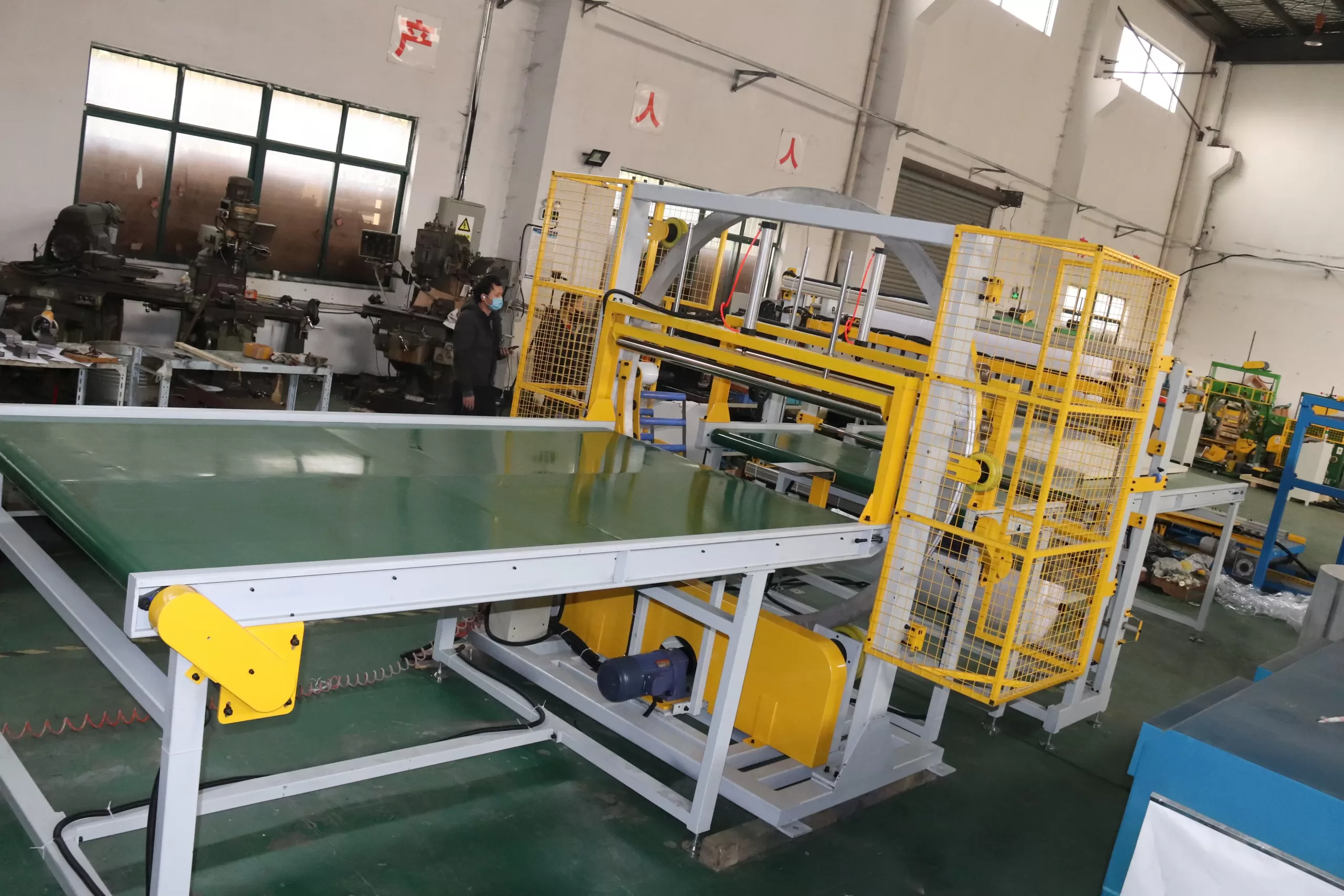
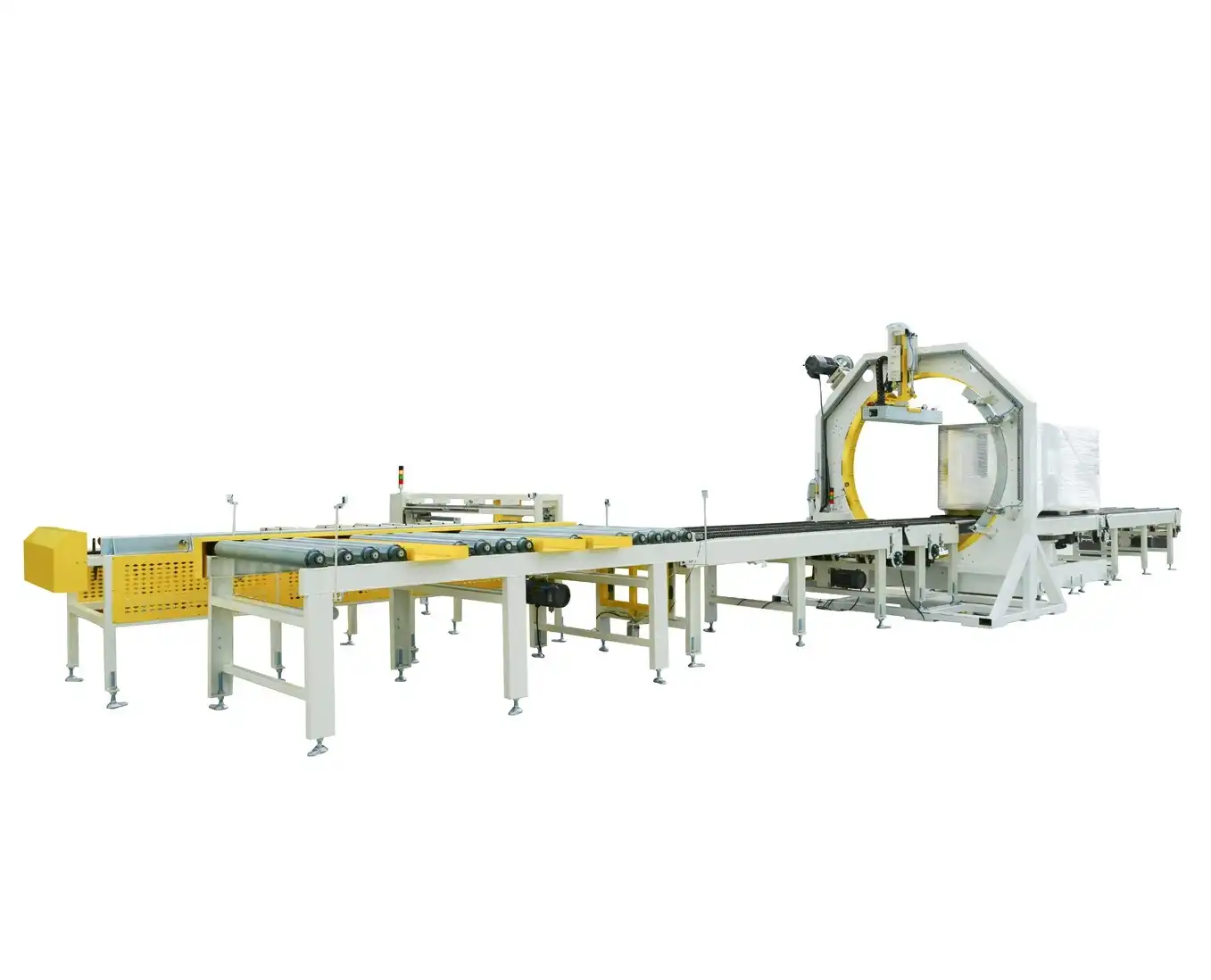
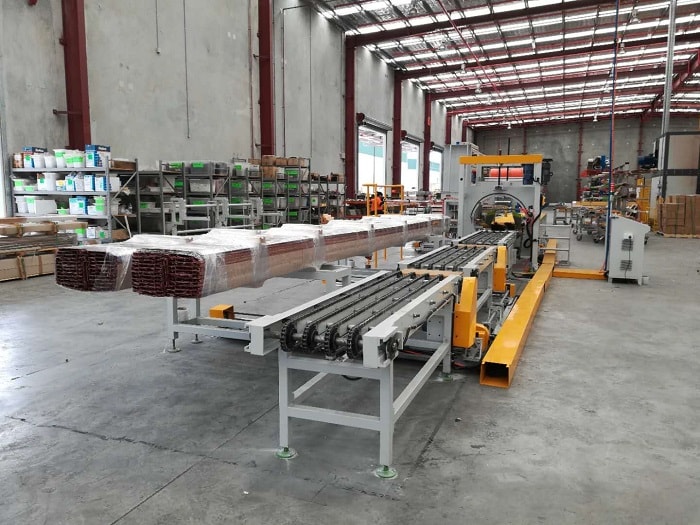
The six phases of the wrap — infeed registration, proportional clamping, ring acceleration, coordinated traversing, tail overwrap and cut-and-wipe — are set out on the product page. What that sequence does not show is where the seconds go, and the seconds are what decide whether one wrapper keeps up with an extrusion press.
Three parts of the cycle are fixed by physics rather than by control tuning. Ring acceleration follows an S-curve, and the ramp time grows with bore: a large ring cannot reach working speed as fast as a small one, so a 1500 mm bore loses a second or more per bundle against a 600 mm bore on the same duty. Traversing time is length divided by conveyor speed, which makes long profiles the dominant term on any line. The tail overwrap adds a fixed count of reinforcing wraps at reduced conveyor advance, typically two to four.
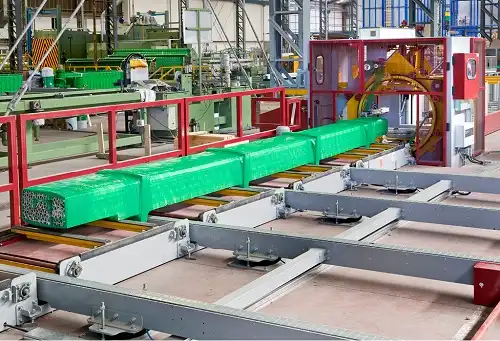
The rest is transfer: how fast the bundle leaves the previous station, how fast the next one accepts it, and whether the wrapper has to wait for either. On an in-line cell coupled to a cooling table runout, that wait is usually the real bottleneck, and it is settled by buffer length rather than by ring speed.
Choosing Between Stretch Film, Knit Belt, and VCI Paper
The machine accepts all three, and the choice is a corrosion decision rather than a cost decision.
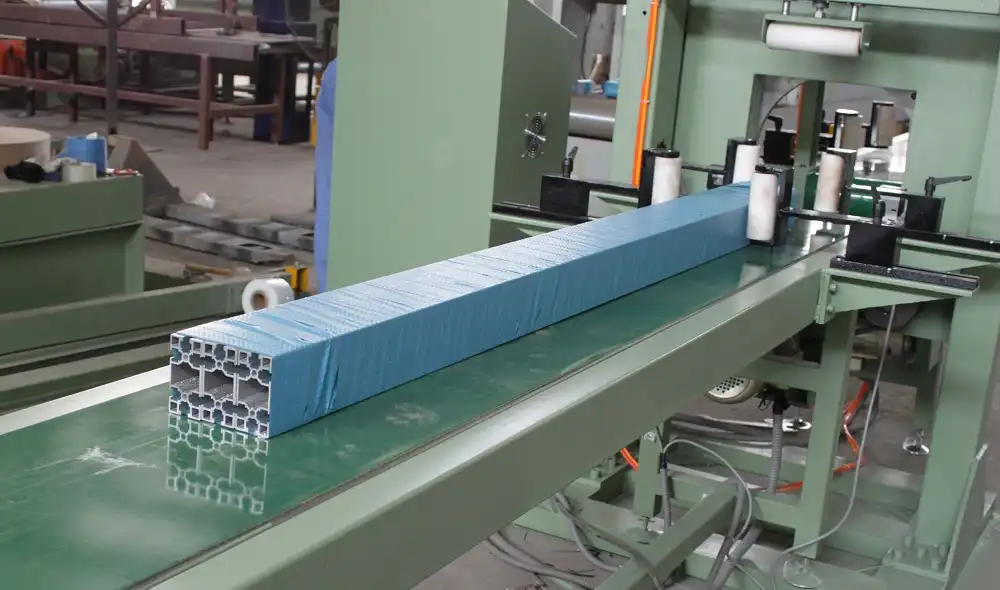
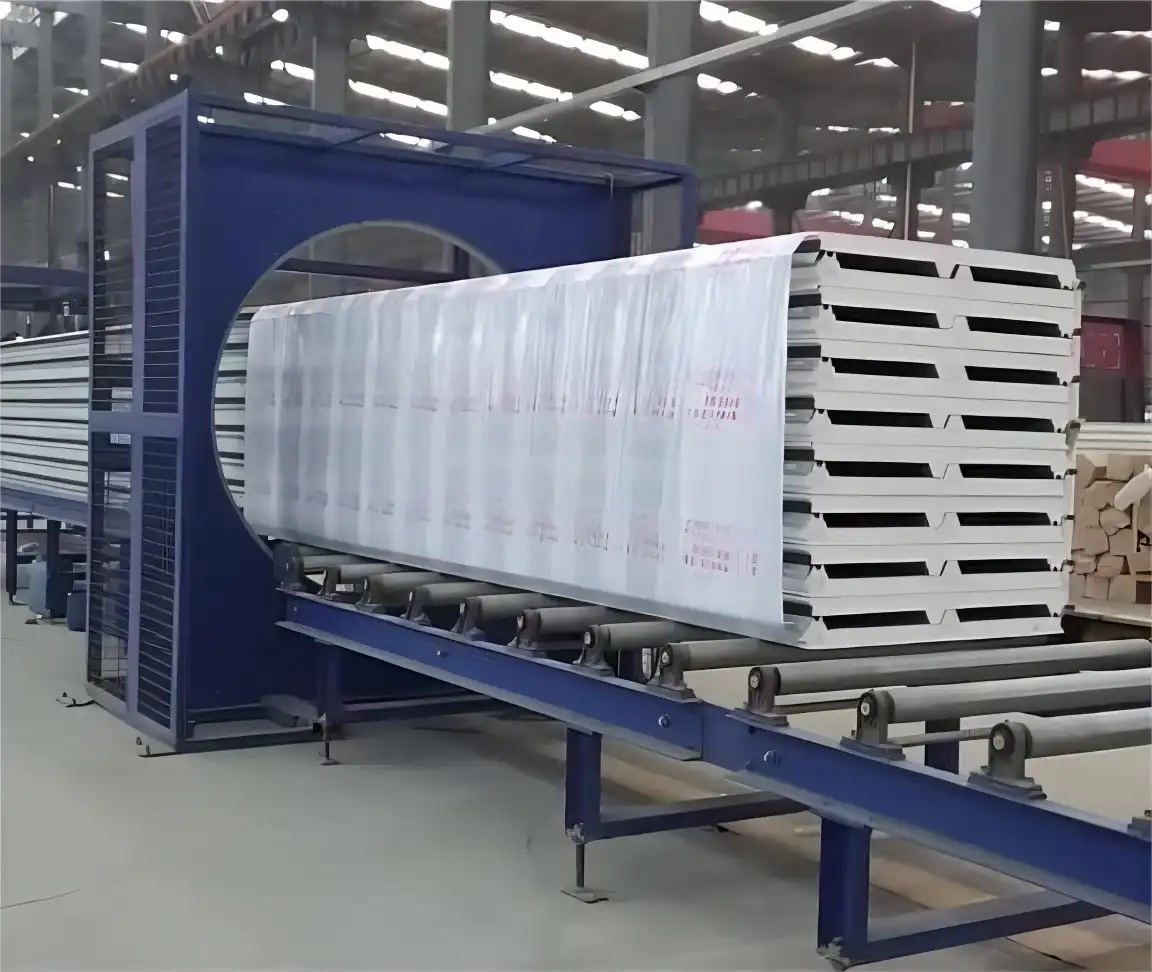
Stretch film is the default: it holds the bundle, keeps dust off the surface and lets the customer see the profile inside. It does not stop humidity, so for a bundle that will sit in a warehouse for a fortnight it is sufficient, and for one that crosses an ocean it is not.
Knit belt costs more per metre and buys abrasion resistance rather than barrier performance. It is the right choice where the bundle will be handled repeatedly — loading, unloading, transfer between yards — because the belt absorbs contact damage that would otherwise reach the profile through the film.
VCI paper is the only one of the three that addresses corrosion chemically. It releases a vapour that passivates the aluminium surface inside the wrap, which matters for anodized and mill-finish profiles that will see condensation during sea freight. VCI paper is usually run as an inner layer beneath the film or belt, so the machine's carriage has to carry two webs and the recipe has to keep both feeds synchronized.
The practical rule: film for domestic transit, belt where handling damage dominates, and film over VCI paper for anything that will cross water.
Mechanical Clearance Formulas and Sizing Verification
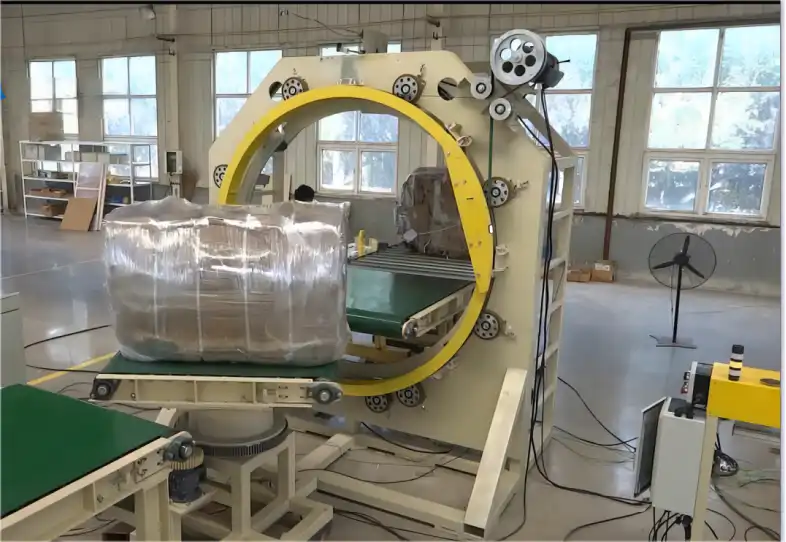
An undersized bore collides at the bundle corners; an oversized one loses rotational efficiency and raises film breakage through unstable web dynamics.
 +------------- D_ring (Nominal Bore) -------------+
                       |                                                 |
                       |       <- S_c ->   [=== TOP PRESS ===]   <- S_c ->
                       |                                                 |
                       |               +-----------------------+         |
                       |               |     Bundle Section    |         |
                       |               |        (W x H)        |         |
                       |   <- C_c ->   |      Diagonal = D     |         |
                       |               +-----------------------+         |
                       |                                                 |
                       |                  [=== CONVEYOR BED ===]         |
                       +-------------------------------------------------+
The Engineering Clearance Model
Minimum bore diameter (D_ring) must satisfy:
D_ring >= sqrt(W^2 + H^2) + 2 * (C_carriage + S_clearance)
kur:
-
W = maximum bundle width (mm).
-
H = maximum bundle height (mm).
-
sqrt(W^2 + H^2) = the circumscribed diagonal dimension (D_diag) of the rectangular cross-section.
-
C_carriage = total radial envelope intrusion of the film carriage, roll spindle, tension bracket and drive counterweights (typical baseline 180 mm to 240 mm, depending on film roll diameter).
-
S_clearance = dynamic safety buffer for profile sweep, vertical bow, sag and tolerance margins (minimum conservative 80 mm to 100 mm).
Engineering Calculation Example (Illustrative Purpose Only)
Consider a commercial architectural bundle:
-
Platums (P) = 600 mm
-
Height (H) = 350 mm
-
Film carriage envelope (C_carriage) = 200 mm, from engineering layout drawings
-
Safety clearance buffer (S_clearance) = 90 mm
Step 1: Calculate Cross-Section Diagonal:
  D_diag = sqrt(600^2 + 350^2) = sqrt(360,000 + 122,500) = sqrt(482,500) ≈ 694.6 mm
Step 2: Calculate Required Ring Clear Bore:
  D_ring >= 694.6 + 2 * (200 + 90)
  D_ring >= 694.6 + 2 * (290)
  D_ring >= 694.6 + 580 = 1274.6 mm
Selection Analysis: Model E1000 provides a 1450 mm nominal inner diameter, offering a safe functional buffer above the 1274.6 mm requirement. Selecting Model E600 (1000 mm bore) would lead to mechanical interference with the film carriage.
Tension Dynamics and Film Consumption Physics
The Challenge of Non-Circular Rotation
Unlike square pallet loads, aluminum bundles carry high aspect ratios (e.g., 600 mm x 150 mm).
Polar Radius Variation R(theta):
  Corner Traversal: R_max = sqrt((W/2)^2 + (H/2)^2)   --> Maximum Draw Velocity
  Flat Face Traversal: R_min = H/2                     --> Minimum Draw Velocity
Across wide flat faces payout velocity drops sharply; rounding the corners it spikes:
V_film(t) = omega * r(theta) + dr/dt
A static friction brake band turns that spike into tension surges that shear the web or crush thin-walled fins.
Our machines use a closed-loop dancer arm read by a rotary potentiometer or encoder. Precision air springs buffer slack; the arm speeds the pre-stretch drive through corners and slows payout over flat faces, holding tension constant around the section.
Linear Overlap and Film Consumption Calculations
For film consumption planning, pitch advance per revolution (P_a) and film use per meter of bundle are modeled as:
P_a = V_c / N_ring
kur:
-
V_c = conveyor speed (mm/min).
-
N_ring = ring speed (rpm).
Percentage overlap between adjacent film bands (P_lap), based on film web width (W_film), is:
P_lap = (1 - (P_a / W_film)) * 100%
Theoretical film mass per linear meter of extrusion (M_film, g/m) accounts for cross-section perimeter, overlap ratio, film thickness and prestretch ratio:
Perimeter = 2 * (W + H)
M_film = [Perimeter / (P_a)] * W_film * Thickness * Density * [1 / (1 + Prestretch_Rate)]
Piemēra atsauce: Standard LLDPE stretch film density is about 0.92 g/cm3. With a power pre-stretch carriage operating at 200% mechanical elongation (pre-stretch rate 2.0), virgin material consumption drops by over 50% compared to conventional un-stretched brake wrappers.
Camber and Bow: What Eight Metres Does to the Clearance Budget
A long extrusion is never perfectly straight, and the deviation matters more than most buyers expect. Commercial camber for aluminium extrusions runs to a few millimetres per metre, which on an eight-metre bundle adds up to tens of millimetres of sweep at the ends.
The clearance budget has to absorb that sweep on both sides of the bore, because the bundle can enter with its bow facing either way. The practical adjustment is to add twice the expected sweep to the bore requirement rather than the nominal allowance:
D_ring_adjusted = D_ring + 2 * Sweep_max
Where the camber is worse than commercial tolerance — long thin-walled sections, bundles stacked without straightening — the answer is not a larger ring but an upstream straightening step: articulated side guides or a hydraulic squaring station that holds the bundle true while it enters the ring. A larger bore costs inertia on every cycle; a straightener costs once.
Mechanical, Electrical, and Safety Architecture
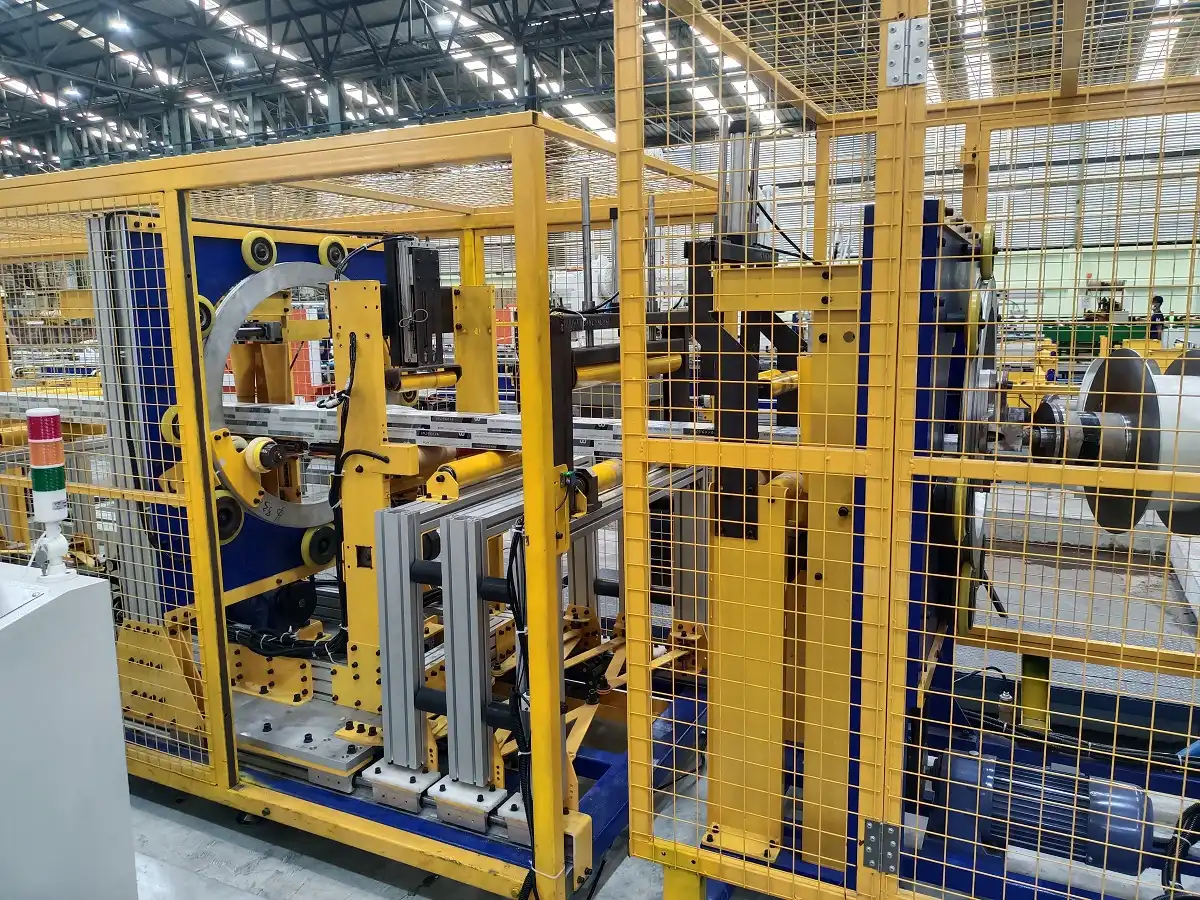
Every unit is engineered to international safety mandates and machinery directives:
1. Structural Mechanical Components
-
Ring Wheel: Cast steel or alloy wheel, dynamically balanced to ISO 1940 G6.3 to suppress vibration at 100 rpm.
-
Friction Wheels: Dual ground-tread drive wheels plus four guide rollers absorb radial shock and carry dynamic load.
-
Conveyor Contact: Rollers are jacketed in high-durometer polyurethane or UHMW-PE, so treated aluminum never meets bare metal.
2. Electrical and Automated Control
-
PLC: Siemens S7-1200/1500 or Allen-Bradley CompactLogix handles recipes, diagnostics and communication.
-
HMI: 7- to 10-inch colour touchscreen for multi-language operation, recipes, error logs and maintenance alerts.
-
Invertora piedziņas: Independent vector-controlled inverters for ring and conveyor give synchronized ramping and variable overlap.
3. Safety Standard Compliance
-
Machinery Directive Harmonization: Designed in full conformance with LV-415 6 (Safety requirements for packaging machines - horizontal orbital wrapping machines) and EN ISO 12100 (General design principles - risk assessment and risk reduction).
-
Elektrodrošība: būvēts līdz LV-60204 1, with IP54 minimum cabinet protection.
-
Safety Circuit Interlocks: Safety relays and category-rated sensors deliver functional safety architectures certified to ISO 13849-1 3. kategorija, veiktspējas līmenis d (PL d).
-
Pneumatics and Guarding: Pneumatic systems conform to ISO 4414 standards, incorporating lockable dump valves. Physical perimeters are secured by 2000 mm steel wire fencing and Category 4 optical safety light curtains complying with LV 61496.
Engineering RFQ Input Requirements and SLA Commitments
Catalogue requests cannot configure an orbital line; we size drives, chassis, hold-downs and transfer interfaces from your data.
Technical Project Input Matrix
|
Parameter Required
|
Primary Mechanical Reason
|
Consequence of Inaccurate or Missing Data
|
|
Max / Min Width (W) and Height (H)
|
Establishes the circumscribed diagonal to confirm the bore tier (D_ring).
|
Carriage collision, or an oversized machine running under capacity.
|
|
Max Lateral Bow / Camber (mm/m)
|
Defines the dynamic safety buffer (S_clearance) for extruded lengths up to 8 m.
|
Extrusion ends scraping internal machine guards.
|
|
Minimum and Maximum Bundle Length
|
Determines roller center distances and transfer gaps between adjacent conveyors.
|
Short profiles dropping between rollers; unstable conveyor transfer.
|
|
Max Bundle Weight (kg)
|
Sets conveyor frame structural ratings, drive motor torque, and roller bearing capacities.
|
Drive motor burnout, roller sag, or chain drive failure.
|
|
Surface Treatment Condition
|
Determines press roller material selection (cast polyurethane, foam rubber, UHMW-PE).
|
Surface rub marks, coating abrasions, or pressure denting on finished faces.
|
|
Pass-Line Elevation & Cycle Time
|
Matches the wrapper conveyor bed with upstream cooling tables and runout sawing systems.
|
Mechanical height mismatch and plant bottle-necking.
|
Engineering Service Level Agreements (SLA)
24
24-Hour Clearance Verification
Within 24 hours of receiving confirmed cross-section dimensions and profile types, our engineering department provides a formal geometric interference and ring size evaluation report.
48
48-Hour GA Layout Drawing
Within 48 hours of baseline data confirmation, we provide a complete 2D/3D General Arrangement (GA) layout drawing. This includes footprint boundaries, line transfer elevations, drop zones, electrical utility ratings, and safety safety perimeter details for integration sign-off.
Bieži uzdotie tehniskie jautājumi
How does the machine accommodate round tubing or solid brass bar bundles?
While optimized for rectangular structural extrusions, round bundles or solid bars are processed by swapping flat cylindrical conveyors with V-trough polyurethane-covered rollers. The vertical pneumatic hold-down assemblies utilize V-notched elastomeric clamping wheels to prevent cylindrical bundles from rotating under film tension.
Is six-sided moisture packaging possible on a horizontal orbital wrapper?
A horizontal orbital ring wraps the four longitudinal sides of the profile bundle. To achieve total six-sided weatherproofing for open maritime flatbed shipping, the line integrates an automated end-sheet capping module or transfers the wrapped bundle directly to an inline shrink film station to seal the cut end faces.
What mechanism prevents thin-wall architectural profiles from deforming?
Hold-down force is controlled via precision electro-pneumatic proportional regulators connected to the recipe database. For hollow profiles with wall thicknesses under 1.0 mm, clamping force drops to minimum stabilizing pressures, and wide-face, low-durometer polyurethane rollers distribute the clamping load evenly.
How is the packaging line integrated into existing extrusion press runout systems?
The PLC system interfaces with upstream stackers and downstream staging beds via industrial fieldbus protocols (EtherNet/IP, PROFINET, or dry-contact terminal interlocks). The machine communicates "Ready to Receive", "Cell Clear", "Cycle Complete", and "System Fault" signals to coordinate upstream and downstream handling equipment.
Secinājumi
A mill's choice comes down to two extremes of its own product list: the largest diagonal it will ever bundle fixes the bore, and the smallest section fixes the rollers and clamps. A wrapper bought for the average profile either fouls the largest pack or marks the smallest one, and both failures surface after commissioning rather than during quotation.
Submit the maximum profile cross-sections, the bundle weights and the floor plan constraints to the FHOPEPACK engineering team for the interference calculation report and the integration quotation.