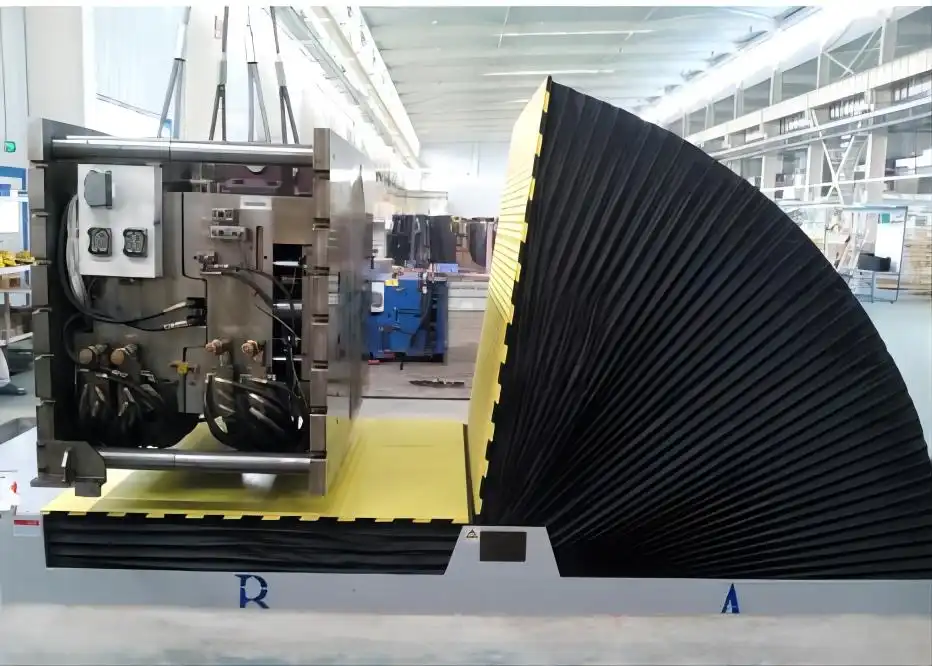
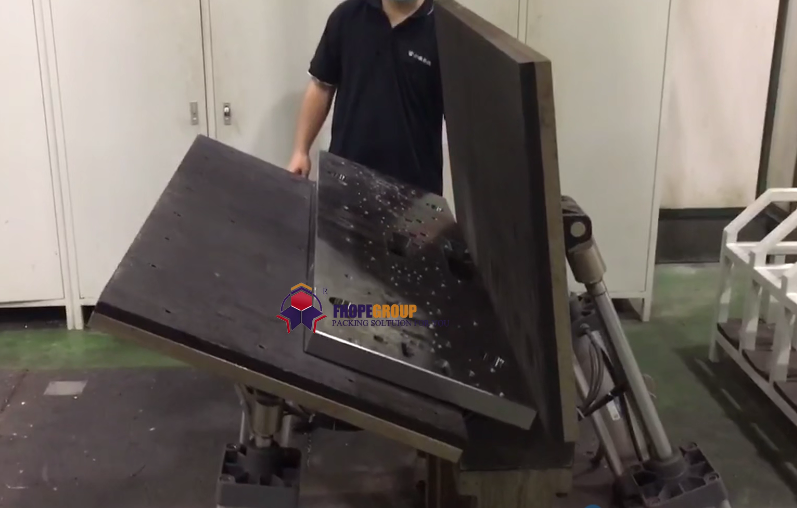
Santrauka In this 77 s clip our L-frame upender turns a large red cast housing from lying flat towards upright, held in a shaped yellow fixture marked 15T. The turn is slow and continuous, which matches the 60–90 s turning time we list for this frame class. For castings the fixture matters as much as the frame: it decides where the centre of gravity sits during the turn and which faces carry the load.
Turinys
- Ką rodo klipas
- Why a casting needs a custom fixture
- Centre of gravity during a 90° turn
- Sizing the frame: load class and turning time
- How we design the fixture
- Selection checklist for a casting upender
- Valdikliai ir sauga
- Inžinerijos DUK
- Kitas žingsnis
- Susijęs skaitymas
- Šaltiniai
Ką rodo klipas
The recording is a vertical clip of 77 s, shot on our workshop floor.
- The machine is an L-frame upender: a green base with a yellow cradle made of a base platen and a back platen at right angles.
- The workpiece is a large red casting, a housing with several flanged ports.
- A raised, shaped yellow bolster on the cradle seats the casting. The side of the fixture carries a 15T marking.
- The cradle turns slowly and steadily through almost the whole recording, taking the casting from flat towards upright. The casting stays seated in the fixture throughout.
- Nobody stands near the machine and no crane is used during the turn.
Why a casting needs a custom fixture
A mould or a steel block has flat faces. It sits on the base platen, and as the frame turns it settles against the back platen. A casting is different:
- Netaisyklingos formos. Ports and flanges stick out, so the casting would rest on a few points instead of a face.
- Offset centre of gravity. Wall thickness varies, so the mass is rarely in the middle of the outline.
- Faces to protect. Machined flanges and sealing faces must not carry load or be scratched.
The fixture turns an awkward shape into a stable one. It gives the casting defined support points on rough cast surfaces, keeps machined faces free, and holds the part in a known position relative to the pivot. That is why the cradle in the clip carries a shaped bolster, not a flat plate.
Centre of gravity during a 90° turn
On an L-frame upender the load first rests on the base platen. As the frame turns, the weight moves progressively onto the back platen. Halfway through the turn both platens share it.
Two rules follow:
- Keep the centre of gravity inside the support area at every angle. If it passes outside the contact points, the casting tips within the fixture instead of turning with it.
- Keep the centre of gravity close to the pivot. The drive must resist the load moment, which equals load weight × horizontal distance from the pivot to the centre of gravity. A fixture that sets the casting deeper into the cradle reduces that distance and smooths the turn.
We take the casting drawing, find the centre of gravity, and check its path through the full 90° before we fix the fixture geometry.
Sizing the frame: load class and turning time
Our standard 90° mould upender range gives a starting point. Values from our product page:
| Modelis | Maks. pakrovimas | Elektros energija | Apsisukimo laikas | Mašinos svoris |
|---|---|---|---|---|
| FPMT-10 | 10 t | 3.0 kW | 60–90 s | 3.5 t |
| FPMT-20 | 20 t | 5.5 kW | 70–90 s | 4.0 t |
| FPMT-30 | 30 t | 10.5 kW | 70–90 s | 5.0 t |
The upender in the clip is marked 15T, between the 10 t and 20 t frames. That is normal for us. We build each frame for the actual load. The same load class can need a different motor and machine weight when the part is larger or its centre of gravity sits further out. A heavy but compact casting and a lighter but bulky one can end up on the same frame size.
Table size and machine size are designed per load, so the fixture and the platens are drawn around your part, not chosen from a catalogue.
How we design the fixture
For a casting fixture we work from four inputs:
- Casting drawing with weight and centre of gravity, or a 3D model we can weigh in CAD.
- Support faces: rough cast surfaces the fixture may touch, and faces it must not touch.
- Orientation before and after the turn: how the casting arrives and how it must be presented for machining, assembly or inspection.
- Dalis šeimos: if several castings share one upender, we design a base fixture with exchangeable inserts.
The finished fixture is welded steel, painted, and fitted to the cradle. Where a part family has several sizes we check every size against the centre-of-gravity rule, not just the heaviest.
Selection checklist for a casting upender
- Heaviest casting and its centre of gravity, with the drawing or model.
- Largest outline: length, width and height in the starting position.
- Faces that may carry load and faces that must stay free.
- Turning angle needed: 90° or 180° (for a full turnover see our 180° load inverter).
- How the casting is loaded and unloaded: crane, forklift or a geležinkelio pervežimo vežimėlis.
- Cycles per shift, which sets the drive duty and turning time.
- Floor space, foundation and supply voltage at the installation point.
Valdikliai ir sauga
Taikomi standartai priklauso nuo paskirties rinkos. CE rinkoms ISO 12100 nustato rizikos vertinimo metodą, o EN 415-10 apima bendruosius pakavimo mašinų reikalavimus, kuriuose nustatomi apsaugos ir avarinio stabdymo įtaisai.
The turning zone is the hazard. Nobody stands inside the sweep of the cradle while it moves, and loading or unloading happens only with the cradle at rest in its end position.
Inžinerijos DUK
Q: Why does the fixture matter more for castings than for moulds? A: A casting has an irregular shape and an offset centre of gravity. The fixture gives it defined support points and keeps the centre of gravity inside the support area through the full 90°.
Q: How long does a 90° turn take? A: Our standard 90° frames list 60–90 s for the 10 t frame and 70–90 s for the 20 t and 30 t frames. The clip shows a slow, continuous turn that fits this range.
Q: Our casting weighs 15 t. Which frame do we need? A: It depends on size and centre of gravity, not weight alone. The unit in the clip is marked 15T; we would size yours from the drawing and may build it on a heavier frame if the part is bulky.
Q: How does the load move across the platens during the turn? A: The casting starts fully on the base platen. As the cradle turns 90°, the load shifts progressively to the back platen; halfway through, both platens share it.
Q: Do we need a 90° or a 180° upender? A: 90° stands a part up or lays it down. 180° turns it over to reach the underside. Our mould upender range has both.
Kitas žingsnis
We size a casting upender in three steps:
- Pateikite savo išdėstymo brėžinį with the casting drawing, weight, centre of gravity and the turning angle you need, to info@fhopepack.com.
- Gaukite pasiūlymą per 48 valandas, including the frame, the drive and a fixture concept drawn around your casting.
- Užsisakykite objekto apžiūrą so we confirm the loading method, the floor and the space for the cradle sweep.
Susijęs skaitymas
- Pramoninis pelėsių savivartis ir viršutinė dalis: Sunkus pelėsių valdymas
- Štampavimo formos apvertimo ir pakreipimo įrenginys
- Saugos investicijų grąža: 90 laipsnių kampu apverčiamos formos, o ne kranu apverčiamos
- Pelėsis aukštyn
Šaltiniai
- Machine, fixture, casting and turn: vaizdo įrašas „YouTube“ platformoje (77 sek.; @fhope9014)
- Frame range, loading, power, turning time, machine weight: Pelėsis aukštyn
- Standartų taikymo sritis: ISO 12100:2010; EN 415-10: 2014
- Pasiūlymo pateikimo laikas: patvirtintas įmonės CTA (pasiūlymas pateiktas per 48 valandas)
Paskutinį kartą peržiūrėta: 2026-10-06