Santrauka: A stack of loose tubes is a stack that shifts in transit, and a bundle that shifts is a bundle that argues about counts on arrival. This page is for buyers deciding whether a steel tube bundle stacking and strapping line fits that step. It describes what the footage shows the line doing with tubes, what it does not, and gives the checklist that makes the purchase testable.
https://www.fhopepack.com/Automatic-Steel-Tube-Packing-Line/
Šiame puslapyje: Ką šis puslapis padeda jums nuspręsti · Why a tube bundle needs a machine · How the line builds a bundle · What the stacking tells you · Ką rodo saugos paveikslėlis · Ką rodo klipas · Pirkėjo patvirtinimo kontrolinis sąrašas · DUK · Susijęs skaitymas · Kitas žingsnis

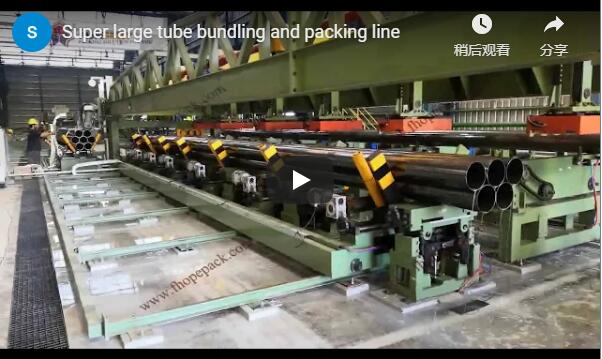
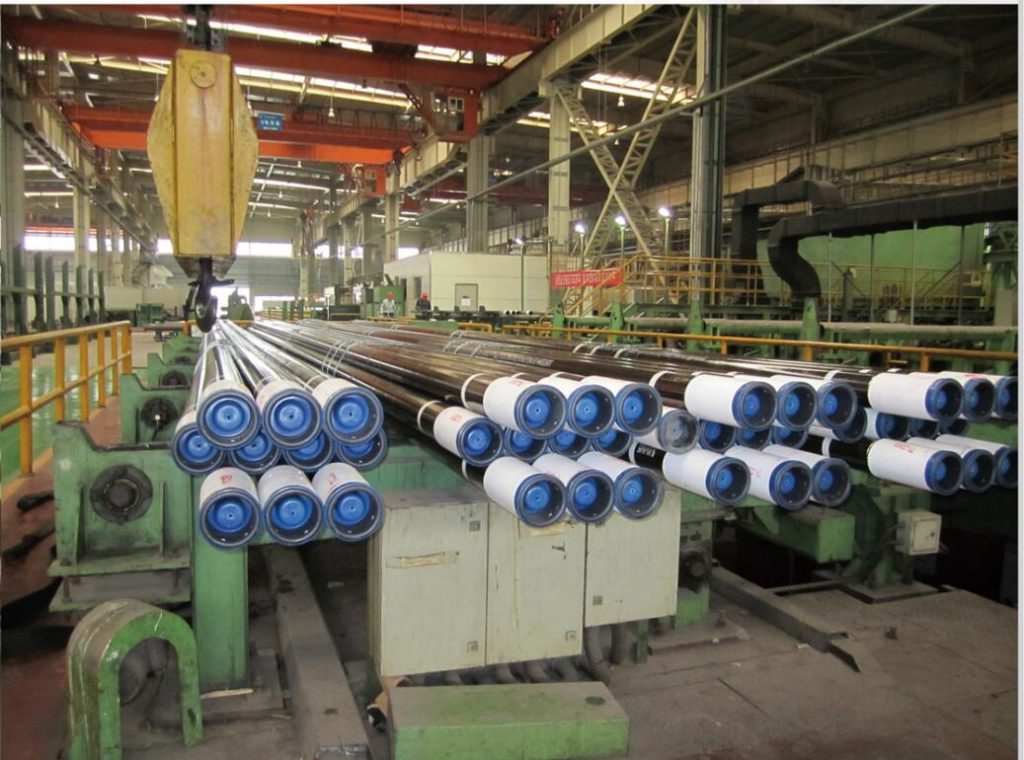
Caption: A steel tube packing line. Product-library reference image, not a still from the clip.
Ką šis puslapis padeda jums nuspręsti
Tubes are easy to count one by one and easy to lose by the bundle. A loose batch of tubes walks, dents and argues about numbers, so the finishing step has to gather the tubes into a counted, ordered bundle.
This page is for the buyer evaluating a steel tube bundle stacking line. It records what the footage shows the line doing with the tubes, and it separates those observations from the stated strapping step.
Why a tube bundle needs a machine
A bundle is the load unit that survives the truck. The tubes pack close together, hold each other flat, and arrive as one stack that the receiver can count in a glance.
Manual stacking cannot keep the count honest. Hands tire, rows shift, and the bundle that leaves uneven arrives uneven, so the line has to stack the tubes square and keep them square.
The bundle also feeds the rest of packing cleanly. A straight, even stack is ready for strapping and wrapping, where a loose pile has to be redone first.
How the line builds a bundle
The footage shows a tube line in light painted frames with orange components. Tubes travel forward on a conveyor in a straight line, and multiple parallel tubes are gathered into a group as the line moves them along.
A gripper on an upper mechanism lifts tubes from the group, and the clip shows single tubes and small groups being handled in sequence. The line then carries the gathered tubes toward the stacking zone at the end.

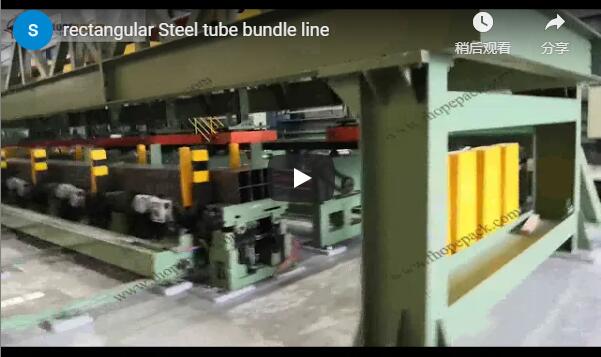
Caption: A steel tube packing line, second view. Product-library reference image, not a still from the clip.
At the end of the footage, tubes sit stacked in a neat horizontal bundle many rows deep, with clamp arms holding both sides and red indicator lamps on the equipment. Two workers stand beside the bundle in the closing frames.
What the stacking tells you
The end-bundle is the payoff of the line. The rows in the footage stack square, one on top of another, and the clamp arms on both sides hold the pile in a counted, rectangular form.
That square stack is the evidence that the counting and the shaping work. A line that delivers an even bundle has done the whole job that manual packing struggles to repeat.

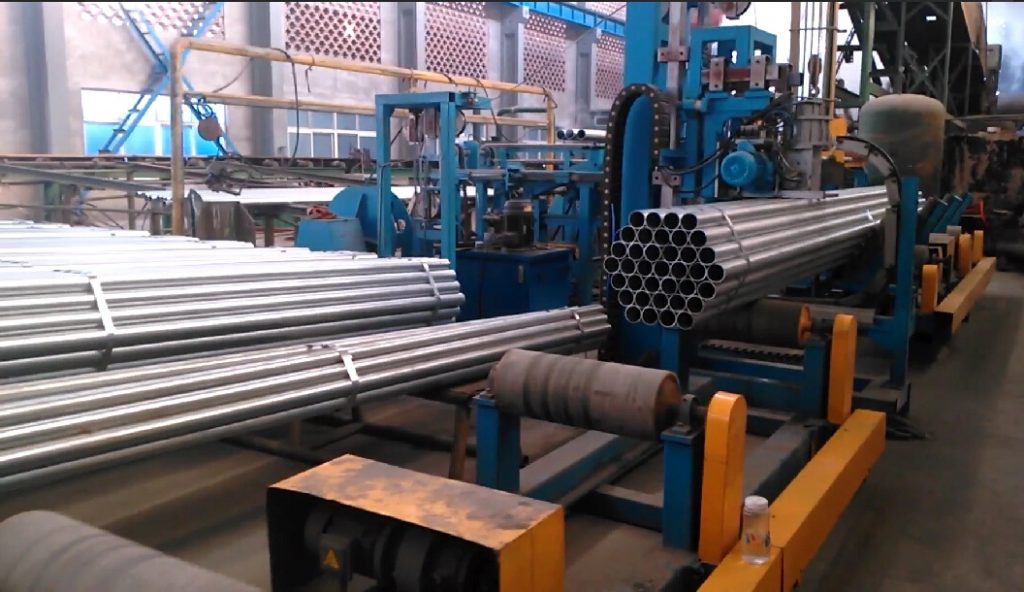
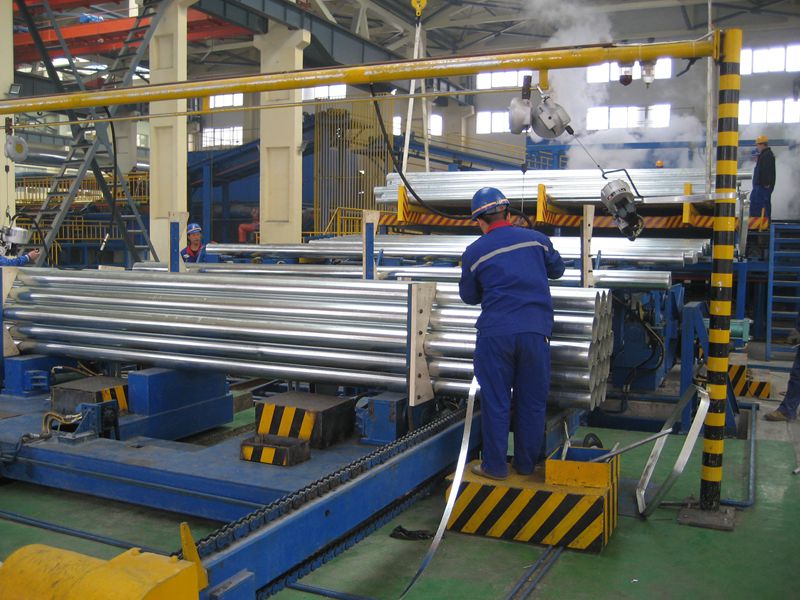
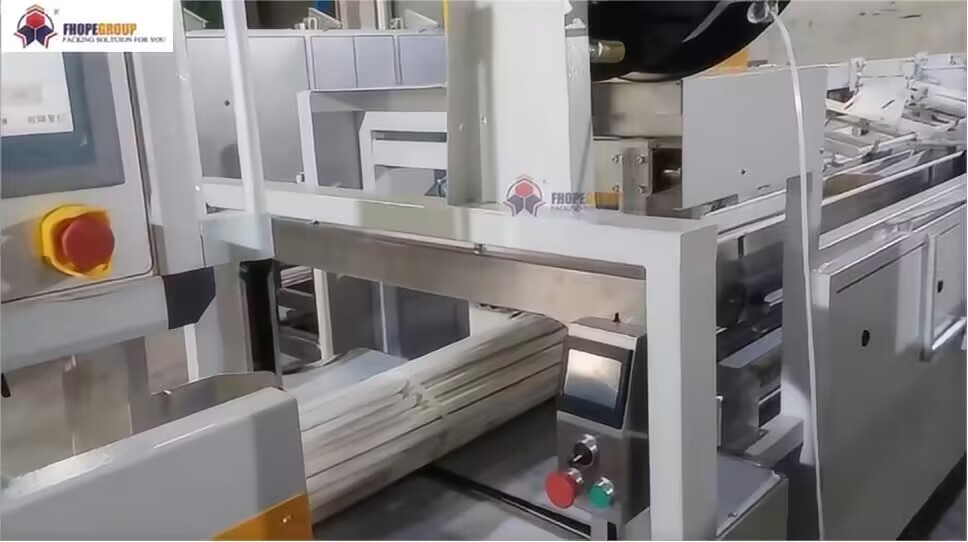
Caption: A steel tube strapping line. Product-library reference image, not a still from the clip.
The camera also shows the crowd of operators at the exit. The final strapping of the stack, the band itself, is not shown being applied in the sampled frames, and the clip’s stated strapping step has to come from the supplier’s specification.
Ką rodo mašinos saugos paveikslėlis
The line in the footage runs open in a workshop, with workers present at the line and at the stacking end. Red indicator lamps sit on the equipment, and the moving tube conveyor and the lifting gripper are the live hazards.
No readable emergency stop, light curtain or guard appears in the sampled frames. The clip carries a site watermark from a third party in the corner, which is not a label on the machinery and is not part of the machine.
The safety list has to arrive with the quotation. Nothing in the footage replaces the supplier’s emergency-stop and guarding statement.
Ką rodo mašininio linijos įrašas
What the video shows is a steel tube line with light painted frames and orange components. Tubes travel forward on a conveyor in a straight line, multiple parallel tubes gather into a group, and an upper gripper lifts tubes from the line as it moves toward a stacking zone.
At the end of the clip, tubes sit stacked in a neat, many-row bundle with clamp arms holding both sides and red indicator lamps on the equipment. The photos on this page are product-library reference images, not stills from the clip. Direct observation notes from the sampled frames, not a performance test.
What the clip does not show is the strapping band being applied, the tube diameter and length range, the bundle dimensions and weight, the cycle time, the stacking rate, a model number, or any certification.
The footage proves the conveying, the gathering and the stacking of the bundle. The bands named in the page title have to be confirmed separately.
Pirkėjo patvirtinimo kontrolinis sąrašas
Six questions decide whether the line fits your tubes. Ask them in writing, and keep the answers with the quotation.
| Klauskite tiekėjo | Kodėl tai lemia pirkimą |
|---|---|
| Tube diameter and length range | Įraše nėra dydžio apribojimų |
| Bundle width, height and weight | The stack forms, the numbers never show |
| Ar surišimas yra integruotas, ar atskiras | The title says strapping; the clip shows stacking |
| Cycle time and stacking rate | Vaizdo įraše nematyti jokio laikrodžio ciklo |
| Tube feed and count automation | The gripper handles tubes in the clip |
| Apsaugų, šviesos užuolaidų ir avarinio sustojimo sąrašas | Kadruose nematyti jokio stabdymo įtaiso |
Nusiųskite tai tiekėjui ir nukopijuokite ją tokią, kokia yra:
- Your tube diameter, length and bundle counts.
- The bundle width, height and weight you need.
- Jūsų pamainos tikslas paketais per valandą.
- Whether strapping is part of the line or separate.
- Whether the tube count and feed must be automatic.
- The safety device list around the conveyor and gripper.
- Etaloninis įrenginys tokioje linijoje kaip jūsų.
DUK
Does the line strap the bundle too?
The footage shows tubes gathered, stacked and held by clamp arms at the end of the line. Applying a steel band is not shown in the sampled frames, so the strapping step has to be confirmed with the supplier.
Is the tube count automatic?
The clip shows gripper handling of the tubes as the bundle forms, and no readable panel appears to confirm a count. Whether the count is automatic is a written question, not something the footage settles.
What tube sizes can it stack?
Not shown. The clip demonstrates one tube size on the conveyor, and no label states a range, so send the supplier your diameters and lengths and ask which line covers them.
Susijęs skaitymas
- Automatinė plieninių vamzdžių pakavimo linija — steel tube packing lines.
- Plieninių ritinių vyniojimo mašina — suvyniotų metalo gaminių įvyniojimas.
- Automatinė pakavimo linija — visiškai automatizuotos pakavimo sistemos.
- Pusiau automatinė padėklų vyniojimo mašina — operatoriaus padedamas apvyniojimas.
- Automatinis pakavimo stalo ritinių pakavimo įrenginys — automatic bagging for rolls and tubes.
- Susitraukimo mašina — shrink-wrapping equipment.
Kitas žingsnis
Send the supplier your tube diameters, lengths and bundle counts first, and ask directly whether the strapping is integrated. The footage proves the conveying, gathering and stacking; the band step has to come from them.
Tada užduokite septynis aukščiau pateiktus klausimus ir paprašykite apsaugos bei avarinio stabdymo sąrašo.
Then run one bundle through the line and count the tubes at the exit. Use the kontaktas puslapis kad pradėtų tą mainą.
Paskutinį kartą peržiūrėta: 2026-09-28
Paskelbta: 2026-09-28