Santrauka
Steel sheet stacks are dense, sharp, and inherently slippery due to protective mill oil coatings. Flipping or upending them with overhead cranes and synthetic slings presents severe operational risks, including interlayer shear slipping, edge damage, and unpredictable pendulum swings. Our industrial C-frame steel sheet inverter mechanically clamps the entire stack between dual-acting hydraulic platens and rotates the load smoothly along a rigid horizontal axis. This provides safe, repeatable 90° upending for vertical storage or 180° inversion for pallet exchange and bottom-sheet inspection.
Turinys
- Why use an inverter for sheet stacks
- Turnover sequence and operational cycle
- Clamping system, drive engineering, and kinematics
- Stack weight calculation and load profiling
- Swing envelope and floor space planning
- Inžinerinės atrankos kontrolinis sąrašas
- Machine safety and statutory compliance
- Inžinerijos DUK
- Next steps for quote and engineering proposals
- Susijęs skaitymas
- Šaltiniai
Why use an inverter for sheet stacks
Handling bundled steel sheets via overhead slings introduces significant occupational hazards and process bottlenecks. As an unevenly bound pack approaches the 90° balance point on crane rigging, friction between oiled sheets can quickly drop below the static threshold (µ < 0.10), causing interlayer shearing, stack fanning, or catastrophic dropped loads. Furthermore, rigging chains and wire ropes inevitably score or crush the finished sheet edges.
A dedicated mechanical inverter eliminates these failure modes by locking the stack inside a rigid C-frame cradle throughout the rotation:
- Controlled center-of-gravity transfer: The stack turns about a fixed machine axis supported on heavy-duty trunnion ground rollers, eliminating uncontrolled swinging.
- Positive compressive clamping: High-rigidity platens apply uniform vertical pressure across the stack face, keeping individual sheets immobilized despite oily surfaces.
- Zero edge distortion: Structural support rests entirely on broad, lined platens rather than localized sling pinch points.
- Separation of operator from hazards: Pendant or remote console controls allow the technician to initiate and supervise turnovers from well outside the machine envelope.
Įprastos programos apima:
- Upending horizontal stacks to 90° for vertical cassette storage or plate-saw infeed.
- 180° complete inversion to flip surface-sensitive plates, exchange transport skids, or access bottom-tier sheets.
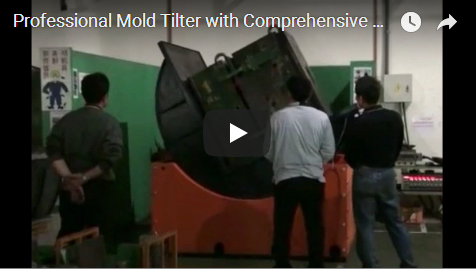
- Turning heavy stamping dies, injection moulds, and machined tooling blocks safely for servicing and tooling inspection.
Turnover sequence and operational cycle
Turning oily or sheared steel sheet requires precise sequencing to prevent stack de-lamination, particularly when transitioning through the 90° vertical threshold.
[1. Forklift Load] ──> [2. Hydraulic Clamp] ──> [3. Controlled Turn] ──> [4. Positive Lock] ──> [5. Unclamp & Offload]
  Bottom platen          Proportional pressure     90° upright or          Self-locking brake       Forklift or crane
receives pallet locks stack bundle 180° full inversion holds payload clears the load- Įkrovos įrašas: A forklift or warehouse crane lowers the palletized stack onto the lower load platen. Fork relief pockets allow quick, stable fork retraction.
- Hidraulinis prispaudimas: The dual or quadruple upper clamping cylinders lower the top platen. Pressure transducers confirm that target clamping tonnage is achieved, preventing interlayer slip without crushing corrugated or thin-gauge sheet.
- Rotational turnover: The electric gear motor drives heavy-pitch roller chains across the circumference of the C-frame cradle. Rotation decelerates automatically as the center of gravity crosses the top dead center (TDC).
- Intermediate or final holding: The machine locks mechanically at 90° (for vertical cassette transfer) or continues to 180° (for full inverted positioning).
- Release and offload: Hydraulic pilot check valves hold cylinder pressure until offload commands are verified. Once open, the inverted stack—or uprighted sheet bundle—is removed via plate clamp or forklift.
Clamping system, drive engineering, and kinematics
The unit operates on a reinforced semi-open C-frame barrel roll. The roll rests on solid steel trunnion rollers lined with high-strength forged flanges, delivering exceptional structural rigidity against cantilevered overturning moments.
| Posistemis | Inžinerinė specifikacija | Inžinerijos nauda |
|---|---|---|
| Clamping actuation | Hydraulic cylinders with pilot-operated check valves | Zero pressure loss during power disruptions; prevents stack fanning |
| Platen lining | Replaceable MC nylon, polyurethane, or hardwood liners | Protects high-grade stainless, copper, or coated sheets from surface scuffing |
| Rotation limits | 0° to 90° upending, or continuous 0° to 180° full inversion | Dual operational flexibility on a single shop footprint |
| Važiuoti traukiniu | Hardened worm reducer paired with double high-pitch roller chain | Self-locking mechanical advantage combined with high torque distribution |
| Motion profiling | Variable Frequency Drive (VFD) controlled S-curve acceleration | Eliminates shock loads when crossing over-center dead points |
| Padėties valdymas | Dual limit switches plus redundant rotary encoder | Hardwired end-stop verification and precision positioning within ±0.5° |
| Emergency holding | Spring-applied, electro-magnetic fail-safe disc brake | Dynamic locking in any angular position during emergency stop |
The self-locking characteristics of the high-reduction worm gearbox, backed by an electromagnetic motor brake, guarantee that the revolving cradle cannot backdrive—even under total facility electrical brownouts.
Stack weight calculation and load profiling
Accurate mass calculation is critical to ensure proper sizing of hydraulic relief valves and motor brake holding torque. Mild steel density is standardized at 7.85 t/m³ (7,850 kg/m³).
Stack Weight (t) ≈ Length (m) × Width (m) × Stack Height (m) × 7.85
Inžinerinio dydžio pavyzdys:
- Bundle Length (L): 2.0 m
- Bundle Width (W): 1.0 m
- Stack Pack Height (H): 0.2 m (excluding pallet runner thickness)
- Solid Volume: 2.0 × 1.0 × 0.2 = 0.4 m³
- Net Steel Weight: 0.4 m³ × 7.85 t/m³ = 3.14 metrinės tonos
Note on structural capacity: When sizing your unit, factor in the gross tare weight of heavy structural wooden pallets, steel dunnage, and upper clamping frames. Always size the inverter to the heaviest projected envelope rather than the average daily workload.
Swing envelope and floor space planning
Because our inverter rotates within an internal barrel cradle rather than tilting over an external perimeter corner, the center of gravity rotates close to the machine’s central horizontal axis.
The radial swing envelope of the payload itself can be checked using the stack’s diagonal cross-section:
R_payload ≈ √((W / 2)² + (H / 2)²) (for a stack centered along the rotation axis)
For overall plant layout and clear overhead ceiling height, the machine frame outer ring diameter (D_ring) governs the actual space envelope:
| Parametras | 5-Ton Standard Frame | 10-Ton Heavy Frame | Custom 20-Ton Frame |
|---|---|---|---|
| Maximum stack length (L) | 2,500 mm | 3,000 mm | 4,000 mm+ |
| Maximum stack width (W) | 1,250 mm | 1,500 mm | 2,000 mm |
| Clamping opening height | 300 - 800 mm | 400 - 1,000 mm | Engineered to spec |
| Outer frame rotation radius | Apytiksliai 1,450 mm | Apytiksliai 1,750 mm | Confirmed on GA drawing |
| Recommended safety zone | Frame radius + 1,200 mm | Frame radius + 1,500 mm | Laser scanner / fence zone |
Always allow unobstructed forklift approach lanes on the loading face, and position the operator console outside the dynamic rotation arc.
Inžinerinės atrankos kontrolinis sąrašas
To receive an optimal sizing proposal and general assembly (GA) layout drawing, verify these core parameters:
- Stack dimensions: Maximum and minimum length, width, and bundle height (including skid).
- Payload weight: Maximum gross weight (sheets + pallet/dunnage).
- Reikalingas pasukimo kampas: 90° upending only, or full 180° turnover.
- Medžiagos paviršiaus būklė: Oily, dry, polished, or prepainted (determines platen liner material and clamping pressure range).
- Loading methodology: Counterbalance forklift, pallet truck, or overhead crane loading (determines C-frame open-throat clearance).
- Throughput frequency: Cycles per shift or hour (dictates hydraulic power unit motor kW and cooling requirements).
- Plant infrastructure: Factory available voltage/frequency (e.g., 380V/480V 3-Phase) and floor concrete loading capacity.
Machine safety and statutory compliance
Our steel sheet turnover systems are designed and manufactured under strict European and international machine safety frameworks:
- EN ISO 12100:2010: Mašinų sauga. Bendrieji projektavimo, rizikos vertinimo ir rizikos mažinimo principai.
- EN 415-10: Safety requirements for packaging machines and integrated handling attachments.
- EN 60204-1: Safety of machinery — Electrical equipment of machines, providing IP54 enclosure protection and proper grounding.
- ISO 13849-1: Safety-related parts of control systems, standardizing dual-channel emergency stop circuits up to Performance Level d (PLd).
- Hydraulic fail-safe integration: Dual pilot check valves directly hard-manifolded onto cylinders to prevent unintended clamp release upon hydraulic hose failure.
Inžinerijos DUK
Q: Can the inverter handle mixed stack sizes without manual platen readjustment? A: Yes. The upper clamping assembly features a wide-stroke hydraulic system. Built-in pressure sensors detect the top of the stack automatically and apply the preset clamping force, adapting instantly to varying stack heights.
Q: What prevents oily sheets from sliding sideways during the critical 90° vertical pass? A: Oily sheets experience low frictional resistance. We counter this by calculating clamping force based on dynamic shear loads under low friction coefficients (µ = 0.08). The high-stiffness box platen prevents center bowing, holding even pressure across the sheet surface.
Q: Can this equipment be integrated into automated slitting or blanking lines? A: Yes. We regularly furnish automated inverters equipped with powered roller or chain platens, automated entry/exit indexing, and fieldbus interfaces (Profisafe, Ethernet/IP) to link into line PLC architectures.
Q: How does the drive handle an out-of-balance center of gravity? A: The variable-frequency drive unit uses active dynamic braking resistors to maintain smooth torque when an asymmetric payload swings past top dead center, preventing motor overspeed or jerky mechanical movement.
Next steps for quote and engineering proposals
- Submit your stack profile: Email your maximum bundle length, width, height, and gross tonnage to info@fhopepack.com.
- Review preliminary layout: Our application engineering team will configure the C-frame throat dimension, trunnion base, and hydraulic power unit (HPU).
- Receive a formal proposal within 24 hours: We deliver an itemized quotation, foundation requirements, and 2D/3D general assembly concept drawings for your plant review.
Susijęs skaitymas
- Load Inverter Systems — Technical Products
- Heavy-Duty 180° Mechanical Upender Video Library
- Industrial Sheet & Panel Turnover Equipment Solutions
- Automatic 180-Degree Multipurpose Coil & Mold Tilters
Šaltiniai
- ISO 12100: 2010 Safety of machinery — Basic concepts, general principles for design
- EN 415-10: 2014 Pakavimo mašinų sauga. Bendrieji reikalavimai
- EN 60204-1: 2018 Mašinų sauga. Mašinų elektros įranga
- Machinery Directive 2006/42/EC Harmonized Standards Directory
Paskutinį kartą peržiūrėta: 2026-10-20