Santrauka: A pipe that ships bare arrives bent, scratched and hard to handle. This page is for buyers deciding whether an automatic pipe bagging and tube packing machine fits the wrapping step. It describes what the footage shows the machine doing with a pipe, what it does not, and gives the checklist that makes the purchase testable.
https://www.fhopepack.com/Plastic-Pipe-Packing-Line/Automatic-PPR/PVC-Pipe-bagging-line.html
Šiame puslapyje: Ką šis puslapis padeda jums nuspręsti · Why a pipe needs a sleeve · How the machine wraps a pipe · What the film feed tells you · Ką rodo saugos paveikslėlis · Ką rodo klipas · Pirkėjo patvirtinimo kontrolinis sąrašas · DUK · Susijęs skaitymas · Kitas žingsnis

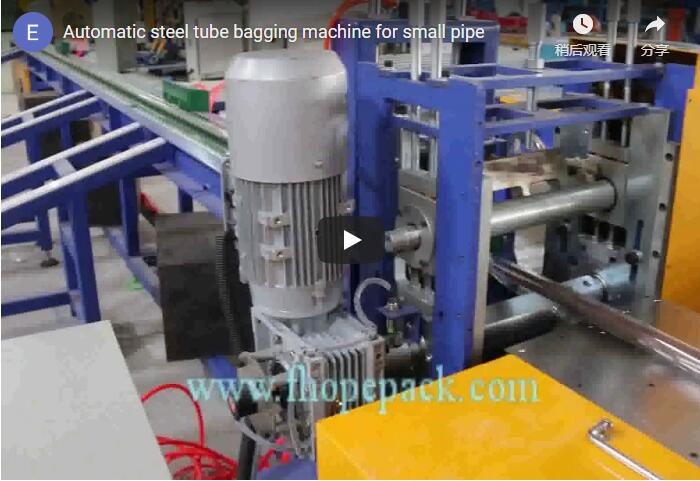
Caption: An automatic pipe bagging machine for plastic pipe. Product-library reference image, not a still from the clip.
Ką šis puslapis padeda jums nuspręsti
A long pipe is fragile on its own. Its finish scratches, its ends knock, and its length makes it awkward the moment it leaves the line, so the step that wraps it in film is what makes it shippable.
This page is for the buyer evaluating an automatic pipe bagging and tube packing machine. It records what the footage shows the machine doing with a pipe, and it separates the visible wrapping from the packing figures the clip never presents.
Why a pipe needs a sleeve
A film sleeve protects the pipe’s face and bore. The wrap keeps dust, scratches and rough handling off a clean pipe, which is the difference between a pipe that ships and a pipe that has to be reworked.
The wrap also binds the pipe’s length. A wrapped pipe carries itself as one unit, holds together on the truck, and unloads without tangling with the next length beside it.
The sleeve is also the label surface. A clean film wrap takes a sticker and a scan, so the pack leaves the line identified as well as protected.
How the machine wraps a pipe
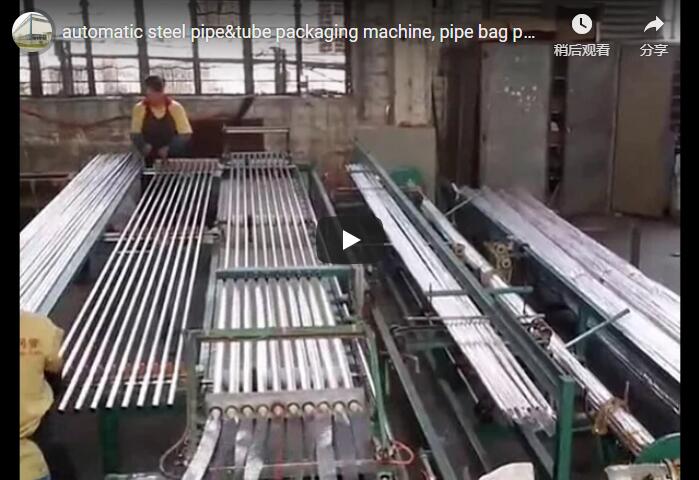
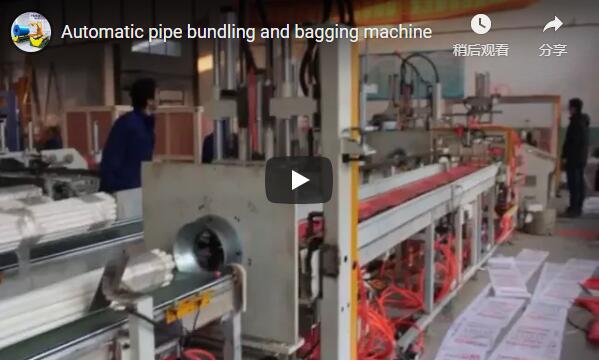
The footage shows a large blue packing machine built around a roller conveyor. A long metal pipe travels on the conveyor from right to left, and enters the wrapping section in the middle of the machine.
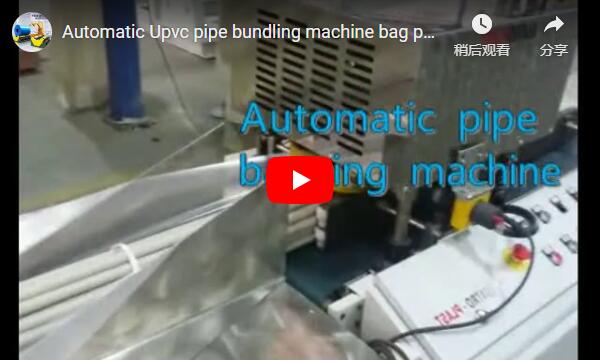
A reel of transparent film at the side of the line feeds the machine. The film is drawn over the pipe, and a set of rollers and arms folds it around the pipe body as it passes through.

Caption: An automatic pipe bagging machine, feed view. Product-library reference image, not a still from the clip.
The pipe is fully wrapped in transparent film by the time it leaves the section. The machine then continues with the next length, and a worker in a blue uniform stands beside the line to oversee the run.
What the film feed tells you
The film supply in the footage is a large reel carried on the machine. The reel pays film toward the pipe, and the machine’s rollers tension and fold the film around the moving pipe without stopping the line.
That arrangement decides the consumable story. The film runs in a continuous reel, so the change cost is a reel swap at the side of the machine, and the film width and grade have to suit the pipe diameter.

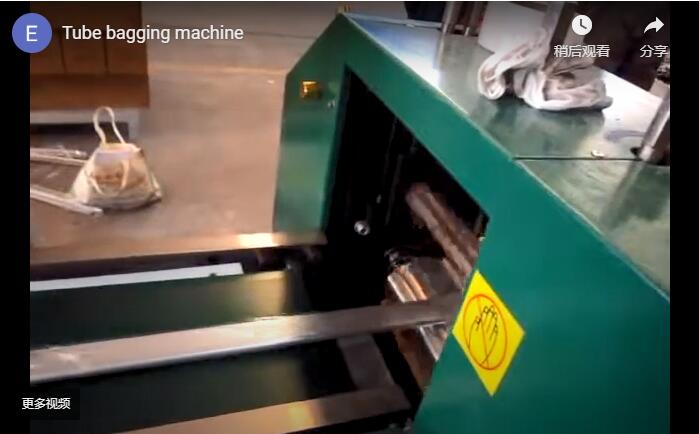
Caption: An automatic pipe bagging machine, third view. Product-library reference image, not a still from the clip.
The wrapping is shown as one smooth pass. The pipe keeps its direction and speed through the section, and no separate bag or sleeve is visible ahead of the wrap in the working frames.
Ką rodo mašinos saugos paveikslėlis
The machine in the footage works in the open beside the roller conveyor. The moving rollers and the folding arms are the live hazards, and no guard fence or light curtain appears around the wrapping section.
No emergency stop is clearly visible in the sampled frames. A worker stands beside the running line, so the stop position and the guarding have to come from the supplier’s safety list.
The footage carries the maker’s own wall mark and site watermark. A Chinese wall sign on the machine frame in some frames is legible only in part, and it is not treated as a specification in this page.
Ką rodo mašininio linijos įrašas
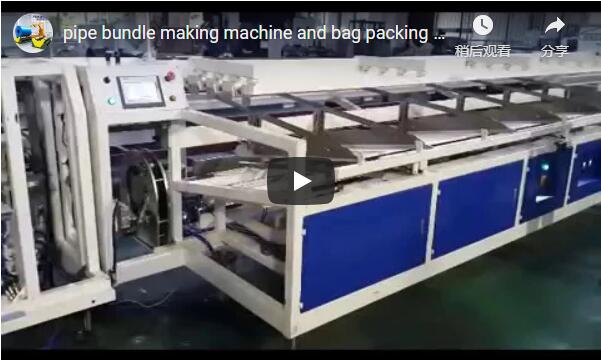
What the video shows is a large blue packing machine built around a roller conveyor. A long metal pipe travels from right to left into the wrapping section, where a film reel feeds film over it. Rollers and arms fold the film around the pipe in one continuous pass, and a worker in a blue uniform stands beside the line during the run.
Šiame puslapyje esančios nuotraukos yra produktų bibliotekos pavyzdžiai, o ne kadrai iš klipo. Tai tiesioginiai stebėjimo užrašai iš atrinktų kadrų, o ne veikimo bandymo rezultatai.
What the clip does not show is the pipe diameter and length range, the film width and grade, the line speed, the cycle time, a separate bagging step, the power ratings, or any certification.
The title names bagging and the machine performs wrapping. The pack rate and the sleeve details have to come in writing.
Pirkėjo patvirtinimo kontrolinis sąrašas
Six questions decide whether the machine fits your pipes. Ask them in writing, and keep the answers with the quotation.
| Klauskite tiekėjo | Kodėl tai lemia pirkimą |
|---|---|
| Pipe diameter and length range | Įraše nėra dydžio apribojimų |
| Film width, grade and feed reel size | The reel feeds, the specs never show |
| Line speed and pack rate | Vaizdo įraše nematyti jokių laikrodžio rodyklę rodančių figūrų |
| Bagging vs film wrapping step | The title says bagging; the clip shows wrapping |
| Infeed and outfeed interface | The clip shows a roller-fed pipe |
| Apsaugų, šviesos užuolaidų ir avarinio sustojimo sąrašas | Stabdymo įtaiso nematyti |
Nusiųskite tai tiekėjui ir nukopijuokite ją tokią, kokia yra:
- Your pipe diameters, lengths and daily volume.
- The film width and grade you intend to run.
- Whether a bag or sleeve is needed over the film.
- Your target line speed in pipes per hour.
- How the pipes must enter and leave the line.
- The safety device list around the wrapping arms.
- A reference installation wrapping a pipe like yours.
DUK
Does the machine bag or wrap the pipe?
The footage shows the film being folded and wrapped around the moving pipe in one pass. A separate bagging or sleeving action is not clearly shown in the sampled frames, so the exact pack type has to be confirmed.
What pipe sizes can it run?
Not shown. The clip demonstrates one long metal pipe, and no label states a range, so send the supplier your pipe diameters and lengths and ask which model covers them.
Ar mašina automatinė?
The pipe feeds on the roller conveyor and is wrapped without halting in the footage, with a worker supervising rather than folding the film by hand.
Susijęs skaitymas
- Automatic PPR/PVC pipe bagging line — automatic pipe bagging lines.
- Woven bagging line — woven bag packing for pipe.
- Vamzdžių pakavimo mašina — vamzdžių gaminių pakavimas.
- Horizontalus autokrautuvas — automatic horizontal bagging machines.
- Pagrindinis ritės apvalkalas — ritinių ir ilgų gaminių vyniojimas.
- Automatinė pakavimo linija — visiškai automatizuotos pakavimo sistemos.
Kitas žingsnis
Send the supplier your pipe diameters, lengths and daily volume first, and ask for the line speed and pack rate. The footage proves the film wrap; the rates have to come from them.
Tada užduokite septynis aukščiau pateiktus klausimus ir paprašykite apsaugos bei avarinio stabdymo sąrašo.
Then run one pipe through the line and measure the wrap from end to end. Use the kontaktas puslapis kad pradėtų tą mainą.
Paskutinį kartą peržiūrėta: 2026-09-29
Paskelbta: 2026-09-29