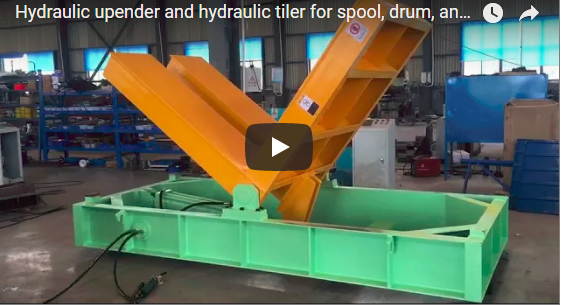
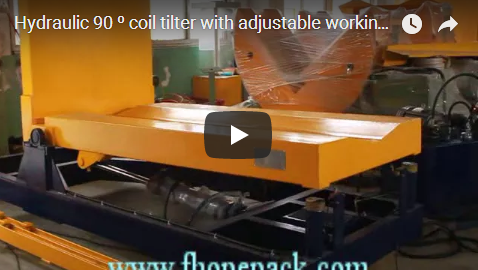
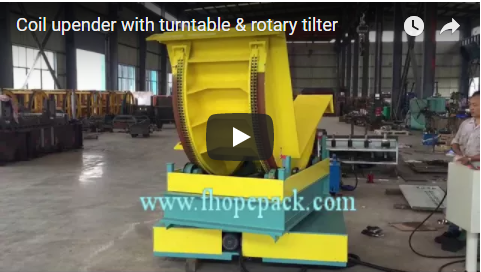
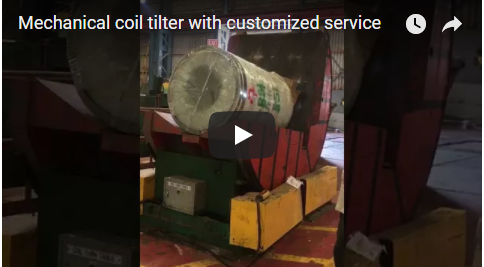
개요 Repositioning a loaded container or bulk bin by hand introduces acute lumbar injury risks, structural pallet tipping, and dropped-load hazards. An industrial automatic box tilter (or ring-type pallet inverter) secures a carton, crate, or containerized pallet onto a powered roller cradle, stabilizes the top deck with integrated hold-down tooling, and rotates the payload through a 90° to 180° guided arc. This mechanical turnover enables non-destructive bulk emptying, orientation flipping for downstream assembly, or pallet exchange without packaging failure. Drive mechanisms, clamping stroke, and rotational dynamics are engineered to match line cycle limits and payload center-of-gravity (CG) shifts.
차례
- 박스 틸터의 역할
- 덤핑 vs 재배치
- 어떻게 기울어지는지
- 핵심 구성 요소
- 적용에 따른 기울기 각도
- 무게중심이 중요합니다
- 일반적인 구성
- 영상이 보여주는 것
- 선택 체크리스트
- 제어 및 안전
- 엔지니어링 FAQ
- 다음 단계
- 관련 독서
- 출처 및 표준
박스 틸터의 역할
An automatic box tilter—operating as a heavy-duty container inverter or tipper—secures large industrial cartons, palletized crates, or raw material bins on a rigid platform and rotates the load through a controlled motion envelope. Powered roller beds and clamping platens support the payload continuously, ensuring that lateral sidewalls and fragile contents remain fully confined throughout rotation.
Depending on line configuration, the machine functions either as an orientation unit that turns loads 90° for downstream pick-and-place stations, or as a full 180° turnover unit that transfers products to sanitary cleanroom pallets, discharges bulk goods into hoppers, or reorients stacked goods for inspection.
덤핑 vs 재배치
The physical dynamics differ substantially depending on the manufacturing objective:
- Repositioning (90° Rotation): The machine rotates the container on its side to present a specific opening or face toward processing machines or manual assembly lines. Travel terminates precisely at 90° via positional limit switches or absolute encoders, prioritizing smooth deceleration and load squareness over dwell time.
- Inversion & Dumping (120° to 180° Rotation): The platform carries the load through vertical dead-center. In dumping routines, it pauses at an acute discharge angle (120°–135°) to meter out materials. In pallet inversion routines (180°), the machine executes complete top-to-bottom reorientation, requiring dual-sided clamping to prevent the container from slipping when inverted.
Speed ramp profiles, hydraulic lock valves, and dwell sequences are matched to the container structure and operational cycle.
어떻게 기울어지는지
The motion profile relies on two primary drive topologies:
| 드라이브 | Operational Character |
|---|---|
| Hydraulic Cylinder & Linkage | Delivers high break-away torque and compact lifting power inside a rigid chassis; equipped with pilot-operated check valves to prevent carriage drop in the event of pressure loss. |
| Electro-Mechanical (Gearmotor & Ring) | Utilizes a frequency-controlled (VFD) brake motor coupled with an external gear ring or roller-chain drive. Provides zero-fluid cleanroom compatibility, dynamic ramp control, and exact angular repeatability (±0.5°). |
The drive assembly rotates the load cradle either on heavy trunnion pivot bearings or across an annular ring track supported by machined alloy steel guide rollers. A programmable logic controller (PLC) coordinates variable-frequency travel, manages deceleration curves, and automatically returns the empty or flipped cradle to its baseline queue.
핵심 구성 요소
| 구성 요소 | 엔지니어링 기능 |
|---|---|
| Load Platform & Conveyor | Heavy-duty structural steel bed equipped with powered rollers (ø76–89 mm) to feed containers in and out automatically. |
| Machined Ring / Pivot Frame | Annealed structural ring or heavy pivot arm engineered to sustain eccentric overturning moments during dynamic rotation. |
| 드라이브 트레인 | High-efficiency brake motor coupled with helical-bevel reducer and spur gear pinion, or dual hydraulic displacement cylinders. |
| Clamping Subsystem | Electric leadscrew or dual hydraulic rams that lower a cushioned top platen to capture the pallet assembly securely. |
| 보안 메커니즘 | Structural side-retaining guide rollers and pressure-regulated containment walls that prevent lateral cargo shifting. |
| PLC 제어 아키텍처 | Industrial PLC (Siemens S7-1200 or Rockwell CompactLogix) managing variable speed drives, optical positioning, and safety zones. |
적용에 따른 기울기 각도
- 90° Tilt: Used to turn tall palletized boxes onto their sides for horizontal feeding, robotic destacking, or ergonomic manual picking.
- 120° to 135° Discharge: Configured with an integrated discharge chute to meter bulk components, agricultural produce, or resin pellets into processing hoppers.
- 180° 반전: Full rotation designed for switching from wooden transit pallets to plastic hygiene pallets, or repositioning stacked modules (e.g., photovoltaic cell cartons) without de-banding.
- Adjustable Hold & Dwell: Digital timer functions maintain the carriage at target angles (1–60 s) to verify material evacuation or coordinate downstream conveyor clearance.
Angular boundaries are dialed in directly via the operator HMI or commanded automatically via line sensor signals.
무게중심이 중요합니다
A machine sized purely for nominal payload weight will vibrate, stall, or induce mechanical shock if the 무게 중심 (CG) shifts during the rotational cycle.
As the box rotates past 45° and crosses the 90° vertical threshold, the gravitational vector transitions from an opposing load into an overrunning load. If drive backlash or hydraulic damping is inadequately calculated, this CG shift causes mechanical surge, inducing shock loading on internal goods and gear teeth.
Overturning Torque (T_rot) = Payload Mass (m) × g × Lateral CG Offset (r_cg)Operators must ensure incoming containers are centered along the conveyor centerline. Off-center placement alters the calibrated rotational moment, triggering drive overcurrent alarms or excessive cradle twist.
일반적인 구성
The following parameters represent standard engineering baselines for inline ring-type box inverters and tilters:
| 매개 변수 | 엔지니어링 기준선 | Custom Project Envelopes |
|---|---|---|
| 유효 탑재량 | 1,500kg – 2,500kg | Up to 5,000 kg for high-density heavy metallurgy |
| 회전 각도 범위 | 90° or 180° continuous | 0° to 180° programmable at any intermediate angle |
| 사이클 속도 | 35 – 55 seconds (for full 180° cycle) | Adjustable via inverter drive from 0.5 to 2.5 RPM |
| Usable Platform Size | 1,400 mm (W) × 1,300 mm (L) | Custom widths up to 2,400 mm for dual pallets |
| Clamping Daylight | 800 mm minimum to 2,000 mm max | Sized to carton profile variations |
| 드라이브 모터 전력 | 4.0 kW – 7.5 kW with electro-mechanical brake | Dual hydraulic power units (7.5 kW, 16 MPa) |
| Line Conveyor Elevation | 450 mm – 650 mm top of roller | Matched to existing customer conveyor datum |
| 전기 공급 | 380–480 V, 3-Phase, 50/60 Hz | 208–240 V, 3-Phase available per facility specs |
영상이 보여주는 것
The engineering demonstration displays a heavy-duty orbital ring inverter processing oversized, pallet-mounted photovoltaic cartons:
- Powered Roller Infeed: The palletized carton travels along the powered infeed roller bed and docks inside the rotating barrel assembly.
- Overhead Clamping Engagement: The top containment carriage descends, applying uniform clamping pressure against the pallet structure to secure internal modules against shifting.
- Controlled 180° Roll-Over: The external ring gear rotates within heavy-duty trunnion wheels, completing a steady 180° inversion under continuous VFD speed control.
- Reverse Discharge: The inverted load transfers out seamlessly along the downstream exit conveyor, demonstrating dynamic load containment without box deformities.
선택 체크리스트
Confirm the following core design inputs before finalizing machine frame and drive dimensions:
| 치수/매개변수 | Required Machine Metric | 디자인 임팩트 |
|---|---|---|
| 최대 총 중량 | Total weight (carton + contents + pallet) | Sizes frame beam sections, bearings, and motor torque |
| Container Dimensions (W×L×H) | Footprint and maximum/minimum height | Dictates ring inner diameter and clamping stroke |
| 컨테이너 구조적 무결성 | Corrugated box, solid crate, or steel bin | Determines whether platen needs full-face rubber padding |
| Process Motion Profile | 90° side tip vs. 180° full inversion | Selects between crank arm tilt vs. continuous ring frame |
| Cycle Rate Requirement | Units per hour (UPH) | Defines roller conveyor line speed and inverter acceleration |
| 인터페이스 요구 사항 | Standalone station vs. automated conveyor integration | Determines PLC I/O architecture (EtherNet/IP, PROFINET) |
제어 및 안전
Rotating heavy containers creates dynamic pinch points and shifting mass risks that require dual-channel safety compliance:
- Perimeter Safety Enclosure: Physical steel-mesh safety fencing (2,000 mm height) isolated by interlocked safety gates preventing operator access during active cycles.
- Optical Safety Curtains: Category 4 / PLe light curtains positioned across the conveyor infeed and outfeed openings, configured with pallet muting profiles.
- 드라이브 중복성: Spring-set mechanical motor brakes coupled with counter-holding balancing valves prevent carriage descent during electrical outages or emergency stops.
- Emergency Stop Loop: Dual-channel E-stop buttons located at the main HMI panel and at remote entry points conforming to ISO 13850.
- Preventive Maintenance Routine: Weekly inspections must verify roller guide clearance, chain/gear tooth backlash, brake shoe wear, and torque retention on pivot anchors.
엔지니어링 FAQ
Q: Can one machine execute both 90° repositioning and 180° inversion? A: Yes. Inverters fitted with programmable VFD controls and multi-position rotary encoders can store multi-recipe routines, alternating between a 90° presentation stop and a 180° turnover at the push of an HMI button.
Q: How does the machine prevent crushing delicate corrugated cartons during clamping? A: Clamping platens utilize torque-limiting servo drives or proportional hydraulic pressure sensors with adjustable limit settings. This ensures the platen applies adequate holding friction without exceeding the box’s edge-crush test (ECT) limits.
Q: Which drive mechanism is better: hydraulic or electro-mechanical ring? A: Electro-mechanical ring designs are preferred for continuous inline packaging systems because they offer high positional accuracy, operate cleanly without hydraulic fluids, and minimize maintenance. Hydraulic drives remain optimal for extreme compact loads (over 5,000 kg) requiring very high holding forces in dirty foundry environments.
Q: Can the inverter integrate directly into an existing SCADA or ERP system? A: Yes. Our control panels are standardly supplied with Siemens or Allen-Bradley PLCs, utilizing industrial Ethernet protocols (PROFINET, EtherNet/IP, Modbus TCP) to exchange line-ready signals, fault codes, and cycle counts.
Q: What floor anchoring is required for installation? A: Standard installations require a reinforced, non-shrink concrete floor pad (minimum 200 mm depth, 25–30 MPa compressive rating) secured with chemical wedge anchor bolts to absorb dynamic rotational forces.
다음 단계
- Send Container Parameters: Forward your payload dimensions (L × W × H), maximum gross weight, and container drawings to info@fhopepack.com.
- Receive Engineering Review: Our technical team will generate a preliminary equipment sizing model, dimensional layout drawings, and cycle-time calculations within 48 hours.
- Validate Integration: Coordinate a technical conference or site survey with our engineers to align conveyor deck heights, PLC interfaces, and safety zone requirements.
관련 독서
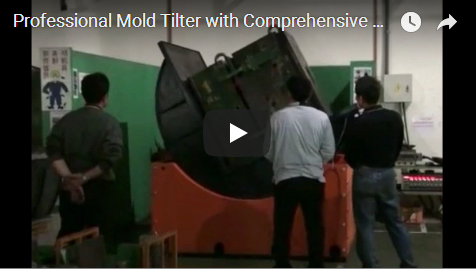
- 포괄적인 기술 지원을 제공하는 전문 금형 틸터
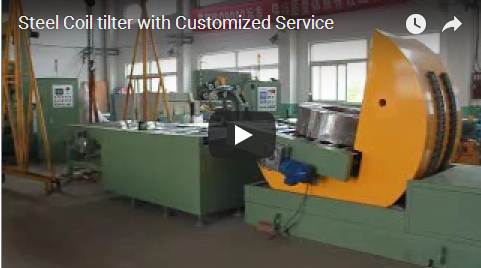
- Steel Coil Tilter and Upender Solutions
- Industrial Coil Tilter & Upender Application Guide
- FHOPE Packaging Machinery Complete Product Lines
출처 및 표준
- ISO 12100:2010 — Safety of Machinery: General Principles for Design, Risk Assessment and Risk Reduction
- EN 415-10:2014 — Safety of Packaging Machines: General Requirements
- EN ISO 13849-1:2023 — Safety of Machinery: Safety-Related Parts of Control Systems
- ISO 13850:2015 — Safety of Machinery: Emergency Stop Function — Principles for Design
최종 검토일: 2026년 10월 10일