**エグゼクティブサマリー**
>
> Testing for checking the time of the 3 straps per coil is how we prove a strapping cell before shipment. We time the whole cycle, not just one strap: pick-up, positioning, three ties and release. Our film strapping head takes 8–10 s per strap, so three straps at one station take 24–30 s, while three stations working at once finish in about one strap time.
目次
- Why we time 3 straps per coil
- The tying cell under test
- How we run the timing test
- The cycle time formula
- Worked example: one station or three
- Coil range for small coil tying
- 選択チェックリスト
- 安全性:EN 415-10およびISO 12100
- エンジニアリングに関するよくある質問
- 次のステップ
- 関連する読書
- ソース
Why we time 3 straps per coil
Three straps per coil is a common spec for small coils. The straps hold the coil round and keep the turns from springing out until the coil is wrapped or boxed. One strap across the coil holds it in place; three, spaced round the ring, keep its shape.
The number of straps sets the line speed. Each extra strap adds time at a single station, so before a line is built we measure the real cycle with your strap count.
The tying cell under test
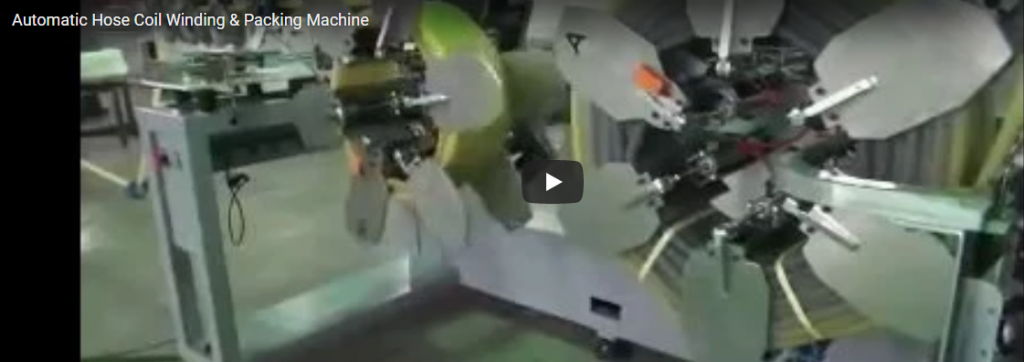
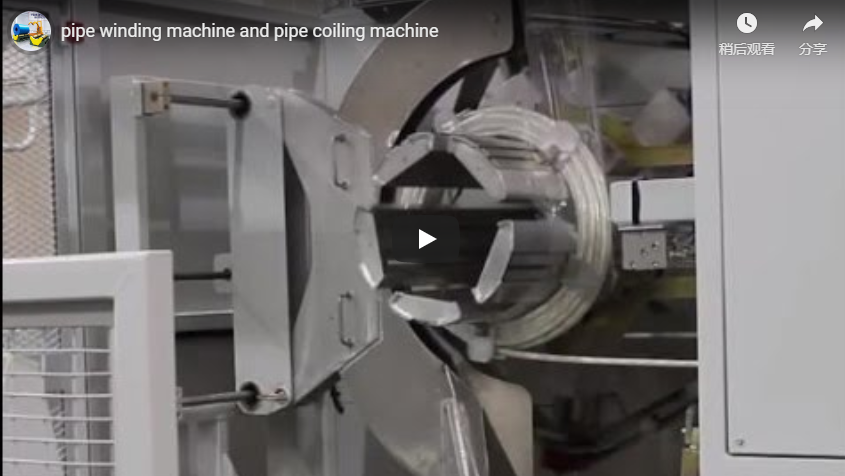
The cell is a white frame with a group of radial grippers in the centre. The arms pick the coil up, rotate it, line it up and press it down at the tying point. An orange tying unit sits behind a yellow mesh guard. The operator sets and starts the test from a touch screen and push buttons outside the guard, and the doors are interlocked so the cell runs only when they are closed.
How we run the timing test
1. **Set the recipe** on the touch screen: coil size, strap count and strap positions.
2. **Run a batch** of coils in automatic mode, not single steps.
3. **Time from release to release**, so pick-up, indexing and transfer are counted.
4. **Repeat** with the strap count changed, to see what each strap costs.
5. **Record** the average and the slowest cycle.
The cycle time formula
For one tying station:
**T = t_pick + n × t_strap + (n − 1) × t_index + t_release**
where n is the number of straps, t_strap is the time for one strap and t_index the time to turn the coil to the next strap position. There are n − 1 index moves, because the coil does not turn after the last strap.
With n stations working at once:
**T = t_pick + t_strap + t_release**
The cell times t_pick, t_index and t_release depend on the coil and the layout, and we measure them in the test above.
Worked example: one station or three
Our film band strapping head takes 8–10 s per strap. This is film band tying for small coils, not heavy PET or steel strapping. For 3 straps:
| Layout | Strap time | Straps in sequence | Tying time |
| :--- | :--- | :--- | :--- |
| 1 station | 8–10 s | 3 | 3 × (8–10) = 24–30 s, plus 2 × t_index |
| 3 stations | 8–10 s | 1 (all at once) | 8–10 s |
**Result.** Three stations cut the tying time by about two thirds and remove the indexing between straps. At 24–30 s, one station allows 3600 ÷ 30 = 120 to 3600 ÷ 24 = 150 coils per hour, and three stations 360–450. These are tying-head limits only. The net line rate is lower once t_pick, t_index and t_release are added, which is why the test times the full cycle. If your coiler makes more coils per hour than one station can tie, we fit two or three stations.
Coil range for small coil tying
From our automatic cable coiling and tying machine page, the non-spindle coil range is:
| Item | Range |
| :--- | :--- |
| コイル内径 | 120~200 mm |
コイル外径 | 200~450 mm |
| Coil height | 50–200 mm |
| Coil weight | ≤5 kg |
Larger coils go to our coil strapping machines; the strap count and timing are tested the same way.
選択チェックリスト
1. Coil ID, OD, height and weight.
2. Straps per coil and their positions.
3. Strap material: film band, or PP strap. Where PP strap is used we commonly specify 10 × 0.8 mm or 15 × 0.6 mm.
4. Coils per hour from your coiler.
5. What follows: wrapping, boxing or stacking.
6. Space for one, two or three stations.
安全性:EN 415-10およびISO 12100
The tying cell is designed to EN 415-10, and its risk assessment follows ISO 12100. The radial grippers and the tying unit are inside the mesh guard. The doors are interlocked, so opening one stops the cell, and the screen and buttons stay outside. Jams are cleared with the cell stopped and the door open. If the tied coil goes on to a film wrapper, that station is also covered by EN 415-10.
エンジニアリングに関するよくある質問
Q: Why not just time one strap and multiply by three?
A: Because pick-up, indexing and release add time too. We time the full cycle so the line figure is real.
Q: Can we change from 3 straps to 2?
A: Yes, the strap count and positions are set in the recipe. We test both counts if you need both.
Q: When do we add a second or third station?
A: When the coiler output is higher than one station can tie in sequence.
質問:どの規格が適用されますか?
A: EN 415-10 for the machine design, with an ISO 12100 risk assessment for CE.
次のステップ
1. **Send coil size, strap count and coils per hour** to info@fhopepack.com.
2. **We work out** one, two or three stations.
3. **24時間以内にレイアウトと見積もりをお送りします。**
関連する読書
- [Automatic cable coiling and tying machine (product)](https://www.fhopepack.com/cable-winder/Automatic-cable-coiling-and-tying.html)
- [Cable coil packing machine and wire packing machine](https://www.fhopepack.com/videos/cable-coil-packing-machine-and-wire-packing-machine/)
- [Wire and cable rewinding and strapping machine: 24-hour continuous running](https://www.fhopepack.com/videos/wire-cable-rewinding-strapping-machine-real-24-hour-continuous-running/)
- [Double wall hose coiling and strapping machine](https://www.fhopepack.com/videos/double-wall-hose-coiling-and-strapping-machine/)
ソース
- FHOPE automatic cable coiling and tying machine product page
- FHOPE project notes on strapping time per strap
- Our tying cell test shown above
- Worked example: formula and illustrative figures
- 規格: EN 415-10; ISO 12100:2010
最終更新日: 2026年10月18日