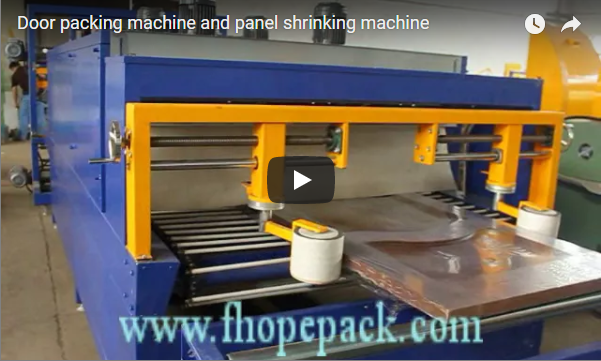
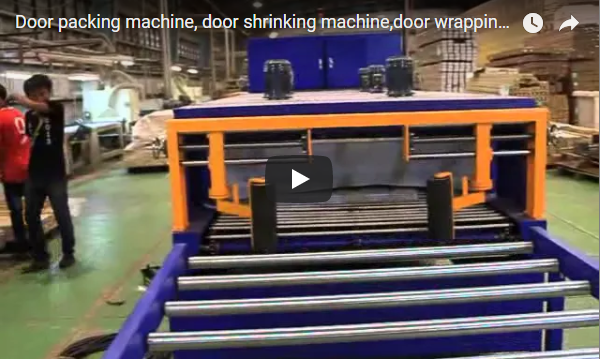
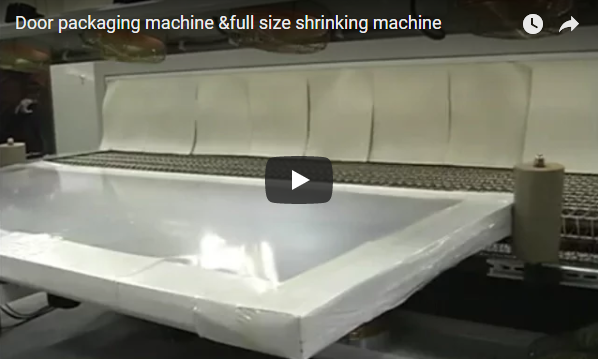
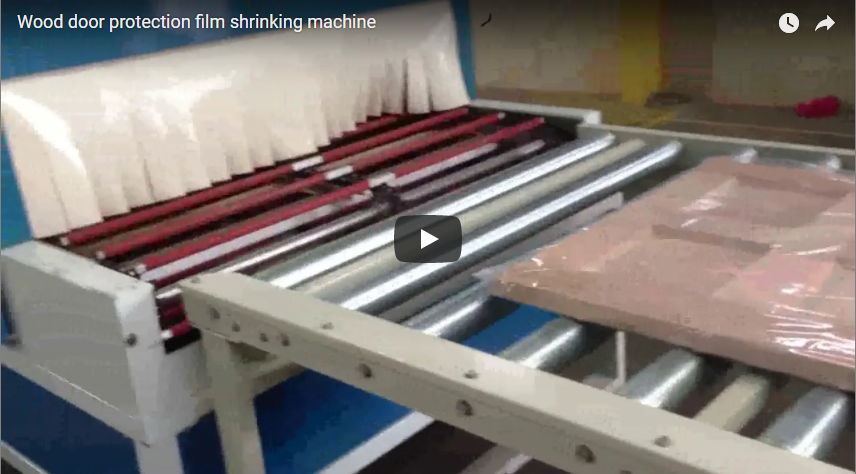
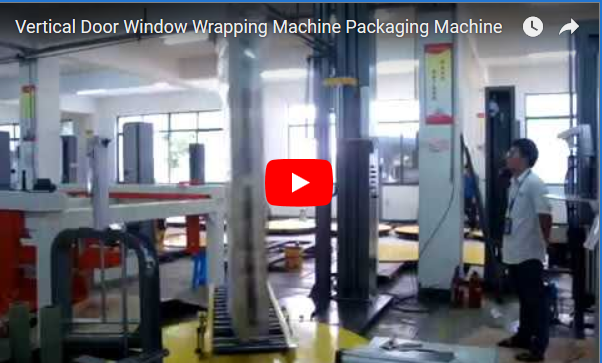
Sintesi This video shows a door shrinking machine processing stacked wood-based door panels on a conveyor line. The footage covers manual loading, automatic infeed, a heated pressing/shrinking section, and roller-based output. Panels emerge flatter and with neater edges. No specifications, temperatures, or cycle times are visible — this article separates what is seen from what must be confirmed with the manufacturer.
Why door shrinking matters in panel and door production
Wood-based panels — door cores, plywood blanks, MDF boards, and composite door leaves — move with changes in humidity. As moisture content shifts between the workshop, the finishing area, and the final installation site, panels can warp, bow, or open at the glue joints. A shrinking machine addresses this by passing each panel through a heated and pressed zone, stabilizing the board before it moves on to laminating, edge banding, or assembly.
The video on this page shows exactly that kind of process. It is a short, silent walkthrough of a production line: boards go in at one end, pass under a heated roller assembly, and come out the other side. There is no narration and no on-screen text, so this article is built entirely on what the camera captures — and it clearly marks what the footage cannot tell you.
If you are evaluating this class of equipment, the practical questions are: How does it feed? What does the operator do? What safety features are (or are not) visible? And what must you verify before buying? The sections below answer those questions from the footage first, and flag everything else as a “confirm with the manufacturer” item.
Cosa mostra il video
The footage runs for roughly 100 seconds and is built from two camera angles of the same line. Here is the sequence, with time references:
| Ora | Che succede |
|---|---|
| ≈0–12s | Empty green belt conveyor; multi-layer roller/press structure in the background; an operator appears with a stack of boards |
| ≈20–24s | Two workers place a stack of light-colored wooden panels onto the infeed end of the belt |
| ≈28–32s | Boards travel right on the conveyor into the main machine frame |
| 36s | Close-up of the control panel: color touchscreen, multiple buttons (red/yellow/black), illuminated red indicator lights, grey-white metal housing |
| ≈40–44s | Panels enter the heated/pressing zone; a transparent plastic film on the surface softens and begins to shrink under heat and pressure |
| ≈48–56s | Processed panels exit to the roller conveyor section; red heating rollers and silver cooling/transport rollers alternate, forming a hot-to-cold transition |
| ≈60–72s | Second angle: idle red roller section, then a stack of boards enters the red roller area |
| ≈76–88s | Boards travel through the red roller zone under heat/pressure; slight edge curling is visible early, then reduces |
| ≈92–100s | Boards exit into the silver roller section; the previous panel is visible waiting in the output/stacking area |
The workpieces are rectangular wood-based panels — door core stock or plywood-type blanks — roughly 1.2–1.5 m long and 0.8–1.0 m wide based on comparison with the operators, and around 12–20 mm thick. They are fed in stacks of several sheets, always face up, and always travel in the same orientation. No flipping or rotation occurs at any point.
La macchina in azione: passo dopo passo
Step 1 — Manual loading. Workers place the stack of panels at the infeed end and align it by hand. This is the one clearly manual step in the cycle. Alignment quality at this stage determines how straight the panel travels through the pressing zone.
Step 2 — Automatic infeed. The green belt conveyor carries the boards forward at a steady pace. From this point on, the video shows no human intervention — the line runs the panels through the machine without further handling.
Step 3 — Heat and press. In the middle section, the panel passes beneath a top pressing roller and through the heated area. The transparent film on the board surface visibly reacts to the heat — softening, wrinkling slightly, and conforming to the panel. This combined film-and-press action appears to serve both surface protection and dimensional stabilization in one pass.
Step 4 — Cooling and output. The panel then moves onto the roller conveyor, where red rollers (consistent with heating elements, though not confirmed) transition to silver rollers for cooling and transport. By the time the panel reaches the output end, its edges are visibly straighter and its flatness improved compared with the entry shots.
The overall flow reads as semi-automatic continuous operation: manual loading at the front, machine-driven transport, heating, pressing, cooling, and discharge — with finished panels collecting in a stacking zone at the far end.
Control panel and visible controls
One segment of the video (around the 36-second mark) shows the operator control station in close-up:
- Un embedded touchscreen a colori with a graphical interface — the specific values and parameters on screen are not readable in the footage.
- È consigliata una distanza di almeno four physical buttons, including a yellow start/stop button, a red emergency-stop mushroom button, and black function buttons.
- Red LED indicator lights at the bottom of the panel, lit during operation.
- A etichetta di avvertimento triangolare gialla on the side of the panel housing — the text itself is not readable.
The panel sits low on the machine, at a height suited to a standing operator. Whether the touchscreen offers recipe storage, temperature zoning, or fault diagnostics cannot be determined from the video — treat all of those as questions for the supplier.
Note di osservazione diretta
The following block stays close to the vision-analysis report, with only grammar-level edits:
- The machine frame is a light grey/off-white painted metal structure with adjustable feet at the columns; blue and red accent parts appear in places.
- The front section uses a green rubber/polyurethane belt conveyor with a tensioning device; a white motor drive unit is visible at the left end.
- The mid-section contains a multi-layer roller/press mechanism with transparent protective covers, a top press roller (black with red clamps), and a central heating/pressing assembly.
- The rear section is a roller conveyor system with red heating rollers (smooth surface) alternating with silver/galvanized rollers for cooling and transport.
- The control cabinet is a freestanding vertical unit with an embedded color touchscreen, multiple function buttons, and status indicator lights.
- A red mushroom-head emergency stop button is clearly visible at the lower right of the control panel.
- The heating/pressing zone and roller zone have fixed transparent acrylic/glass guards; no physical fence surrounds the whole machine.
- No light curtains, safety-door interlocks, or safety switches are observed in the footage.
- No readable text, nameplate, model number, brand marking, or watermark appears anywhere in the video.
- Workpieces are rectangular wood panels, face-up throughout, with no rotation or flipping; edges show slight curl during heating and are straighter at output.
- No dimension changes are measured on camera; the “shrinking” effect is judged visually from surface and edge appearance only.
Ciò che il video non mostra
This is where buyer diligence matters most. The footage does non è un mostrare:
- Potenza nominale (kW), tensione e frequenza
- Maximum and minimum panel dimensions and thickness range
- Heating temperature setpoints, pressure values, or temperature zones
- Cycle time per panel or hourly throughput
- Dimensioni e peso complessivi della macchina
- Whether the control system is PLC-based, and what HMI functions are available
- Safety certifications (CE, UL, CCC, or others)
- Whether the red rollers are actual heating elements or heated-zone supports
- Dust extraction or exhaust configuration
- Warranty terms, spare parts, and after-sales support arrangements
- Any model name or manufacturer marking
None of these can be inferred responsibly from the footage. If any of them affect your purchase decision — and for most industrial buyers, power supply, panel size range, and throughput do — request written specifications before comparing quotes.
Dove si inserisce questa macchina: applicazioni tipiche
Based on the workpiece type visible in the video, the most plausible applications are:
- Interior door manufacturing — stabilizing door core panels or door leaves before lamination or painting
- Plywood and composite panel processing — reducing warpage between pressing and finishing
- Custom cabinet and wardrobe door production — keeping panel flatness consistent across batches
- Surface-film work — the on-camera film softening suggests the line can combine protective film application with the shrink/press pass
The line is suited to flat rectangular panels. Shaped or routed door faces would need a customized adaptation — ask the manufacturer whether such variants exist.
Honest limitations seen in the footage
A fair evaluation includes the drawbacks visible on camera:
- Manual loading and alignment — there is no powered stacker or auto-aligning infeed in view, so feeding quality depends on operator discipline.
- No observed safety interlocks — the guards over the hot zones are fixed covers; no light curtain or door switch is visible. Whether interlocks are available as an option is a key question.
- Flat panels only — the roller and press geometry limits the line to flat workpieces.
- No measured results — the video shows improved flatness visually but never quantifies the shrink ratio, dimensional change, or rejection-rate improvement.
Lista di controllo per la verifica pre-acquisto
Utilizza questo elenco quando contatti un fornitore:
- Panel size range (length × width × thickness) the machine accepts
- Whether heating is zoned and independently temperature-controlled
- Confirmation of what the red roller section does (heating element vs. press support)
- Cycle time per panel and realistic hourly output for your panel mix
- Power supply requirements (kW, V, Hz) and installation footprint
- Available safety options: interlocked guards, light curtains, emergency-stop coverage
- Belt and roller material temperature ratings
- PLC/HMI capabilities: recipes, alarms, remote diagnostics
- Documentazione CE o altra documentazione di certificazione
- Warranty, commissioning, training, and spare-parts support in your region
FAQ
What is a door shrinking machine used for? It stabilizes wood-based door panels by passing them through a heated, pressed zone — reducing warpage and edge irregularities caused by moisture movement. In the video, panels also carry a surface film that softens and conforms during the heated pass.
La macchina è completamente automatica? No. The footage shows manual loading by two workers; transport, heating, pressing, and output are machine-driven. It is best described as semi-automatic continuous operation.
Does it handle only one panel size? The video shows one panel format only. Whether roller spacing or guides can be adjusted for different sizes is a spec question — check with the manufacturer.
Che caratteristiche di sicurezza ha? A red emergency-stop button and fixed transparent guards over the hot zones are visible. No light curtain or interlocked safety door appears in the footage, so confirm available safety options with the supplier.
How much does it shrink the panels, and what temperatures does it run at? The video never shows temperature settings, pressure values, or measured dimensional change. These figures must be requested from the manufacturer for your specific panel material and thickness.
Can it process curved or routed door faces? Based on the flat roller geometry seen in the video, no. Special-shaped doors would require a custom configuration — ask before ordering.
Fonte e metodo
The factual basis for this article is the embedded video alone. It was analyzed frame-by-frame using a vision model on sampled stills; the video contains background music only, with no narration or speech, so no audio transcription was used. All statements in “What the video shows” and “Direct observation notes” come directly from what is visible; anything not visible is explicitly marked as requiring manufacturer confirmation.
Lettura correlata
- Panoramica della macchina per il restringimento
- Macchina avvolgitrice
- Avvolgitrice semiautomatica per pallet
- Avvolgipallet automatico
- Avvolgitrice a braccio rotante
Passo successivo
If this semi-automatic door shrinking line matches your panel production needs, the fastest way to get answers is direct: request the full specification sheet, panel-size range, heating configuration, and a quotation for your workshop layout. Visit our qui to send your panel dimensions, material, and target output — and get the confirmed figures the video cannot show you.
Pubblicato: 03/09/2026