Ringkasan
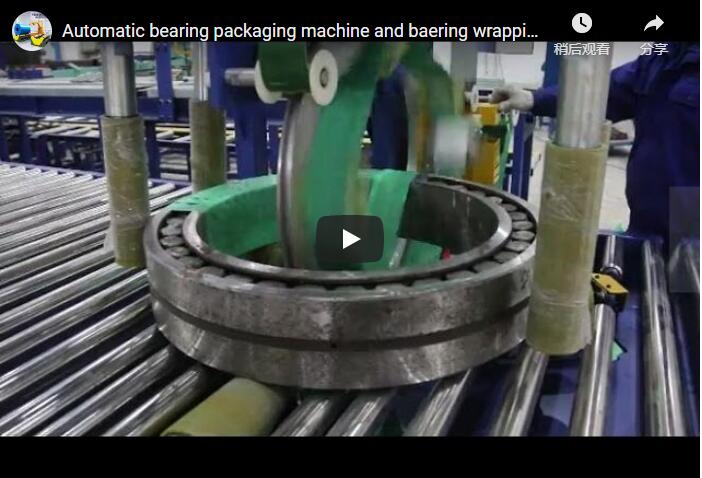
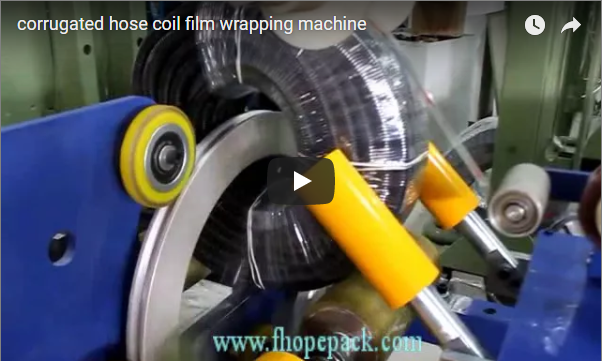
A bearing wrapping machine seals a bearing ring in film so the finished surface stays clean and rust-protected through storage, handling and transit. In ring-type wrapping, a rotating ring carries the film roll through the bearing bore while support rollers slowly turn the bearing, so the whole section — inner and outer faces and the bore — is covered in one pass. In the footage the operator feeds bearing rings by hand and the machine completes the cycle automatically. This page is for bearing plants and logistics teams that pack bearings before dispatch; it explains how to select a model by ring (bore) size, wrap time and throughput.
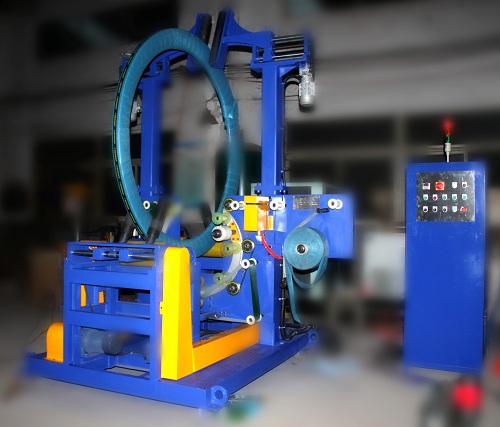
How the Ring Wraps a Bearing Cross-Section
The station is built around a ring that travels through the bore of the bearing. In the demonstration, the operator places the ring on support rollers by hand, starts the cycle at the control panel, and a press-down device holds the bearing while the wrapping ring turns. As the ring passes through the bore, the support rollers rotate the bearing so film advances around the circumference, one film width per pass. Coverage — the overlap between passes — is set in the program, and an automatic cut finishes the wrap. Manual feed suits smaller runs; for higher throughput the models connect to conveyor-based infeed and outfeed.
| Cycle stage | Apa yang terjadi |
|---|---|
| Beban | Operator places the bearing on the support rollers, or it arrives by conveyor |
| Memegang | Press-down device steadies the bearing while the ring turns |
| Bungkus | Ring passes through the bore as rollers rotate the bearing; film covers the section |
| Memotong | Automatic cutter ends the wrap at the programmed coverage |
| Membongkar | Wrapped bearing is released and removed, or carried out by conveyor |
Bearing Wrapping Machine Model Ranges
The models differ above all by the bore (the ring size actually passed), the section size and the weight. Figures are from the current model data sheets; confirm in the proposal.
| Pilih Model | ID Bantalan | Diameter Luar Bantalan | Section (OD − ID) | Berat | Kecepatan dering | Waktu penyelesaian |
|---|---|---|---|---|---|---|
| FPBS-200 | 120 – 270 mm | - | <190 mm | 5–70 kg | maksimal 100 r/min | 20-35 dtk |
| FPB-300 | 300 – 900 mm | 600 – 1200 mm | - | 10–500 kg | 30–70 putaran/menit | 40-50 dtk |
| FPB-400 | 300 – 800 mm | 500 – 1200 mm | - | 100–500 kg | 30–70 putaran/menit | 30-50 dtk |
ID and OD are separate ranges, not paired values; on the FPBS-200 the section OD − ID must stay below 190 mm. Larger slewing, wind and supporting bearings move to the big-size machine, which wraps large bearing packages in one pass with several material layers; the specific package OD/ID coverage and weight ceiling for that size class are confirmed in the proposal rather than fixed here.
Selection: Ring Size First, Then Wrap Time
The bore is the first value to check: the ring must pass through it, so a candidate model has to accept the smallest bearing ID in your range. After that, confirm the section (OD − ID) and the weight, then match wrap time to throughput. Wrap time is tied to ring speed and to the chosen coverage; the figures above are the stated wrap times at the listed ring speeds. Because the bore circumference is shorter than the outer circumference, coverage set at the OD gives more overlap at the bore — a bearing that looks lightly covered outside is heavily covered at the bore.
Operation, Controls and Safety
The machines use PLC and HMI control with manual and automatic modes. Ring and roller speeds are set through frequency converters, and the FPB-400 stores up to six programs selected on the keypad. Sensors detect position for automatic start and stop; the FPB-300 and FPB-400 can connect to a production line with infeed and outfeed conveyors. The rotating ring and support rollers are the main hazards; guarding, a foot-switch jog and soft start and stop are typical on the compact model. For CE markets, a risk assessment to ISO 12100 and the general packaging-machine requirements of EN 415-10 are typically referenced. As a stated manufacturer practice for this machinery family, each unit goes through sustained functional and safety testing before delivery (about 24 hours where stated), including the control system and the emergency-stop function.
FAQ (Pertanyaan Umum)
Q: What is the smallest bore the machines can wrap?
A: The FPBS-200 starts at bearing ID 120 mm, with the section OD − ID below 190 mm and 5–70 kg. Because the ring must pass through the bore, ID is the first value to check.
Q: How long does it take to wrap one bearing?
A: The stated wrap times are 20–35 s on the FPBS-200, 40–50 s on the FPB-300 and 30–50 s on the FPB-400; the big-size machine runs about 60–110 s per coil with three layers in one pass.
Q: Which model suits an 800 mm OD bearing of 300 kg?
A: Check the bore first: both the FPB-300 (ID 300–900 mm) and the FPB-400 (ID 300–800 mm) cover this size and weight; choose the FPB-400 where the width exceeds about 300 mm.
Q: Can VCI film and stretch film be applied together?
A: Yes. The big-size machine applies VCI film with stretch film in one pass; on the standard models the setup depends on the bore and is confirmed per project.
Q: How is wrap time matched to throughput?
A: State your bearings per hour and section range; FHOPE matches the model, ring speed and coverage and returns the wrap-time check in the proposal.
Langkah Selanjutnya
- Email info@fhopepack.com a layout drawing with your bearing ID, OD, width, weight, bearings per hour and packing material.
- Ask FHOPE for a proposal with the model, ring size, material setup and a wrap-time check; lead time depends on the scope you define.
- Book a site survey to place the station or connect it to the bearing line.
- Automatic Bearing Packing Machine for Big Bearings — ring wrapping and sizing applied to large bearings.
- Mesin Pembungkus Orbital Horizontal untuk Papan Sirkuit — the ring wrapping method applied to other long or bulky products.