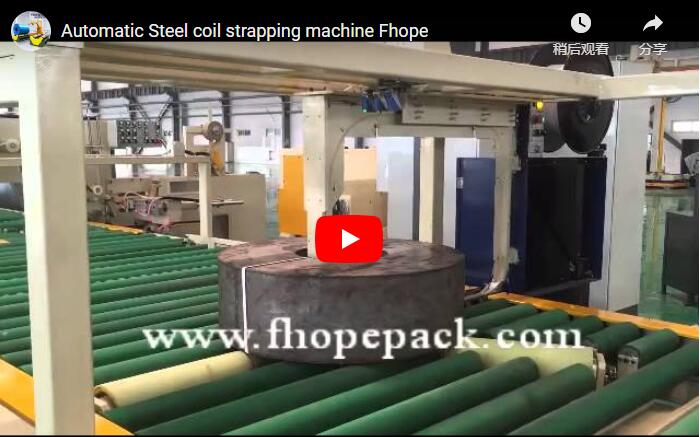
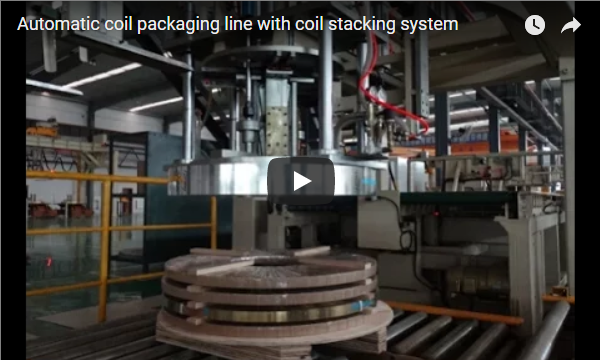
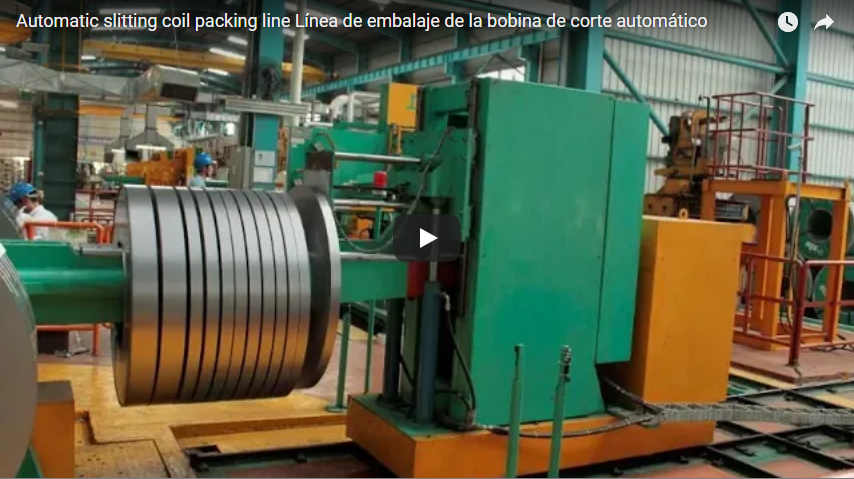
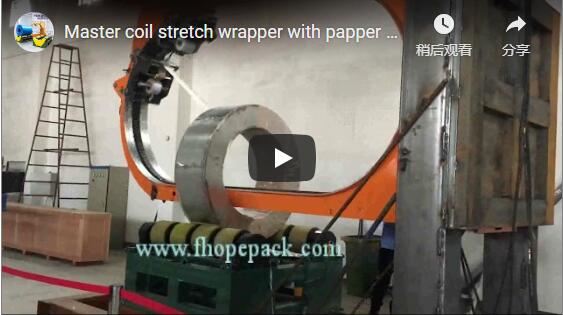
Bare coils straight from a slitter recoiler or rolling mill face constant transit hazards on the plant floor. Manual crane hooks, chains, and hand wrapping often cause dented edges, torn packaging layers, and loose strapping. Inconsistent manual wrapping tension also lets moisture penetrate between wraps during outside storage. When transferring heavy slit coils by hand or forklift, operators face real pinch hazards, while the packaging line runs unevenly because individual manual packing tasks cannot keep up with high mill output.
An automated coil packaging line receives bare coils directly from a slitter, crane, or coil car, then wraps, straps, and discharges them ready for shipment without manual handling. The complete system uses an eye-through wrapper, motorized transfer tables, and an indexing strapping station. Required strap consumption follows your exact coil geometry and strapping layout.
I have worked on heavy coil packaging equipment for over 15 years, and layout planning always starts by sizing stations to match your slowest operational cycle. When we synchronize each step, coils move smoothly without bottleneck delays or surface damage.
Table des Matières
- What stations make up an automated coil packaging line?
- How much strap does one coil take?
- How do you plan the layout before the line is built?
- What controls and guarding does the line use?
- What should you confirm before ordering the line?
- What else do coil packers ask?
- Suivant
- Lecture connexe
- Références
What stations make up an automated coil packaging line?
An automated coil packaging line integrates five mechanical stations: a loading station, an orbital eye-through wrapper, inter-station transfer or turning units, a radial and circumferential strapping station, and an automated discharge station. Coils transfer automatically across motorized rollers or coil cars, so operators never lift, push, or rotate coils by hand.
Chaque séquence de transfert est verrouillée et automatisée. La bobine n'est jamais soulevée, poussée ou tournée manuellement entre son entrée et son expédition, ce qui élimine tout risque de dommages mécaniques et de fatigue au travail. Grâce au fonctionnement synchrone de chaque module, le débit de la ligne entière est aligné sur celui de son poste le plus lent.
| Station | Ce qu'il fait |
|---|---|
| chargement | Récupère la bobine nue depuis la grue ou le chariot porte-bobines. |
| Enveloppe transparente | Recouvre la bobine à travers l'œillet et par-dessus le mur |
| Manœuvres et virages | Déplace ou fait tourner la bobine entre les stations |
| Costaud | Ajoute des bandes radiales et circonférentielles |
| Décharge | Remet la bobine à l'empilage ou à l'expédition |
Chaque station transmet automatiquement la bobine à la suivante, de sorte que la ligne fonctionne au rythme de sa station la plus lente.
Core handling and wrapping machinery
Dans notre intégration standard, le noyau mécanique comprend un basculeur mécanique, une station de transport de bobines indexée et un système d'emballage orbital entraîné par des motoréducteurs SEW Eurodrive. La station d'emballage accepte différents matériaux d'emballage, tels que du papier crêpe enduit de PE, du film étirable ou du ruban PP tissé (avec des rouleaux de diamètre intérieur 50 mm, de diamètre extérieur 200 à 500 mm et de largeur 100 mm), afin de protéger les bobines contre la corrosion, la condensation et les frottements durant le transport.
Technical parameters and line envelopes
Depending on line configuration, the packaging stations handle coil weights from 100 kg to 2,500 kg in standard horizontal formats, or 150 kg up to 6,500 kg on vertical packaging systems (with heavy-duty configurations accommodating 4,000 kg to 11,000 kg) [manufacturer rating].
The eye-through wrapping station supports slitted coils with widths of 20–500 mm, outside diameters of Ø800–1,400 mm, and eye inside diameters of Ø508–610 mm [manufacturer rating]. Conveyor roller speed is maintained at 12 m/min, while the rotating ring delivers 8–80 r/min variable speed, completing an eye-through wrap in 40–70 sec/pcs [manufacturer rating]. For integrated mill systems utilizing automated turnstiles, walking beams, and coil cars, throughput achieves up to 60 coils per hour [manufacturer rating].
These envelope ratings vary with specific slit dimensions and selected options, so your plant layout must confirm actual package profiles before construction.
How much strap does one coil take?
Strap consumption per coil depends directly on the core inner diameter, outside diameter, coil face width, and total band count. An illustrative 1,500 mm OD, 508 mm ID, 1,200 mm wide steel coil bound with four radial and two circumferential bands requires approximately 23 meters of strapping before adding seal overlap.
La quantité de sangle nécessaire est calculée directement à partir de la géométrie de la bobine et du schéma de ligature spécifié. Voici un exemple détaillé pour une bobine de 1 500 mm de diamètre extérieur, 508 mm de diamètre intérieur et 1 200 mm de largeur, configurée avec 4 bandes radiales et 2 bandes circonférentielles :
| Produit | Valeur |
|---|---|
| Mur, (1 800 − 508) ÷ 2 | 496 mm |
| Bande radiale, 2 × (1 200 + 496) | 3,392 mm |
| Bandes radiales, 4 × 3.39 m | à propos de 13.6 m |
| Bande circonférentielle, π × 1 500 | À propos de 4,712 mm |
| Bandes circonférentielles, 2 × 4.71 m | à propos de 9.4 m |
| Sangle par spire, avant chevauchement du joint | à propos de 23 m |
Ajoutez le chevauchement du joint à chaque bande lors de votre commande de sangle ; la marge de jointure exacte dépend de la tête de cerclage et du type de sangle, et est confirmée par le plan de sangle.
To budget strapping material accurately across annual production runs, follow two basic layout rules:
- Calculate radial bands based on the cross-section perimeter passing through the center eye.
- Calculate circumferential bands using the outer circumference of the outer diameter.
How do you plan the layout before the line is built?
Layout planning balances coil arrival methods, wrapping materials, strap counts, dispatch orientations, and line cycle times in a 3D digital model before laying foundation steel. This layout stage proves clearances for factory cranes, coil storage racks, and conveyor pathways to prevent plant bottlenecks.
| Questionne toi | Pourquoi cela compte |
|---|---|
| Comment arrivent les bobines | Configure le poste de chargement : grue, chariot porte-bobines ou convoyeur |
| matériau d'emballage | Papier, film ou les deux sur l'emballage |
| Bandes par bobine | Définit le nombre de têtes de cerclage |
| Œil vertical ou horizontal à l'expédition | Détermine si la ligne a besoin d'une gare de retournement. |
| Production par heure | Définit la station la plus lente et la distance tampon entre les stations |
Pour la station de cerclage radial, notre système de cerclage modulaire peut être configuré pour appliquer 2, 3, 4 ou 6 bandes radiales par cycle [données constructeur]. Le mécanisme de cerclage intègre une tête de cerclage rotative à 360° et un système d'arche qui indexe précisément autour de l'œillet de la bobine en modes semi-automatique et automatique. La tête de cerclage renforcée est conçue pour une durée de vie allant jusqu'à 1 000 000 de cycles de cerclage [données constructeur].
Pour la station de cerclage seule, consultez notre machine de cerclage automatique de bobines d'acier . Pour les lignes de retournement et d'empilage de bobines lourdes, consultez notre guide d'achat sur le filmage et l'empilage vertical.
Nous dessinons d'abord le plan en 3D, afin que l'usine puisse vérifier l'espace et la circulation avant la construction.
What controls and guarding does the line use?
Les bobines se déplacent automatiquement entre les stations, et les têtes d'emballage et de cerclage fonctionnent à l'intérieur de la zone de sécurité. Interdisez l'accès à la ligne de production sous surveillance pendant son fonctionnement et n'y entrez que lorsque la station est arrêtée et isolée.
L'architecture de contrôle principale est basée sur un automate programmable industriel Siemens S7-1200 relié à une interface homme-machine (IHM) tactile multilingue. L'alimentation électrique principale est de 380 V CA (±5 %), 50 Hz, triphasé à 4 fils, avec un circuit de commande monophasé 220 V CA / 24 V CC, alimenté par une alimentation en air comprimé propre de 5 à 8 kgf/m² [valeur nominale du fabricant].
The standards that apply depend on the destination market. For CE markets under Machinery Directive 2006/42/EC, ISO 12100 sets the basic risk-assessment methodology and EN 415-10 sets specific safety requirements for automated packaging machines. Guarded enclosures are protected by safety light curtains, perimeter fencing, door interlocks, and emergency stop pushbuttons at the operator stations [manufacturer rating]. Engineering teams design layout enclosures and safety interlocking according to these specific destination standards.
What should you confirm before ordering the line?
Before requesting engineering designs or equipment quotes, gather these plant specifications:
- Plage de diamètre extérieur, diamètre intérieur, largeur et poids de la bobine.
- Bobines par heure.
- Matériau d'emballage : papier, film ou les deux.
- Bandes radiales et circonférentielles par bobine.
- Position des yeux au moment de l'expédition.
- Espace du bâtiment, accès pour grue et charge au sol.
What else do coil packers ask?
How much strap does a coil take?
About 23 m for 4 radial and 2 circumferential bands on a 1,500 mm OD, 508 mm ID, 1,200 mm wide coil in our illustrative example, before adding joint and seal overlap allowances.
What wrap materials can the line run?
Paper, stretch film, or woven PP tape on the wrapper, configured individually or in combination to suit project requirements.
How does coil delivery affect the line?
Whether coils arrive by overhead crane C-hook, automated coil car, or roller conveyor determines the mechanical structure of the loading station.
Why start with a 3D layout?
So the plant engineering team can check foundation boundaries, crane clearances, and logistics flow before any steel is cut or installed.
Do I need a turning station?
Only if coils must leave eye vertical when they are wrapped eye horizontal, or the other way round. Upenders and downenders bridge the orientation gap between slitters and warehouse stacking.
How many radial bands can the strapping station apply automatically?
The radial strapping head system can be programmed to index and apply 2, 3, 4, or 6 strapping bands automatically per coil.
Conclusion
If your coils weigh up to 2,500 kg and remain eye-horizontal throughout finishing, select a standard horizontal packaging line with inline wrapping and strapping. If your coils weigh between 150 kg and 6,500 kg or require palletized eye-to-sky shipping, configure a vertical packaging line with an integrated upender turning station. For high-speed slitting lines requiring up to 60 coils per hour, choose an automated mill system with indexing turnstiles and coil cars.
Nous planifions votre ligne d'emballage de bobines en trois étapes :
- Soumettez votre plan d'aménagement avec les dimensions des bobines, la puissance et la configuration du bâtiment à info@fhopepack.com.
- Recevez une proposition sous 48 heures, avec le plan de la station et le plan des sangles.
- Réservez une visite du site vérifier l'espace disponible dans le bâtiment et l'accès à la grue.
Explore complete line configurations and technical layouts at www.fhopepack.com.
Lecture connexe
- Ligne automatique d'emballage de bobines
- Machines de cerclage de bobines d'acier
- Vidéo : machine d’emballage de bobines d’acier et de cuivre pour film transparent
Références
- Contenu de la machine : Équipe d'ingénierie FHOPE, 04/10/2026
- Exemple de sangle : notre exemple détaillé, valeurs illustratives
- Machine en action : notre vidéo sur YouTube
- Portée des normes : ISO 12100: 2010, EN 415-10: 2014
- Spécifications techniques de l'équipement : Machine d'emballage horizontale de bobines d'acier FPCA-1200
- Données techniques de l'unité de cerclage : Cercleuse radiale pour bobines d'acier
- Intégration du système de ligne : Ligne d'emballage de bobines verticales
Dernière mise à jour : 05/11/2026