Résumé
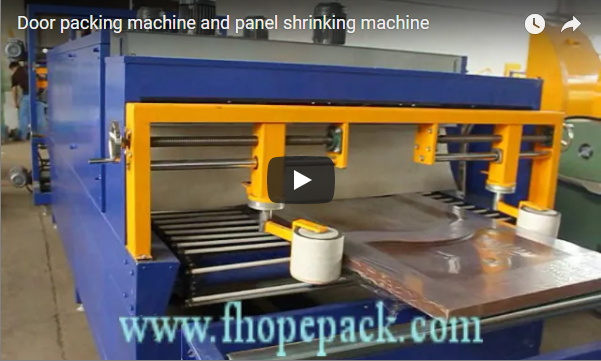
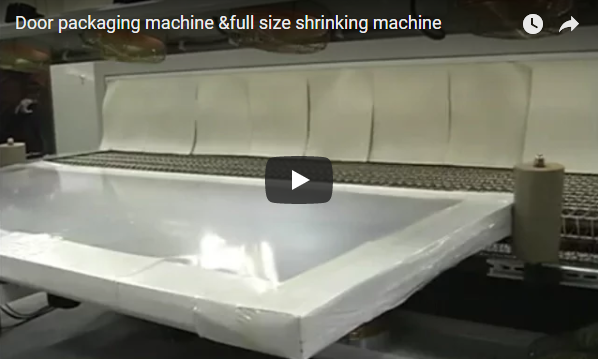
Finished wooden doors, modular furniture boards, and architectural panels are highly susceptible to corner impact, surface scratching, and ambient moisture ingress during distribution. Our continuous-motion three-side sealing and shrink packaging machine encapsulates individual panels or nested stacks in heavy-gauge film, forming a hermetically sealed barrier before conveying them through an insulated, dual-zone recirculating thermal tunnel. The controlled bi-axial shrinking forces yield a rigid, skin-tight contour that stabilizes edges, locks out moisture, and eliminates protective slip-sheet costs.
The packaging line integrates a continuous high-friction in-feed conveyor, bilateral handwheel-adjusted centering guides, a synchronized cross-and-side motion sealer, and a high-volume forced-air recirculation shrink tunnel. Operating seamlessly across variable door lengths without mechanical tooling changeovers, this system provides factory-grade protective packaging at industrial cycle times.
Table des Matières
- Pourquoi utiliser un film rétractable pour les portes ?
- séquence machine
- Paramètres machine
- Choix et utilisation des films
- Vitesse de ligne
- Liste de contrôle de sélection
- Sécurité
- FAQ technique
- Suivant
- Lecture connexe
- Références
Pourquoi utiliser un film rétractable pour les portes ?
Traditional horizontal stretch wrapping applies radial tension along the circumference of an elongated load. While cost-effective for profile extrusions, stretch film around flat architectural doors exhibits two distinct physical flaws:
- Edge Looseness and Face Wrinkling: Elastic film neck-down creates gaps at the square corners, leaving decorative veneers and painted edges exposed to abrasion.
- Lack of Complete Hermetic Sealing: Stretch wrapping cannot seal the front and trailing headers without redundant end-cover operations, permitting dust, condensation, and humidity into raw core materials (such as MDF or solid wood cores).
Controlled thermal shrink wrapping solves these challenges. Center-folded polymeric film is wrapped and sealed along all three open sides, followed by short-duration exposure to balanced convective heat. The polymeric matrix contracts uniformly across both transverse and longitudinal directions, generating an impermeable skin-tight envelope that stabilizes the perimeter and insulates sensitive finishes against transit scuffing.
séquence machine
[In-Feed Conveyor] ──> [Centering Guides] ──> [Film Unwind & Micro-Perforation]
                             │
                             ▼
[Cooling Egress] <── [Dual-Zone Recirculating Tunnel] <── [3-Side Motion Sealer]- In-Feed Transfer: The door panel is loaded onto the high-friction belt conveyor, either manually or via vacuum portal destackers.
- Centering & Film Enveloping: Bilateral guides center the product along the longitudinal axis. The panel advances into a center-folded film web, automatically opening the sheet so the fold continuously covers one long edge.
- Micro-perforation: Integrated mechanical needle rollers puncture precision micro-vents to vent trapped air during subsequent thermal contraction, preventing film ballooning.
- Three-Side Motion Sealing: Optical sensors detect the leading edge, triggering the pneumatic cross-seal bar. The synchronized side-sealing knife trims and seals the longitudinal seam while moving in tandem with the conveyor, eliminating product stop-and-go.
- Dynamic Length Detection: Photoelectric arrays measure the trailing edge in real time, firing the trailing cross-seal cut without manual operator intervention.
- Thermal Convective Shrinkage: The sealed enclosure enters the insulated tunnel. High-velocity laminar air jets distribute heat evenly across both faces and narrow edges.
- Discharge & Film Cure: The panel exits onto an extended live-roller conveyor, where ambient air cures the polymer into a durable, scratch-resistant outer layer.
Paramètres machine
The standard structural and operational parameters of our door sealing and shrinking line are summarized below:
| Paramètre machine | Spécification standard | Heavy-Duty / Custom Options |
|---|---|---|
| Longueur de la pièce | 1,000 – 4,000 mm | Custom lengths up to 6,000 mm |
| Largeur de la pièce | 300 – 1,200 mm | Extended frame up to 1,500 mm |
| Épaisseur de la pièce | 10 – 100 mm | High-clearance tunnel up to 200 mm |
| Capacité de charge utile | 10–100 kg per panel or pack | Reinforced roller beds up to 250 kg |
| Linear Line Speed | 4–9 m/min (contrôlé par variateur de fréquence) | High-speed motion lines up to 15 m/min |
| Films compatibles | Polyethylene (LDPE), POF, PVC | VCI anti-corrosion, UV-stabilized LDPE |
| Gamme d'épaisseur de film | 80 à 150 µm | 30–60 µm (POF), up to 200 µm (Heavy PE) |
| Type de scellant | Continuous-motion heat sealing | Dual-carriage servo cross sealer |
| Cutting/Sealing Tool | PTFE-coated alloy bar (±2 °C precision) | Smokeless nichrome impulse knife |
| Conveyor Passline | 800 mm (±50 mm adjustable) | Matched to customer line elevation |
| Puissance de chauffage du tunnel | 30 kW (Dual-zone recirculating) | 36–45 kW for high-throughput lines |
| Dimensions des tunnels | L 2,500 × l 1,500 × H 300 mm | Scaled to maximum product cross-section |
| Main Control Platform | Automate programmable Siemens/Delta avec interface homme-machine tactile | EtherCAT / Profinet plant integration |
Sealing Assembly Engineering: The longitudinal and transverse sealing units utilize permanently heated, PTFE-coated sealing blades backed by solid-state relays (SSR) and PID algorithms. Operating temperatures remain stable within ±2 °C, preventing smoke emissions, noxious smells, or burnt plastic residue on the knife edges.
Choix et utilisation des films
- Polyolefin (POF, 30–60 µm): Offers optical clarity and high puncture resistance. Recommended for architectural retail doors, pre-hung glazed doors, and decorative cabinetry panels requiring high retail shelf appeal.
- Low-Density Polyethylene (LDPE, 80–150 µm): Delivers structural tear strength, moisture barriers, and impact cushioning. Suited for heavy commercial exterior doors, solid fire-rated doors, and multi-panel logistics stacks.
- Heavy-Duty LDPE (150–200 µm): Deployed for flat-pack knock-down furniture stacks and rough-surface textured doors prone to edge puncturing.
Calcul de la consommation de films
Because center-folded film provides an integral wrap along one longitudinal side, total film surface area consumption per cycle is determined by:
Film per door = (L_door + G_seal) × (2 × W_door + 2 × T_door + A_film)Où? :
L_door: Product length in metersW_door: Product width in metersT_door: Product thickness in metersG_seal: Leading/trailing seal gap and clamp clearance (standard engineering value: 0.35–0.40 m)A_film: Geometric lateral allowance for weld bead formation and shrink draw (typically 0.15–0.20 m)
Exemple de calcul d'ingénierie: For a standard residential door slab measuring 2.1 m (L) × 0.9 m (W) × 0.04 m (T), using a 0.40 m total seal gap and a 0.20 m shrink reserve:
Step 1: Length component = 2.1 m + 0.40 m = 2.50 m
Step 2: Perimeter component = (2 × 0.9 m) + (2 × 0.04 m) + 0.20 m = 2.08 m
Step 3: Total film area ≈ 2.50 m × 2.08 m ≈ 5.20 m² per cycle
Vitesse de ligne
Production capacity is constrained by tunnel retention time (ensuring full polymeric shrinkage without blistering heat-sensitive veneers) and mechanical cross-sealing cycles:
Throughput (doors/hour) = (V_line × 60) ÷ (L_door + G_conveyor)Où? :
V_line: Operational line feed speed in meters per minute (m/min)L_door: Workpiece length in meters (m)G_conveyor: Longitudinal clearance pitch between successive pieces (typically 0.40 m)
Vérification de la capacité: At an operational speed of 6 m/min wrapping 2.1 m long door units:
Throughput = (6 × 60) ÷ (2.1 + 0.40) = 360 ÷ 2.5 = 144 doors/hourWhen scheduling diverse product runs, line speed must be set to provide sufficient thermal residence time for the thickest or longest component in the batch.
Liste de contrôle de sélection
To configure an automated door packaging line for your production facility, review the following engineering parameters:
- Spectre dimensionnel: Minimum and maximum panel length, width, and cross-sectional thickness.
- Style d'emballage: Single door leaves, pre-hung units with door jambs, or banded multi-panel stacks.
- Débit cible: Peak units per hour and current upstream cycle times.
- Sensibilité du substrat: Finished paint coats, direct UV lacquer, natural wood veneers, or unprimed skins (determines max tunnel temperature).
- Formulation de polymères: Preferred film gauge, stretch-ratio specifications, and material type (LDPE vs. POF).
- Floor Layout & Orientation: Available footprint, conveyor line elevation (standard: 800 mm), and line transfer direction (inline vs. 90° transfer).
- Pre-Sealing Equipment: Integration of corner-protector applicators, automatic desiccant feeding, or barcoding systems.
Sécurité
All packaging machinery conforms to global industrial safety directives:
- EN ISO 12100: 2010: Systematic risk assessment and hazard reduction protocols applied across mechanical assemblies.
- EN 415-10: Specific machine safety requirements for continuous-motion thermal shrink and film sealing machines.
- EN 60204-1: Electrical safety, grounding integrity, and control enclosure standards.
Key mechanical protection components include:
- Fully guarded cross-sealing carriages with pneumatic safety-edge trip switches that immediately reverse sealer motion upon physical obstruction.
- High-density thermal insulation surrounding the recirculation tunnel to maintain exterior surface temperatures below safe touch limits.
- OSHA-compliant Lockout/Tagout (LOTO) disconnects and emergency stop actuators located at in-feed, HMI console, and tunnel egress stations.
FAQ technique
Q: Can this machine package stacked flat-pack panels or knock-down furniture sets? A: Yes. The side-centering guides and vertical clearance handle stacks up to 100 mm (standard) or 200 mm (high-clearance package). For bundle weights exceeding 50 kg, heavy-gauge LDPE film (120–180 µm) is recommended to prevent puncture tears during logistics handling.
Q: Does changing the door length require tooling downtime or manual adjustments? A: No. Product length detection is governed by integrated photoelectric sensor arrays. The cross-sealer fires dynamically based on actual door measurements, enabling batch-size-one processing of random product lengths between 1,000 mm and 4,000 mm. Width variations are adjusted within 30 seconds via manual handwheels or optional motorized width adjusters.
Q: Why is three-side sealing preferred over traditional open-ended sleeve wrapping? A: Open sleeve wrapping (two-side bundle wrap) leaves door ends exposed to dust, weather, and rough handling. Automated three-side sealing completely encloses the perimeter, generating continuous structural seal strength and uniform shrink coverage on all four corners.
Suivant
- Send Production Parameters: Forward your maximum/minimum workpiece dimensions, film specifications, and target door throughput to info@fhopepack.com.
- Receive Machine Proposal: Our packaging engineering group will complete clearance drawings, compute electrical load distributions, and verify line footprints.
- Citation formelle: Comprehensive layout proposals and investment quotations are delivered within 24–48 hours.
Lecture connexe
- Automatic Door Shrinking Machine Technical Details
- Door Shrinking Machine with High-Speed Motion Sealer
- Door Panel Sealing and Shrink Packaging System Video
- High-Throughput Three-Side Panel Sealing and Wrapping Line
Références
- ISO Machinery Safety Catalog: EN ISO 12100:2010 (Safety of Machinery – Basic Concepts)
- European Standards: EN 415-10 (Safety of Packaging Machines – Part 10: General Requirements)
- International Electrotechnical Commission: IEC / EN 60204-1 (Safety of Machinery – Electrical Equipment)
- FHOPEPACK Engineering Validation Data: Continuous Motion Door & Panel Sealing System
Dernière mise à jour : 20/10/2026
<iframe loading="lazy" width="940" height="535" src="https://www.youtube.com/embed/-n0sx56bKng?rel=0" frameborder="0" allow="accelerometer; autoplay; clipboard-write; encrypted-media; gyroscope; picture-in-picture; web-share" allowfullscreen></iframe>