Résumé
An online pipe strapping line straps long pipes in place as they travel along a power roller conveyor. The operator lays each pipe on the conveyor, the strapping unit holds the pipe, and a strap head applies the band before the pipe continues out. Strapping while the line runs keeps the pipes secure without stopping for each one. Pipe length, band spacing and line speed are confirmed per project.
Table des Matières
- Why strap online
- Ce que fait la ligne
- Power roller conveyor and strap head
- Cycle de cerclage et contrôle
- Ce que montrent les images
- Configuration typique
- Liste de contrôle de sélection
- Fonctionnement et sécurité
- FAQ technique
- Suivant
- Lecture connexe
- Sources et normes
Why strap online
Long pipes are easy to shift during handling, and a loose stack can spread or scrape in transit. Strapping the pipe in place while it is on the conveyor keeps the line moving and holds the pipe steady for the next step.
An online line applies the strap as part of the flow, so the pipes do not need to be moved off the line to be secured. Pipe length and band spacing are confirmed per project.
Ce que fait la ligne
The line is a pipe strapping unit built around a power roller conveyor. The operator lays a long pipe on the conveyor, the pipe travels under a strapping unit, and a strap head applies a band around the pipe while it is held in place.
The strapped pipe continues along the conveyor, and the next pipe can be loaded without stopping the line. Pipe length and line speed are confirmed per project.
Power roller conveyor and strap head
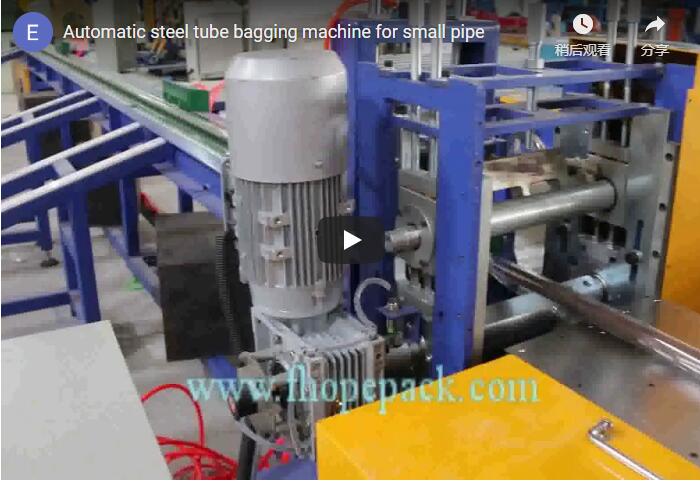
A power roller conveyor runs through the line, with the rollers moving each pipe forward under its own power. A strapping unit stands over the conveyor, with a strap head that lowers onto the pipe and a strap supply beside the line.
The head holds the pipe while a band is applied around it, then lifts as the pipe continues out. Strap spacing and band tension are confirmed per project.
Cycle de cerclage et contrôle
The cycle starts when the operator lays the pipe on the conveyor. The pipe travels to the strapping unit, the strap head lowers and applies a band, and the head lifts as the strapped pipe continues forward.
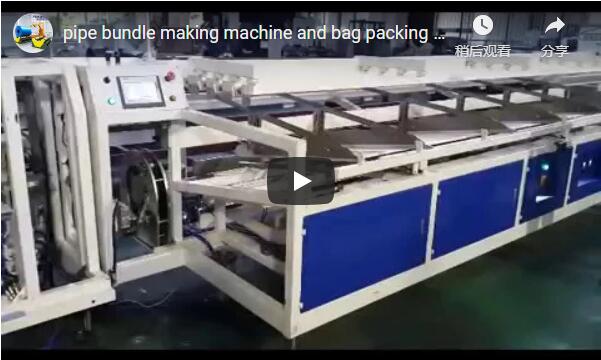
A control cabinet beside the line carries the buttons and indicator lamps for the cycle, and the conveyor feeds pipes through continuously. Strap count and cycle sequence are confirmed per project.
Ce que montrent les images
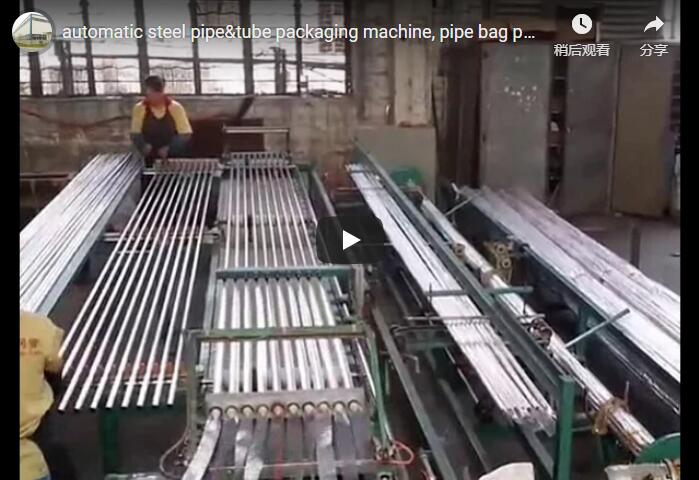
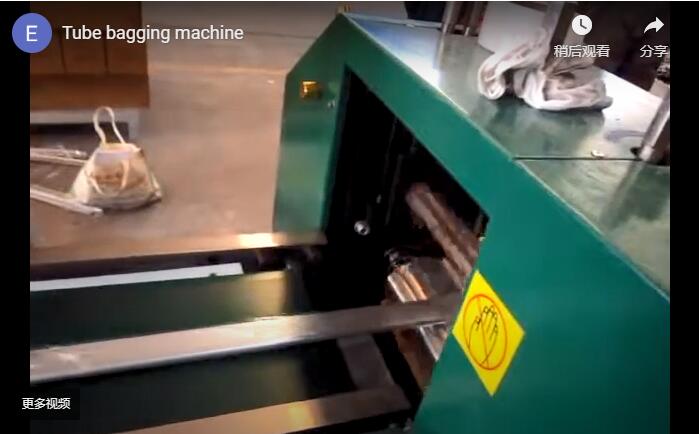
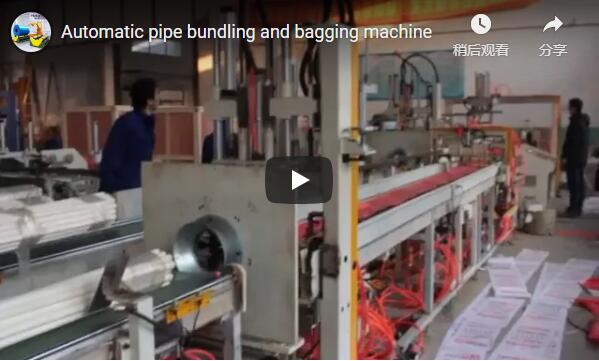
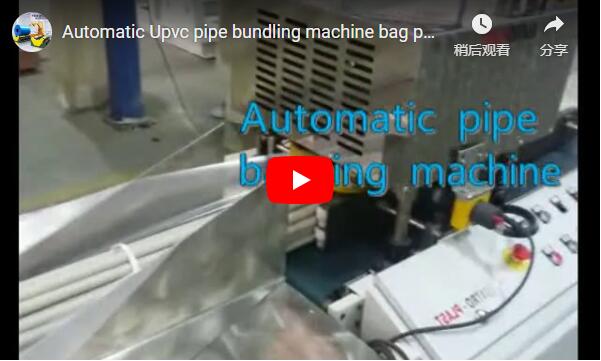
Our footage shows an operator laying a long pipe on the power roller conveyor and the pipe travelling under the strapping unit. The strap head lowers to hold the pipe and apply a band, then lifts as the pipe continues out on the rollers. It is a general demonstration, so your pipe length, band spacing and line speed are confirmed with us per project.
Configuration typique
Les figures ci-dessous indiquent les limites de conception fonctionnelles plutôt que des valeurs numériques, et sont confirmées pour chaque projet.
| Paramètre | Plage de valeurs typique, confirmée par projet |
|---|---|
| Charge | long pipes laid on the power roller conveyor |
| Processus | band applied around each pipe in place |
| Hold | strap head lowers to hold the pipe |
| Fournitures de sangles | band material feed beside the line |
| Transferts | roller conveyor in, strapped pipe out |
| Contrôle | control cabinet with buttons and indicator lamps |
| Monter | floor, in line with the pipe flow |
| Interface | connects with line feed and take-away |
| alimentation électrique | 380 V triphasé 50 Hz ou 220 V monophasé pour les machines légères, selon le projet. |
Liste de contrôle de sélection
| Questionne toi | Confirmer par projet |
|---|---|
| Gamme de tuyaux | outer diameter, length, weight |
| Sangle | band width, material, tension |
| Cycle | strap count, cycle time, feed speed |
| Ligne | hauteur du convoyeur, interfaces d'entrée et de sortie |
| Site | surface au sol, accès aux deux extrémités |
| alimentation électrique | tension, phase et fréquence sur site |
Fonctionnement et sécurité
Lay each pipe on the conveyor, start the line, and let the strapping unit hold and band the pipe as it passes. Keep hands clear of the rollers and the strap head while the line is running.
Routine checks cover the conveyor, the strap head and the strap supply, per the machine manual. Confirm the pipe is seated on the rollers before each pass.
FAQ technique
Q: What does this line do? A: It straps long pipes in place as they travel along a power roller conveyor.
Q: How is the band applied? A: The strap head lowers onto the pipe and applies a band while the pipe is held on the conveyor.
Q: Does the line stop between pipes? A: No, the conveyor feeds pipes through continuously and the strap head works as each pipe passes.
Q: Can it strap different pipe sizes? A: The strap head and conveyor adapt within the machine range; your pipe size is confirmed per project.
Q: What does it suit? A: Long pipes and profiles that need a secure band before the next process, storage or transport.
Suivant
- Email us at info@fhopepack.com with your pipe size and line speed.
- We send an online strapping proposal within 48 hours.
- We confirm the conveyor interface and band choice for your line.
Lecture connexe
- Ligne de cerclage de tuyaux en ligne
- Enroulement et cerclage de tuyaux flexibles : des solutions pour l'industrie
- Filmage partiel et conditionnement par banderoleuse orbitale
- Gammes de machines d'emballage FHOPE
Sources et normes
- ISO 12100:2010 Sécurité des machines, principes généraux de conception et d'évaluation des risques
- EN 415-10:2014 Sécurité des machines d'emballage, exigences générales
- EN ISO 13849-1:2023 Sécurité des machines, parties des systèmes de commande relatives à la sécurité
FHOPE online pipe strapping line demonstration video. Reviewed as a general demonstration; pipe length, band spacing and line speed confirmed per project.
Dernière mise à jour : 12/10/2026