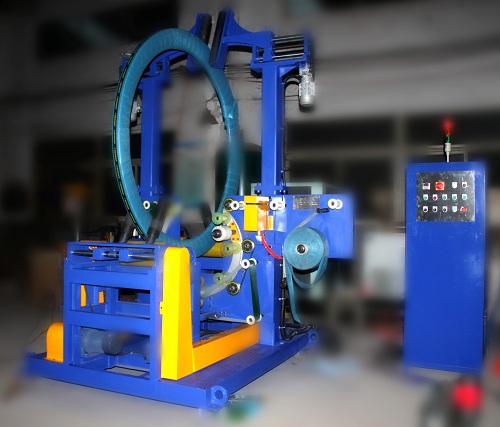
Résumé: A steel coil packaging line is not a single fixed machine. It is one line family configured by coil class: slit packs run narrow stations, standard coils run the common mill range, and heavy-gauge cold-roll coils run the largest packs. This page covers what changes between configurations, the published capacity bands by class, the limits a buyer should confirm, and the inputs an RFQ needs.
Table des Matières
- What This Line Family Adapts To
- What the Configuration Changes
- How the Configured Line Runs
- Published Capacity by Coil Class
- Limits and What to Confirm
- FAQ technique
- Next Step: Line Sizing & RFQ Checklist
- Références
- Lecture connexe
What This Line Family Adapts To
Per the FHOPE product range, a steel coil packaging line takes coils from the slitting or cold-rolling process through wrapping and onward transfer to the stacking station, with no manual transfer between stations. The same line platform is then configured per coil class rather than being a one-off machine per customer.
The range splits into coil classes: slit coils for the narrow packs, standard coils for the common mill range, and heavy-gauge coils for the largest, heaviest cold-roll packs. Slit coil is produced by cutting a wide coil lengthwise into strips, so narrow packs dominate that class.
What the Configuration Changes
In the FHOPE product range, the configuration is selected per project. Three station choices change between classes:
- Slit coil lines run the narrow stacker layout for multiple small packs per pallet.
- Lignes standard run the mid-size wrapper for the common mill OD and width band.
- Heavy-gauge lines add the larger master wrapper and the higher stacker rating for cold-roll coils.
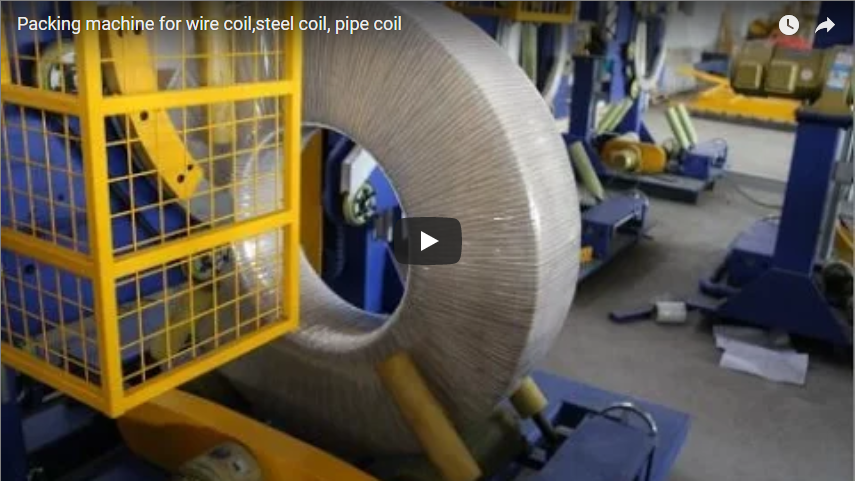
The demonstration clip shows the heavy-duty wrap head applying film around the rotating coil in continuous passes.
How the Configured Line Runs
Coils enter on the conveyor and are staged for the wrap cycle. The wrap head applies film around the rotating coil in continuous passes over the pack surface; per the product range, a tension controller keeps wrap pressure steady. The wrapped coil then moves forward on the conveyor past the wrap station, and the line indexes the next coil into the station without manual transfer.
The clip shows a steel coil packaging line; per the product range, the difference between classes is the station configuration. Operator safety should follow standard lock-out and isolation practice whenever a station is opened for service, in line with the machine-access rules of the applicable packaging-machinery standard.
Published Capacity by Coil Class
The figures below are product-range references FHOPE publishes for this line family on the Machines d'emballage automatique de bobines page. They are published capacity bands, not a promise for every project, and each line is sized after OD, width, and weight are confirmed.
| Station | Référence publiée |
|---|---|
| Automatic coil stacker (fork-arm lifter) | up to 6 t; stack height 600–1200 mm; 70–120 s per coil |
| Arm-type stacker centering | 0–3 mm on the pallet |
| Master coil wrapper (orbital, eye-through) | tension-controlled film application |
| Heavy-gauge cold-roll coil | OD up to 2500 mm; width up to 2200 mm; up to 35 t |
These are independent station references. The stacker rating and the master-wrapper rating are sized per station and per project; they are not combined here into one unconditional whole-line capability.
Limits and What to Confirm
Per the product range, this family fits when your coil class sits inside a published band and your line can feed a staged conveyor infeed. Before sizing, confirm four inputs with the builder:
- Bobine la plus lourde. The 6 t stacker figure is a station reference; heavier cold-roll coils need the rating restated per project.
- Wrapper OD and width headroom. The 2500 mm OD / 2200 mm width figure belongs to the heavy-gauge cold-roll configuration.
- Matériel d'emballage. VCI film, kraft paper, or HDPE is selected to match the transit route and climate, not a single default.
- Plan d'étage. The line needs a defined infeed and a defined exit for the wrapped coils.
The standards that apply depend on the destination market. For CE-marketed installations, ISO 12100 sets the risk-assessment method and EN 415-10 covers the safety requirements of packaging machines.
FAQ technique
Q: Which configuration fits my coil? A: Per the FHOPE product range, match your coil class first: slit packs suit narrow stations, standard coils the common mill range, and heavy-gauge cold-roll coils the larger master wrapper and stacker. Sending OD, width, and weight is the practical way to have the class confirmed.
Q: Are the stacker and wrapper ratings unconditional for the whole line? A: No. They are independent station references published for the family, and they are sized per station and per project, not read as one combined line capability.
Q: Which regulations must the machine meet? A: Compliance depends on where the line ships. CE-bound projects usually face ISO 12100 risk analysis and EN 415-10 machinery-safety requirements; other destinations follow their local framework.
Q: Why does the RFQ need OD, width, and weight? A: Coil weight follows from thickness, width, and length, so the same OD can sit at very different weights depending on the gauge. OD, width, and weight are the three numbers a coil order is defined by.
Next Step: Line Sizing & RFQ Checklist
To have a line configuration matched to your coil range, send:
- Your coil classes: slit widths, or standard OD/width, or heavy-gauge OD and weight.
- A layout drawing showing the conveyor infeed and the exit for wrapped coils.
- Packing material preference, if any.
- Destination market, for the standards check.
Submit your layout drawing; receive a proposal within 48 hours; book a site survey. Write to info@fhopepack.com and the engineering team will match the configuration to your coil range.
Références
- Vidéo: Heavy-Duty Steel Coil Packaging Equipment: Different Configuration Options
- FHOPE product page: Machines d'emballage automatique de bobines
- [1] EN 415-10 — Safety of packaging machines: general requirements. CEN, 2014. Accessed 2026-10-19.
- [2] ZERUST — Steel Coil Corrosion Protection: VCI Paper and Poly. Accessed 2026-10-19.
- [3] Mead Metals — Unrolling the Basics of Steel Slitting and Its Benefits. Accessed 2026-10-19.
- [4] Everest Steel — Steel Coil Weight: Average Tons by Type + Size Chart. Accessed 2026-10-19.
- [5] Scott’sdale Steel Frames — Expert Guide to Steel Coil Ordering in the Global Market. Accessed 2026-10-19.
Dernière mise à jour : 19/10/2026