Préface
Stabilizing elongated, heavy-duty structural bundles—such as steel conduits, composite panels, timber packs, and extruded metal profiles—demands horizontal orbital wrapping rather than vertical turntable rotation. Passing payloads horizontally through a rotating aluminum ring eliminates centrifugal load displacement, prevents tipping, and ensures balanced containment. Selecting the right platform requires reconciling bundle mass with ring rotational inertia (
J ≈ m × r²), matching variable ring speeds (10–60 r/min) to linear conveyor transit (3–12 m/min), and integrating automated conveyors within strict factory footprint envelopes.
What heavy duty changes
Handling oversized, non-palletized, or high-mass bundles fundamentally alters the mechanical demands on packaging machinery. On traditional vertical turntable wrappers, tall or long items develop severe cantilevering, eccentricity, and dangerous tipping moments.
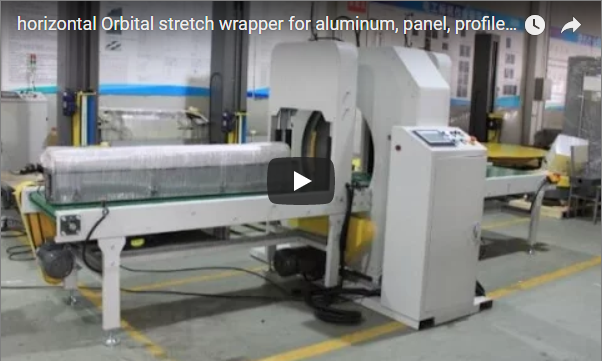
Horizontal orbital wrappers eliminate this hazard by keeping the payload’s center of gravity statically supported along a horizontal roller bed while the orbital ring revolves around it.
[Infeed Conveyor] [Rotating Orbital Ring] [Outfeed Conveyor] ─────────────────────┬─── ───┬───────────────────── ● ● ● ● ● │ ( O-Ring ) │ ● ● ● ● ● ─────────────────────┴─── ───┴───────────────────── Linear Travel Axis ───────────────────────────────────────────────────► For heavy-duty applications, three engineering constraints shift significantly:
- Support de charge structurelle: Conveyor beds must bear loads up to several hundred kilograms per linear meter without roller deflection, requiring solid steel shafts and thick-walled rollers.
- Dynamic Decoupling: Rotational forces are isolated exclusively within the precision-machined ring assembly, preventing mechanical stress from transferring into fragile product corners.
- Contrôle de la tension: Applying stretch film around non-square or high-aspect profiles induces rapid peak-tension spikes, necessitating motorized power pre-stretch carriages to prevent crushing bundle edges.
Bundle mass and ring inertia
In heavy-duty orbital equipment, ring sizing is governed not only by product cross-section clearance, but also by rotational dynamics. As the inner diameter and payload capacity expand, the rotating ring assembly, film carriage, counterweights, and mounting hardware accumulate significant mechanical mass.
The system rotatory inertia can be evaluated using the thin-ring approximation:
J ≈ m × r²
Où? :
J= Mass moment of inertia (kg·m²)m= Total rotating mass including loaded film carriages (kg)r= Mean radius of the rotating ring (m)
For example, on an industrial ring assembly with an effective rotating mass of m = 400 kg and a mean radius of r = 0.6 m:
J ≈ 400 × (0.6)² = 400 × 0.36 = 144 kg·m²
A rotational inertia of 144 kg·m² represents substantial kinetic energy at rated speeds. Consequently, direct-on-line starting or sudden mechanical braking creates catastrophic drive-belt wear and gearbox shock. Motor drives must be paired with variable frequency drives (VFDs) featuring programmed S-curve acceleration and deceleration ramps, matched with appropriately sized dynamic braking resistors to manage regenerative energy during emergency stops.
Ring speed and overlap
Film coverage, containment strength, and line cycle times are determined by the kinematic ratio between the orbital ring’s rotational speed and the conveyor’s linear travel speed.
Film Pitch = Film Width × (1 – Overlap Ratio) Conveyor Linear Speed = Film Pitch × Ring Rotational Speed The pure wrapping cycle duration is governed by:
t_wrap = (Wrapping Turns × 60) ÷ Ring Speed
Total processing time per bundle is:
t_total = t_wrap + Handling and Conveyor Transfer Time
Operating within a 10–60 r/min variable ring speed range, applying a standard 6-turn reinforcement wrap on a stationary section requires:
- À 10 tr/min:
(6 × 60) ÷ 10 = 36 seconds - À 60 tr/min:
(6 × 60) ÷ 60 = 6 seconds
| Equipment Class & Configuration | Enveloppe de la pièce | Capacité de charge utile | Vitesse de l'anneau | Puissance motrice |
|---|---|---|---|---|
| Emballeuse étirable horizontale automatique E1000 | Length >1,000 mm; Bundle OD 400–1,000 mm | 50-400 kg | 10–60 tr/min | ≈ 4.5 kW (AC380V, 50Hz, 3P) |
| Semi-Auto Orbital Wrapping Machine S300 | Length >1,000 mm; Bundle OD 50–300 mm | Light-to-medium profiles | Jusqu'à 100 tr/min | ≈ 1.5 kW (AC380V, 60Hz) |
| Semi-Auto Orbital Wrapper | Length >1,500 mm; Bundle OD 50–200 mm | Light bundles, rods, extrusions | 20–100 tr/min | ≈ 1.5 kW (AC380V, 60Hz) |
Note: Sizing must clear the workpiece diagonal envelope √(Width² + Height²) plus a radial clearance margin (typically ≥ 150 mm) to avoid interference with the revolving film carriage.
Intégration de ligne
Integrating an orbital wrapper into an existing continuous manufacturing line requires electrical and mechanical synchronization:
- Infeed Handshake: Upstream production machines (e.g., extrusion lines, sawing stations, or strapping systems) signal bundle readiness via dry-contact PLC interlocks or Ethernet/IP protocols.
- Indexing & Centering: Side guide rollers automatically centralize incoming products along the machine’s longitudinal center line before entry into the wrapping ring.
- Automated Cut & Wipe: At the end of the wrapping program, pneumatic clamps capture the film web, a hot-wire or serrated blade severs the film, and a pneumatic wiping arm presses the tail firmly against the bundle to ensure seamless bonding.
- Outfeed Clearance: Once wrapping finishes, the conveyor accelerates to discharge the load onto cooling, staging, or palletizing decks, clearing the ring zone for the next workpiece.
Conveyor and buffer
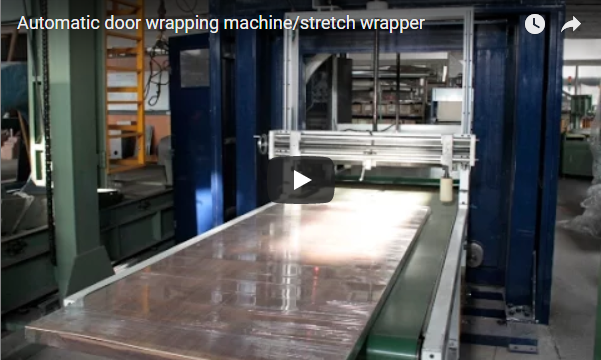
Conveyor design directly influences product stability and line throughput. For the E1000 automatic platform, standard integration utilizes a 2,000 × 1,200 mm infeed conveyor and a 2,000 × 800 mm outfeed conveyor, operating at variable speeds from 3 to 12 m/min.
|| ┌─────────────────┬───────────────────┬─────────────────┐ │ Infeed Conveyor │ Main Ring Chassis │ Outfeed Conveyor│ │ 2,000 × 1,200 │ 4,800 × 1,800 │ 2,000 × 800 │ │ mm │ × 2,000 mm │ mm │ └─────────────────┴───────────────────┴─────────────────┘
- Footprint Envelope: The central wrapping machine chassis occupies approximately L4800 × W1800 × H2000 mm. Line planners must add the lengths of the infeed (2,000 mm) and outfeed (2,000 mm) conveyors, plus a mandatory 1,000 mm perimeter perimeter clearance for maintenance access and perimeter guarding.
- Combler les écarts: The gap between infeed and outfeed roller conveyors within the ring plane is bridged by auxiliary powered transition rollers. This ensures continuous product support and prevents short or flexible workpieces from dipping into the ring void.
- Top Hold-Down Restraints: Light or high-aspect bundles risk shifting due to tangential film pull. Overhead pneumatic-actuated vertical hold-down rollers and lateral guide rollers stabilize the bundle during the entire wrapping pass.
Film et pré-étirement
Orbital wrappers handle various packaging media, selected according to transport hazards and surface protection requirements:
- Film étirable LLDPE: Width 100–500 mm, outer diameter (OD) 100–250 mm, core inner diameter (ID) 50 mm. Standard film thicknesses range from 17 to 35 µm.
- Alternative Protective Media: Industrial crepe paper, reinforced VCI anti-corrosion barrier film, or woven PE tape for heavy metal profiles.
Motorized mechanical pre-stretch carriages elongate the film by 150% to 250% prior to application. This pre-stretching reduces film consumption, enhances puncture resistance along sharp edges, and decouples unwinding drag from bundle containment force—preventing corner crush on hollow or delicate components.
Garde
Heavy rotating rings represent severe shear and entwinement hazards. Equipment must comply with harmonized safety standards, specifically EN 415-10 (wrapping machine safety) and ISO 12100 (risk assessment):
- Interlocked Physical Enclosures: Welded mesh perimeter fencing encloses the entire rotation perimeter. Muting sensors allow cargo bundles to pass while instantly halting ring rotation if operator access is detected.
- Pneumatic Isolation (LOTO): The pneumatic preparation unit (operating at 5–8 kgf/cm² / 0.5–0.8 MPa) includes lockable residual pressure dump valves, ensuring maintenance teams can exhaust trapped air from hold-down cylinders prior to servicing.
Liste de contrôle de sélection
Verify the following engineering criteria when configuring an orbital wrapping station:
- Bundle Cross-Section & Clearance: Measure maximum bundle width and height. Ensure cross-sectional diagonal
√(W² + H²)leaves at least 150 mm radial clearance inside the machine ring inner diameter. - Payload Mass vs. Roller Capacity: Confirm bundle weight per meter matches the conveyor roller load rating (e.g., 50–400 kg for the E1000 series).
- Sensibilité de la surface: Specify polyurethane-lagged rollers and soft-rubber hold-down wheels for delicate finishes, wood veneers, or pre-painted metal.
- Wrapping Media Compatibility: Confirm film roll dimensions (width 100–500 mm, OD ≤ 250 mm, ID 50 mm) and specify dual or single carriage setups based on throughput requirements.
- Services publics de l'installation: Ensure supply matches the machine electrical specification (e.g., AC380V, 50Hz / 60Hz, 3-Phase, total power ≈ 4.5 kW for automated platforms; ≈ 1.5 kW for compact semi-auto models) and a dry air supply of 5–8 kgf/cm².
FAQ technique
Q: Why use horizontal orbital wrapping instead of a vertical turntable? A: Long, heavy goods cannot be safely rotated vertically without excessive cantilever overhang and severe tipping hazards. Orbital wrapping advances the cargo linearly along powered conveyor beds while rotating only the balanced wrapping ring around it.
Q: How does ring inertia affect motor and drive selection?
A: Because rotating rings exhibit high moments of inertia (J ≈ m × r²), drive systems require heavy-duty VFDs with dynamic braking resistors. Direct-on-line starting or sudden mechanical stops can shear drive components or damage the transmission belt.
Q: Can orbital wrappers accommodate lightweight bundles? A: Yes. However, light workpieces under 100 kg can shift or lift due to film tension. Overhead pneumatic hold-down rollers and lateral guide assemblies are required to maintain positive tracking along the conveyor center line.
Q: How is film consumption minimized? A: By utilizing a motorized power pre-stretch carriage, the film is mechanically stretched by up to 250% before application, maximizing material yield while maintaining calibrated bundle containment.
Suivant
To size your horizontal orbital wrapping system, prepare your application parameters:
- Données d'application: Record your maximum and minimum load dimensions (length, width, height, diagonal profile), unit mass, and target line cycle times.
- Audit technique: Our engineering team reviews bundle diagonal clearance envelopes, roller load ratings, and line integration requirements.
- Turnaround: Contact our application engineers at info@fhopepack.com to receive an engineering layout drawing and functional machinery proposal within 24–48 hours.
Dernière mise à jour : 05/11/2026