Resumen ejecutivo A copper coil packing line has to keep up with the mill, and it has to know what each coil weighs, because copper is sold by weight. Our copper coil packing lines run from 6 to 10 coils per hour on the Economy line up to 18 to 30 on the Ultimate line. Weighing stations reach ±0.1% on the Premium line and ±0.05% on the Ultimate line. Pick the line from your annual tonnage and average coil weight, then decide how tight the weighing must be.
Índice
- Why packing speed matters
- Why weighing accuracy matters
- Our copper coil line range
- Worked example: from annual tonnage to the right line
- Worked example: what ±0.1% means in tonnes
- Lista de selección: qué enviarnos
- Seguridad: EN 415-10 e ISO 13849
- Preguntas frecuentes sobre ingeniería
- El próximo paso
- Lectura relacionada
- Fuentes
Why packing speed matters
A drawing or slitting line produces coils at a steady rate. If packing is slower, finished coils pile up at the end of the mill, get handled twice and pick up dents and fingerprints. Copper marks and oxidises easily, so every extra handling step costs quality as well as time.
Manual packing reaches about 2 to 3 coils per hour. Our Economy line raises that to 6 to 10, and the higher lines go further. The right speed is the one that clears the mill's output with some margin, not the highest on offer.
Why weighing accuracy matters
Copper is traded by weight, so the coil weight goes on the packing list, the label and usually the invoice. A scale error is a billing error on every coil. Weighing inline, before wrapping, also catches a coil that is out of tolerance before it is packed and shipped.
Accuracy is set as a share of the weight. On our Premium line the weighing station gives certified measurement to ±0.1%; on the Ultimate line it reaches ±0.05%, and a labelling station applies an RFID or QR label in about 2 s. That ties the weight to the coil all the way to the customer.
Our copper coil line range
| Line | Bobinas por hora | Capacidad anual | Peso | Notas |
|---|---|---|---|---|
| Economía | 6 a 10 | 5,000 a 20,000 t | no automated weighing | ID 508 to 762 mm, OD 800 to 1,800 mm; laser positioning ±3 mm |
| Estándar | 8 a 14 | por proyecto | por proyecto | OD up to 2,000 mm; 250% pre-stretch; changeover under 10 minutes |
| Avanzado | 10 a 16 | 30,000 a 80,000 t | por proyecto | strapping and orbital wrapping; 20 to 25 s cycle |
| Premium | 12 a 18 | 50,000 a 120,000 t | ±0.1%, certified | strapping, wrapping, timber blocking, stacking |
| Paquete ULTIMATE | 18 a 30 | 80,000 to 200,000 t and more | ± 0.05% | RFID or QR labelling, about 2 s per label; ERP link |
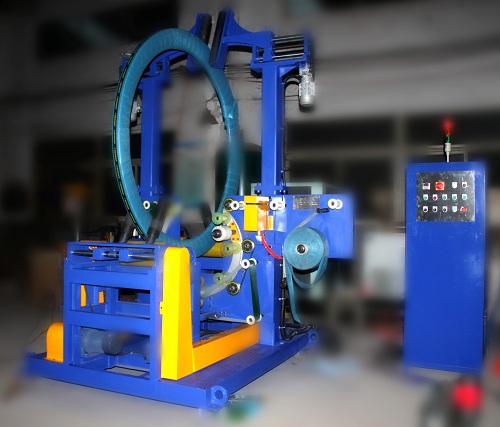
The two-stage wrapping and stacking line on this page is the core that all of these build on. Weighing, strapping and labelling stations go in before or after it as the tier requires.
Worked example: from annual tonnage to the right line
Coils per hour = annual tonnage ÷ average coil weight ÷ operating hours. The operating hours and coil weights below are illustrative.
| Planta A | Planta B | |
|---|---|---|
| Producción anual | 20,000 t | 100,000 t |
| Average coil weight | 1,000 kg | 1,000 kg |
| Coils per year | 20,000 | 100,000 |
| Horas de funcionamiento al año | 6,000 | 6,000 |
| Coils per hour needed | sobre 3.3 | sobre 16.7 |
| Line that fits | Economy, 6 to 10 | Premium, 12 to 18 |
Plant A has plenty of margin on the Economy line. Plant B is above the Standard line's 14 per hour, so the Premium line fits. Its 50,000 to 120,000 t capacity matches the tonnage too.
Worked example: what ±0.1% means in tonnes
| ±0.1% (Premium) | ±0.05% (Ultimate) | |
|---|---|---|
| On one 1,000 kg coil | ± 1 kilogramos | ± 0.5 kilogramos |
| On 100,000 t a year | ±100 t | ±50 t |
On Plant B, a ±0.1% scale leaves up to 100 t a year of weight in question, in either direction. Halving the error halves that band. For high-value copper, that difference often justifies the tighter scale. Where the weight goes on the invoice, the scale must also be verified for trade in the country of sale; we confirm the verification class with you per project.
Lista de selección: qué enviarnos
- Annual tonnage and operating hours.
- Diámetro interior, diámetro exterior, ancho y rango de peso de la bobina.
- Whether weight is invoiced, and the accuracy your customers expect.
- Label type: printed, QR or RFID, and the data on it.
- Strap and film: PET straps suit copper because they do not rust.
- ERP or MES system for weight and label data.
Seguridad: EN 415-10 e ISO 13849
For CE markets, ISO 12100 sets the risk-assessment method and EN 415-10 sets the general safety requirements for packaging machines. Our Premium line is built to ISO 13849 for its safety-related control functions.
Fence the turnstile, wrapping and stacking areas with interlocked access. Keep the weighing station inside the guarded zone, so no one stands on the scale conveyor while coils move.
Preguntas frecuentes sobre ingeniería
Q: How fast can a copper coil packing line run? A: From 6 to 10 coils per hour on the Economy line up to 18 to 30 on the Ultimate line.
Q: How accurate is inline weighing? A: ±0.1% on the Premium line and ±0.05% on the Ultimate line.
Q: Does the Economy line weigh coils? A: No. Automated weighing comes in on the Premium line, and weighing with automatic labelling on the Ultimate line.
Q: What coil sizes do the lines take? A: ID 508 to 762 mm, and OD from 800 mm up to 1,800 mm or 2,000 mm depending on the line.
Q: Which safety standards apply? A: For CE markets, ISO 12100 and EN 415-10, with ISO 13849 for safety-related controls.
El próximo paso
- Email your annual tonnage, coil sizes and weighing needs a info@fhopepack.com.
- Le responderemos en un plazo de 24 horas con una propuesta. naming the line and the weighing and labelling stations.
- Enviamos un plano de distribución. from your mill exit to the dispatch stack.
Lectura relacionada
- Línea de empaquetado de bobinas de cobre
- Premium copper coil packing line
- Ultimate copper coil packing line
- Economy copper coil packing line
- Two-stage coil stretch wrapping and stacking line
- Copper coil packaging from two-stage wrapping to pallet stacking
- Copper coil packaging line from upending and strapping to stacking
Fuentes
- Specifications: FHOPE Economy, Standard, Advanced, Premium and Ultimate copper coil packing line product pages
- Video de la máquina: copper coil packing line on YouTube
- Tonnage and weighing: our worked examples, illustrative hours and coil weights
- Standards: EN 415-10 (packaging machines, general safety); ISO 12100:2010; ISO 13849 (safety-related control systems)
Última revisión: 17/10/2026