> **Resumen ejecutivo**
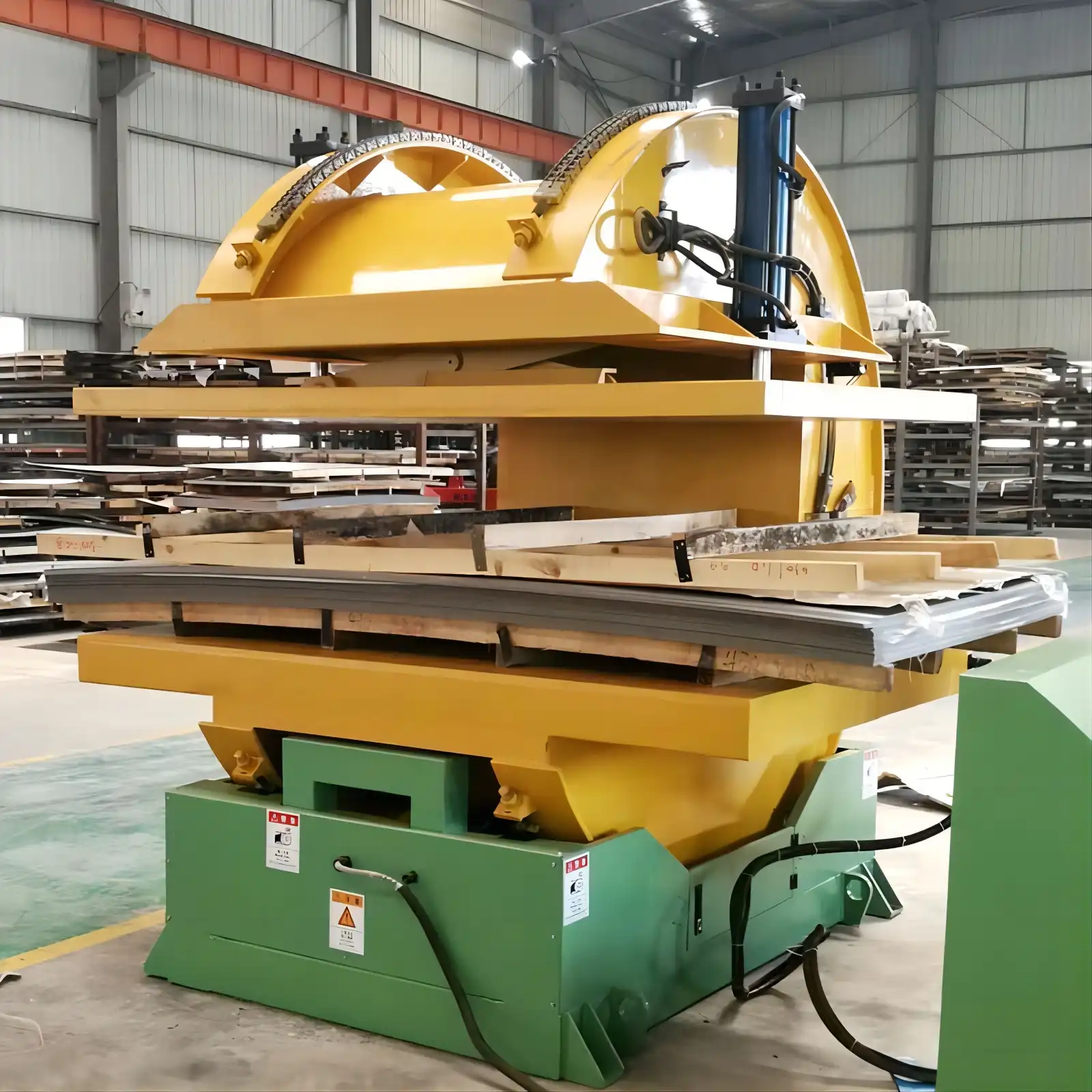
> Our steel sheet inverter clamps a stack of sheets in a C-shaped frame and turns it 180 degrees, so the bottom face comes up or the pallet can come off. It takes stacks up to 3,000 mm long, 1,850 mm wide and 350 mm high, and up to **15 t**. A full-size steel stack at that height weighs about 15 t, so the size and weight limits match.
Índice
- Cómo funciona el giro de 180 grados
- ¿Por qué invertir una pila de láminas de acero?: cambio de cara y cambio de palés.
- Límites de tamaño de pila y carga, hasta 15 t
- Especificaciones técnicas y alcance de la integración
- Hidráulica y seguridad
- Lista de verificación para la selección de un inversor de hojas
- Preguntas frecuentes sobre ingeniería
- El próximo paso
- Lectura relacionada
- Fuentes
Cómo funciona el giro de 180 grados
Las plantas también llaman a esta máquina inversora de placas o volteadora de placas. El ciclo se desarrolla en cinco pasos:
1. A forklift sets the sheet stack on the lower table of the C-shaped frame.
2. Double-acting hydraulic cylinders close the upper table onto the stack and clamp it.
3. A motor turns the whole C-frame through 180 degrees on its base, at an adjustable speed.
4. The machine stops automatically at the end of the turn, and mechanical and electric stop blocks hold the end position.
5. The clamp opens and the forklift takes the stack away, now upside down.
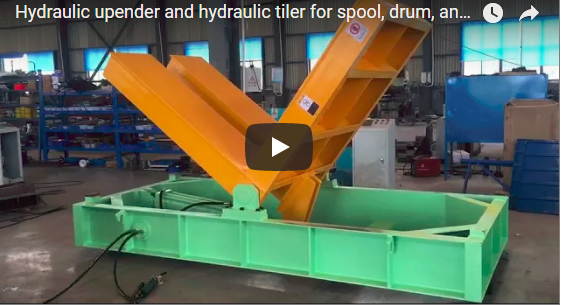
El vídeo explicativo muestra el ciclo completo de principio a fin: sujeción, un giro vertical de 90 grados, un acabado a 180 grados, con la pila mantenida entre ambas mesas durante todo el proceso.
¿Por qué invertir una pila de láminas de acero?: cambio de cara y cambio de palés.
We turn sheet stacks for two reasons. The first is to change the face that is up, for example so the underside can be inspected or the next process, such as a [steel sheet packing line](https://www.fhopepack.com/videos/steel-sheet-packing-line/), sees the right face. The second is a pallet swap: after the turn the pallet is on top and lifts off, and a new pallet or dunnage goes on before turning back.
Límites de tamaño de pila y carga, hasta 15 t
| Parameter | Steel sheet inverter |
|---|---|
| Stack length | 100–3,000 mm |
| Stack width | 250–1,850 mm |
| Stack height | 10–350 mm |
| Load weight | up to 15 t |
El acero pesa aproximadamente 7.85 toneladas por metro cúbico. Una pila del tamaño más grande, 3,000 × 1,850 × 350 mm, tiene un volumen de 1.94 m³, o aproximadamente 15.2 toneladas, por lo que los límites de tamaño y peso coinciden casi al mismo tiempo.
| Example stack | Size | Volume | Weight |
|---|---|---|---|
| Full window | 3,000 × 1,850 × 350 mm | 1.94 m³ | about 15.2 t |
| Common sheet | 2,500 × 1,250 × 150 mm | 0.47 m³ | about 3.7 t |
Una pila de tamaño completo está justo en el límite, por lo que confirmamos la pila más pesada de su lista. Los parámetros básicos también se pueden diseñar según sus especificaciones de carga.
Especificaciones técnicas y alcance de la integración
| Parameter | Steel sheet inverter |
|---|---|
| Turning | 180 degrees, speed adjustable |
| Motor | 2.5 kW |
| Hydraulic system | 4.5 kW |
| Hydraulic cylinder | 100 mm (listed as OD), double acting |
| Machine size | about 3,000 × 2,200 × 2,600 mm (L × W × H) |
| Machine weight | about 4 t |
| Loading | by forklift |
| Control | control panel (standard) or remote operation (selection per project) |
Hidráulica y seguridad
Presión de aceite, fuerza de sujeción y presión de contacto
La presión del aceite hidráulico alcanza los 14 MPa. Dicha presión actúa sobre los pistones del cilindro y genera la fuerza de presión que mantiene la carga sujeta durante la rotación.
La presión sobre la lámina es un valor diferente. Es esa fuerza dividida por el área en contacto con la lámina, por lo que un área de contacto pequeña genera una presión muy alta. Ejemplo ilustrativo para un cilindro con un diámetro interior de 63 mm (los 100 mm en las especificaciones corresponden al diámetro exterior del cilindro):
| Artículo | Valor |
|---|---|
| Oil pressure | 14 MPa |
| Piston area, π ÷ 4 × 63² | about 3,117 mm² |
| Press-down force, 14 × 3,117 | about 43.6 kN |
| Pressure on the sheet through a 100 × 100 mm pad | about 4.4 MPa |
| Pressure on the sheet through a 10 mm² point | about 4,360 MPa |
Por eso, las mesas de sujeción ejercen presión sobre superficies anchas y planas en lugar de puntos. Tras un fallo eléctrico, la máquina bloquea su posición automáticamente y se reinicia suavemente. Los topes mecánicos y eléctricos limitan el giro. Las normas aplicables dependen del mercado de destino. Para los mercados CE, la norma ISO 12100 establece el método de evaluación de riesgos y la EN 415-10 establece los requisitos generales para las máquinas de embalaje.
Lista de verificación para la selección de un inversor de hojas
- [ ] Stack length, width and height, smallest to largest.
- [ ] Heaviest stack weight.
- [ ] Sheet surface: oiled, coated or bare, and whether the sheets go on to a [protective film application machine](https://www.fhopepack.com/videos/protective-foil-application-machine-on-sheet/).
- [ ] Reason for turning: face change or pallet removal.
- [ ] Forklift capacity and access.
- [ ] Local power supply.
Preguntas frecuentes sobre ingeniería
Q: How heavy a stack can it turn?
A: Up to 15 t, which is about a full 3,000 × 1,850 × 350 mm steel stack.
Q: How thin can the stack be?
A: The listed stack height starts at 10 mm.
Q: How is the stack held during the turn?
A: Double-acting hydraulic cylinders press rigid flat tables across the stack's upper and lower faces, keeping a constant clamping force all the way through the rotation.
Q: What happens if the power fails mid-turn?
A: The machine locks its position automatically and resets softly when power returns.
Q: How is the stack loaded?
A: By forklift, onto the lower table.
Q: How does the clamp avoid marking thin or coated sheets?
A: The clamp tables press through wide, flat faces rather than points, so the cylinder force is spread over a large contact area and the pressure on the sheet stays low.
Q: How is the turn controlled?
A: From the control panel or by remote operation, with an adjustable turning speed.
Q: How does the machine prevent over-rotation at 180 degrees?
A: Mechanical and electric stop blocks halt the C-frame automatically at the completed 180-degree position.
Q: What drives the clamping and rotation?
A: A 2.5 kW motor turns the C-frame at adjustable speed, and a 4.5 kW hydraulic power unit drives the double-acting clamp cylinders at up to 14 MPa.
Q: How big is the machine itself?
A: About 3,000 × 2,200 × 2,600 mm (L × W × H) and about 4 t.
El próximo paso
Planificamos su inversor de láminas en tres pasos:
1. **Submit your layout drawing** with your stack sizes and weights to **info@fhopepack.com**.
2. **Receive a proposal within 48 hours**, with the frame size and capacity.
3. **Book a site survey** to plan forklift access.
Lectura relacionada
- [Steel sheet inverter and upender](https://www.fhopepack.com/Mechanical/steel-sheet-upender.html)
- [Load inverter](https://www.fhopepack.com/Mechanical/Load-Inverter.html)
- [Die mould upender](https://www.fhopepack.com/Mechanical/die-mould-upender.html)
- [Video: C-type 180-degree pallet turnover and pallet inverter](https://www.fhopepack.com/videos/c-type-180-degree-pallet-turnover-and-pallet-inverter-from-fhope/)
- [Video: why 90-degree mold upenders are replacing overhead cranes](https://www.fhopepack.com/videos/the-roi-of-safety-why-90-degree-mold-upenders-are-replacing-overhead-cranes-in-industrial-toolrooms/)
Fuentes
- Inverter data: [steel sheet inverter and upender page](https://www.fhopepack.com/Mechanical/steel-sheet-upender.html)
- Machine in action: [our steel sheet turning video on YouTube](https://www.youtube.com/watch?v=cKzJKLsoX8o)
- Steel density: 7.85 t/m³, standard value for carbon steel
- Alcance de las normas: [ISO 12100:2010](https://www.iso.org/standard/51528.html), [EN 415-10:2014](https://www.nen.nl/en/nen-en-415-10-2014-en-191845)
Última revisión: 09/10/2026