Resumen ejecutivo
A rectangular steel tube bundle line takes tubes from the mill run-out, counts them, turns each rectangular tube flat side down and builds them layer by layer into a square or rectangular bundle, then straps it with steel strap. Our line handles rectangular tubes from 80 × 100 to 200 × 300 mm and bundles up to 13,000 kg and 16 m long. A worked example builds a 32-tube, 8.7 t bundle.
Índice
- Why rectangular tubes need their own bundling logic
- La línea, estación por estación
- How the bundle is formed
- Tube and bundle range
- Steel strapping data
- Worked example: a 32-tube rectangular bundle
- Lista de verificación de selección
- Seguridad: EN 415-10 e ISO 12100
- Preguntas frecuentes sobre ingeniería
- El próximo paso
- Lectura relacionada
- Fuentes
Why rectangular tubes need their own bundling logic
Round tubes roll into a hexagon on their own. Rectangular tubes do not: each one can land on its narrow side or its wide side, and a bundle with mixed orientation is loose, uneven and hard to strap tight. On a manual bench, workers turn every tube by hand.
A bundle line detects each tube’s orientation and turns it so the wide face is down. Every layer is then flat and the same height, so the bundle stacks square and the straps bite evenly.
La línea, estación por estación
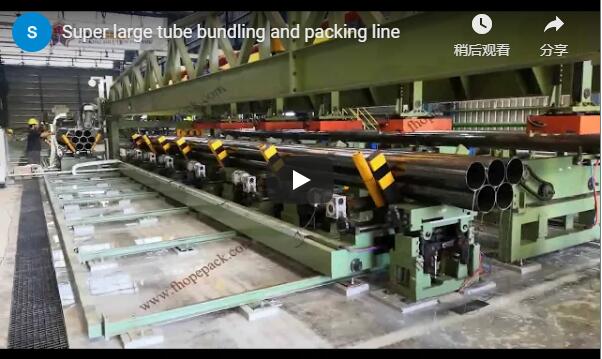
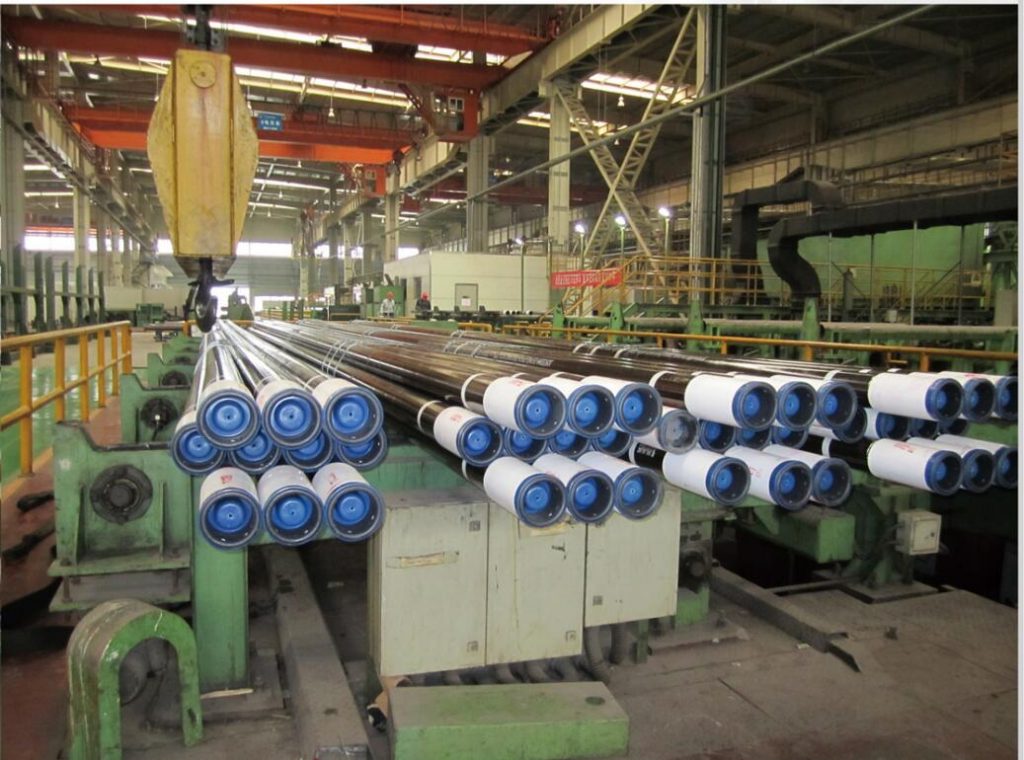
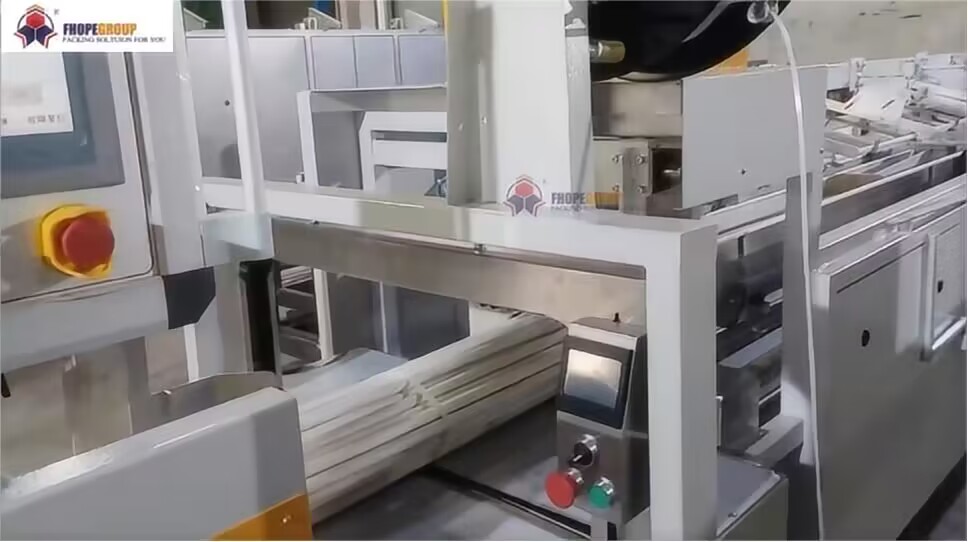
Black hollow sections run along the conveyors under a green frame, with yellow forming plates along the line. The bundle being strapped is a small square bundle, three tubes by three; the same line builds the larger rectangular bundles worked out below.
- Run-out and reject. A roller conveyor takes tubes from the mill, kicks out rejects and collects waste pieces.
- Pick-up and air blowing. Tubes are picked one by one, and air blows each tube clean on the chain conveyor.
- Align, count and flip. Motor-driven roller stations align the tubes parallel and count them. A detector confirms a rectangular tube and turns it 90° so the wide face is down.
- Row layering. A storage station collects the counted tubes for one row and drops the row onto the conveyor chain.
- Agrupación. An electromagnetic chuck stacks row on row in the forming device.
- Fornido. The bundle carriage moves the bundle through the automatic steel strapper.
- Out-loading and stacking. A transverse conveyor takes the bundles out, and a chain stacker holds 5 bundles.
The whole line runs from a touch-screen station in automatic, semi-automatic or manual mode.
How the bundle is formed
The forming device adjusts to the bundle shape and holds the sides until strapping is done. The tube row is pushed into the bundling position. The stacking stopper pushes out, then the bundling stopper clamps the row tight. The supporting forks reset for the next row, and the bundling stopper stays out to keep the bundle from loosening.
Tube and bundle range
| Parámetro | Valor |
|---|---|
| Tubo rectangular | 80 × 100 mm a 200 × 300 mm |
| Tubo cuadrado | 90 × 90 mm a 250 × 250 mm |
| Tubo redondo | 114.3–323.9 mm de diámetro |
| espesor de pared | 3.0 – 12.7 mm |
| Square / rectangular bundle width | 350 – 950 mm |
| Square / rectangular bundle height | 300 – 800 mm |
| Paquete hexagonal | ancho 450–1,100 mm, alto 350–1,000 mm |
| Longitud Mínima | 4.5-16 m |
| Peso del paquete | máx. 13,000 kg |
| Cinta transportadora de salida | aproximadamente 43 m, con la máquina flejadora |
Steel strapping data
| Parámetro | Valor |
|---|---|
| Correa | steel, 25 or 32 mm wide, 0.8 or 1.0 mm thick |
| tensión de la correa | 7,000–18,000 norte |
| Seal | notch seal |
| Velocidad de alimentación y recogida | 2-3 m / s |
| Velocidad de tensión | 6 m/min |
| Hidráulica | 100 bar system, 80–90 bar working; water-cooled oil |
The strapper is stationary; the bundle moves to put each strap at its position along the length.
Worked example: a 32-tube rectangular bundle
Illustrative tube: 100 × 200 mm, 5 mm wall, 12 m long, laid wide face down.
| Comprobar | Cálculo | Resultado |
|---|---|---|
| Sección de acero | 2 × (195 + 95) × 5 mm | mm² 2,900 |
| Masa por metro | 2,900 mm² × 7,850 kg/m³ | ≈ 22.8 kg/m |
| Mass per tube | 22.8 × 12 m | ≈ 273 kg |
| Tubes per row | 4 tubes × 200 mm | 800 mm de ancho |
| filas | 8 rows × 100 mm | 800 mm de alto |
| Tubos por paquete | × 4 8 | 32 |
| Masa del paquete | 32 × 273 kg | ≈ 8,740 kg |
Resultado. An 800 × 800 mm bundle of 32 tubes weighs about 8.7 t, inside the 950 × 800 mm and 13,000 kg limits. Each row is 100 mm high only because every tube is turned wide face down; one tube left on edge would make that row 200 mm high and the bundle uneven.
Strap count and spacing along the 12 m are set from the tube length and your transport rules. Line capacity is set by the slowest station; we work it out from your mill speed in tubes per minute and the tubes per bundle.
Lista de verificación de selección
- Tube shapes and sizes: rectangular, square, round; wall thickness.
- Lengths and bundle weight.
- Bundle shape and size, tubes per bundle.
- Strap width and number of straps per bundle.
- Mill speed in tubes per minute.
- Next step: film wrapping, labelling, stacking.
Seguridad: EN 415-10 e ISO 12100
We design the line to EN 415-10 and assess its risks to ISO 12100. The hazards are moving tubes on chains and rollers, the magnetic stacker, the forming stoppers and the strapping head. The line is fenced along its length, and the operator works from the touch-screen station. Guards and CE documents are agreed per project.
Preguntas frecuentes sobre ingeniería
Q: How does the line know a tube is rectangular? A: A detection system on the aligning station checks each tube’s shape and position. When it confirms a rectangular tube standing on its narrow side, the turnover turns it 90° so the wide face is down. The sensor and turnover type are set for your tube range at quote.
Q: Can it also make hexagon bundles of round tube? A: Yes, the forming device adjusts to hexagon, square or rectangular bundles.
Q: What strap does it use? A: Steel strap, 25 or 32 mm, notch sealed, at 7,000–18,000 N.
Q: Which standard applies? A: EN 415-10 for the line, with ISO 12100 for the risk assessment.
El próximo paso
- Send tube sizes, lengths and bundle sizes a info@fhopepack.com.
- Nosotros extendemos the line for your mill.
- Respondemos dentro de las 24 horas. con un diseño y una cotización.
Lectura relacionada
- Línea de embalaje automática para haces de tubos de acero (producto)
- Automatic steel tube strapping machine (product)
- Envolvedora orbital horizontal para tubos de acero
- Línea de embalaje de haces de tubos de acero
- 32 mm heavy-duty steel tube bundle strapping machine
Fuentes
- FHOPE product pages: automatic packing line for steel tube bundle; steel pipe bundle packing line; automatic steel tube strapping machine
- Our rectangular tube bundle line shown above
- Ejemplo práctico: figuras ilustrativas; densidad del acero 7,850 kg/m³
- Normas: EN 415-10; ISO 12100:2010
Última revisión: 19/10/2026