> **Resumen ejecutivo**
>
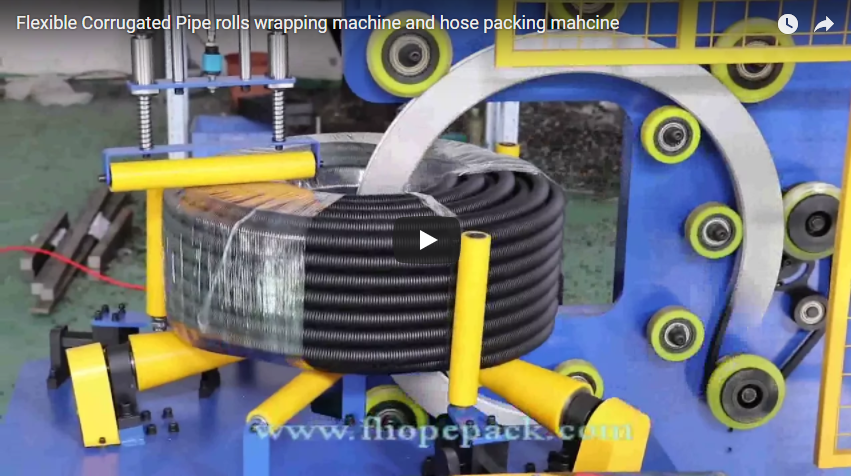
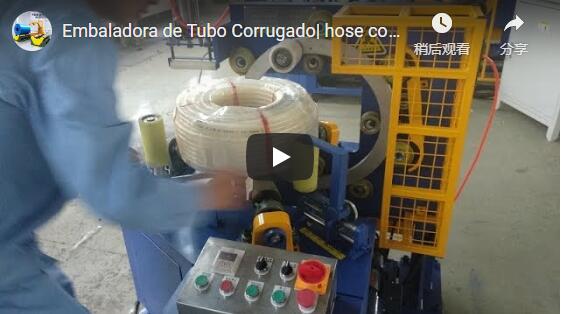
> A PVC hose packing machine wraps light, flexible coils of garden hose, PVC braided hose, corrugated conduit and flex pipe in a spiral of film through the eye. These coils are soft and spring open easily, so the machine needs gentle tension, guiding rollers and low coil weights. Our FPH-200 takes coils of 300–600 mm ID, 400–900 mm OD, 50–200 mm wide and 5–50 kg, at 15–35 s per coil. Below: what makes flexible coils different, the packing steps, the data and a worked film example.
Índice
- Why flexible coils need their own wrapper
- Packing a flex pipe coil, step by step
- FPH-200 data
- Worked example: a flex pipe coil
- Tension, tying and film
- Lista de verificación de selección
- Seguridad: EN 415-10 e ISO 12100
- Preguntas frecuentes sobre ingeniería
- El próximo paso
- Lectura relacionada
- Fuentes
Why flexible coils need their own wrapper
Rigid hydraulic hose holds its shape; PVC hose and flex pipe do not. A light coil squashes if the film is pulled too tight, and its turns slide apart if it is handled loose. So the wrapper for these products is smaller and lighter than one for heavy rubber hose. It runs the ring and rollers at speeds set by inverter and supports the coil on guiding rollers so it keeps its round shape while the film goes on.
Packed this way, the coil arrives clean, round and ready for retail shelves or for the installer.
Packing a flex pipe coil, step by step
1. **Tie.** The coil comes from the coiler already tied with a few straps, so it holds its shape on the machine.
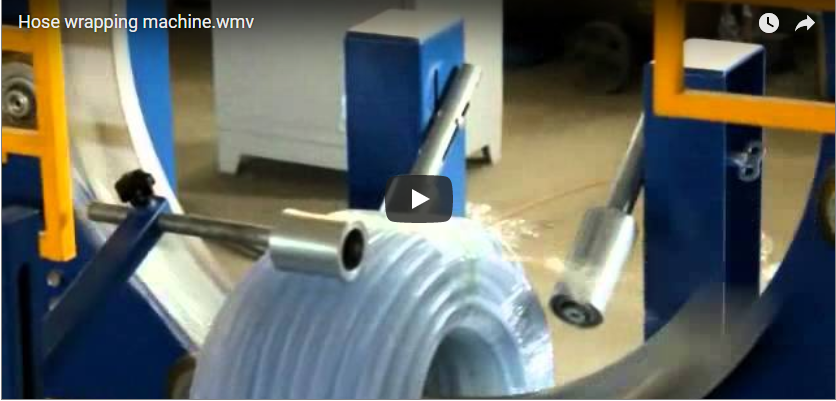
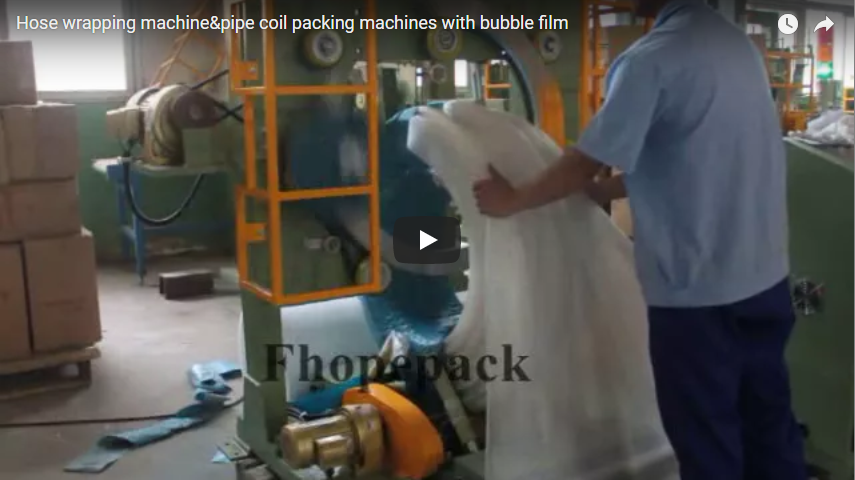
2. **Load.** The operator places the coil on the yellow guiding rollers, with the ring through its eye.
3. **Start the film.** The operator threads the film end onto the coil and starts the cycle.
4. **Wrap.** The ring turns and spirals clear film over the coil's cross-section, while the rollers turn the coil slowly so the film covers it all round.
5. **Finish.** The ring stops; the operator presses the film tail onto the pack and cuts it.
A yellow fence surrounds the machine and the control buttons sit on the blue base.
FPH-200 data
| Item | FPH-200 |
| :--- | :--- |
| Diámetro interior de la bobina | 300–600 mm |
| Diámetro exterior de la bobina | 400–900 mm |
Ancho de la bobina: 50–200 mm
| Peso de la bobina | 5–50 kg |
| Cycle | 15–35 s per coil |
| Ring speed | 20–90 r/min, inverter adjusted |
| Superposición | 20–90% |
| Film | LLDPE, PE stretch film or PVC |
| Power | 1.5 kW; AC 380 V, 50 Hz, or to requirement |
Heavier and larger coils, up to 100 kg and 1,000 mm OD, go to the FPH-300N.
Worked example: a flex pipe coil
Illustrative coil: 600 mm OD, 350 mm ID, 120 mm wide; 100 mm film at 40% overlap, so each ring turn advances 60 mm round the outside.
| Comprobar | Cálculo | Resultado |
| :--- | :--- | :--- |
| Outer circumference | π × 600 | ≈ 1,885 mm |
| Ring turns | 1,885 ÷ 60 = 31.4, rounded down for this estimate | ≈ 31 |
| Time at 90 r/min | 31 ÷ 90 | ≈ 0.35 min ≈ 21 s |
| Radial wall | (600 − 350) ÷ 2 | 125 mm |
| Film per turn | 2 × (125 + 120) | 490 mm |
| Film per coil, relaxed | 31 × 0.49 | ≈ 15 m |
**Result.** About 21 s and 15 m of film, inside the 15–35 s range. For very soft hose, slow the ring and lower the tension; the cycle moves toward the top of the range.
Tension, tying and film
- **Tie first.** Straps or ties hold the coil turns in place while the film goes on.
- **Low tension.** Set the film brake just tight enough to lay flat; a squashed coil looks poor and may kink.
- **Overlap.** Settable from 20% to 90%; use more for outdoor storage.
- **Film.** Clear film shows the product and label; PVC film suits retail packs.
Lista de verificación de selección
1. Coil ID, OD, width and weight range.
2. Product: garden hose, braided PVC hose, conduit or flex pipe.
3. Bobinas por hora.
4. Film type and whether a label goes under the film.
5. Manual loading or a link to the coiler.
Seguridad: EN 415-10 e ISO 12100
Hose coil wrappers are built to EN 415-10, with the risk assessment done to ISO 12100. The hazards are the turning ring and the driven rollers. A fence surrounds the machine. The cycle runs to a complete stop before the operator reaches in to press down and cut the film tail. On this model the cut is manual, and an automatic cutter is available on our larger FPH range.
Preguntas frecuentes sobre ingeniería
Q: Will the film squash soft PVC hose?
A: Not if tension is set low; ring and roller speeds are inverter adjusted for soft products.
P: ¿Qué tamaños de bobina son compatibles con el FPH-200?
A: 300–600 mm ID, 400–900 mm OD, 50–200 mm wide, 5–50 kg.
Q: What decides whether a coil takes 15 s or 35 s?
A: Coil OD and overlap set the number of ring turns, and ring speed (20–90 r/min) sets how fast they are laid. Soft hose run at low speed and high overlap sits near 35 s; a small coil at full speed near 15 s.
Q: Do coils need tying first?
A: Yes, a few ties keep the coil round on the machine.
El próximo paso
1. **Envíe las dimensiones, pesos y producción de las bobinas** a info@fhopepack.com.
2. **We match** the wrapper and film.
3. **Respondemos en un plazo de 24 horas** con una propuesta y un presupuesto.
Lectura relacionada
- [Envolvedora de mangueras FPH-200 (producto)](https://www.fhopepack.com/Pipe-packing-machine/Hose-Coil-wrapper-FPH-200.html)
- [How coil wrapping machine for hose/pipe coils packing](https://www.fhopepack.com/videos/coil-wrapping-machine-for-hose-pipe-coils/)
- [Flexible corrugated pipe rolls wrapping machine](https://www.fhopepack.com/videos/flexible-corrugated-pipe-rolls-wrapping-machine-and-hose-packing-mahcine/)
- [Corrugated hose coil film wrapping machine](https://www.fhopepack.com/videos/corrugated-hose-coil-film-wrapping-machine/)
- [Vertical hose coil wrapping machine](https://www.fhopepack.com/videos/vertical-hose-coil-wrapping-machine/)
- [Hose coil wrapping machine by film](https://www.fhopepack.com/videos/hose-coil-wrapping-machine-by-film/)
Fuentes
- FHOPE product pages: hose coil wrappers FPH-200 and FPH-300N
- Our PVC hose packing machine shown above
- Ejemplo práctico: figuras ilustrativas
- Normas: EN 415-10; ISO 12100:2010
Última revisión: 19/10/2026